
Corporate Strategy
FMCG CEOs: 2024 Full-Year Results In Review - Unprecedented & More Discriminating Times - The Rise Of The Red Queen Effect

Author | Managing Director & Partner @ FFA
“My dear, here we must run as fast as we can, just to stay in place. And if you wish to go anywhere you must run twice as fast as that.” (also described as the Red Queen Effect)
― Lewis Carroll, Alice In Wonderland
2024 results of the world largest listed FMCG companies are now all out
Here is our summarized take:
Increasingly challenging environment as three super-cycles end (unprecedented pricing, China hyper-growth, post COVID growth acceleration on specific categories: beauty, spirits, VMS, Pet Care...)
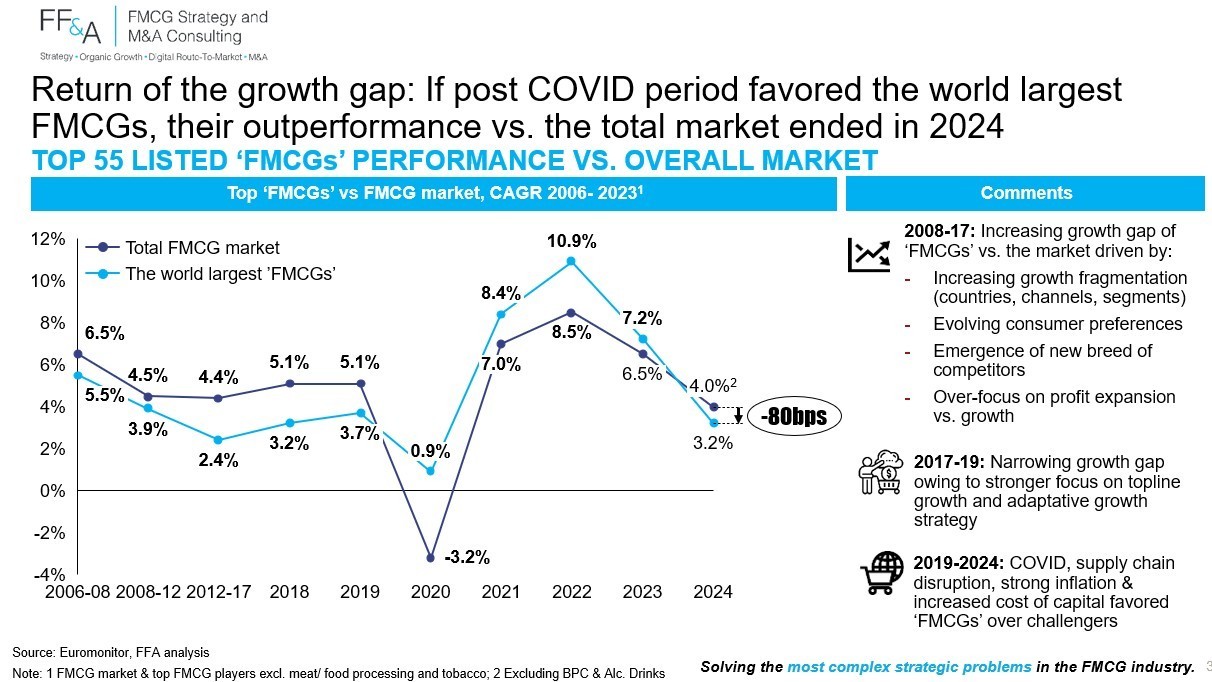
With now the return of the Growth Gap (world largest FMCG companies losing on average market share) as post-COVID exceptional context ends (unprecedented pricing, more discriminating environment for small brands - supply chain, capital, shelf space...)
Increasing gaps between Winners & Losers as those three super-cycles impact differently each FMCG company based on their country/ category footprint & the quality of their portfolio/ 4Ps/ execution
In this context, most FMCG companies have been focusing & increasing resources (innovations, A&P) on their top brand/ country couples
But alone this approach is likely to drive modest incremental growth with a profit dilutive impact considering the above mentioned context (unprecedented challenging/ more discriminating environment)
Hence, we see an elevated risk for FMCG companies to have an increasing number of their brand/ country couples falling in the value destruction/ shrinking to glory trap:
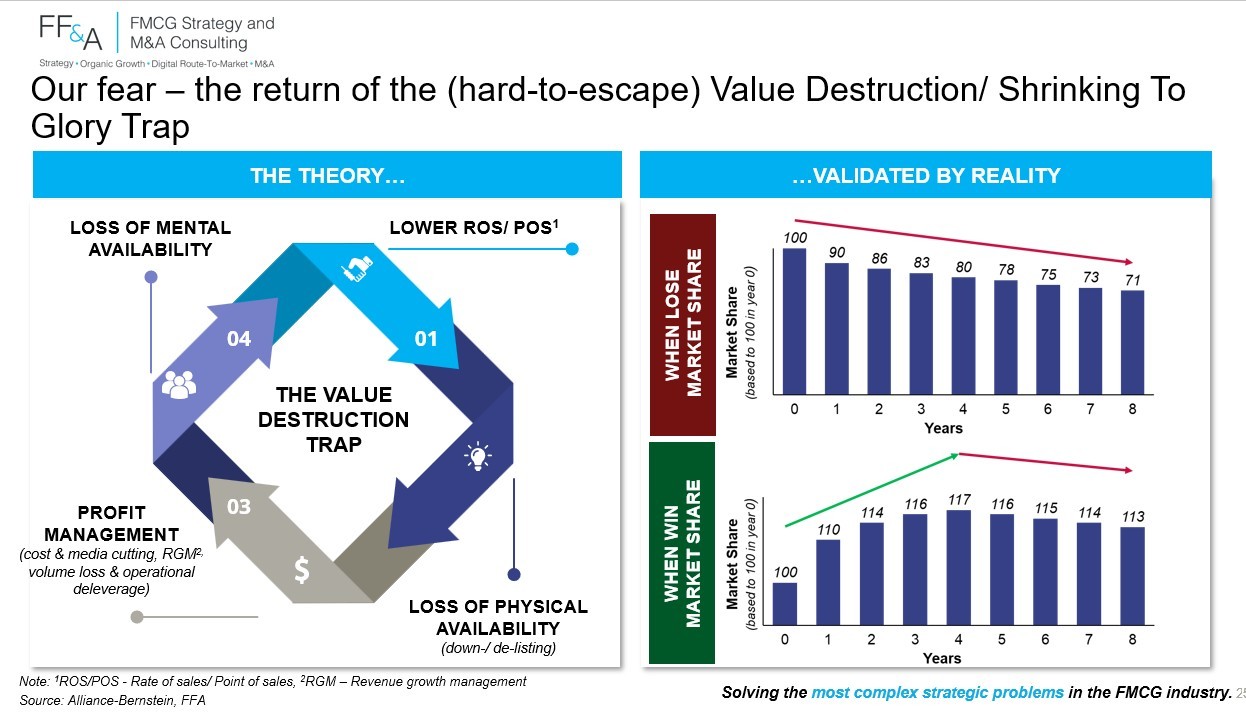
In this context, we recommend to:
=> Enrich top-down/ one-off only growth approach (portfolio transformation & A&P/ innovations resources allocation) to a full bottom-up/ sustainable growth acceleration (embedded competitive brand plans, execution capabilities)
Cf. Zero-Based-Growth® (our bespoke approach to organic growth acceleration blending the best of strategic marketing, granular consumer research, disciplined finance & rigorous strategic problem-solving):
=> Adapt growth strategy to outperform in the highest value at stake areas (most uncomfortable & competitive, worse market share performance & highest share of growth):
i) Emerging Markets (cf. our Ten Outperformance Rules for EMs in the below publication):
ii) Ecommerce (cf. our Ecommerce 2.0® approach to leverage ecommerce to create large incremental omnichannel value)
=> Focus on highly synergistic/ high ROCE M&A (high share of growth/ medium-size assets/ same categories/ same countries/ GTM capabilities)
=> Learn from the most successful turnaround cases of the last decade:
The overall being summarized in our 2025 opened letter to FMCG CEOs & key predictions for 2025-30:
Exciting year 2025 ahead
As usual, here is our take in 20 brief key messages:
1) We left Q3 with a record high top-line misses driven by the inability of most FMCG companies to anticipate/ forecast accurately the end of three super-cycles

2) Return of the growth gap: If post COVID period favoured the world largest FMCGs, as predicted earlier this year, their outperformance vs. the total market ended in 2024 (end of the three super-cycles that drove their outperformance)
3) In a context most revised top guidance for Q4, only ~26% of the world largest listed FMCG companies missed revenue consensus while ~72% managed to beat EPS

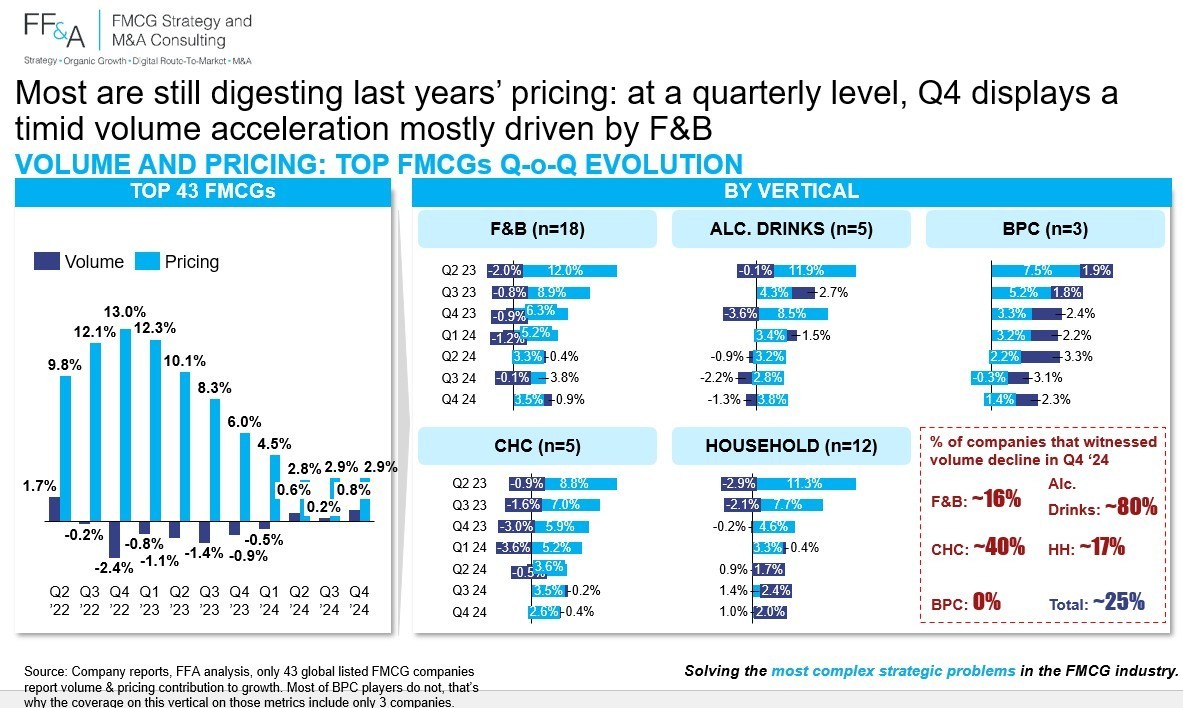
4) Most are still digesting last years’ pricing: at a quarterly level, Q4 displays a timid volume acceleration mostly driven by F&B
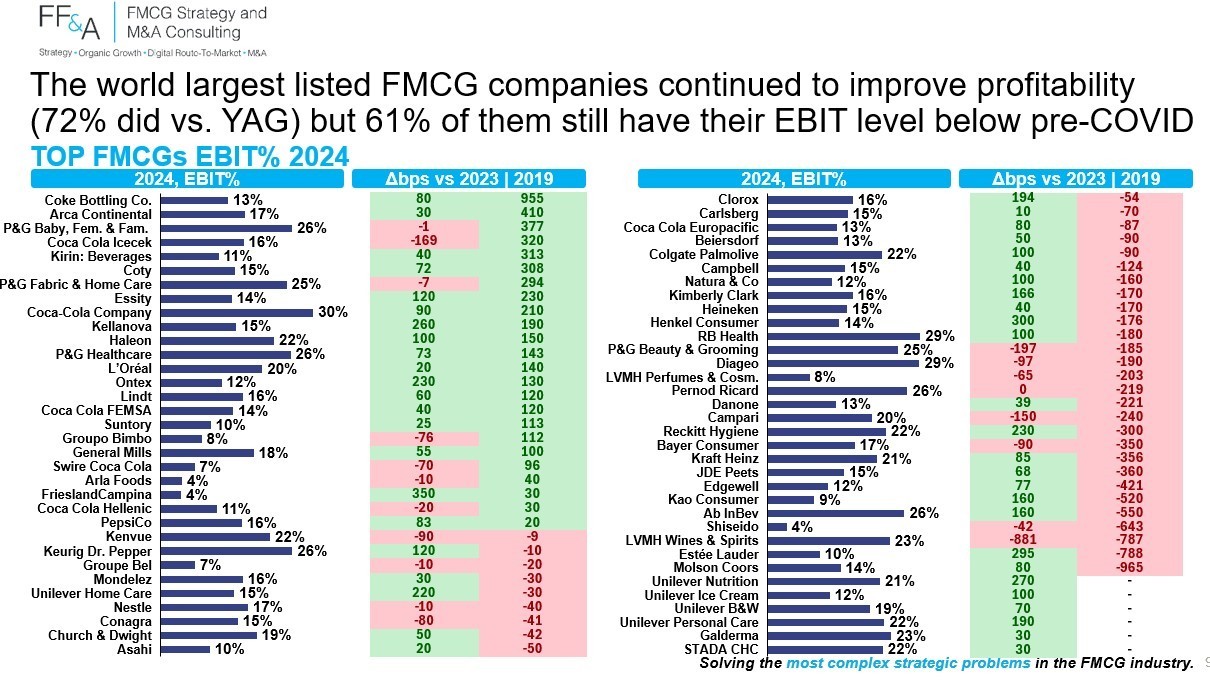
5) The world largest listed FMCG companies have continued to improve their profitability performance (72% did vs. YAG) but 61% of them still have their profitability level below pre-COVID
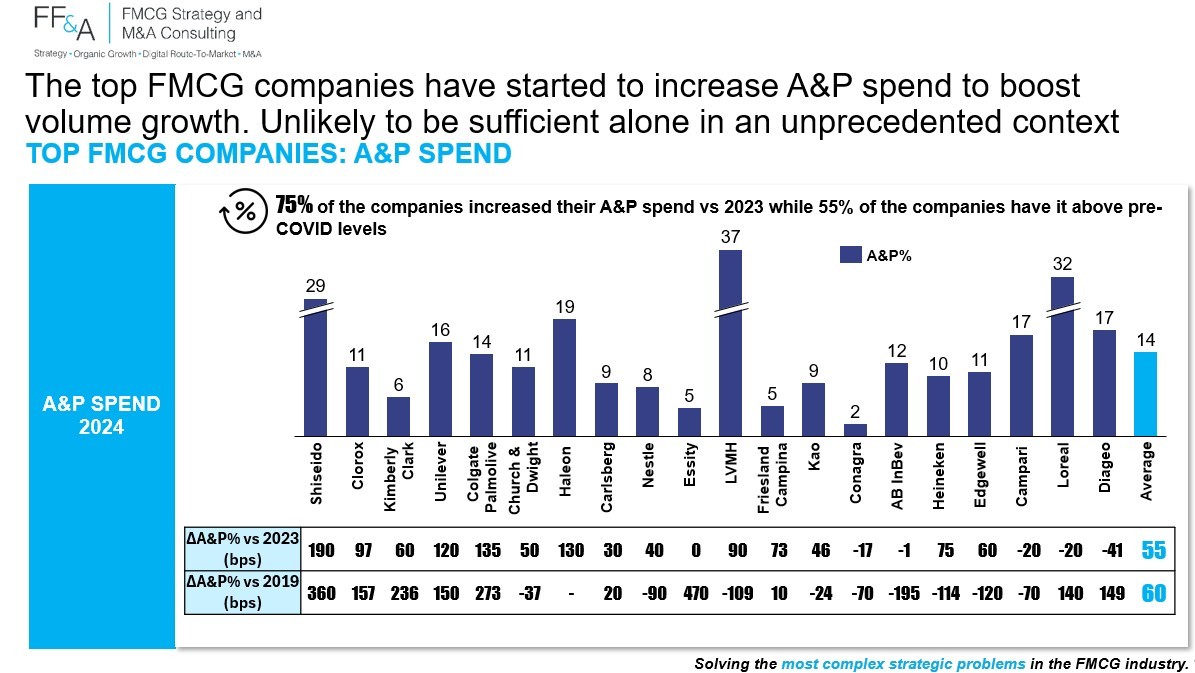
6) FMCG companies have started to spend back their profitability gains in increased A&P with the objective to boost volume. Not only it will take time but it is unlikely alone to move the needle in a context of unprecedented inflation
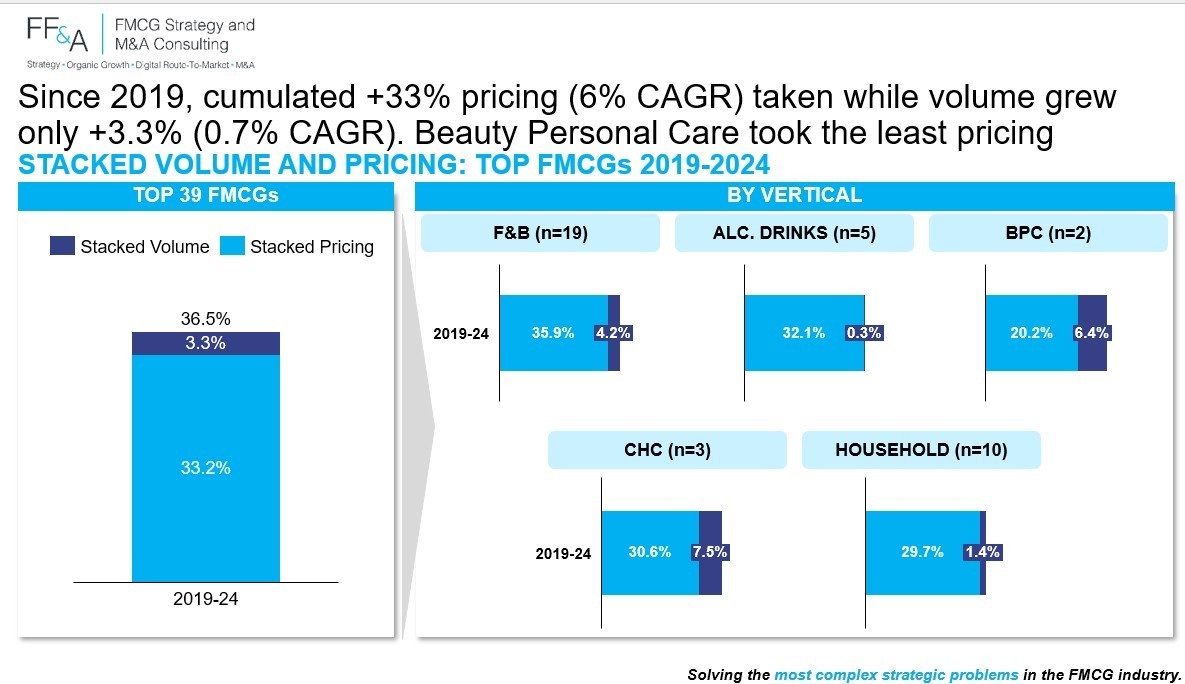
7) Since 2019, the world largest listed FMCG companies took a cumulated +33% pricing (6% CAGR) while volume increased only +3.3% (0.7% CAGR) over the period. Beauty Personal Care took the least pricing
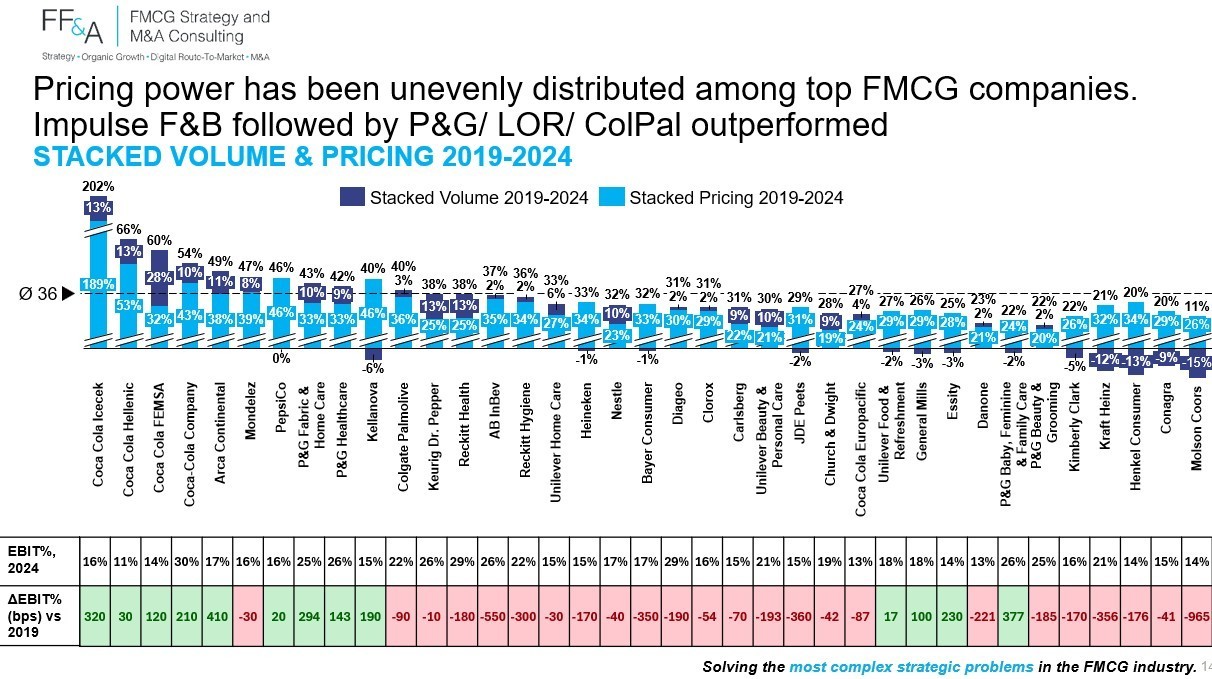
8) Pricing power has been unevenly distributed among top FMCG companies. Impulse F&B followed by P&G/ L'Oréal/ Colgate outperformed, all reflecting:
i) Category/ country lower price elasticity footprint
ii) Company strength (brand portfolio, 4Ps, execution)
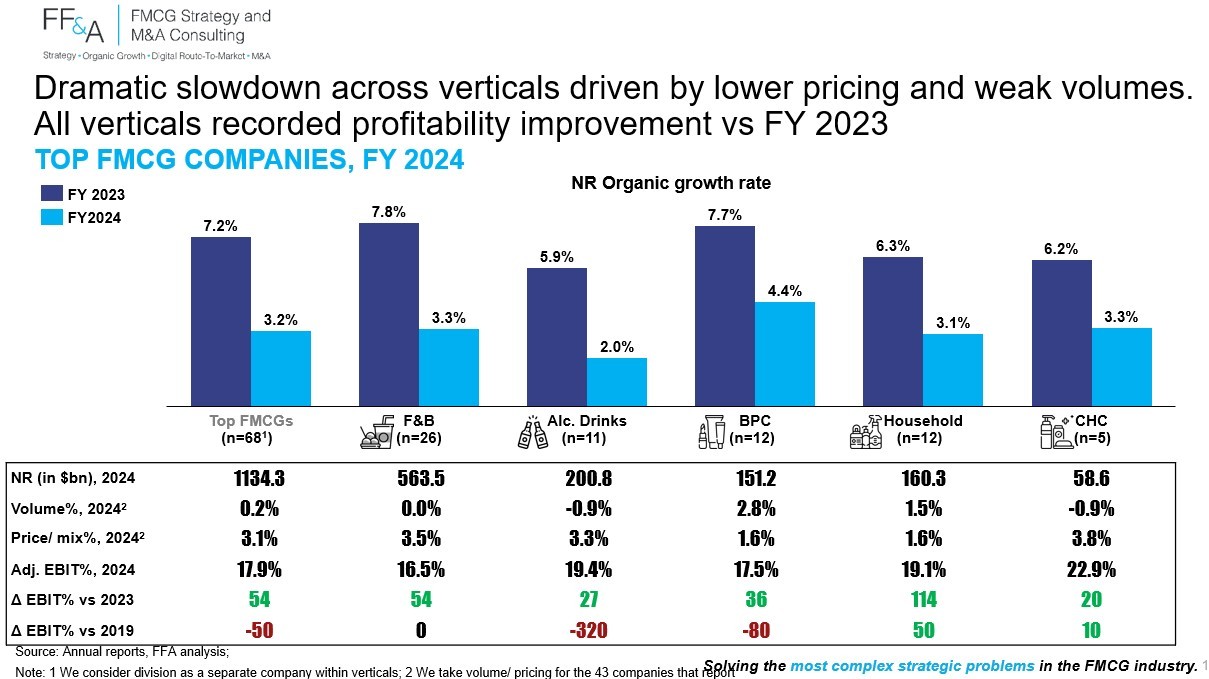
9) 2024 saw a dramatic growth slowdown across all FMCG verticals driven by lower pricing and weak volumes. All verticals recorded profitability improvement vs FY 2023
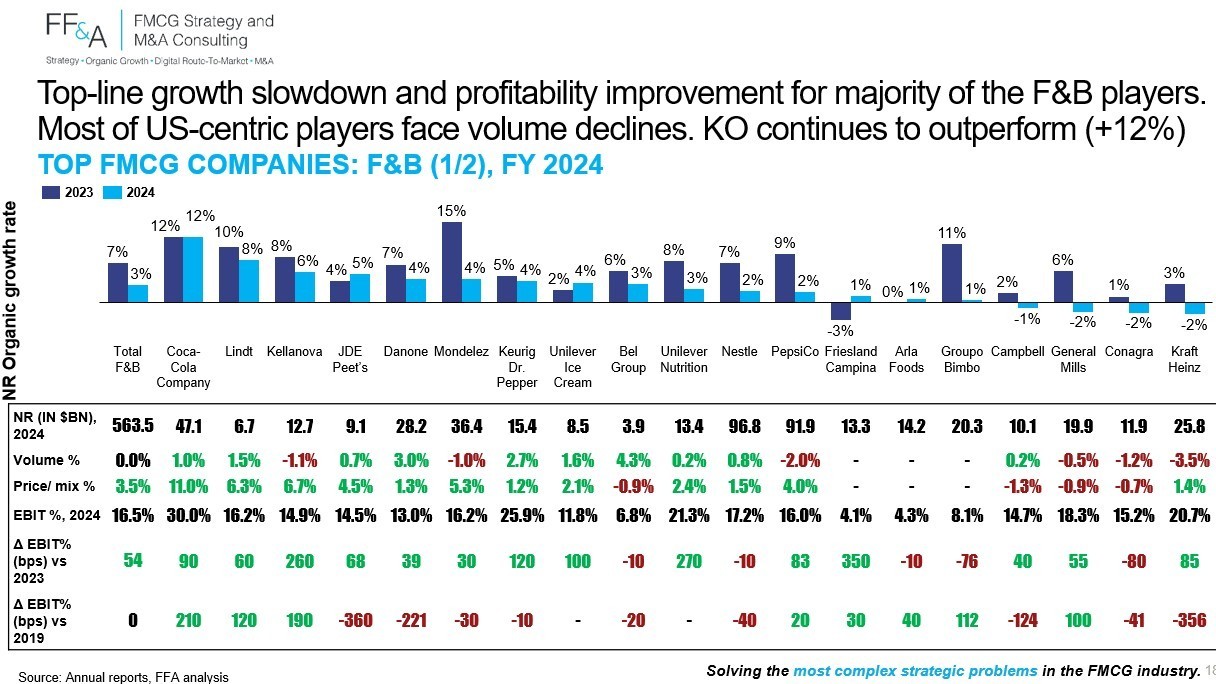
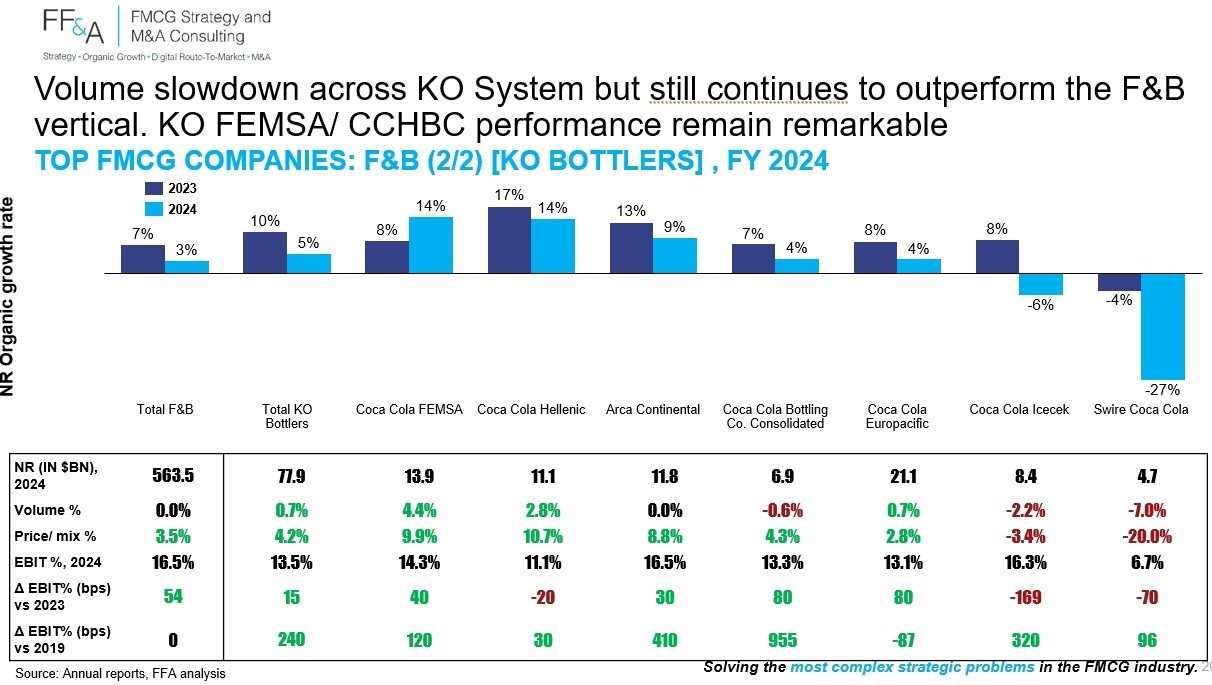
10) On the Food & Beverage (F&B) vertical, we noticed similar dynamics (top-line growth deceleration, pricing deceleration & weak volume) with US-centric F&B suffering most (most unfavourable category/ country footprint & higher price elasticity) where The Coca-Cola System continues to outperform
11) The alcoholic drinks vertical recorded the largest growth deceleration driven by a sharp category growth slow-down. Heineken outperformed the vertical

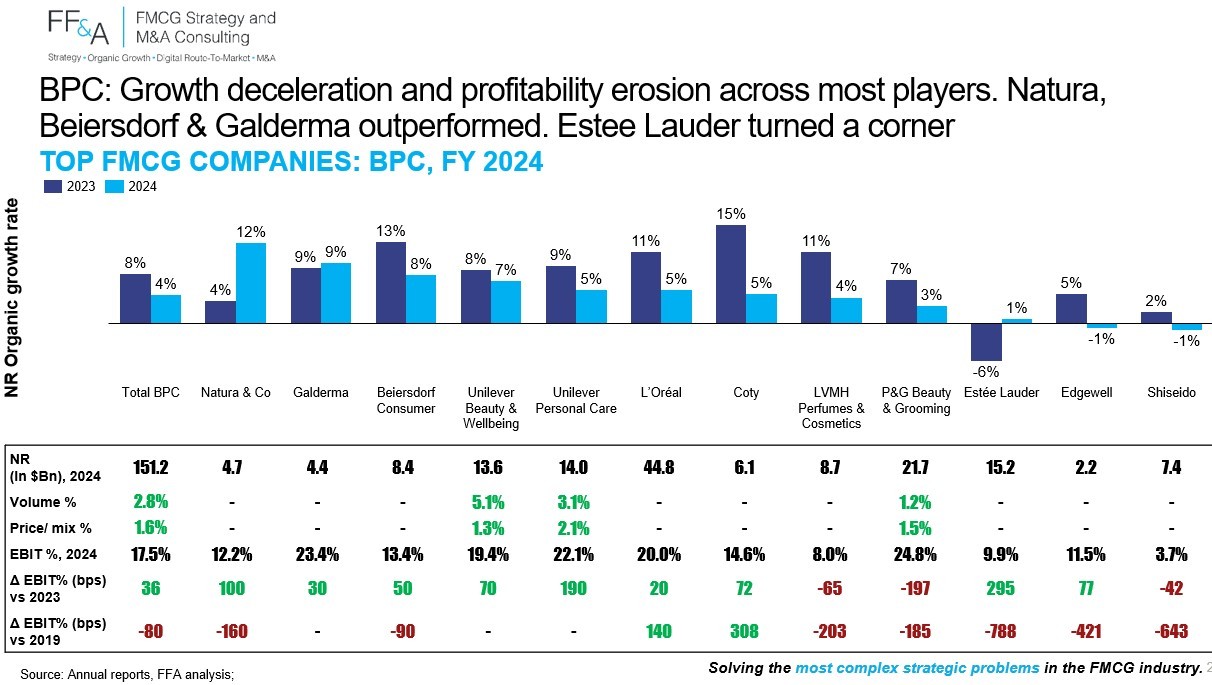
12) Beauty Personal Care: Growth deceleration and profitability erosion across most players. Natura, Beiersdorf & Galderma outperformed. Estee Lauder turned a corner
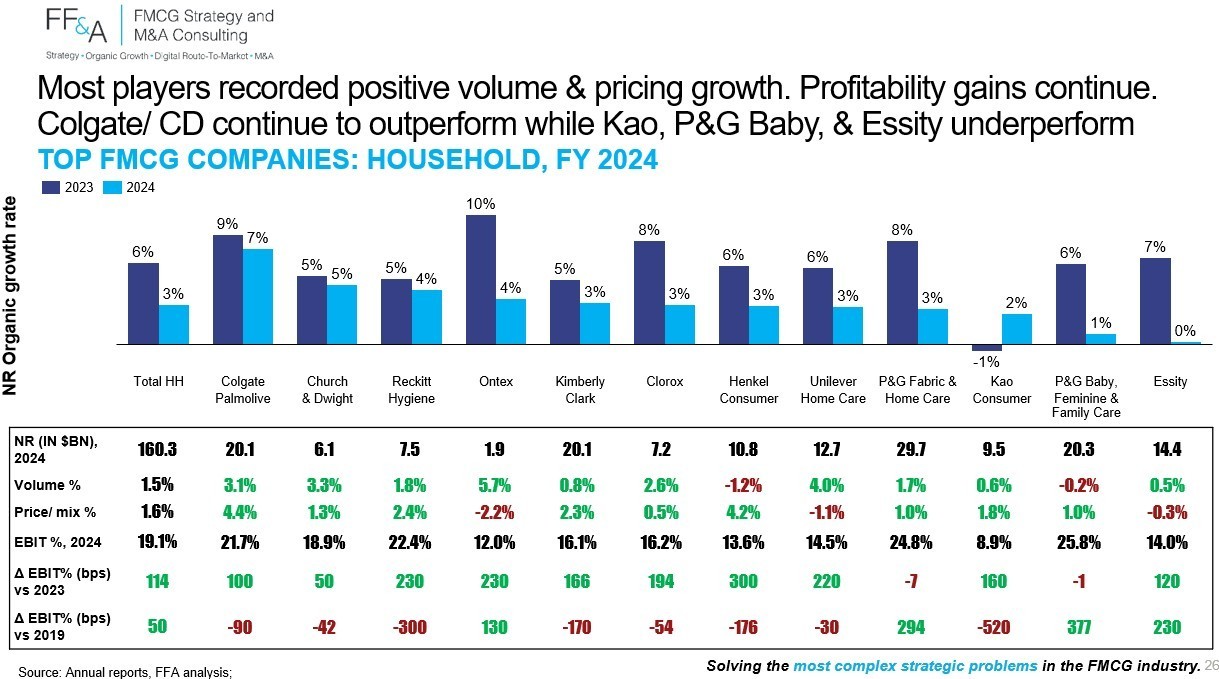
13) On Household, most players recorded positive volume & pricing growth. Profitability gains continue. Colgate and Church & Dwight continue to outperform while Kao, P&G Baby, & Essity underperform
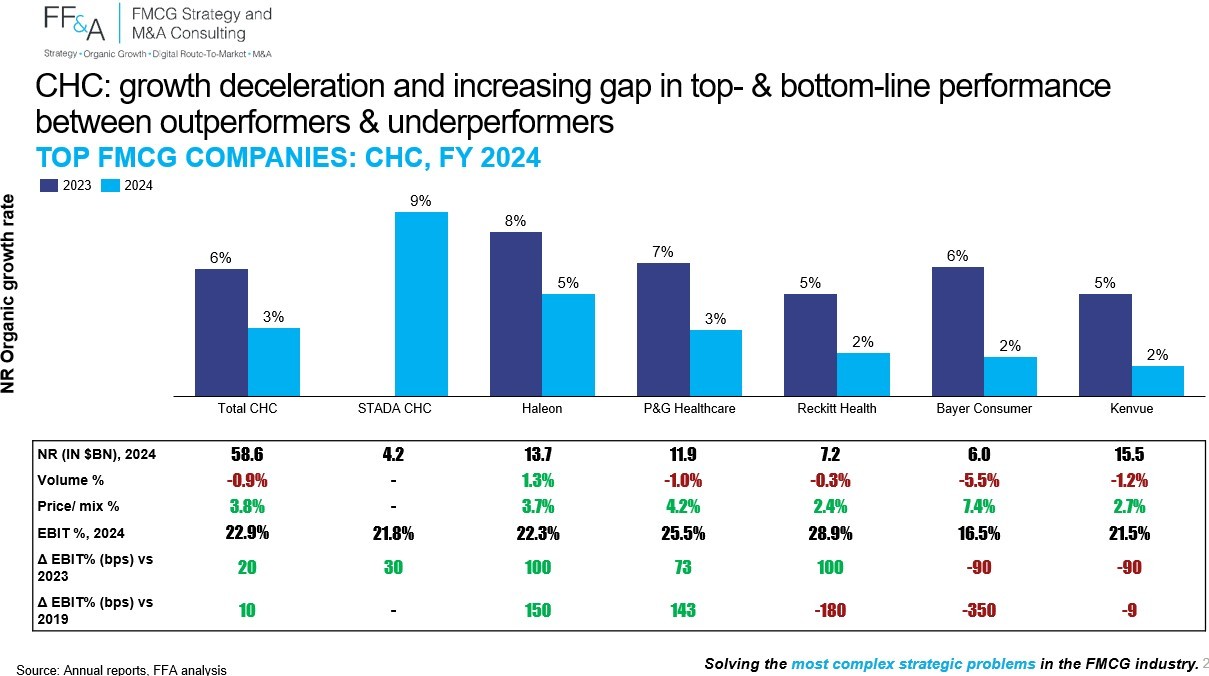
14) Consumer Health Care: growth deceleration and increasing gap in top- & bottom-line performance between outperformers & underperformers
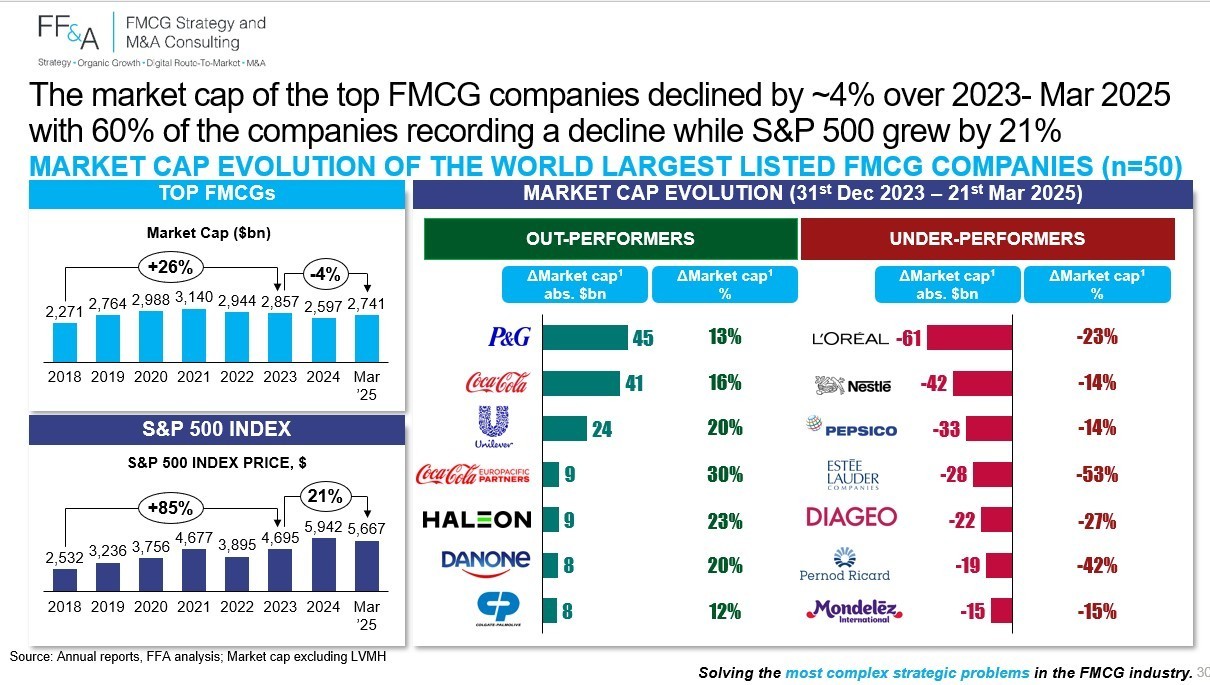
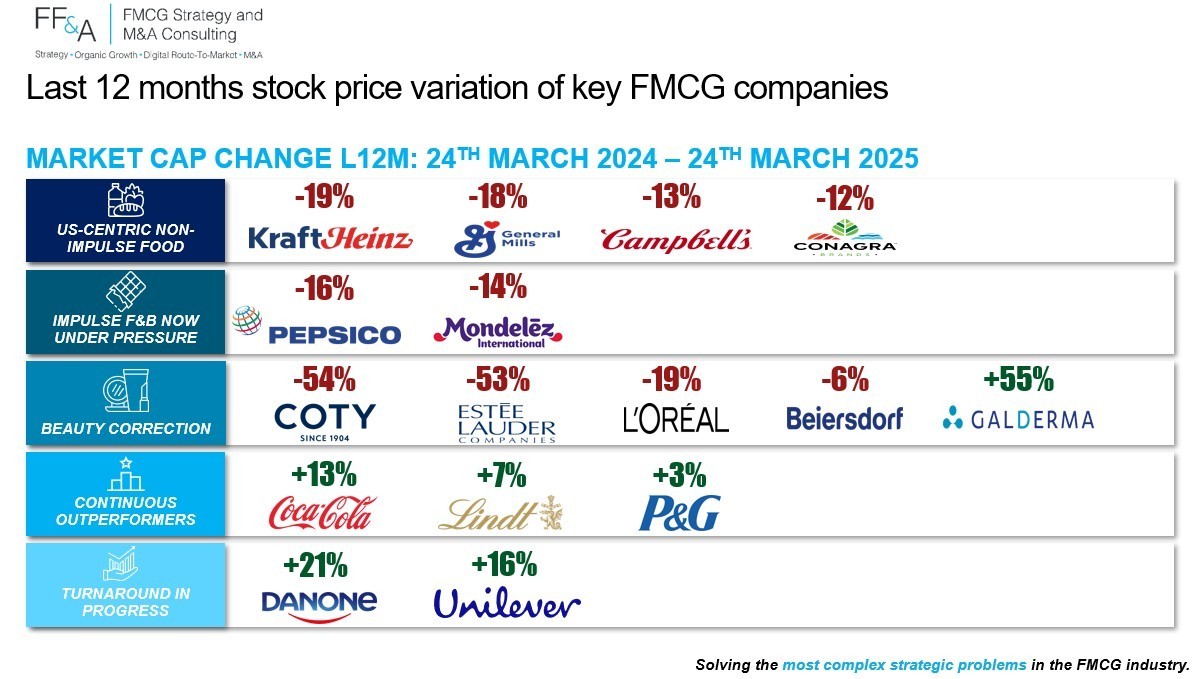
15) The market cap of the world largest listed FMCG companies eroded by 4% over 2023-Mar 25 with many names losing significant ground post releases. Gap between Winners & Losers continue to widen. Beauty vertical corrected heavily as category volume deceleration/ normalization is increasingly confirmed. Some last 5 years outperformers start feeling price elasticity (Mondelez, PepsiCo) while the companies with the most unfavourable category/ country footprint (highest price elasticity & weakest category growth) suffer the most (US Food - Kraft Heinz, GenMills...)
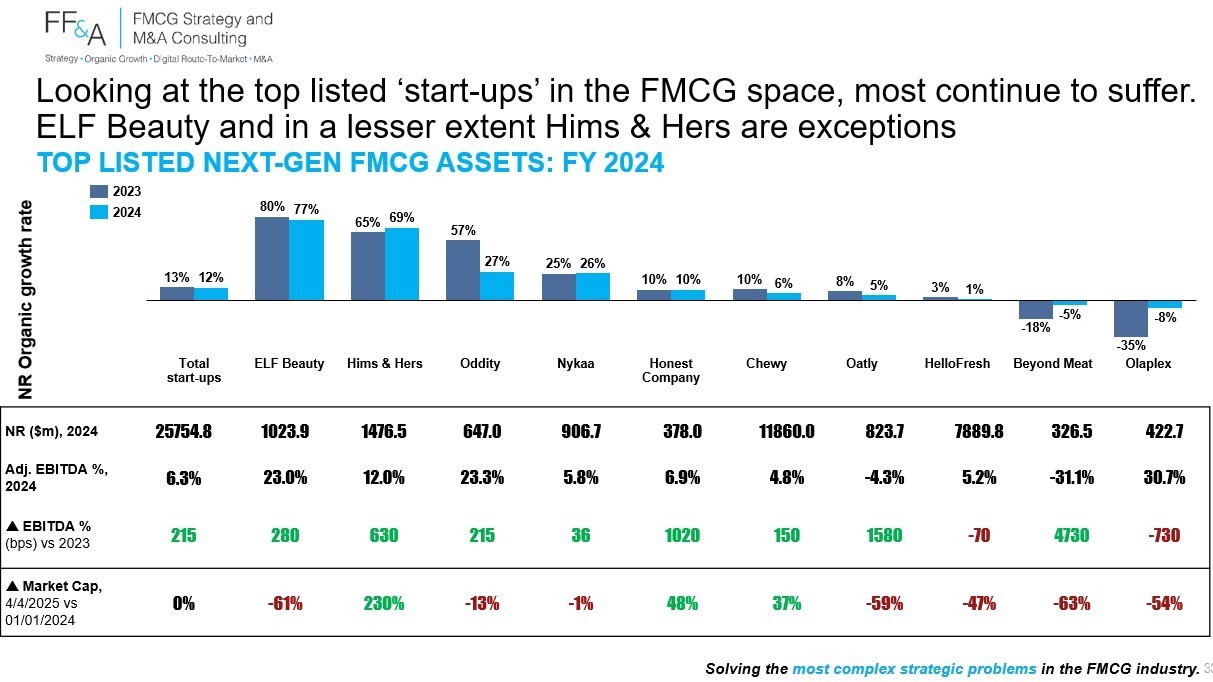
16) Looking at the top listed next-gen FMCG assets, most continue to suffer. Honest is progressing on its turnaround (+10% revenue, +1020 bps profitability, +48% market cap). ELF Beauty stock price corrects heavily (-61% since Jan 2024) although performance continues to remain exceptional (+77% growth, 23% EBIT). HIMS & HERS continue to impress & surf for now on the GLP1 trend
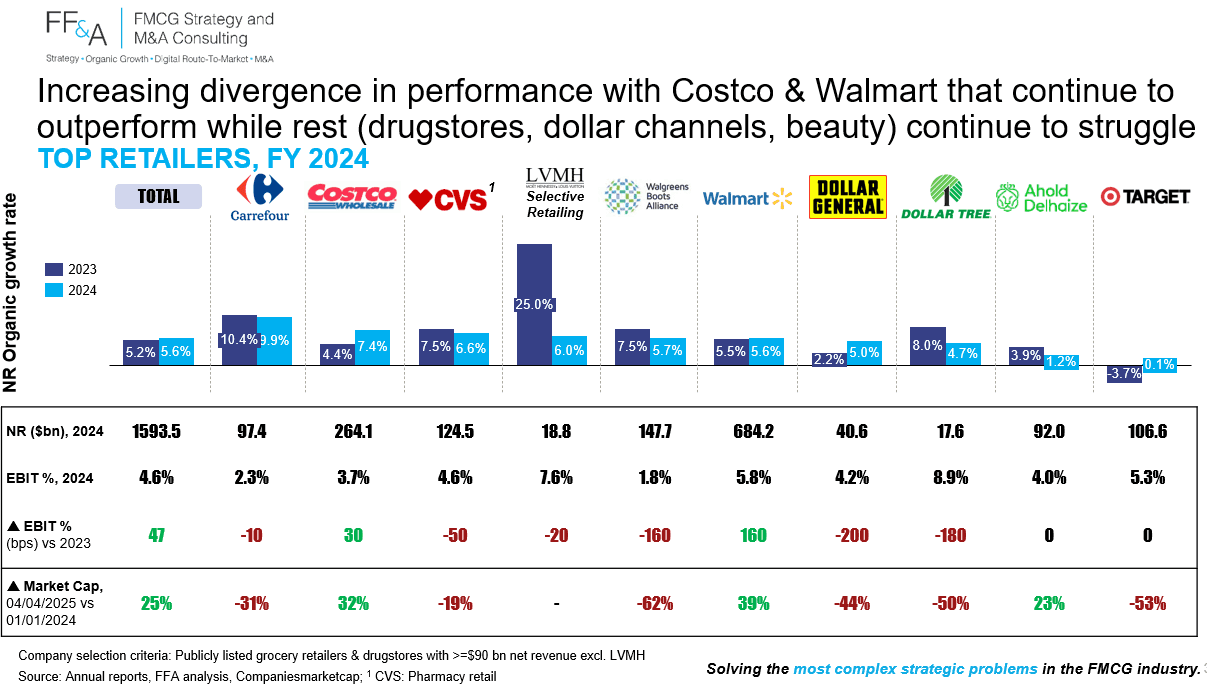
17) Legacy retailers: Walmart & Costco impress most. WMT stock is up 40% YTD on the back of solid top-/bottom-line results illustrating its superior ability to win with all shoppers in the current environment but also its progress on ecommerce & retail media that now play a critical role in its traditional flywheel (reinforcing its assortment/price/convenience advantages) hence profitability. Rest struggle:
Drugstores continue to suffer from their stuck in the middle positioning between Amazon, Walmart & Ulta/ Sephora
Dollar channels continue to suffer from the huge standard deviation in wealth distribution in the US (rich getting richer & shopping at WMT & premium retailers, rest getting poorer & reducing their overall food spend)
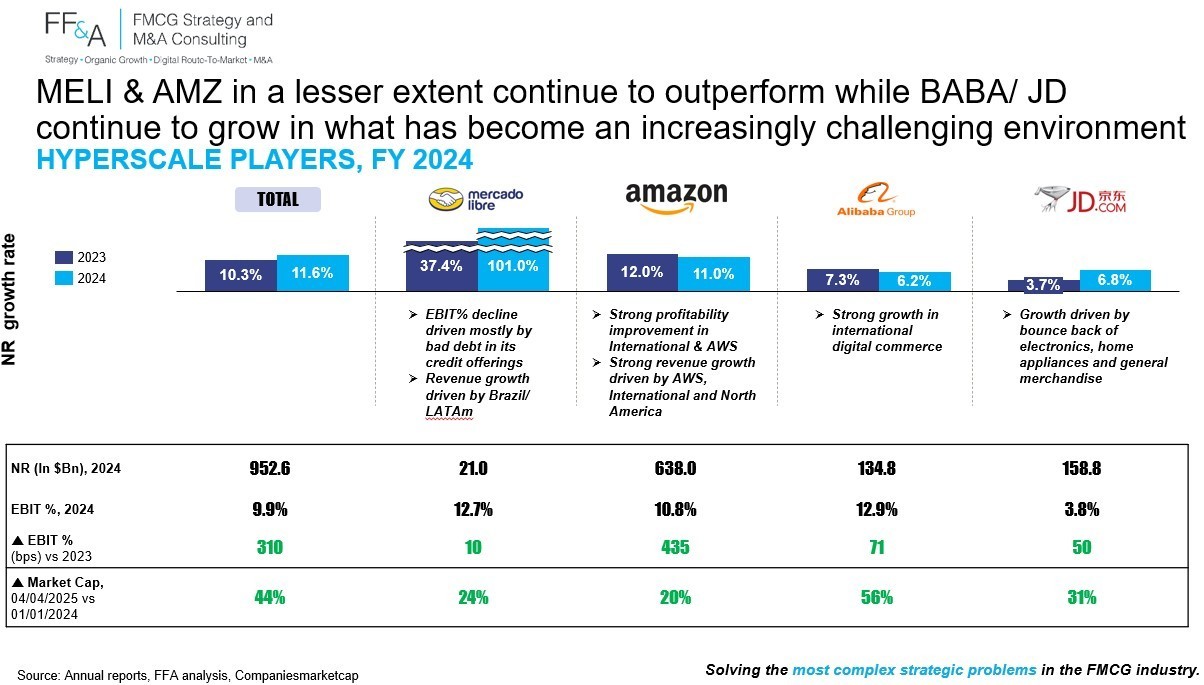
18) Ecommerce pure players: Mercado Libre & in a lesser extent Amazon continue to outperform while Chinese BABA/ JD continue to grow in what has become an increasingly challenging environment
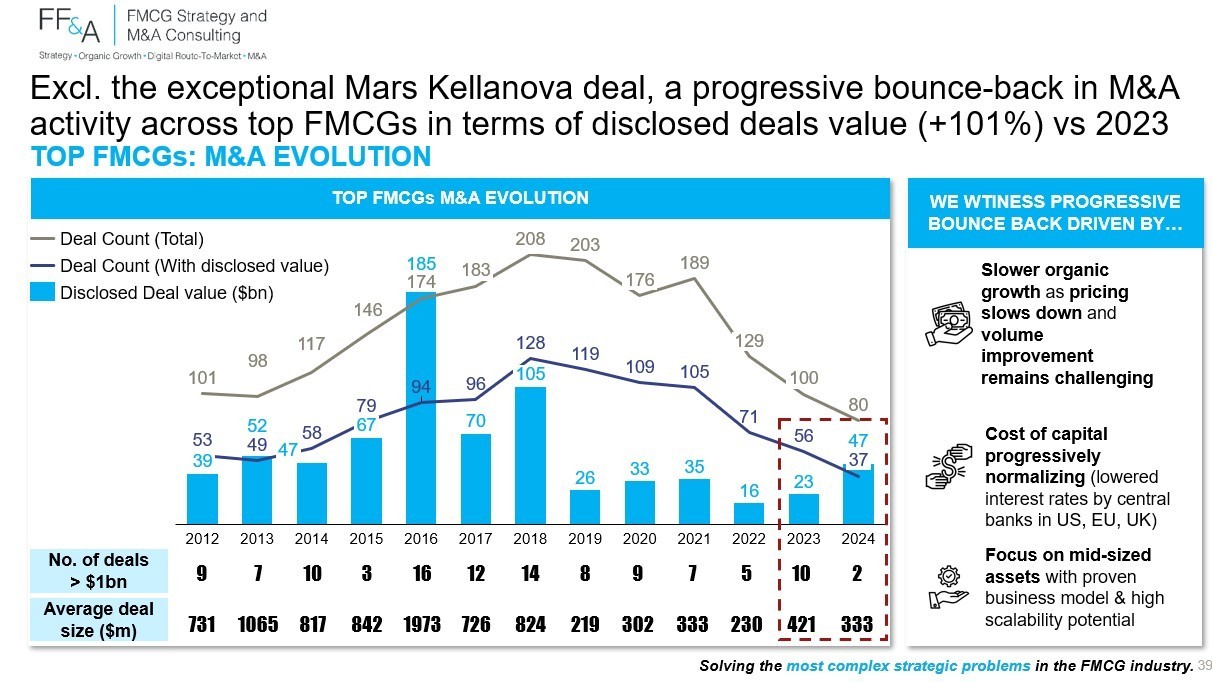
19) Excluding the exceptional Kellanova-Mars deal, M&A continued to progressively bounce-back driven by mid-size growth assets on same categories
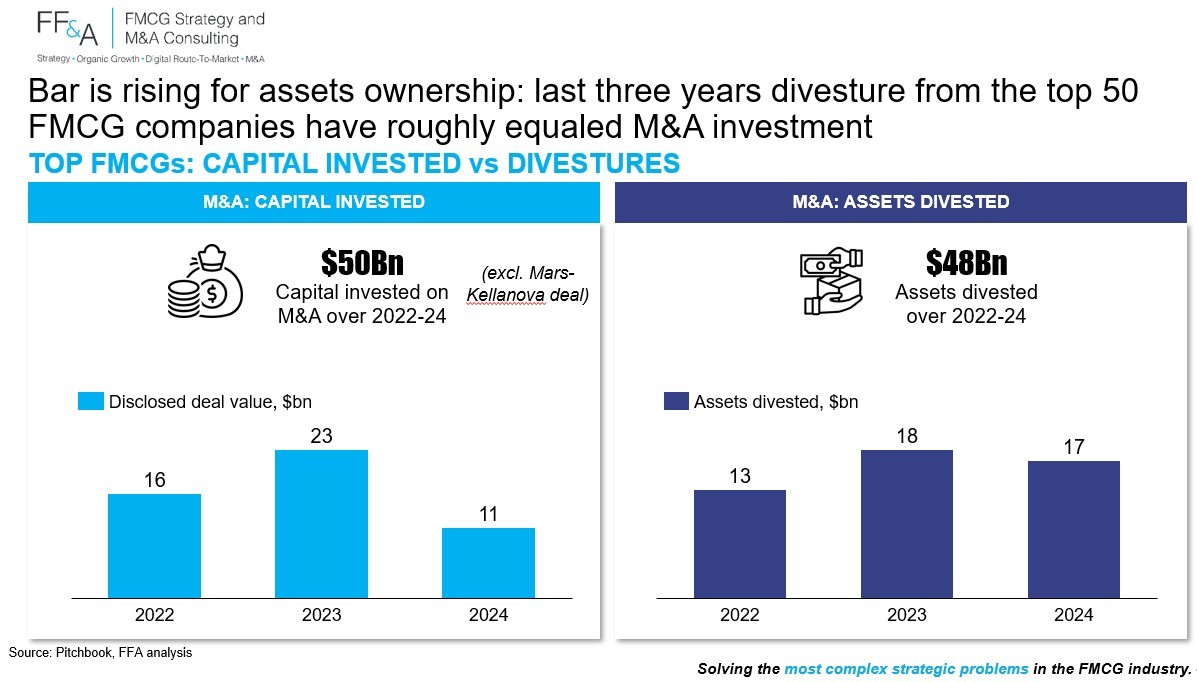
20) A good proof point showing how much bar has been rising to justify assets ownership: last three years divesture from the top 50 FMCG companies have now roughly equalled M&A investment
“My dear, here we must run as fast as we can, just to stay in place. And if you wish to go anywhere you must run twice as fast as that.”
― Lewis Carroll, Alice In Wonderland
Exciting times
Get in touch:
To join the ~53,000 FMCG executives that follow Frederic on LinkedIn, please click here. To start a conversation, email at: frederic@fredericfernandezassociates.com
To participate to the Growth FMCG CEO podcast, email at: frederic@fredericfernandezassociates.com
To join the ~31,000 FMCG executives that receive our newsletter and all our CEOs Insights, sign-up at the following link: FMCG CEOs - Managing For Growth
To read all our previous publications, visit our newsletter page: FMCG CEOs - Managing For Growth
About FF&A:
FF&A solves the most complex strategic problems of the world largest FMCG companies across Corporate Strategy, Organic Growth, Digital RTM (Ecommerce, DTC and EB2B) and M&A. 14 out of the world 20 largest FMCG companies are repeat Clients
FF&A team intervenes all across the globe and across all FMCG categories. To know more, please visit our website:
www.fredericfernandezassociates.com
Disclaimers:
No FF&A employees own any stocks or financial instruments of any FMCG companies or companies mentioned in the above article. All the above information are public information
Enjoyed this article?

FMCG CEOs: Managing For Growth
Strategic insights for FMCG/ CPG CEOs