M&A
FMCG CEOs: M&A Q1 2024 In Review - A New Bottom & Four Reinforcing Trends

Author | Managing Director & Partner @ FFA
'When you hit rock bottom, the only one way left to go is up..., isn't it?' A NYC-based M&A banker commenting Q1 2024 FMCG M&A activity
To join the >18,000 FMCG executives that receive automatically all our FMCG CEOs Insights (posts & articles like this one), sign-up to our newsletter at the following link: FMCG CEOs: Managing For Growth
As announced in February in our last M&A publication:
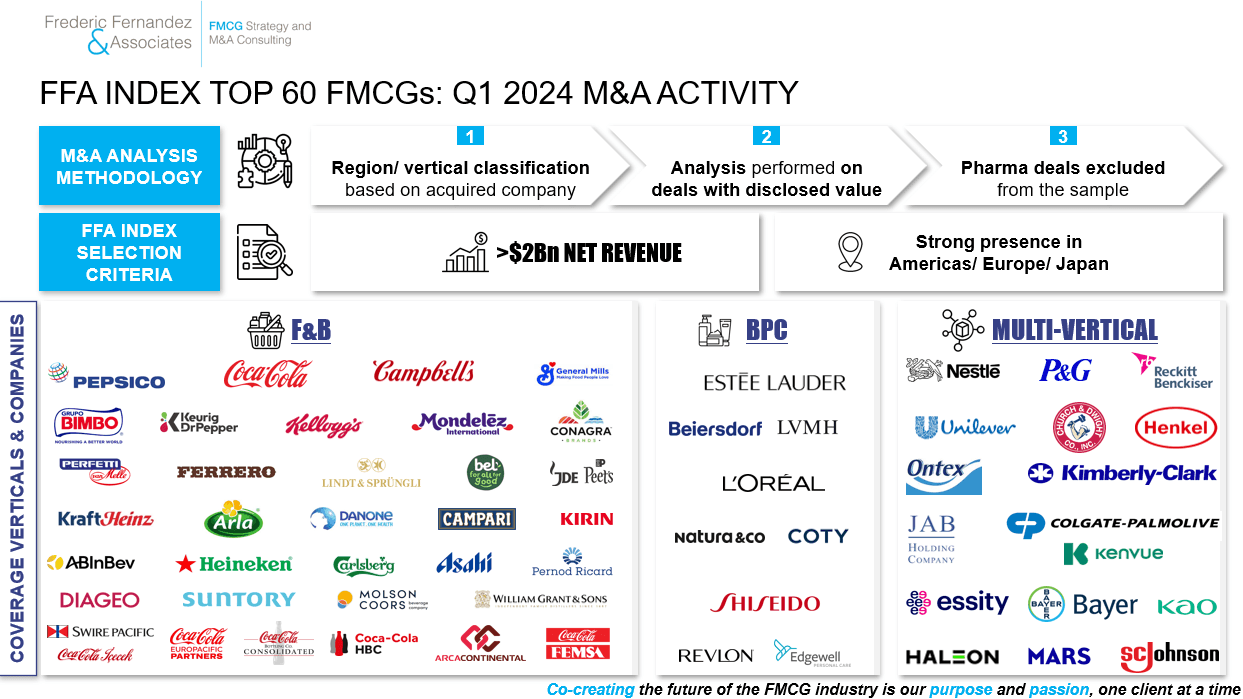
We start now covering/ analyzing every quarter the M&A market for the world largest FMCG companies. As usual, our coverage includes the 60 world largest FMCG companies.
Here are the details of our coverage:
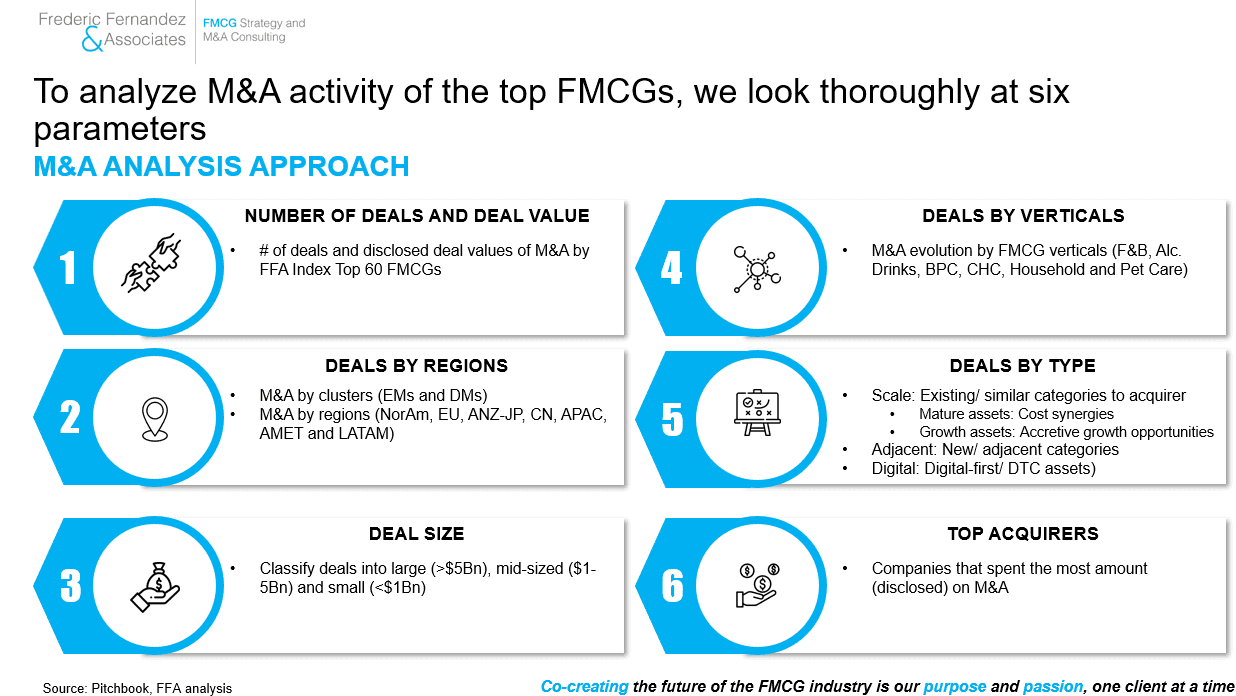
In terms of methodology, we analyzed deals across six main metrics
Here is our take on M&A activity over Q1 2024 for the world largest FMCG companies in seven key messages:
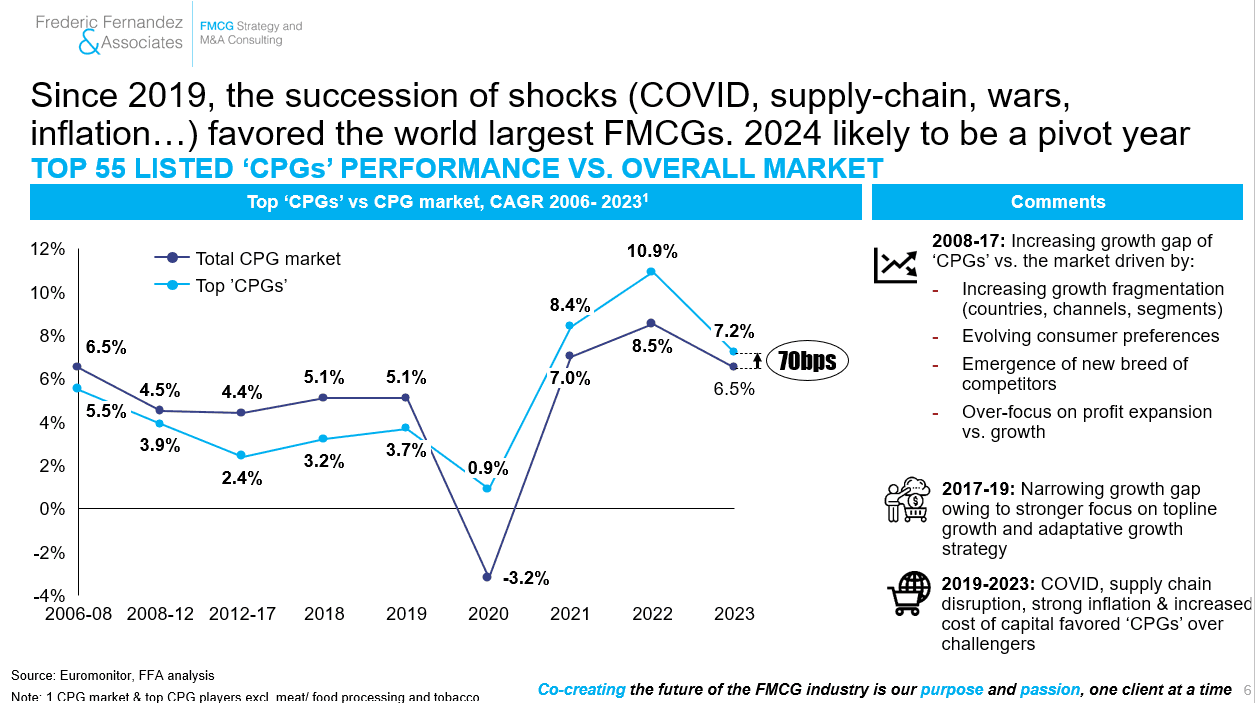
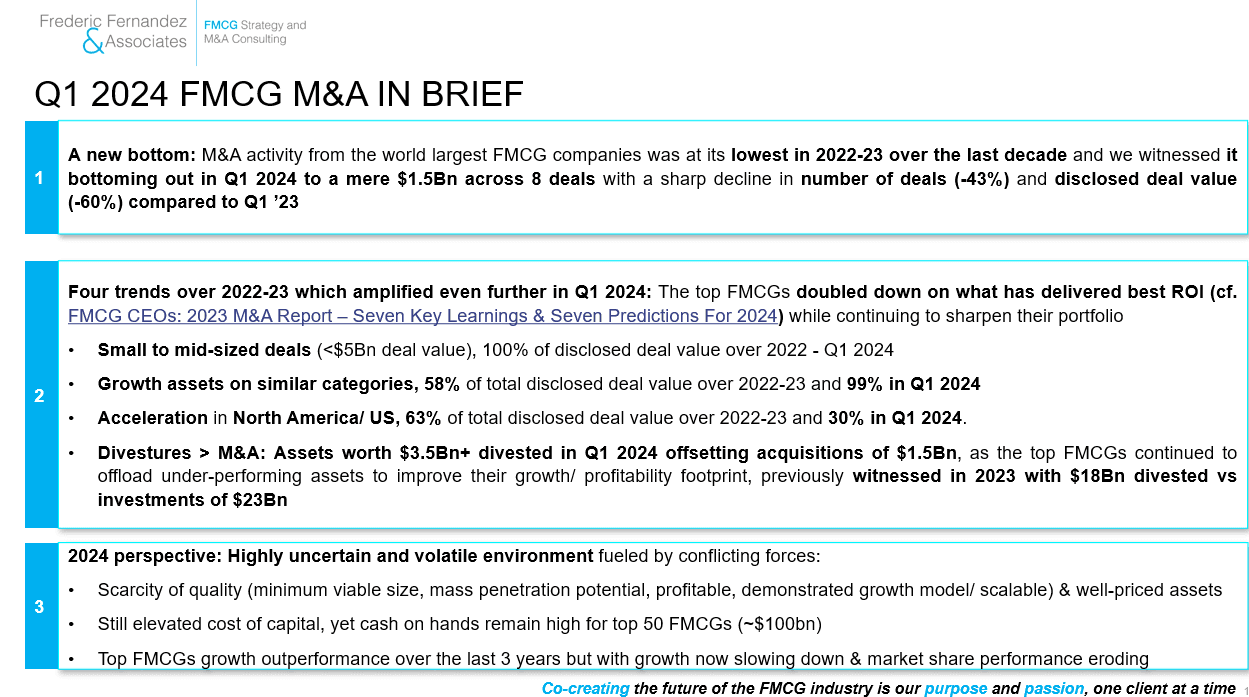
1) Q1 2024 marks a new low in M&A activity for the world largest FMCG companies. Number of deals & disclosed value are down respectively 47%/ 86% vs. Q1 2023 that was itself the lowest year in M&A value over the last 20 years. Reasons are multiple (difficulty to reach attractive M&A ROI, scarcity of quality assets, easier organic growth performance in a context the multiple 'shocks' - COVID, war, inflation - benefited most to the world largest FMCG companies vs. challenger brands)
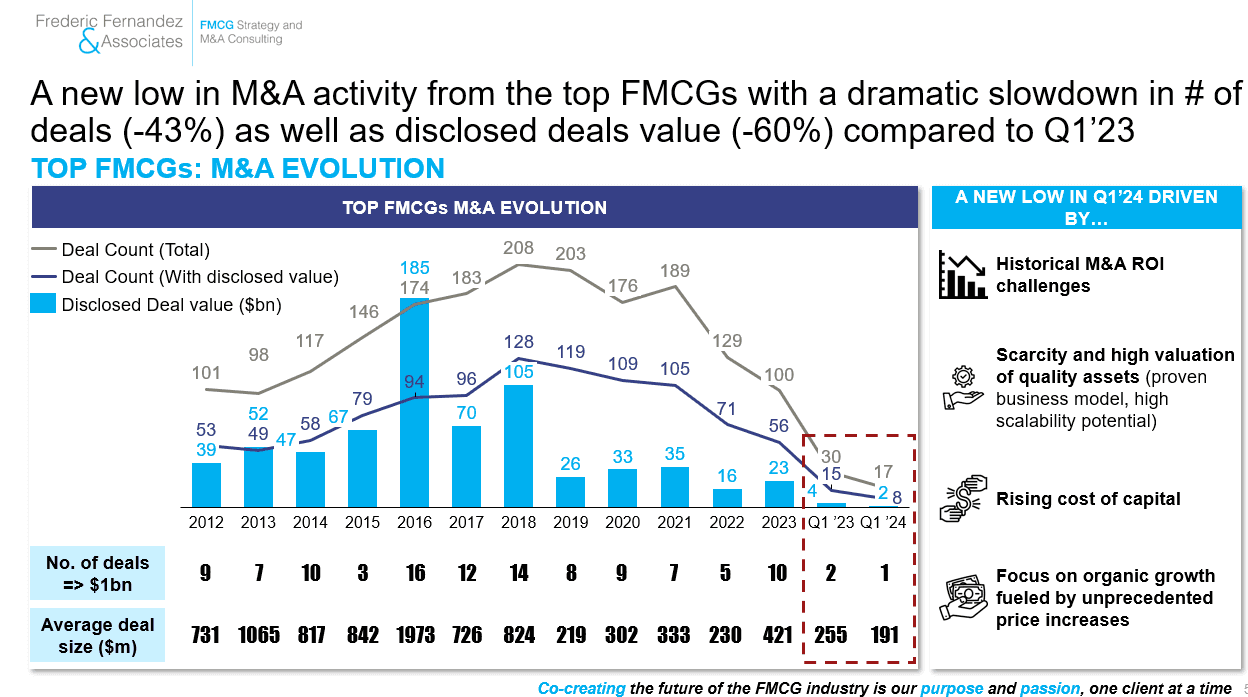
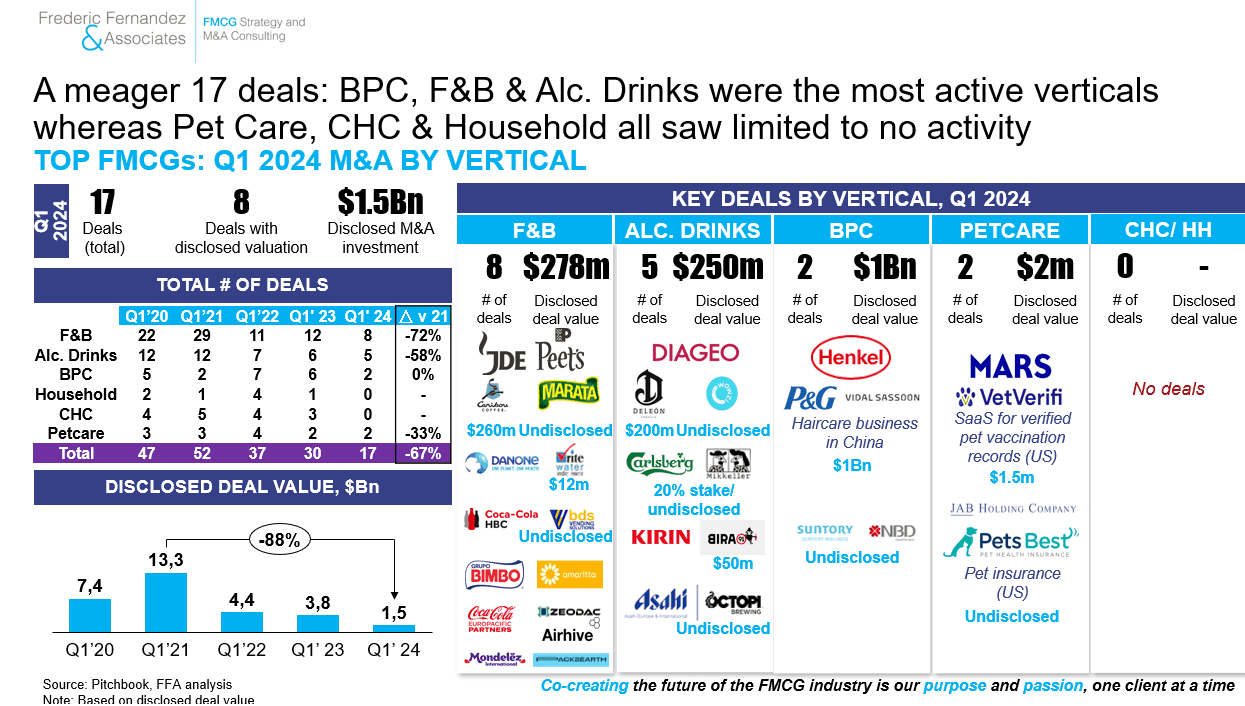
2) Q1 2024 saw a meager 17 deals being announced. F&B and Alcoholic Drinks were the most active verticals whereas Beauty, Pet Care, Consumer Health & Household all saw limited to no activity
To know more about the drivers behind this sharp decline, please refer to our 2023 M&A publication:
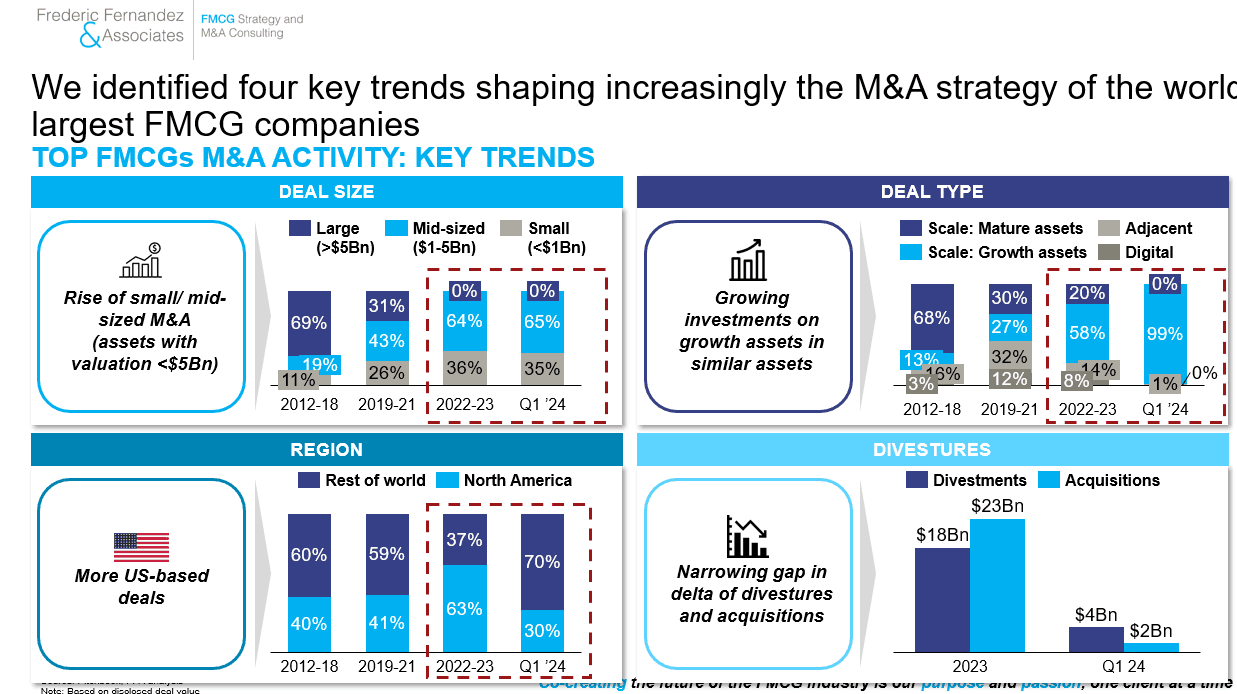
3) We identified four key trends that are increasingly shaping the M&A strategy of the world largest FMCG companies:
i) Mid-size vs. large/ small deals as they deliver better ROI (best risk/ reward ratio)
ii) Growth assets on same categories with an omnichannel footprint to fully leverage acquirer's expertise/ GTM scale vs. deals on adjacent categories or involving assets with majority of revenue online
iii) Mostly US-based assets to de-risk value creation case (local scale-up enough to deliver a ROI, US-based assets tend historically to 'travel' better than assets from other regions)
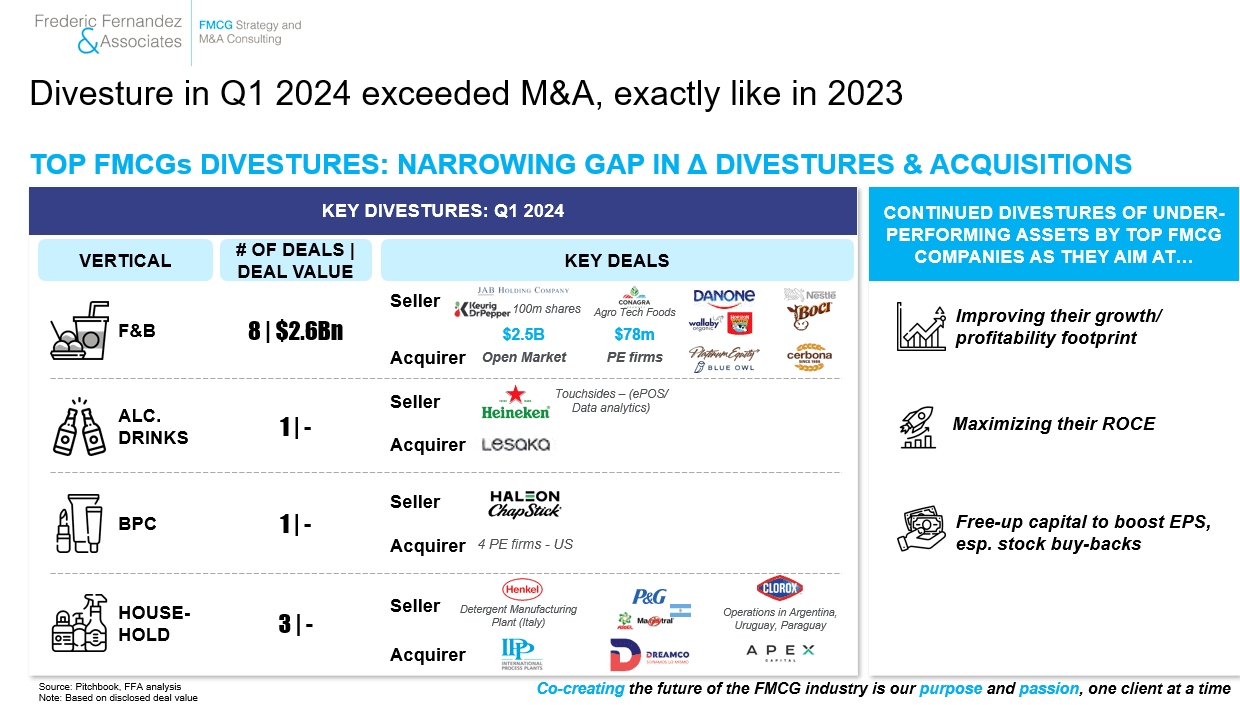
iv) Divesture value continues to exceed M&A value as FMCG companies continue to rationalize their portfolio, seek to step-change their growth/ profitability footprint (easiest/ fastest way remains divesture) while building further their B/S to drive their EPS (esp. share buy-backs) in an increasingly challenging top-line context
4) Saying it differently, the world largest FMCG companies have been doubling down on what worked best for them. Indeed the top FMCG M&A ROI transactions over the last decade have in common:
i) To be mid-size deals (demonstrated enough to limit risks, yet with enough growth runway to maximize ROI)
ii) To mostly involve growth assets operating on same categories than acquirers to maximize category expertise & go-to-market scale/ capabilities
iii) To involve US-based assets (best risk/ reward ratio)
iv) To be performed by frequent acquirers

To know more about last 10 years history of M&A in the FMCG industry and best-/worst-in-class players & corresponding learnings, please refer to our 2012-22 M&A publication:
5) Divesture value in Q1 2024 exceeded disclosed M&A value, exactly like in 2023
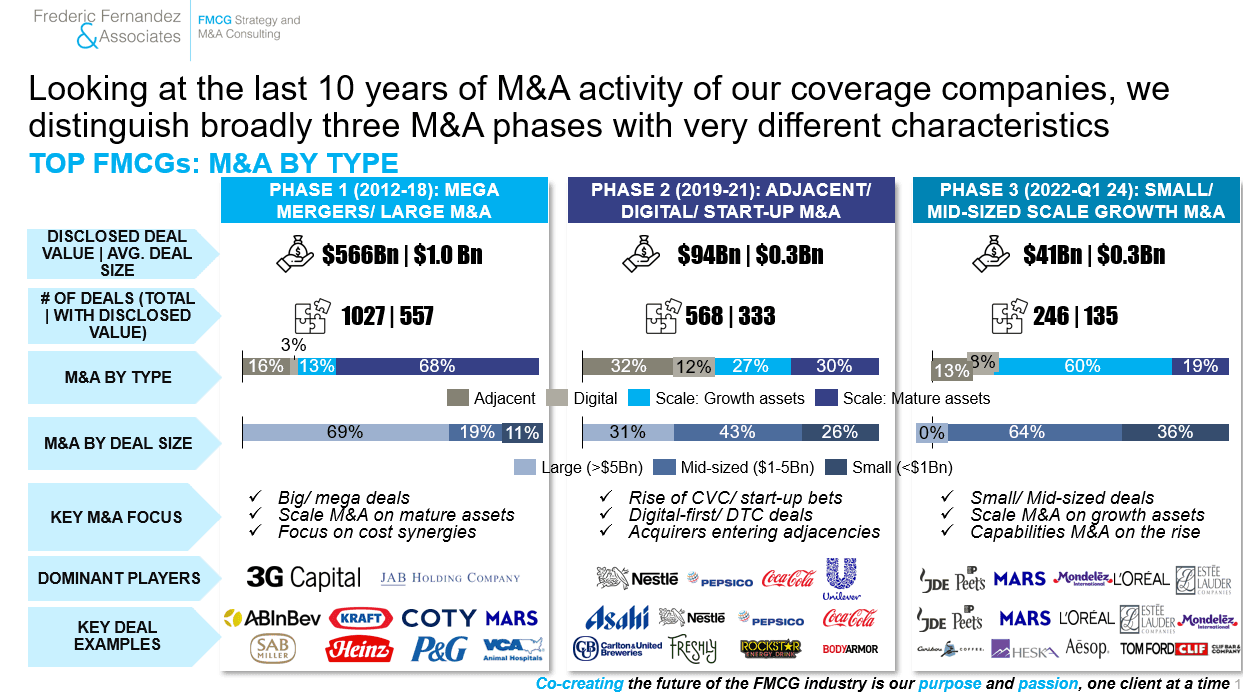
6) Looking at the last 10 years of M&A activity of our coverage companies, we distinguish broadly three M&A phases with very different characteristics
i) 2012-18 was dominated by large deals (>$5bn EV) on mature assets (ABI-SABMILLER, KRAFT-HEINZ, RECKITT-MEAD JOHNSON, COTY-P&G BEAUTY, DAONE-WHITEWAVE...). Most of those deals failed to-date to deliver above average M&A ROI
ii) 2019-21 was dominated by small (<$1bn EV) & medium-size ($1-5bn EV) on growth assets, often on adjacent categories with a significant proportion of digital assets
iii) 2021-Q1 2024 has been dominated by mid-size growth assets on same categories (best risk/ reward ratio and M&A ROI track records)
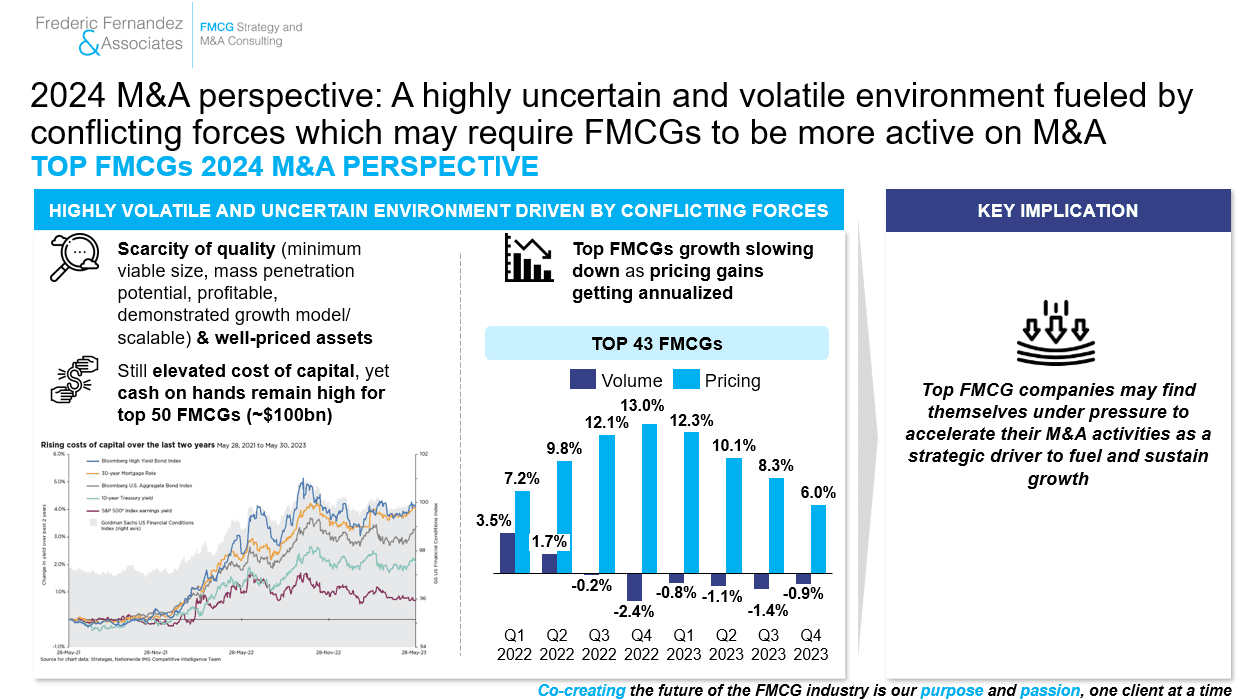
7) Looking ahead for 2024, we recognize both conflicting forces against & in favor of a bounce-back in M&A value making it rather difficult to predict 2024 developments:
i) Against:
Scarcity of quality & well-priced assets with still elevated cost of capital
Top-line growth outperformance for most (cf. prelim Q1 2024 results
ii) In favor:
Most frequent FMCG acquirers still active/ on the look-out
For some, increasingly challenging to drive revenue outperformance in a context of annualized price increase & relative volume losses
Adjusting multiples
High value assets about to hit the M&A market
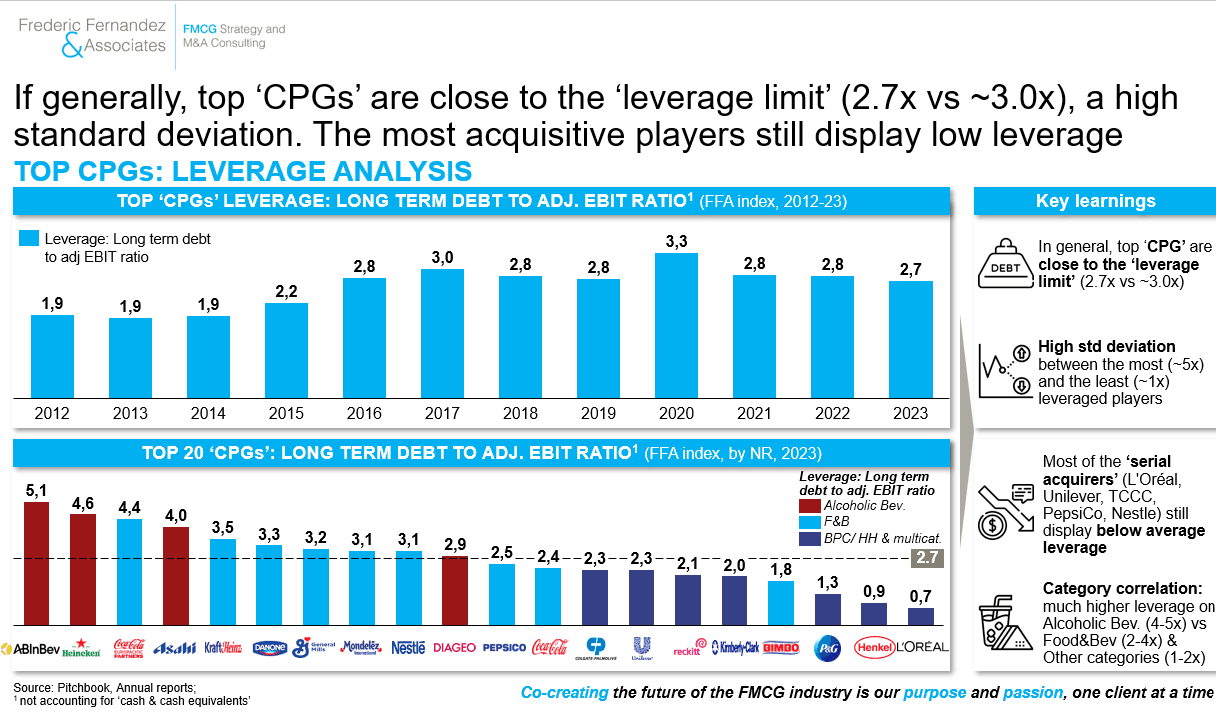
High cash on-hand ($100bn for the top 60 FMCGs), relatively low leverage esp. at the most active acquirers & continuous high volume of divesture boosting affordability
Bringing it all together:
'When you hit rock bottom, the only one way left to go is up..., isn't it?'
Time will tell.
What is clear is that 2024 will be an interesting year for M&A in the FMCG industry with most likely a more progressive bounce-back that most expected & maybe few big surprises
Exciting times.
Get in touch:
To follow Frederic, please click Here, To start a conversation, email at: frederic@fredericfernandezassociates.com
To get the full deck of this publication, please write us at contact@fredericfernandezassociates.com
To subscribe to our newsletter and receive all our CEOs Insights, sign-up at the following link: FMCG CEOs: Managing For Growth
About the Firm:
Frederic Fernandez & Associates (FFA) is a global bespoke Strategy Consulting Firm exclusively focused on Organic Growth (Zero-Based-Growth® approach), Digital GTM (Ecommerce 2.0®, DTC & Ecoystems and EB2B) and M&A serving the world largest FMCG companies. Its purpose is to help its clients win today while renewing their competitive advantages to win tomorrow. 14 out of the top world 20 largest FMCG companies are repeat Clients.
The Firm's team intervenes all across the globe and across all FMCG categories. To know more about the Firm, please visit our websites: www.fredericfernandezassociates.com
No FFA employees own any stocks or financial instruments of any FMCG companies or companies mentioned in the above article. All the above information are public information
Enjoyed this article?

FMCG CEOs: Managing For Growth
Strategic insights for FMCG/ CPG CEOs