
Corporate Strategy
FMCG CEOs: 2025 Results Confirmed Broken Algo & Increasing Premium For Quality Portfolio. Expect 2026 To Refocus On Three Areas

Author | Managing Director & Partner @ FFA
'Face reality as it is, not as it was or as you wish it to be' Jack Welch
The Q4 2025 earning season is finally completed for the world largest listed FMCG companies. As usual, here are our summarized thoughts.
2022-23 were about pricing & supply chain disruption
2024 was a transition year with a refocus on traditional organic growth tactics (sharper resources allocation, more innovations, more A&P)
2025 made clear that:
- The long-term growth algo is broken for most (negative volume continued & worsened in Q4, profitability target missed, gap between winners & losers is widening) with announcements of large price reductions for some (e.g. PepsiCo with Lays NA)
- The premium for quality portfolio (faster growing categories, leadership and/ or highly differentiated brands portfolio, lower price elasticity hence higher profitability) is dramatically increasing. Saying it differently an increasing number of large assets do not meet the requirements of large listed FMCG companies (low price elasticity, leading positions, growth potential >4%, EBIT >15%, high-single digit EPS, FCF >90%)
- The FMCG industry is not anymore a counter-cyclical/ ‘bond-like’ safe-haven for investors as showed the long-term decorrelation between the overall stock market & the FMCG sector performance, even in current period of instability. Adding to this, the historic stock price corrections on earning days for many names, incl. long-term outperformers
2026: As a result of the above, we expect the world largest listed FMCG companies to focus on three areas:
1) On organic growth side, if most FMCG companies have implemented clear 'where-to-play' strategies (shifting resources - A&P, innovations - to highest value at stake/ right-to-win areas), the 'how-to-win' (scalable/ replicable approach to growth) has remained a weakness. Expect company-wide effort to implement replicable approach to growth (cf. link to Zero-Based-Growth® below)
2) As cost of inorganic vs. organic growth reverses, expect a dramatic acceleration in M&A fuelled by:
- Large divesture to reshape portfolio & step-change underlying growth & sometimes profitability footprint
- Scale-M&A to increase minimal viable scale
- Bolt-on (mid-sized growth-driven) M&A to increase exposure to increasingly fragmented growth tailwinds
To avoid the last decade $600bn M&A-led shareholder value bonfire, lessons of the last decade will have to be carefully integrated (cf. links below to M&A Best Acquirers®)
3) Last but not least, expect an acceleration of costs cutting & shares buy-back as FMCG companies run out ammunition to deliver on their EPS commitments, especially at the FMCG companies with the lowest GM% categories most impacted by operational deleverage (F&B, Household) and at the FMCG companies executing large Divesture or M&A transactions as the pressure will be on to mitigate stranded costs and/ or to deliver on the costs synergies
Exciting year 2026 ahead
As usual, here is our take in 20 key charts:
1) 66% of FMCG companies missed profit expectations in Q4
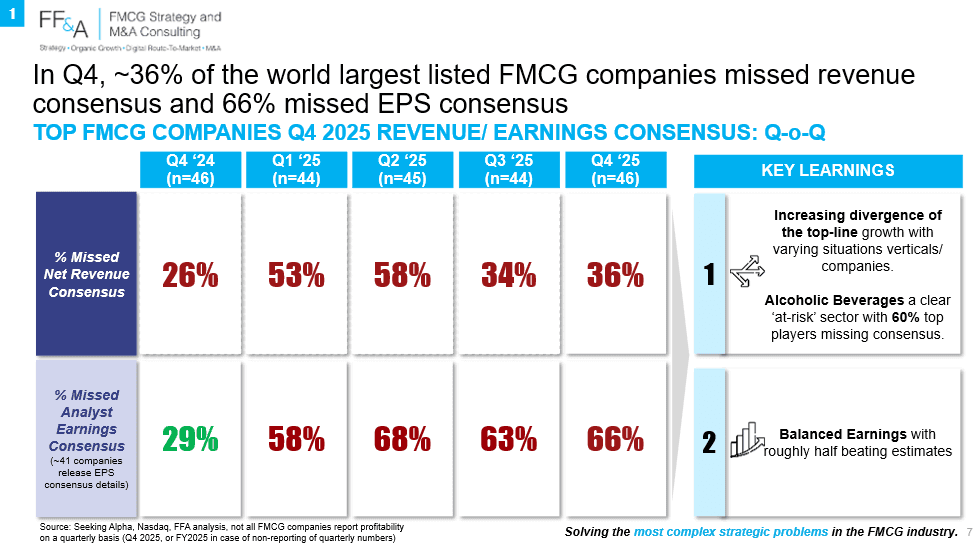
36% of the world’s largest FMCG companies missed revenue consensus and 66% missed EPS in Q4 2025. Revenue misses improved from the Q2 peak (58%), but EPS misses increased from 29% in Q4 2024. Top line is stabilizing, but bottom line pressure is intensifying — misses are becoming more common
2) 39% of FMCG companies saw their stock price decline on earnings day, a record
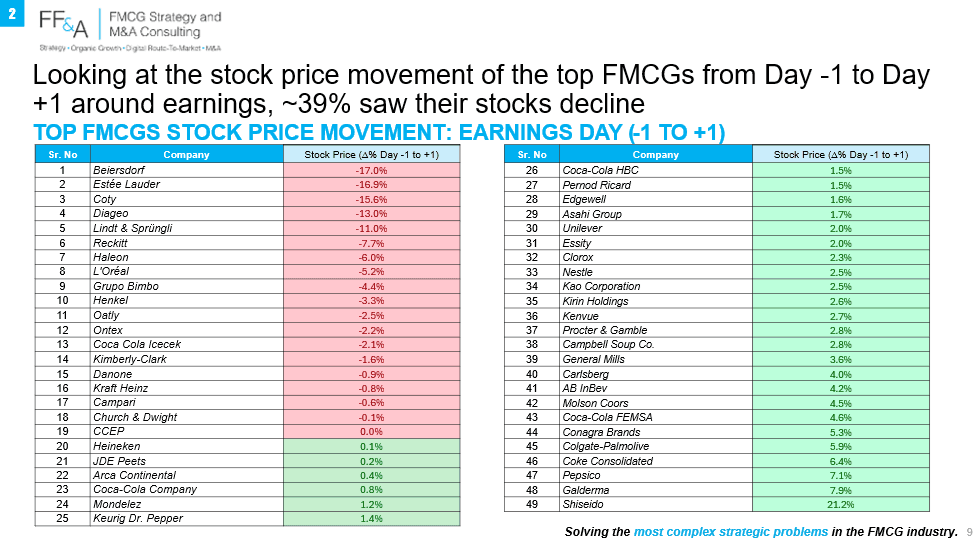
Beiersdorf dropped -17%, Estée Lauder -16.9%, Coty -15.6%, and Diageo -13% in just the two days around their earnings release. Nearly 39% of the top FMCGs saw stock decline on the day after earnings
3) Volumes in Q4 got worse across the board, not better.
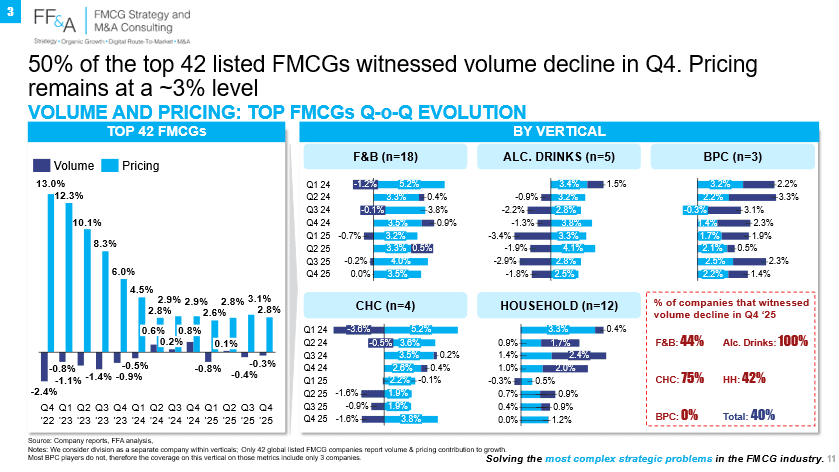
50% of top FMCGs saw volume declines in Q4 2025, up from 40% in Q3. In Q4, 100% of alcoholic drinks companies saw volume decline, CHC was at 75%, F&B at 44%, Household at 42% — only BPC avoided widespread drops. Companies are still relying on pricing (~3%) to hold the line, but consumers aren’t buying more.
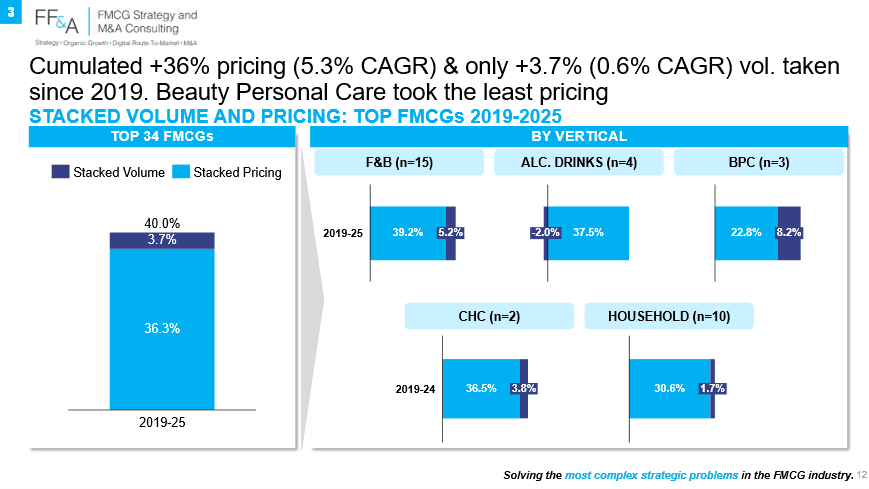
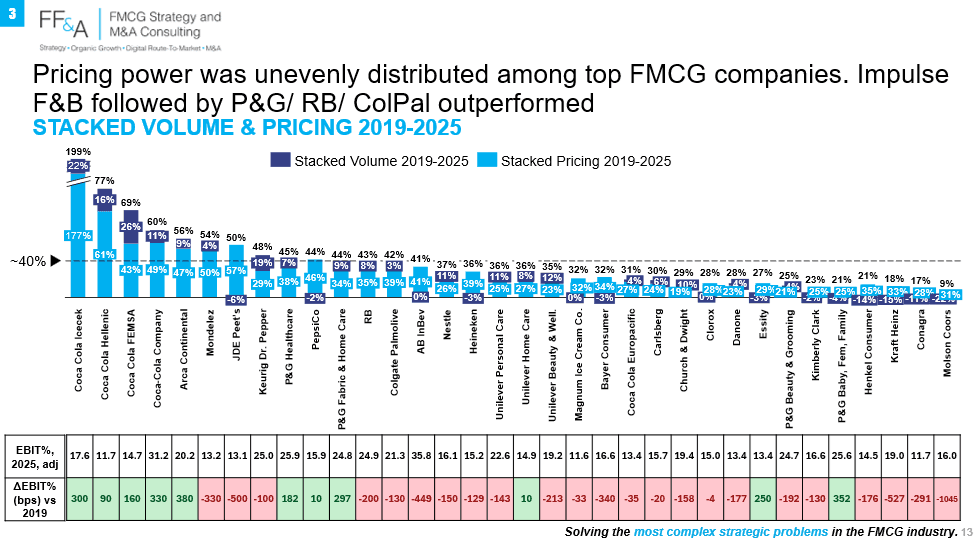
4) Since 2019, cumulative pricing is up ~36% while volume has grown just +3.7%. Consumers are paying more but not buying more
5) KO System/ P&G/ ColPal have been the clear outperformers since 2000
6) Profitability improved for some vs 2024, but the overall picture got on average worse and most are still below pre-COVID levels
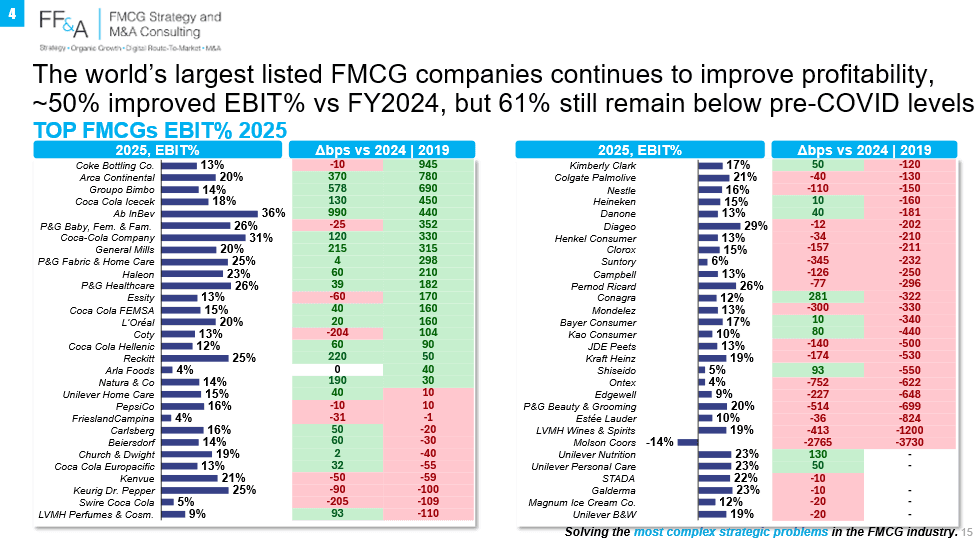
About 50% of companies improved EBIT% vs 2024, but 61% still remain below pre-COVID (2019) margins. Overall, average EBIT margins dropped -33bps vs 2024. The margin recovery story from 2023-2024 has stalled
7) A&P spending is marginally up
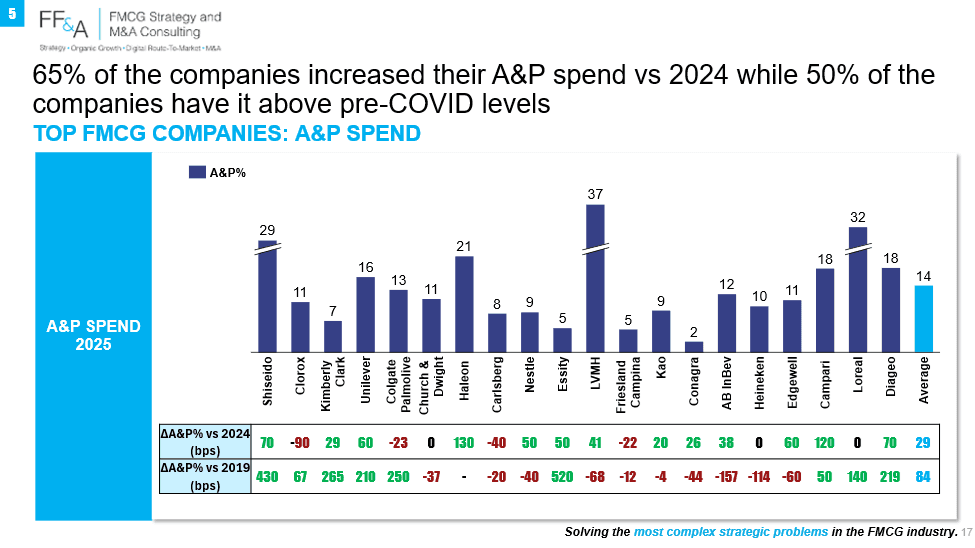
65% of companies increased advertising and promotion spend vs 2024, and 50% are now above pre-COVID levels. But the average increase was just +29bps — some companies like Clorox, Carlsberg, and Friesland actually cut back.
8) Organic sales growth slowed across every single FMCG vertical
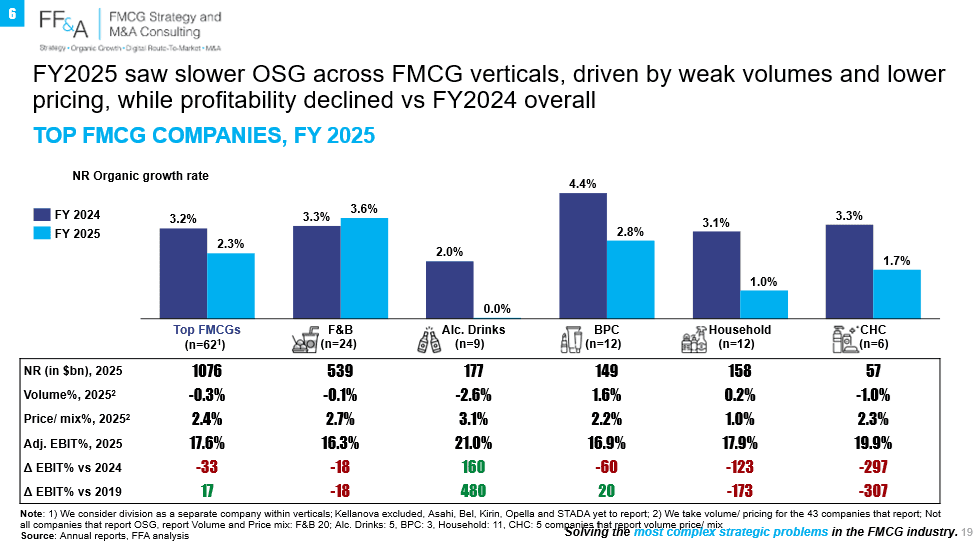
Total FMCGs went from 3.6% organic growth in FY2024 to 2.3% in FY2025. No vertical was spared — F&B, Alcohol, BPC, Household, and CHC all decelerated.
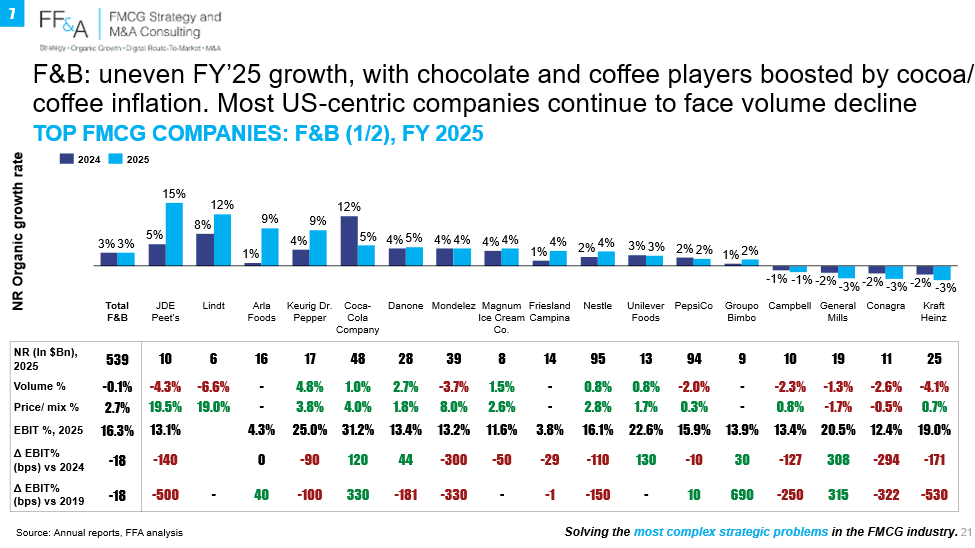
9) F&B growth was uneven — chocolate and coffee numbers are inflated by commodity costs, while US-centric players are in decline
Total F&B grew 3.3% organically in FY2025, down from 4.4% in FY2024, with EBIT margins declining -18bps vs 2024. The headline hides a split: JDE Peet’s (15% growth) and Lindt (12%) posted big top-line numbers, but JDE’s pricing was +19.5% while volume was -4.3%, and Mondelez had +8% price/mix but -3.7% volume — driven by cocoa and coffee cost pass-through, not real demand. Meanwhile, US-centric companies like General Mills, Conagra, Kraft Heinz, and Coca-Cola bottlers are one of the few bright spots
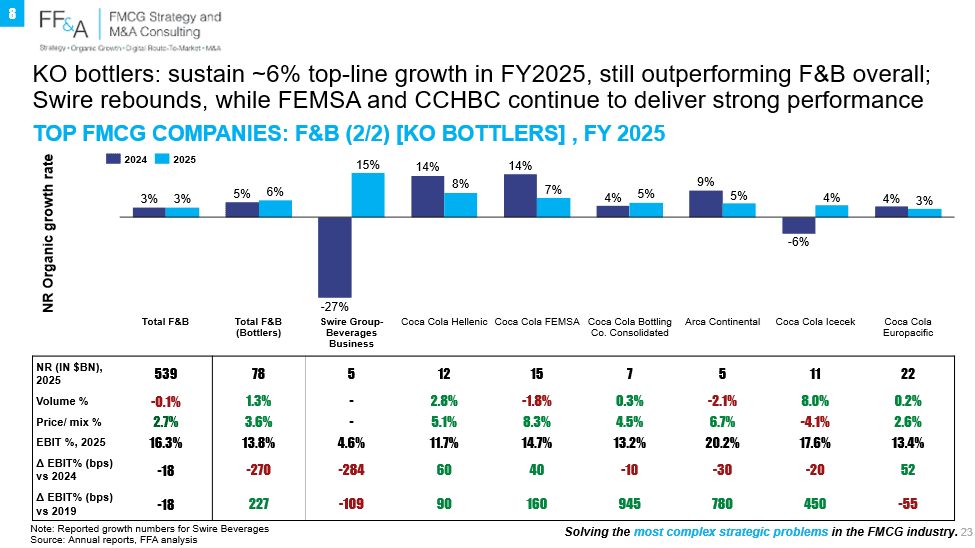
10) Coca-Cola bottlers are one of the few bright spots
KO bottlers delivered ~6% top-line growth in FY2025, outperforming the broader F&B sector. Swire, FEMSA, and CCHBC continued to deliver.
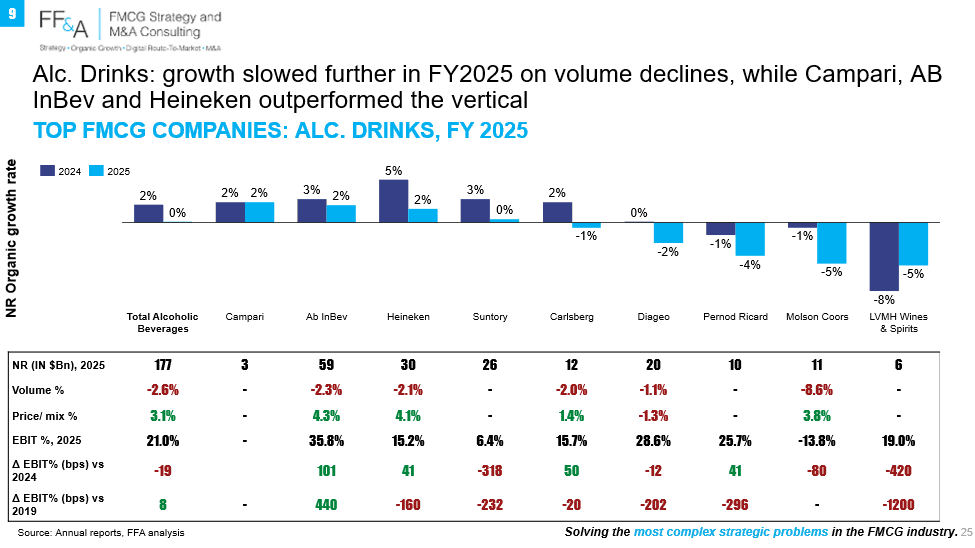
11) Alcoholic drinks growth slowed further on volume declines, with only a few outperformers
The vertical grew just 0% organically in FY2025, down from 2% in FY2024, with volume declining -2.6%. 60% of top alcohol players missed revenue consensus in Q4. Campari, AB InBev, and Heineken outperformed the vertical, while Diageo (-1%), Pernod Ricard (-1%), Molson Coors (-5%), and LVMH Wines & Spirits (-8%) all shrank. EBIT margins declined -19bps vs 2024, with LVMH Wines & Spirits (-420bps) and Suntory (-318bps) seeing the sharpest drops.
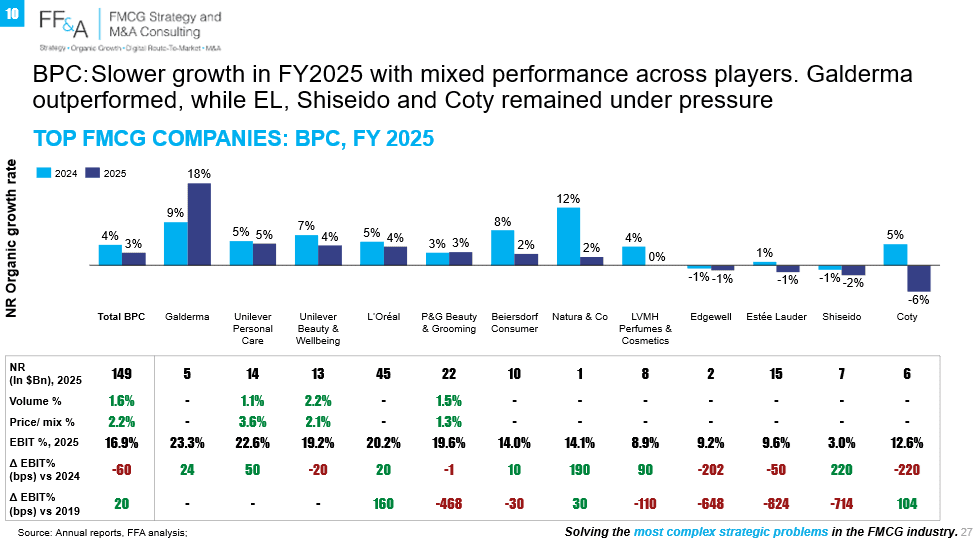
12) BPC growth halved with a widening gap between winners and losers
Galderma (18% growth) is the standout. But Estée Lauder (-1%), Shiseido (-1%), and Coty (-2%) are still in trouble. Estée Lauder’s EBIT margin is -824bps below 2019 levels.
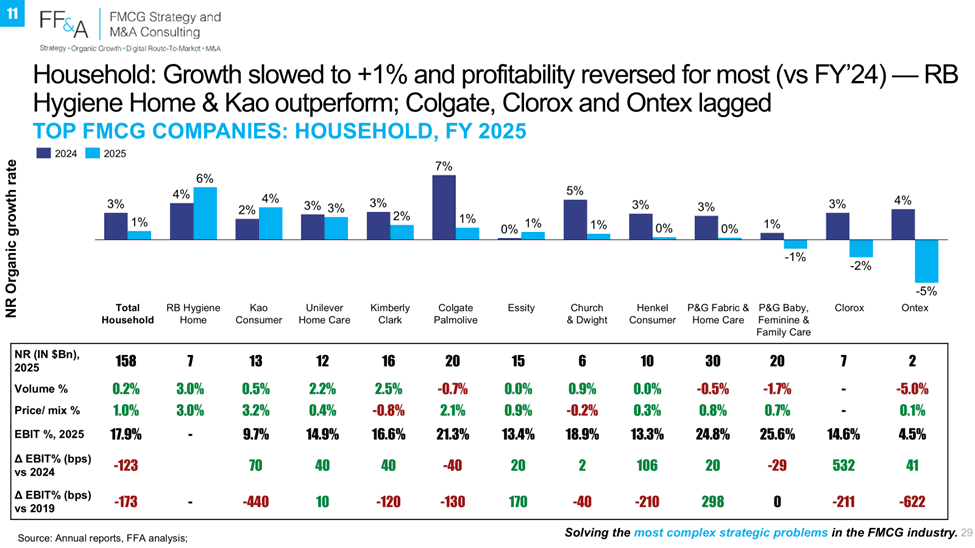
13) Household sector basically stopped growing
Organic growth slowed to just +1% in FY2025. Profitability reversed for most players vs FY2024, with EBIT margins down -123bps. Clorox, Ontex, and Colgate lagged the pack.
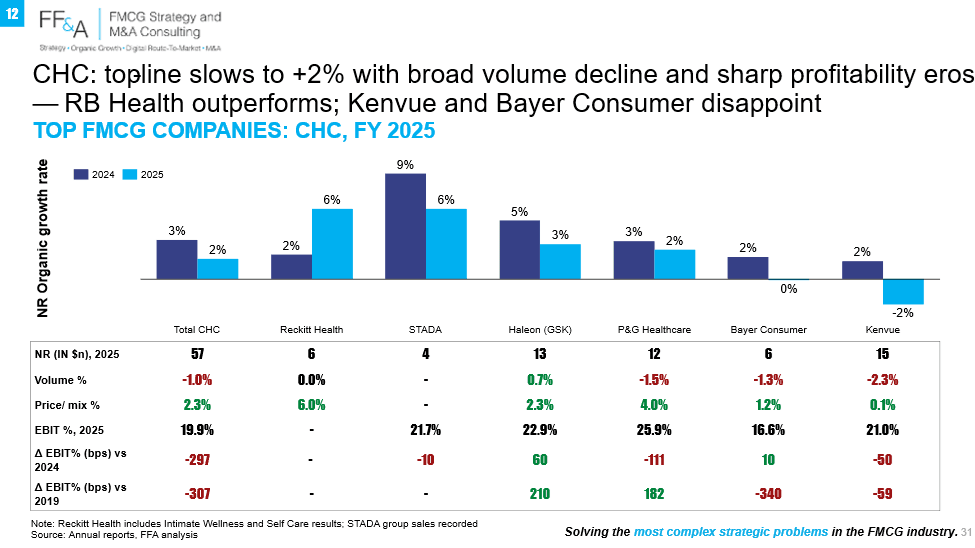
14) Consumer Healthcare is shrinking in volume and losing margins fast
CHC had the sharpest profitability erosion of any vertical (-297bps vs 2024 and -307bps vs 2019). Kenvue and Bayer Consumer are disappointing — both saw negative volume and weak pricing
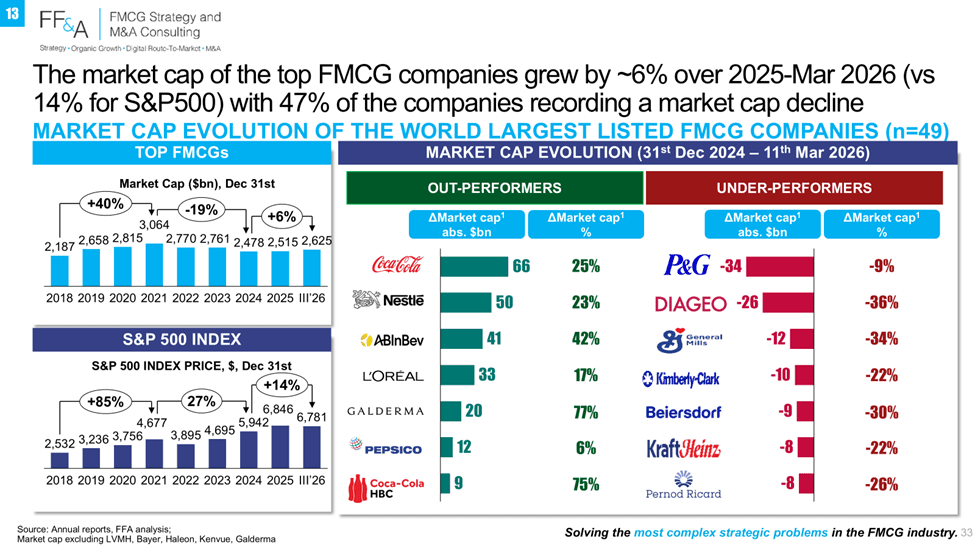
15) FMCG valuations grew more slowly than the S&P 500, with greater dispersion across companies
The market cap of the world largest listed FMCG companies eroded by 4% over 2023-Mar 25 with many names losing significant ground post releases. Gap between Winners & Losers continue to widen (in L'Oreal case the stock performance is mostly driven by the slowdown of the Beauty market, not by the intrinsic market share performance of L'Oreal)
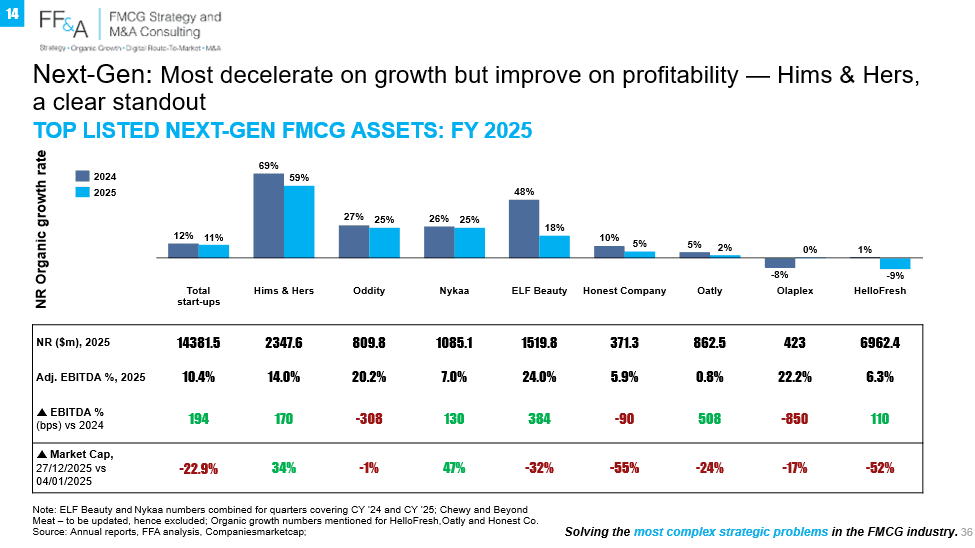
16) Next-gen FMCG companies mostly slowed on growth but improved profitability
Hims & Hers is the clear winner among next-gen FMCG assets, combining the highest organic growth (59%) with strong profitability improvement (+170 bps EBITDA) and being the only company to see its market cap rise (+34%) in 20
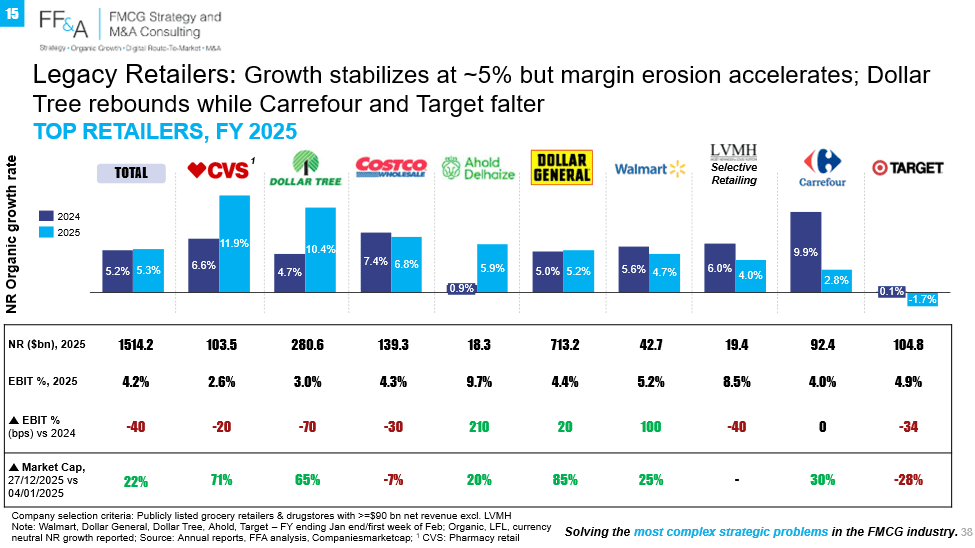
17) Legacy retailers held ~5% growth but margins are eroding, with sharp divergence between players
Top retailers posted ~5% organic growth in FY2025, but EBIT margins declined -40bps vs 2024 to 4.2%. Dollar Tree rebounded strongly (11.9% growth, +210bps EBIT improvement, +71% market cap). Walmart sustained ~5% growth with same-day delivery volumes up +70%. On the other side, Carrefour (0.9% growth) and Target (0.1% growth) faltered, with Target’s market cap dropping -28%.
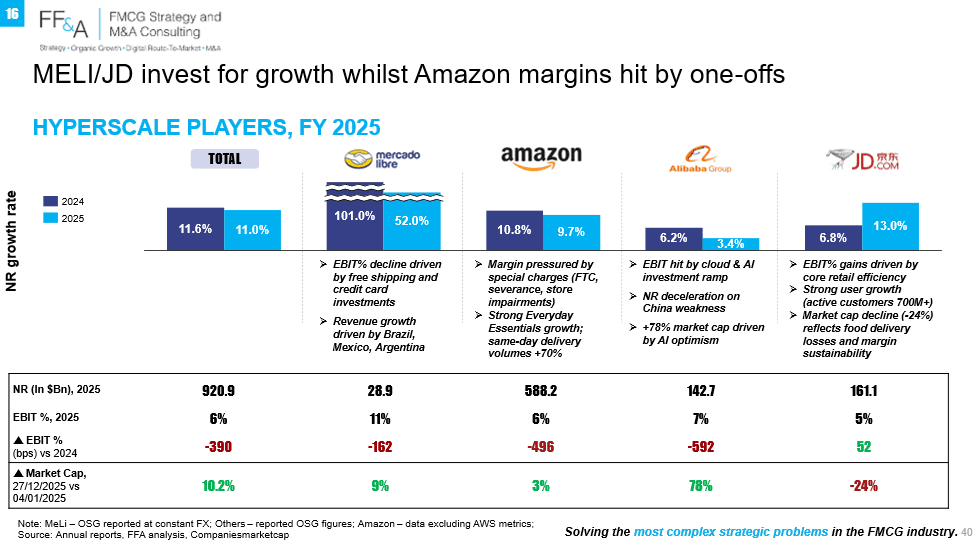
18) Ecom pure players held +11% top-line growth but EBIT eroded broadly as all pours money into AI and logistics. MELI continues to outperform
All major Ecom pure players saw EBIT margins decline vs 2024 — Amazon -496bps, MercadoLibre -162bps, Alibaba -592bps — except JD (+52bps), which gained from core retail efficiency. Alibaba’s +78% market cap rally is a bet on future AI returns, not current operating performance. Amazon’s margins were hit by special charges including FTC costs, severance, and store impairments.
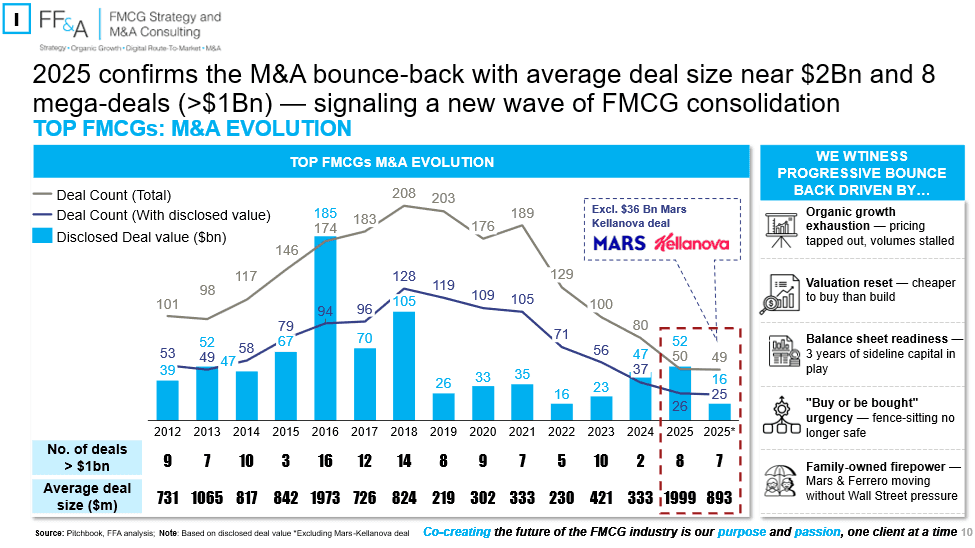
19) M&A bounced back strongly in 2025 driven by mid-size deals ($0.5-5bn EV)

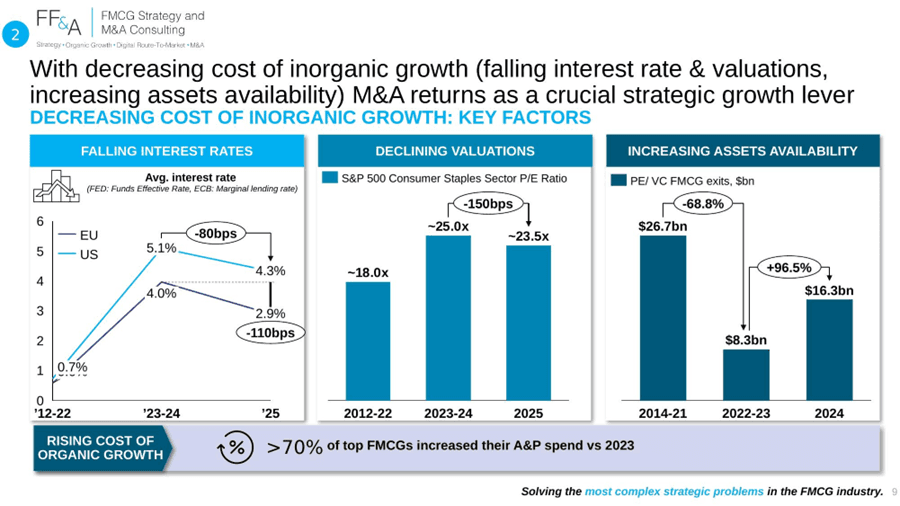
20) All driven by the inversion in the cost of organic vs. inorganic growth
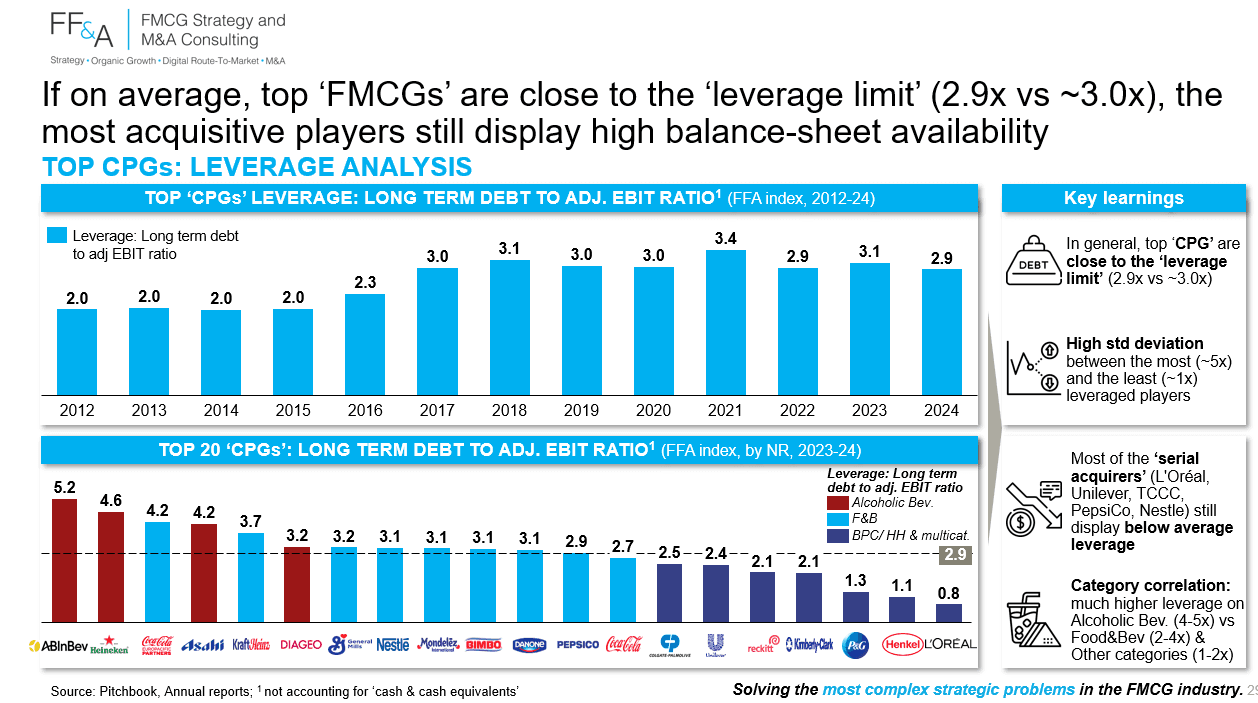
More in our latest publication: M&A 2025 In Review
Bringing it all together, 2025 confirmed that:
- The long-term growth algo is broken for most (negative volume continued & worsened in Q4, profitability target missed, gap between winners & losers is widening) with announcements of large price reductions for some (e.g. PepsiCo with Lays NA)
- The premium for quality portfolio (faster growing categories, leadership and/ or highly differentiated brands portfolio, lower price elasticity hence higher profitability) is dramatically increasing. Saying it differently an increasing number of large assets do not meet the requirements of large listed FMCG companies (low price elasticity, leading positions, growth potential >4%, EBIT >15%, high-single digit EPS, FCF >90%)
- The FMCG industry is not anymore a counter-cyclical/ ‘bond-like’ safe-haven for investors as showed the long-term decorrelation between the overall stock market & the FMCG sector performance, even in current period of instability. Adding to this, the historic stock price corrections on earning days for many names, incl. long-term outperformers
2026: As a result of the above, we expect the world largest listed FMCG companies to focus on three areas:
1) On organic growth side, if most FMCG companies have implemented clear 'where-to-play' strategies (shifting resources - A&P, innovations - to highest value at stake/ right-to-win areas), the 'how-to-win' (scalable/ replicable approach to growth) has remained a weakness. Expect company-wide effort to implement replicable approach to growth (cf. link to Zero-Based-Growth® below)
2) As cost of inorganic vs. organic growth reverses, expect a dramatic acceleration in M&A fuelled by:
- Large divesture to reshape portfolio & step-change underlying growth & sometimes profitability footprint
- Scale-M&A to increase minimal viable scale
- Bolt-on (mid-sized growth-driven) M&A to increase exposure to increasingly fragmented growth tailwinds
To avoid the last decade $600bn M&A-led shareholder value bonfire, lessons of the last decade will have to be carefully integrated (cf. links below to M&A Best Acquirers®)
3) Last but not least, expect an acceleration of costs cutting & shares buy-back as FMCG companies run out of fuel to deliver on their EPS commitments, especially at the FMCG companies with the lowest GM% categories most impacted by operational deleverage (F&B, Household) and at the FMCG companies executing large Divesture or M&A transactions as the pressure will be on to mitigate stranded costs and/ or to deliver on the costs synergies
'Face reality as it is, not as it was or as you wish it to be' Jack Welch
Time to manage for growth,
Exciting times
Frederic
Get in touch:
To join the ~66k FMCG executives that follow Frederic on LinkedIn, please click here. To start a conversation, email at: frederic@fredericfernandezassociates.com
To participate to the Growth FMCG CEO podcast, email at: frederic@fredericfernandezassociates.com
To join the ~40k FMCG executives that receive our newsletter and all our CEOs Insights, sign-up at the following link: FMCG CEOs - Managing For Growth
To read all our previous publications, visit our newsletter page: FMCG CEOs - Managing For Growth
About FF&A:
FF&A solves the most complex strategic problems of the world largest FMCG companies across with proprietary approaches developed along with our Clients over the last decade:
Corporate Strategy (Zero-Based-Strategy®)
Organic Growth (Zero-Based-Growth®)
Digital RTM (Ecommerce, DTC and EB2B) (Ecommerce 2.0®)
M&A (Best Acquirers®)
14 out of the world 20 largest FMCG companies are repeat Clients. FF&A team intervenes all across the globe and across all FMCG categories.
To know more, please visit our website: www.fredericfernandezassociates.com
Disclaimers:
No FF&A employees own any stocks or financial instruments of any FMCG companies or companies mentioned in the above article. All the above information are public information
Enjoyed this article?

FMCG CEOs: Managing For Growth
Strategic insights for FMCG/ CPG CEOs