

Corporate Strategy
FMCG CEOs: How To Make Big Consumer Health Great Again? - In 10 Key Messages & Five Predictions For 2026-30

Author | Managing Director & Partner @ FFA
'The real voyage of discovery consists not in seeking new landscapes but in having new eyes' - Marcel Proust, In Search Of Lost Time
To join the ~43,000 FMCG executives that receive automatically all our FMCG CEOs Insights (publications like this one), sign-up to our newsletter at the following link: FMCG CEOs: Managing For Growth
The growth gap is back, and nowhere is it starker than in Consumer Healthcare (CHC). After years of post-COVID tailwinds, the world’s largest FMCGs are once again trailing the overall market, by ~150 bps. The gap is everywhere (11-265 bps across verticals), but CHC is the standout: in FY2025 the top players grew just 1.7%, with negative volumes against a 4.4% category, a -266 bps gap.
This is the CHC paradox: a tale of two stories. The vertical has never been more attractive: a large, expandable, faster-growing, profitable ~$400bn market, with structural tailwinds, a low private-label weight & a genuine premium for scale (R&D, regulatory, pharma go-to-market). Yet it has never been more unforgiving: fragmenting fast, with lowering barriers-to-entry & intensifying competition from global CHC players, FMCG incumbents, PE-funded regional CHC, VC-funded start-ups & local incumbents.
Between 2023 & 2025, the top six CHC players swung from outperformance to strong underperformance and, tellingly, they have been leaking share to challenger brands (‘Others’), not to private labels. The global CHC pure players have been hit the worst.
But the gap is bridgeable. A 4-6% growth rate is a reachable ambition for every top CHC player, versus 1.7% today. That is a ~+400 bps swing versus the market, unlocked through five very ownable where-to-play & how-to-win choices.
Here's the diagnosis and the five priorities to fix it - all in 10 key messages and five key predictions for 2026-30.
Enjoy the read
1) The growth gap is back: the world's largest FMCGs underperform their markets again (-150 bps in 2025)
• The post-COVID tailwind is over: across the top 60 listed FMCGs, the growth gap vs. the overall market is back
• The world’s largest FMCGs grew 2.3% vs. a 3.8% market in 2025, a gap of -150 bps
• It echoes the 2008-17 era: growth fragmentation (countries, channels, segments), evolving consumer preferences, new competitors & an over-focus on profit
• The gap narrowed in 2017-19 on a renewed topline focus; in 2019-23 COVID, supply-chain disruption, inflation & a higher cost of capital briefly favoured incumbents
• Since 2024 the gap is back: fading COVID tailwinds & pricing, plus K-shaped consumer behaviour

2) CHC is the standout: top players grew 1.7% — with negative volumes vs a category at 4.4%. A -266 bps gap, the worst of all verticals
• The gap spans every vertical: Alcoholic Drinks -114 bps, F&B -139 bps, BPC -196 bps, Household -214 bps
• CHC is the worst: top players grew just 1.7%, with negative volumes (-1.0%), vs. a 4.4% category, a -266 bps gap
• The six CHC players in scope: Haleon, Kenvue, Bayer, STADA, P&G HealthCare & Reckitt (~$57bn net revenue)
• For a category this attractive, that under-growth is the puzzle

3) A tale of two stories: a $400bn, fast-growing, profitable, low-PL vertical — yet fragmented, with falling barriers-to-entry and intensifying competition
• Structural tailwinds (ageing, wellness, self-care); a low private-label weight; a premium for scale (R&D, regulatory, pharma GTM)
• Yet increasingly unforgiving: fragmenting fast, with lowering barriers-to-entry
• Intensifying competition: global CHC, FMCGs, PE-funded regional CHC, VC-funded start-ups, local incumbents
• The same attractiveness that rewards the winners is precisely what invites the competition

• CHC sits at the crossroads of Health Care, Food & Beverage & Personal Beauty Care: a ~$400bn vertical spanning OTC core (Cough & Cold, Analgesics, Digestive, Dermatologicals), OTC tail (Eye, Sleep, Wound, Smoking Aids, Mouth, Emergency Contraception) & non-OTC (VMS, Sports Nutrition, Weight Management, Oral Care)
• No segment dominates: VMS leads at 36%, followed by Oral Care (15%), Cough & Cold (12%), Analgesics (9%), Sports Nutrition (8%), Digestive (6%), plus a long tail of sub-segments
• The fragmentation is the point: there is no single 'CHC' game, but many adjacent ones

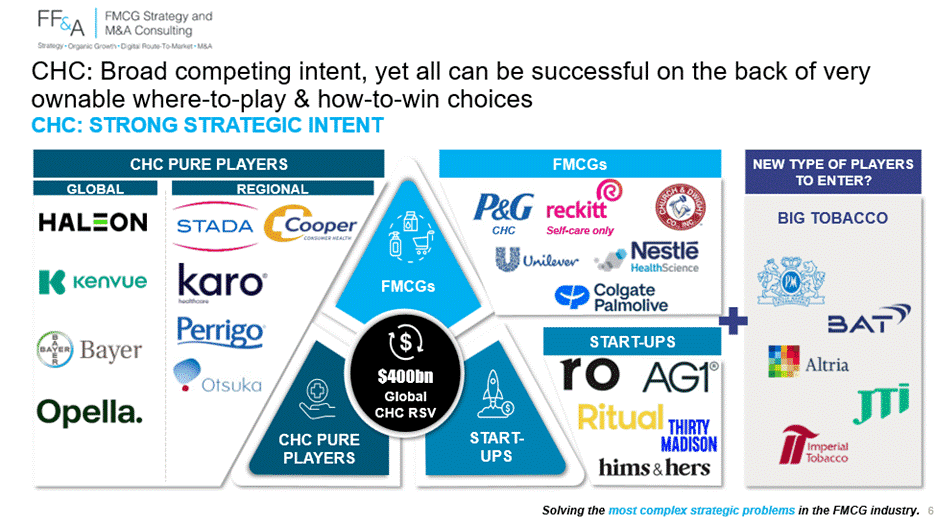
Competition is intensifying from all sides:
• CHC pure players: global (Haleon, Kenvue, Bayer, Opella) & regional (STADA, Cooper Consumer Health, Karo Healthcare, Perrigo, Otsuka)
• FMCG incumbents: P&G, Reckitt (self-care), Church & Dwight, Unilever, Nestlé Health Science, Colgate-Palmolive
• Start-ups scaling fast: Ro, AG1, Ritual, Thirty Madison, Hims & Hers
• New entrants coming: Big Tobacco (PMI, BAT, Altria, JTI, Imperial)
• Not a zero-sum fight: Every archetype can win on very ownable where-to-play & how-to-win choices
4) The Top 6 are leaking share to smaller brands, not private labels — and global pure players are hit the worst (up to -580 bps vs footprint). It is a competitiveness problem, not a commoditization one
• Between 2023 & 2025, the Top 6 swung from outperformance to strong underperformance: +21 bps (2022-23), -73 bps (2023-24), -266 bps (2024-25), all vs a healthy CHC market growing +4.9% p.a. to $400bn
• Not a private-label story: Top 6 share slipped from 17.7% to 16.9%, while PLs actually declined from 5.4% to 5.1%
• The gains went to 'Others', the challenger brands, rising from 76.9% to 78.0% of the category
• Global CHC pure players have been hit the worst. Des-averaged by player, the global pure players suffered most vs. their own footprints:
– Kenvue -583 bps (footprint 3.6% vs. -2.2% reported)
– Bayer -469 bps (4.6% vs. -0.1%)
– Haleon -95 bps
• P&G HealthCare trailed by -120 bps
• The bright spots outgrew their footprints: Reckitt +196 bps, STADA +68 bps; rest of market +23 bps
• Scale & heritage are not protecting the category leaders

5) 4-6% growth is reachable for all: up to +400 bps of swing vs the market, across five ownable priorities. Saying it differently, the growth gap is mostly SELF INFLICTED
• A 4-6% CAGR is a reachable ambition for every top CHC player vs. 1.7% today
• That moves them from -266 bps vs. the market to up to +150 bps: a +400 bps swing
• The value at stake breaks cleanly across five priorities:
– US-dedicated holistic strategy: 25% (est.)
– Ecommerce-first 4Ps (excl. US): 25% (est.)
– Emerging markets over-drive (excl. eCom): 20% (est.)
– CHC legacy playbook (market-making brand building, pharma go-to-market, HCP activation - DMs excl. US): 20% (est.)
– (Bolt-on) M&A & Rx-to-OTC switch: 10% (est.)
All of the 5 are known and executable lever

This brings us to our next set of key messages: the 2026 strategic priorities that should be on every CHC CEO's agenda.
6) Priority 1 — US dedicated holistic strategy (~25% of value at stake): win with a consumer/eCom-led model, not the legacy HCP-led one. See Unilever Wellbeing: ~$2.5bn, >16% CAGR
• The US is the single largest CHC market: estimated 36% of the Top players’ RSV, yet contributed only 15% share of growth (2022-25)
• A long-term underperformance: the Top 6 trailed the US market by ~190-250 bps every year (-251, -191, -188 bps)
• Root cause is a model mismatch: the US rewards a consumer/eCom-led model (brand desirability, digital-shelf excellence, retail media), not the legacy HCP-led playbook
• Fixing the US (~25% of the value at stake) needs a dedicated, holistic operating-model re-design around the US consumer

Unilever Wellbeing: An M&A-Built CHC Platform
• Unilever used disciplined M&A to assemble a large, fast-growing US-anchored wellbeing business
• ~$2.5bn RSV in 2025, growing at >16% CAGR (2022-25, organic/rebased)
• Built from OLLY, Liquid I.V., SmartyPants, Welly, Onnit, Nutrafol, K18 & Grüns across VMS, hydration, first aid & adjacencies
• Proof that US can be a growth engine, not a drag, with the right consumer-first model

7) Priority 2 — eCommerce-first 4Ps (~25%): eCom is already 26% of CHC and >50% of growth, yet top players carry a $3.5bn under-trading gap today, $5.6bn by 2030 'as-is'
• eCommerce is already significant in CHC: 26% of RSV & more than half of all growth (~50% SOG)
• Online is expected to compound at estimated 7% CAGR to 2032
• But the differences inside CHC are stark, in 2025 (SOG 2020-25):
– VMS: 39% online, 78% SOG
– Oral Care: 25% online, 53% SOG
– OTC: 11% online, 21% SOG
• Where-to-play online is therefore a sub-category-specific question, not a single channel bet

Read more on our Digital RTM / Ecommerce thinking: FMCG CEOs: The Rise Of Ecommerce 2.0
FF&A E-Commerce IQ: 2025 CHC Rankings
• Most top CHC players under-trade online vs. their offline fair share
• A $3.5bn value at stake today, widening ‘as-is’ to $5.6bn by 2030 (Total index 65)
• P&G leads (Ix 88); Bayer (Ix 87) & Reckitt (Ix 79) closer to fair share; STADA (Ix 69); Haleon & Kenvue under-trade most (Ix 56 each)
• Closing this online under-trading (excl. US) is worth ~25% of the total value at stake
• Recovery path: a disciplined ecommerce-first 4Ps model — right assortment, content, keywords & share-of-search first, then accelerate via retail media

Read our CHC E-Commerce IQ Report and how FF&A can help, here – FMCG CEOs: Bridging The $5bn Ecommerce Gap On CHC & Launching FF&A Ecom IQ Index® & Ecommerce 3.0®
Hero Cosmetics: Success Case
• An Amazon-native brand that reached ~$350m net revenue in nine years (est. $27m in 2020 to est. $347m in 2025)
• No proprietary science, an effective product solving a problem
• An AMZ-first model & bold targeted marketing (not heavy ATL/BTL)
• Mighty Patch became the #1 pimple patch in the US; Church & Dwight acquired the brand for around $630m in 2022
• Challengers win online because they are built online, incumbents must answer with the same discipline

8) PRIORITY #3 — Emerging markets over-drive (~20%): EMs are >50% of CHC growth, yet the Top 6 are both underweight (26% vs 38% fair share) and underperforming. Durex India shows the playbook
• Emerging markets account for more than half of all CHC growth (incl. eCom); ~8% CAGR vs. ~4% for developed markets, the structural growth engine
• The Top 6 are both under-exposed & under-performing:
– Est. 26% EM weight vs. a 38% fair share
– trailed EM growth by around 140-300 bps (-308, -138, -144 bps) across 2022-25
• Closing the double gap (excl. eCom) is worth ~20% of the value at stake
• Requires bespoke EM playbooks: holistic market sizing, engagement-based segmentation, local relevance, fit-for-purpose operating models, premium-meets-penetration

Durex India: Success Case
• Became the #2 condom brand in India within a decade; 2.6x growth over 2022-25
• Drivers: premium positioning; culturally relevant sex-education; segmented go-to-market (premium omnichannel / eCom-first); disruptive product innovation; witty, taboo-breaking, always-on communication
• EMs reward brand-building courage & local relevance, not exported DM tactics


9) PRIORITY #4 — Execution excellence on the CHC legacy playbook in DMs (~20%): market-making brand building, pharma GTM, HCP activation. It still wins when executed brilliantly: Sensodyne, Lemsip, ZzzQuil.
• In developed markets (excl. US) the prize is excellence in the CHC legacy growth model: market-making brand building, pharma go-to-market excellence & HCP activation excellence
• 20% of the value at stake sits behind simply executing this model better than anyone
• The top five most common sins:
– Not the best-possible consumer/HCP stories
– Over-focus on premiumization vs. penetration (innovation overdose)
– Over-focus on ATL/media vs. BTL/HCP
– Sub-optimal pharma/HCP team coverage & frequency
– Poor KPI tracking (e.g. number of recommendations per week)

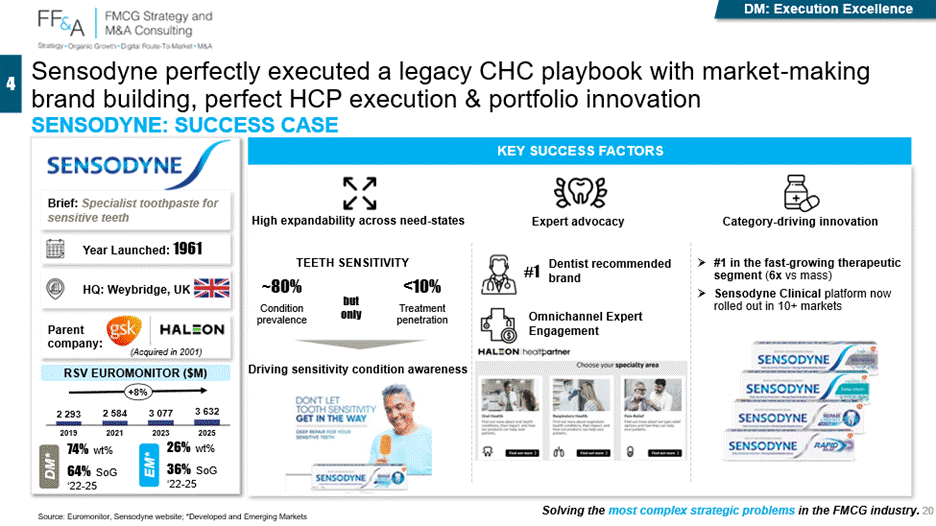
Sensodyne: Success Case
• The legacy playbook executed to perfection: category-driving innovation, expert advocacy & high expandability across need-states
• #1 dentist-recommended brand; #1 in therapeutic segment growing 6x mass; +8% growth (RSV $2.3bn in 2019 to $3.6bn in 2025)
• Sensodyne Clinical platform now rolled out in 10+ markets
Lemsip (UK): Success Case
• Growth outperformance built & sustained on a national hero brand (+6% since 2019)
• Drivers: format versatility (capsules, sachets, syrup); 5/15-minute speed claims; occasion-based segmentation (Max Cold & Flu, Day & Night, First Action)

P&G ZzzQuil: Success Case
• A rare case of category & organic brand building in CHC from an incumbent (+13% since 2019)
• Leverages the Vicks brand to build familiarity & trust; active ingredients that work (melatonin); a habit-free formulation
• Started in the US, now available in 10+ markets

10) PRIORITY #5 — Bolt-on M&A & Rx-to-OTC switches (~10%): mid-size, proven assets in fast-growing segments. P&G x Merck CHC is the reference case
• M&A complements organic growth, it does not substitute for it
• Sweet spot: mid-sized ($0.5-5bn), proven assets in fast-growing segments, where the acquirer has genuine category expertise & clear go-to-market synergies
• Track record: P&G–Merck ($4.2bn, 2018); Reckitt–Boots Healthcare International ($3.3bn, 2006); L’Oréal–CeraVe ($1.3bn, 2017); Unilever–Liquid I.V. ($0.7bn, 2020); Church & Dwight–TheraBreath ($0.6bn, 2021)
• Bolt-on M&A plus Rx-to-OTC switch is worth ~10% of the value at stake

Read more on our M&A strategy: FMCG CEOs: The $600bn M&A Bonfire — Introducing FF&A’s Best Acquirers
P&G–Merck Deal: Consumer Health
• P&G acquired Merck’s consumer-health business for $4.2bn in 2018 (19x EBITDA, 4.7x NR)
• Strategic rationale: improve the OTC country/brand/category footprint; complement existing brands with stronger healthcare capabilities; terminate the JV with Teva
• Integrated into the P&G Healthcare division in 2019, it drastically accelerated & sustained organic growth
• Net revenue growth stepped up from +2% pre-deal to +6% then +9%; EBIT followed from +3% to est. +6-7%
• Disciplined, expertise-adjacent, mid-sized M&A works and the failures come from straying outside the sweet spot

Bringing It All Together
• Five priorities:
(1) Tailor strategy for the US and its unique omnichannel digital-first nature (cf. Zero-Based-Growth® & ZBG Sprint)
(2) Address the eCom bleed (around 25% each) (cf. Ecommerce 2.0® & Ecommerce Gap On CHC)
(3) Over-drive emerging markets (around 20%) (cf. Emerging Market Outperformance®)
(4) Execution excellence in developed markets (around 20%)
(5) Bolt-on M&A (est. 10%) (cf. Best Acquirers®)
• Together they turn 1.7% into 4 to 6% CAGR: the +400 bps swing from -266 bps to up to +150 bps vs. the market
• None is a moon-shot; each is a known, executable lever: the differentiator is the will to choose & execute
• The next five years will reward the bold: those who re-make these five choices will realize CHC’s full potential, while those who defend the status quo will only widen the gap to the winners

Five Key Predictions For 2026-30
1) Structural CHC Attractiveness Will Remain
• The fundamentals: expandability, ageing & wellness tailwinds, self-care behaviour, profitability & a low private-label weight — are structural, not cyclical
• CHC will remain one of the most strategically desirable categories in all of FMCG, the question is who captures it
2) ‘As-Is’, Underperformance Will Persist — & The Winners/Losers Gap Will Widen
• Absent structural intervention across the top five where-to-play priorities, incumbent underperformance will continue
• Those who re-make their US, eCommerce, EM, execution & M&A choices will separate decisively from those who defend the legacy model
3) Fragmentation Will Remain — No Large Industry-Wide Consolidation Ahead
• CHC will stay fragmented; we do not expect large-scale, industry-wide consolidation (as a share of total CHC)
• The category will keep being contested by global players, regional platforms & start-ups, keeping the bar for differentiation high
4) M&A Will Accelerate Sequentially — But Large Strategic M&A Stays Unlikely
• Deal activity will pick up sequentially: strategic bolt-ons, PE-led transactions & big-pharma consumer-health carve-outs
• Large, transformational strategic M&A remains unlikely, the winners stay inside the mid-sized, expertise-adjacent sweet spot
5) Big Tobacco Will Enter CHC — & Become A Driving Force
• Big Tobacco will enter CHC through functional pouches (but not only) and become a genuine driving force
• Deep pockets, nicotine-adjacent consumer expertise & a need to diversify will reshape parts of the landscape faster than many expect
‘We do not succeed in becoming someone else but in becoming the best version of ourselves & in changing selectively.’
It is the challenge for big CHC players.
Exciting times
Frederic
Get in touch:
To follow Frederic, please click Here. To start a conversation, email at: frederic@fredericfernandezassociates.com
To get the full deck of this publication, please write us at contact@fredericfernandezassociates.com
To subscribe to our newsletter and receive all our CEOs Insights, sign-up at the following link: FMCG CEOs: FMCG CEOs: Managing For Growth
About FF&A:
FF&A solves the most complex strategic problems of the world's largest FMCG companies across:
- Corporate Strategy
- Organic Growth (cf. our proprietary Zero-Based-Growth - https://lnkd.in/eWQEmcK3)
- Small Brands Growth (cf. our proprietary How Small Brands Grow - https://lnkd.in/eyp3Baq5)
- Digital RTM / Ecommerce (cf. our proprietary Ecommerce 2.0 - https://lnkd.in/e4-Q69Fi)
- M&A (cf. our proprietary Best Acquirers approach in FMCG - https://lnkd.in/gK7yj8Gm)
14 out of the top 20 world's largest FMCG companies are repeat Clients.
FF&A team intervenes all across the globe and across all FMCG categories. To know more, please visit our websites: www.fredericfernandezassociates.com | www.exponentialfmcg.com
No FF&A employees own any financial instruments on any FMCG companies or companies mentioned in the above article. All the above information is public information.
Enjoyed this article?

FMCG CEOs: Managing For Growth
Strategic insights for FMCG/ CPG CEOs