M&A
FMCG CEOs: M&A FY 2025 In Review In 10 Key Messages - The Return Of Mega-Deals, The Rise of Strategic Exits & What Lies Ahead

Author | Managing Director & Partner @ FFA
‘Be fearful when others are greedy, and be greedy when others are fearful.’ — Warren Buffett
To join the >39,000 FMCG executives that receive automatically all our FMCG CEOs Insights (posts & articles like this one), sign-up to our newsletter — ‘FMCG CEOs: Managing For Growth’ — at the following link: https://www.linkedin.com/newsletters/7045696201089785857/
FY 2025: $52Bn deployed. 50 deals. 8 mega-deals above $1Bn. The most aggressive M&A year for the world’s largest FMCG companies since 2016. After two years of side-line caution (2023–24), the floodgates have reopened.
But the real story isn't the volume — it's the widening gap between the few that will create value & the many that will destroy it. We analysed every disclosed deal across all 6 FMCG verticals through the lens of our Best Acquirers® framework.
Here below is our take in 10 key messages. Enjoy the read
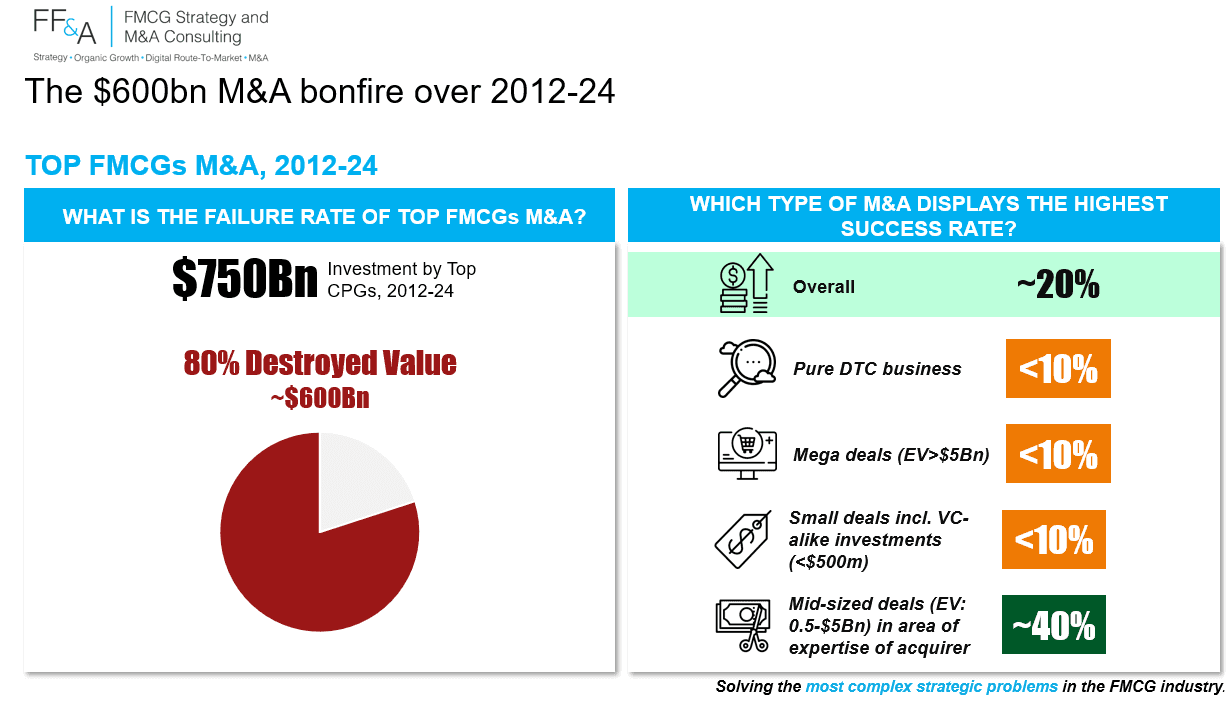
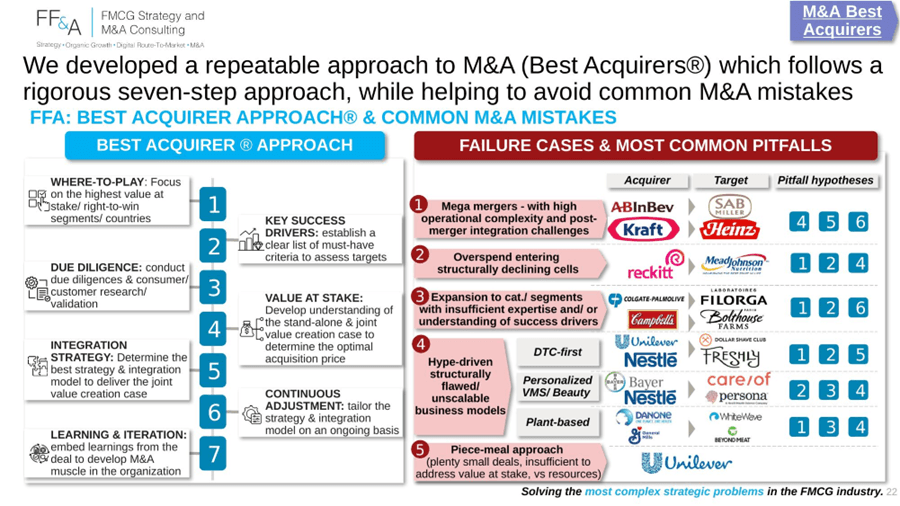
1) Only ~20% of FMCG M&A $ Spent Over 2012-24 Created Value (the $600bn M&A Bonfire): introducing FF&A’s Best Acquirers® to fix what’s broken
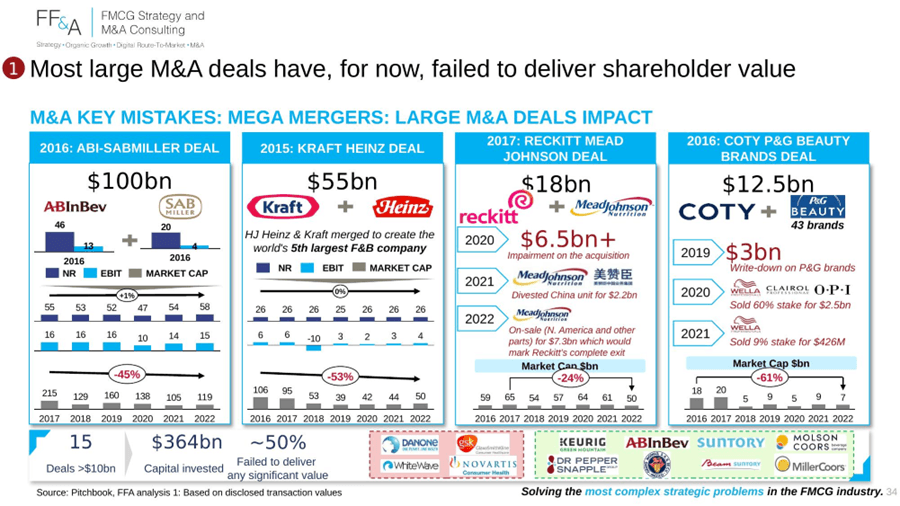
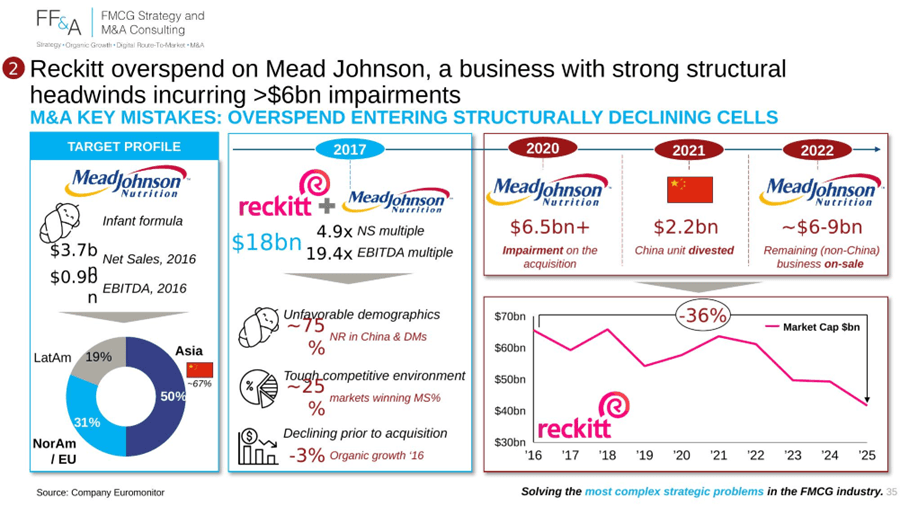
More on the why behind the $600bn M&A bonfire & how to fix it in our last publication below:
2) M&A is Back Driven By Mid-Size Growth Assets, But Value Destruction Looms: 183 deals in 2016, 37 in 2023, 50 in 2025 — the imperative for precision has never been higher
The resurgence of M&A in FMCG is undeniable. But without surgical precision, it’s a high-stakes gamble with proven destructive potential.
Looking at M&A activity among the world’s 60+ largest public FMCG companies (FFA Index; >$2Bn NR) over the last decade (2016–2025), the trajectory is striking. From a peak of 183 deals & an average deal size of ~$2Bn in 2016 (with 16 transactions above $1Bn in a single year), activity contracted sharply. By 2020, deal count had dropped to 71, average deal size to $302m. The COVID period, Kraft-Heinz’s $15Bn write-down (Q4 2018) & the broader market punishment of acquirers created a prolonged freeze. Between 2020 & 2024, the industry was on the side-line — deal counts ranged from 37 to 129, average deal sizes from $230m to $421m. CEOs were cautious. Boards were hesitant. Balance sheets were accumulating dry powder.
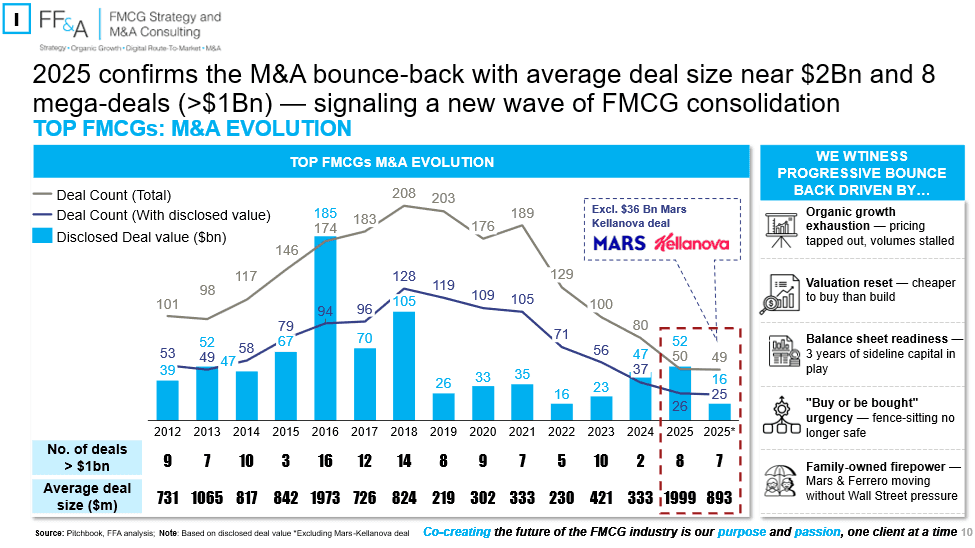
If we except the Mars-Kellanova mega deal, this bounce back continues to be driven by growth mid-size assets. The type of assets that have delivered the best ROCE over the last 20 years

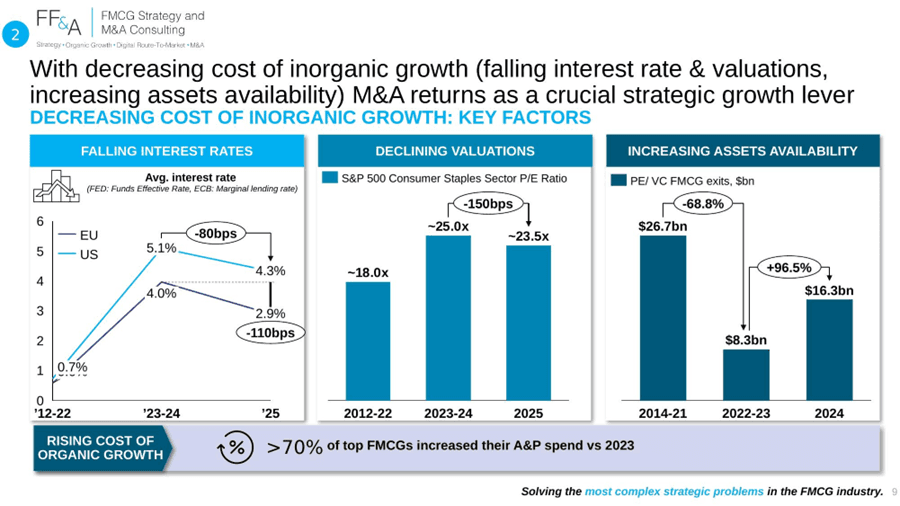
3) Increasing growth scarcity, the inversion of the cost of organic vs. inorganic growth & the specific strategic framework of some of the world largest private companies explain this acceleration
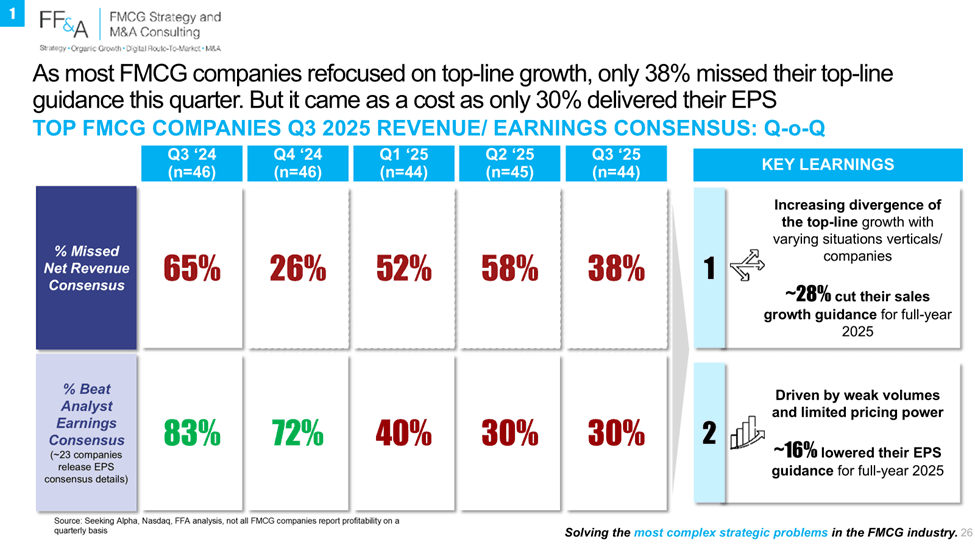
Organic growth exhaustion: Pricing has been tapped out. After 2–3 years of aggressive revenue management, volumes have stalled across most categories. The Q3 2025 data is unambiguous: 38% of the world’s largest listed FMCG companies missed NR consensus (n=44), only 30% met/ exceeded EPS expectations. The pressure has been building quarter after quarter — 65% missed in Q3 2024, 52% in Q1 2025, 58% in Q2 2025. ~28% cut their sales growth guidance for FY 2025. ~16% lowered their EPS guidance. Weak volumes & limited pricing power are the root cause
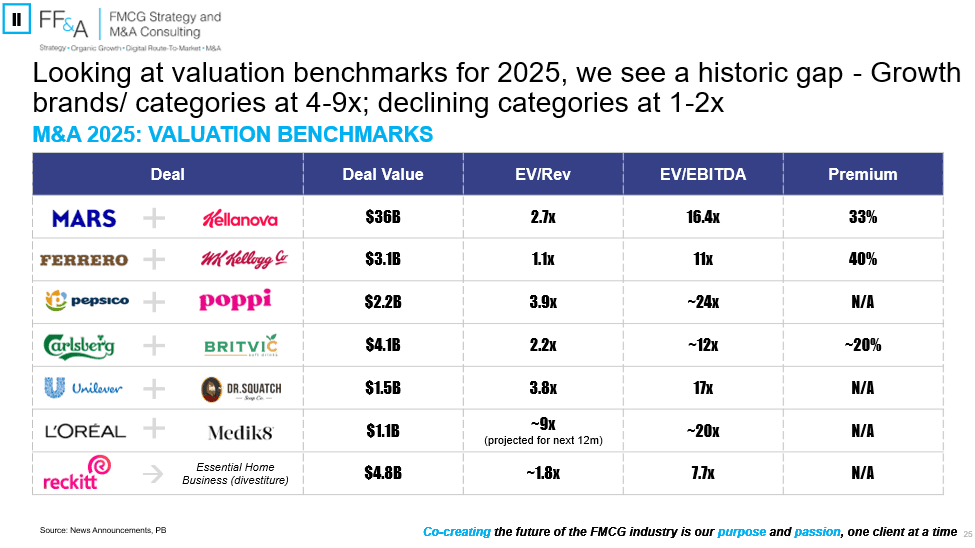
Valuation reset — cheaper to buy than build: Valuation benchmarks in 2025 reveal a historic gap. Growth brands/ categories command 4–9x EV/Revenue (Poppi at 3.9x, Medik8 at ~9x), while declining categories trade at 1–2x (WK Kellogg at 1.1x). When building a new brand from scratch costs more than acquiring an established one, the math favors M&A
Balance sheet readiness: Three years of sideline capital is now in play. Companies accumulated cash through pricing-driven margin expansion while deferring large transactions. The war chests are full.
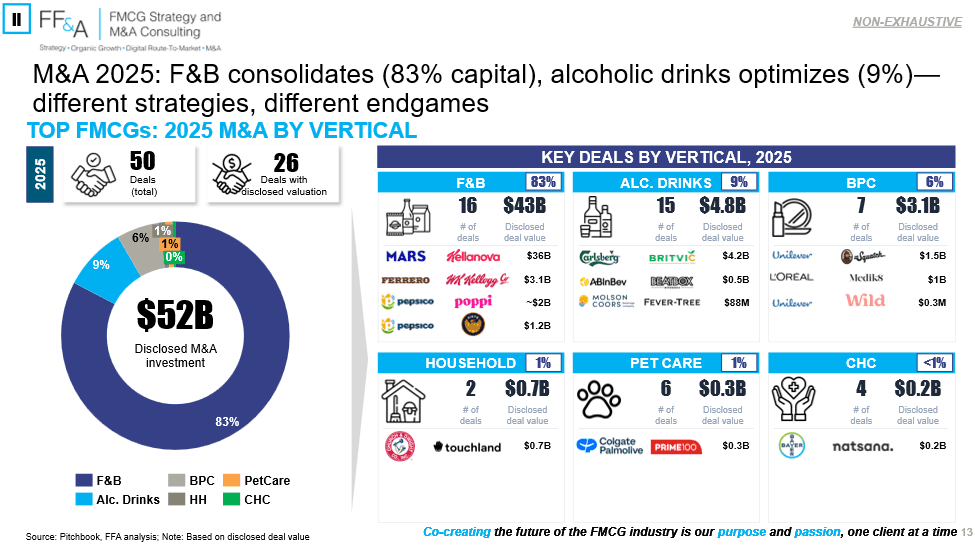
4) 2025 Confirms the Bounce-Back: 50 deals, $52Bn deployed, 8 mega-deals above $1Bn — F&B captures 83% of capital & Mars leads with $36Bn+
2025 marks the decisive turning point. 50 deals. $52Bn in disclosed M&A investment (excl. divestitures). 8 mega-deals above $1Bn. F&B dominated with 83% of M&A value, followed by alcoholic drinks (9%, ~$5bn) and Beauty Personal Care (6%, ~$3bn). Average deal size of $893m (excl. the $36Bn Mars-Kellanova transaction). After a decade of contraction, the M&A market has aggressively rebounded
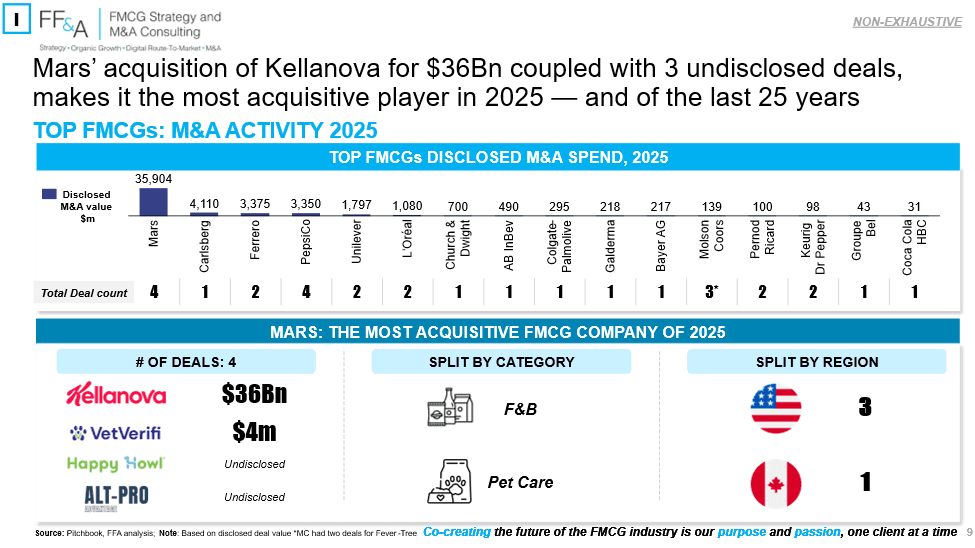
5) FMCG Mega-Deal: Mars + Kellanova at $36Bn — building the global snacking powerhouse
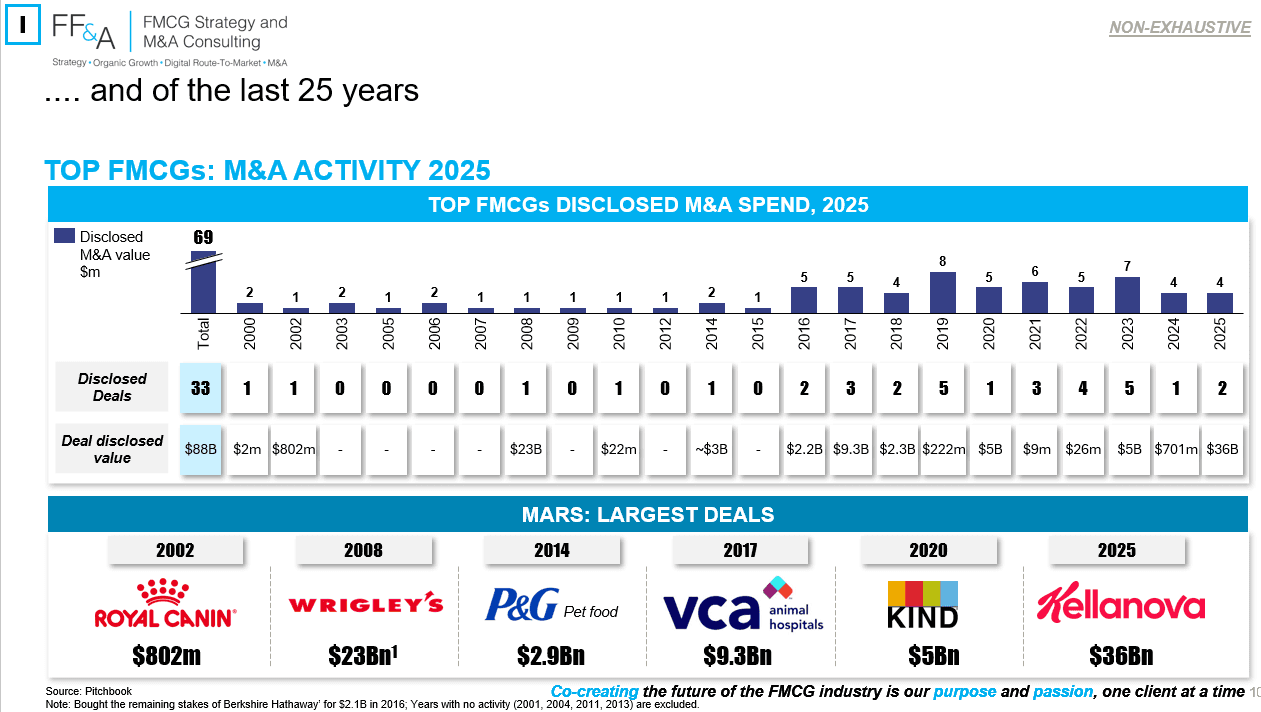
Mars $36Bn acquisition of Kellanova — announced August 2024, completed December 2025 — is a landmark FMCG mega-deal and the third-largest FMCG transaction, after the ABI-Sab miller in 2016 ($107Bn) and Kraft-Heinz merger ($46Bn) in 2015. It is also the defining deal of the 2025 M&A cycle & a case study in the strategic logic of the new era.
The strategic logic:
i) Building the global snacking powerhouse: Mars combines Kellanova’s Pringles, Cheez-It, Pop-Tarts & Eggo with its own confectionery portfolio (M&Ms, Snickers, Twix). The combined entity creates a daily consumption colossus spanning snacking, confectionery & breakfast.
ii) Occasion ownership, not category play: Mars is not buying market share in a single category — it is acquiring consumption occasions. Snacking. Breakfast. On-the-go. The bet is that owning the moment of consumption matters more than owning the shelf.
iii) Family-owned advantage: As a private company, Mars can pursue a long-term integration horizon without quarterly earnings pressure. No activist investors. No share price volatility. No pressure to cut costs to offset acquisition premiums in year one.
iv) Valuation — full price for scale: Mars paid 2.66x EV/Revenue, 16.4x EV/EBITDA & a 44% premium. Full price — but for a unique, scaled asset with global distribution.
Mars' broader 2025 M&A activity: Beyond Kellanova, Mars completed three additional acquisitions — including deals in Pet Care (a $4m tech-enabled vet services acquisition) & two undisclosed F&B transactions. With 4 deals in total & $36Bn+ in disclosed spend, Mars was the most acquisitive FMCG company of the year across both deal count & disclosed value — and arguably of the last 25 years. Since 2000, Mars has deployed an estimated ~$80Bn+ in cumulative disclosed M&A spend (incl. Wrigley at $23Bn, VCA at $9.1Bn, Kind at $5Bn & Kellanova at $36Bn), making it the most acquisitive family-owned FMCG company in history by disclosed deal value
The question: Can Mars — historically a confectionery & petcare company — successfully integrate a $36Bn salty snack & breakfast asset? The history of FMCG mega-deals would suggest caution. But Mars’ private ownership structure, long-term orientation & the unique growth potential of Kellanova may make this the exception. Definitely a space to watch
More on the Kellanova deal:
6) Strategic Clarity Drives Success: six verticals, six distinct M&A playbooks — from F&B’s occasion ownership to BPC’s premium value propositions
The most successful acquirers in 2025 demonstrated laser-focused strategies, making fewer, higher-impact bets. Across verticals, the common thread is strategic intent. These deals are not just about market share; they’re about owning emerging categories, gaining control of route-to-market & future-proofing portfolios.
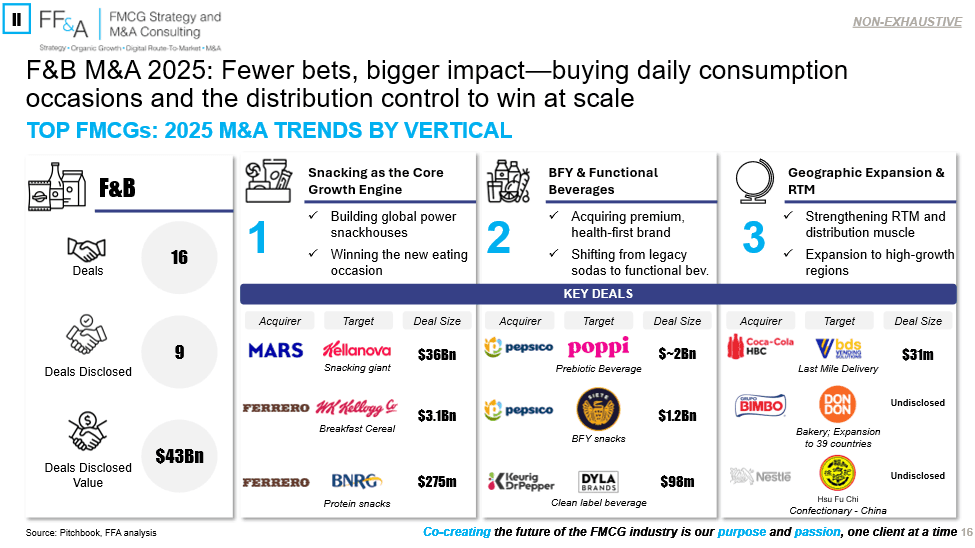
F&B — Fewer bets, bigger impact. Three themes: i) snacking as the core growth engine (Mars-Kellanova, Ferrero-WK Kellogg), ii) better-for-you & functional beverages (PepsiCo-Poppi) & iii) geographic expansion for route-to-market control (Grupo Bimbo acquiring last-mile delivery assets, expanding to 39 countries). The pattern: acquire the eating/ drinking occasion, not just the category.
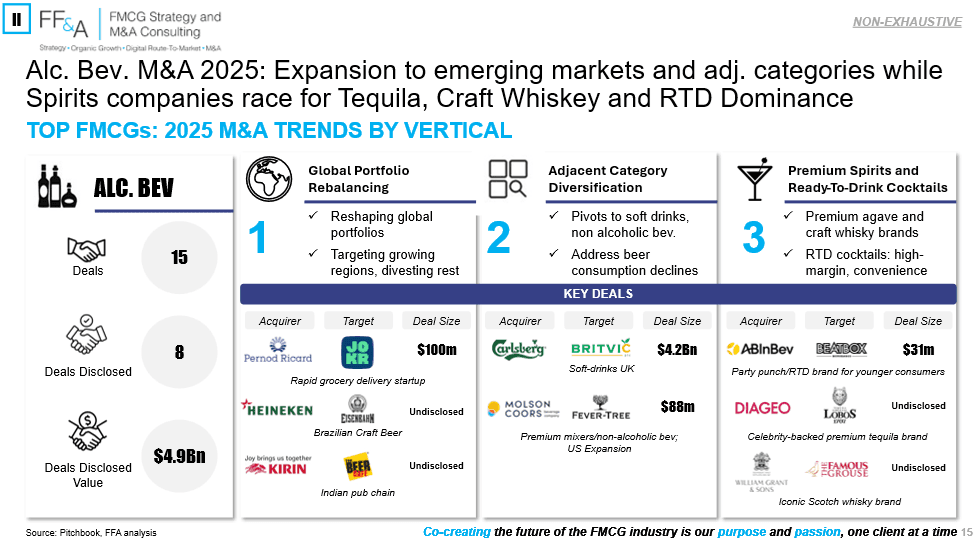
Alcoholic Drinks — Portfolio rebalancing, not consolidation. Three moves: i) global portfolio rebalancing — reshaping portfolios across geographies, targeting growing regions while divesting the rest, ii) adjacent category diversification — Carlsberg bought Britvic to become a multi-beverage platform beyond beer while gaining GTM scale in a priority market (UK) & iii) premium spirits & RTD cocktails — acquiring celebrity-backed tequila brands, craft whiskey & high-margin RTD lines for younger consumers.
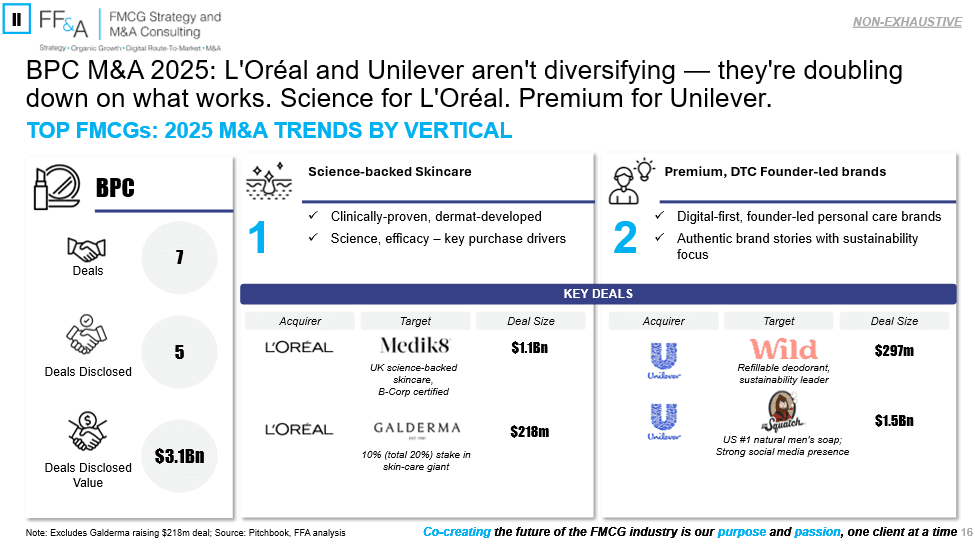
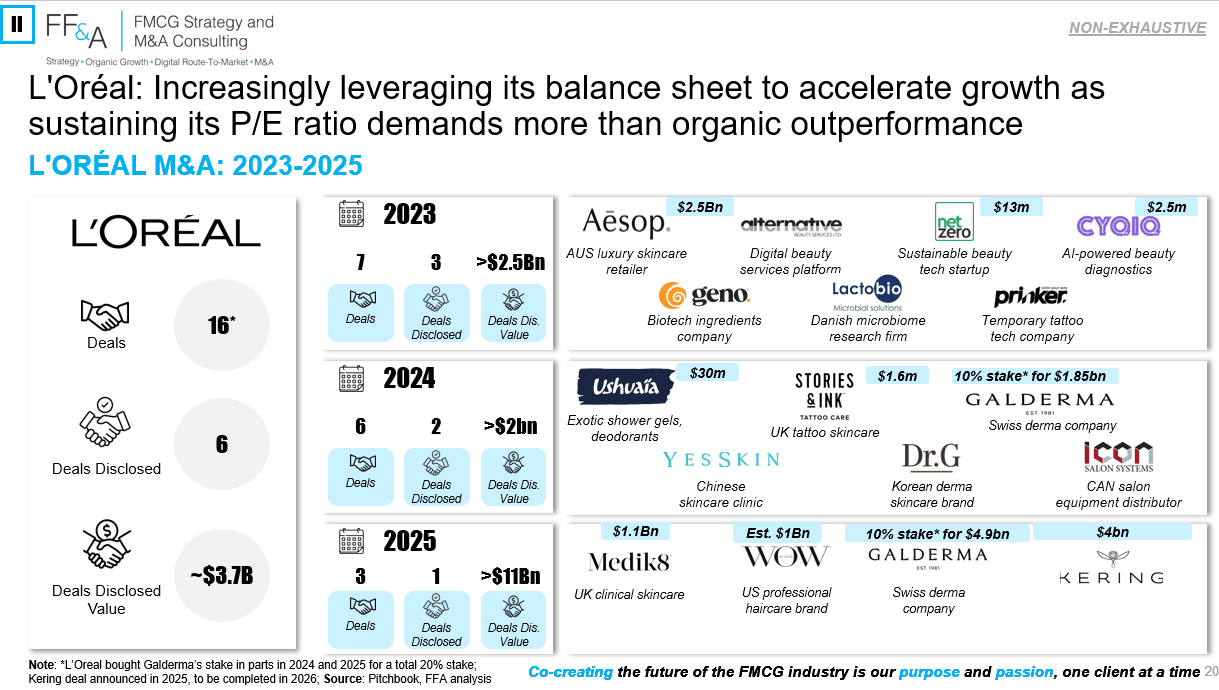
BPC — Two players, two clear strategies. L'Oréal reinforced its science moat with Medik8 ($1.1Bn) and Galderma ($218m) in skincare, while expanding into professional haircare with ColourWow. Unilever's play was different but equally deliberate: Wild ($297m) and Dr. Squatch ($1.5Bn) to close a premium personal care portfolio gap it couldn't build organically.
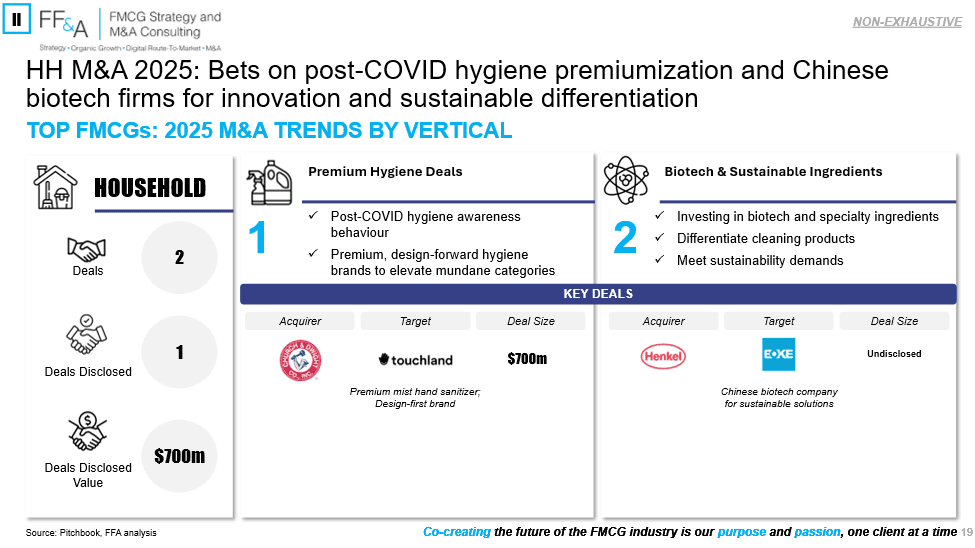
Household — Premiumization of the mundane. Limited deal flow, but two clear themes: i) premium hygiene deals driven by post-COVID awareness behaviour & ii) biotech/ sustainable ingredients — investing in Chinese biotech firms to differentiate cleaning products & meet sustainability demands.
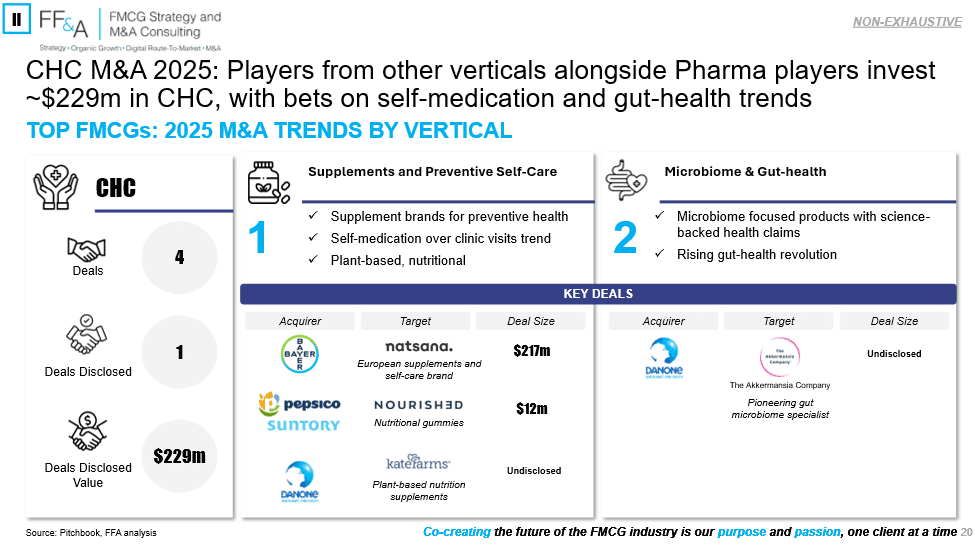
CHC — The convergence play. CHC M&A in 2025 (~$229m) centered on two themes: i) supplements & preventive self-care & ii) microbiome/ gut-health specialists with science-backed health claims. Players from adjacent verticals (not just pharma) are investing. The Kimberly-Clark–Kenvue announcement ($49Bn), if completed, would be the largest cross-vertical M&A play in FMCG history.
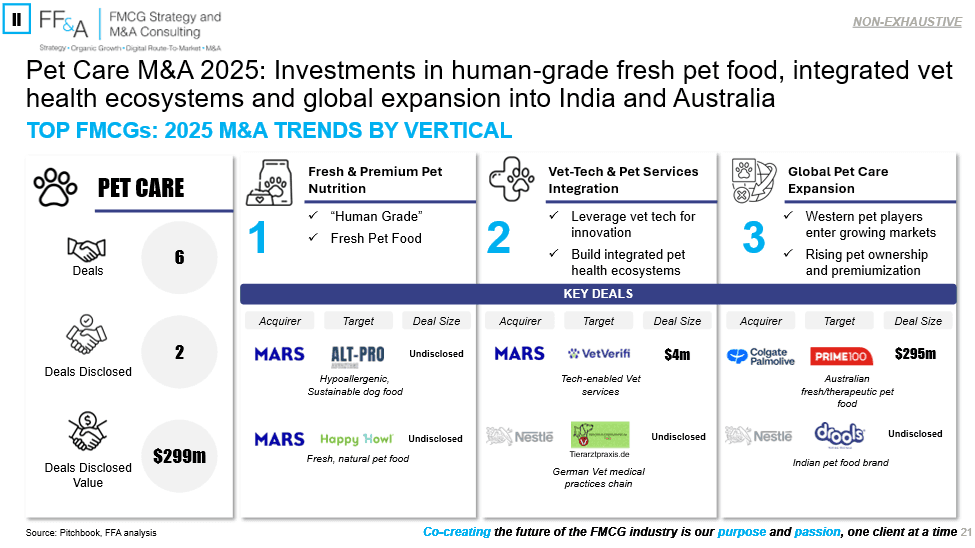
Pet Care — Humanization continues. Three themes: i) fresh & premium pet nutrition (‘human-grade’, hypoallergenic, sustainable dog food), ii) vet-tech & pet services integration — Mars acquiring tech-enabled vet services to build integrated pet health ecosystems & iii) global expansion into India & Australia reflecting rising pet ownership & premiumization in EMs.
7) 2025 Deals Reveal a Historic Valuation Gap: from Poppi at 3.9x to WK Kellogg at 1.1x highlighting the diverging valuation dynamic between growth and mature FMCG assets
Zooming-in now on the four other defining completed transactions of 2025:
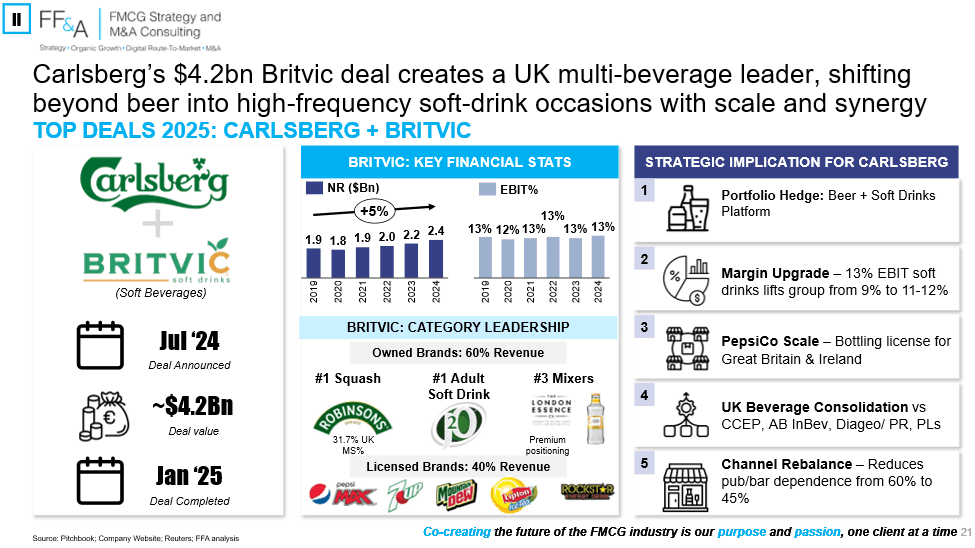
Carlsberg + Britvic ($4.2Bn): Creates a UK multi-beverage leader, diversifying beyond beer into high-frequency soft drink occasions. Britvic brings #1 UK Squash, #1 Adult Soft Drink & the Pepsi bottling license for Great Britain and Ireland. EBIT margin lifts from ~9% to 11–12%. Pub/ bar channel dependence drops from 60% to ~45%. The thesis: portfolio hedge — beer + soft drinks platform with margin upgrade & channel rebalance.
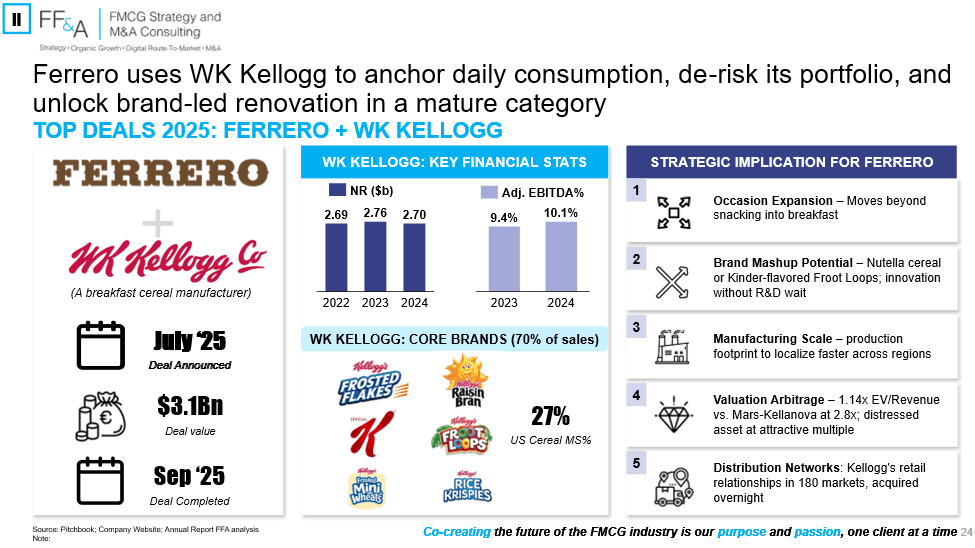
Ferrero + WK Kellogg ($3.1Bn): Ferrero acquired the #1 US breakfast cereal company (27% market share) at a distressed 1.1x EV/Revenue & 11x EV/EBITDA, paying a 40% premium — a deal that allows Ferrero to anchor daily consumption, de-risk its portfolio & unlock brand-led renovation in a mature category.
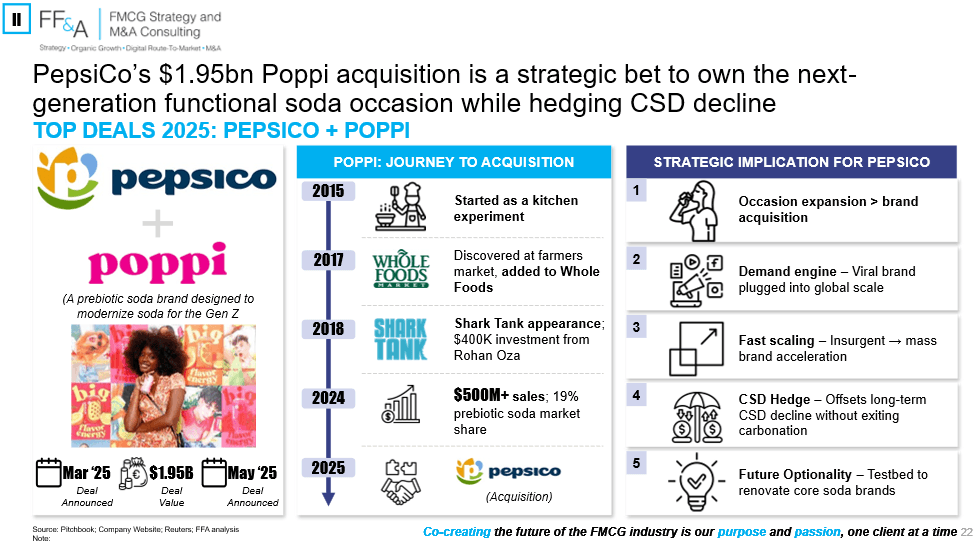
PepsiCo + Poppi ($1.95Bn): Started as a kitchen experiment in 2015, was discovered at a farmers market, appeared on Shark Tank ($400K investment from Rohan Oza) & reached ~$500M sales with 19% prebiotic soda market share by 2024. The deal gives PepsiCo a demand engine (viral brand plugged into global scale), fast scaling capability (insurgent to mass brand acceleration), a CSD hedge (offsets long-term CSD decline without exiting carbonation) & future optionality (a testbed to renovate core soda brands)
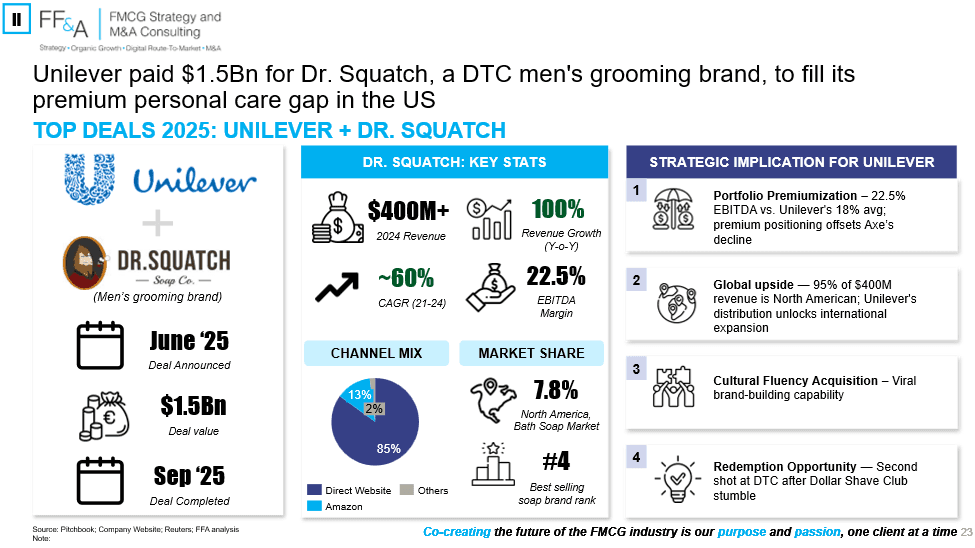
Unilever + Dr. Squatch ($1.5Bn): $1.5Bn for a DTC men's grooming brand to fill Unilever's premium personal care gap in the US — delivering portfolio premiumization (22.5% EBITDA vs. Unilever's 18%), a social-first playbook (85% DTC + first-party data), global upside (95% of $400M revenue is North American), cultural fluency & a redemption opportunity after the Dollar Shave Club stumble.
Kimberly-Clark + Kenvue ($49Bn): A significant diversification into high-margin consumer health, despite risks associated with integrating two underperforming assets. Kenvue’s stock is down ~40% since its IPO with significant litigation overhang. The $2.1Bn synergy target is ambitious.
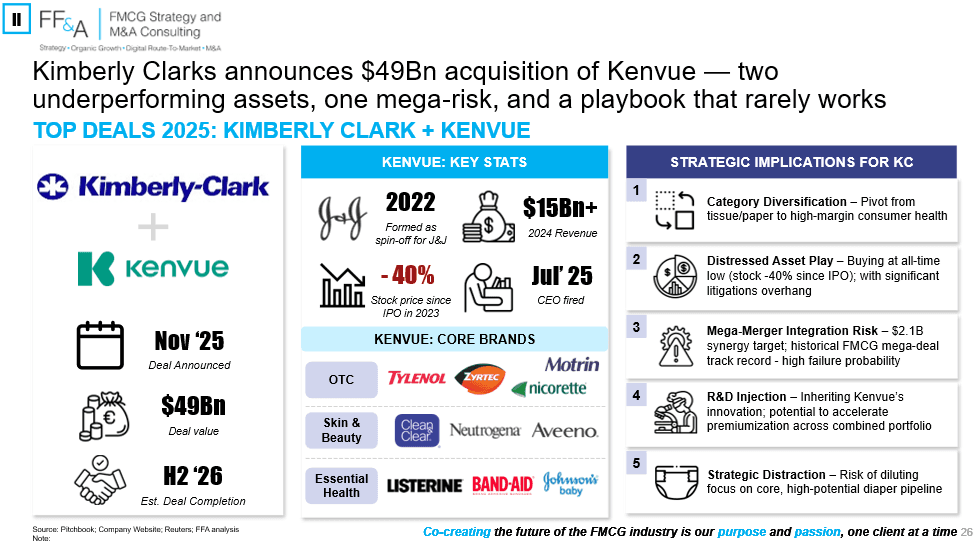
This mega-merger echoes historical FMCG mega-deal failures & carries a high failure probability. But KMB + Kenvue can beat the odds if they:
i) Don't let cost synergies become the strategy — Our Best Acquirers® payback analysis is clear: Top-performing acquirers (Diageo, L'Oréal, The Coca-Cola Company) maintained or increased brand investment post-close. Cost extraction without reinvestment is the #1 value destroyer
ii) Replicable approach to growth, differentiated execution — KMB's Powering Care not replicable to Kenvue. No PLs to exit, no mix game. Understand the unique success drivers of OTC, dermo, oral care, household — then build a consumer-back process across all of them
iii) Execute revenue synergies mindfully — KMB, strong in Asia whilst Kenvue, weak. Kenvue, strong in Europe and KMB, barely exists. Focus on the 10% of synergies that matter
iv) Design a growth-enabling operating model — L'Oréal grew 35 of 36 acquired brands as each division runs independently. Coty tried one model for 43 Procter & Gamble brands — $3bn write-down. The operating model must serve growth, not become a goal-seek for synergy commitments
v) Win the integration tempo — P&G-Merck Group CHC worked because they had genuine expertise and kept adjusting. Coty-P&G Beauty collapsed since integration was rigid and talent walked. The first 100 days set the tone
vi) Build a winning culture — KMB's DNA: Darwin Smith legacy, commercial execution, "last 3 feet" shelf discipline. Kenvue's DNA: J&J Credo, science credibility, HCP trust. The danger is defaulting to one — or creating a bureaucratic hybrid with neither KMB's speed nor Kenvue's depth
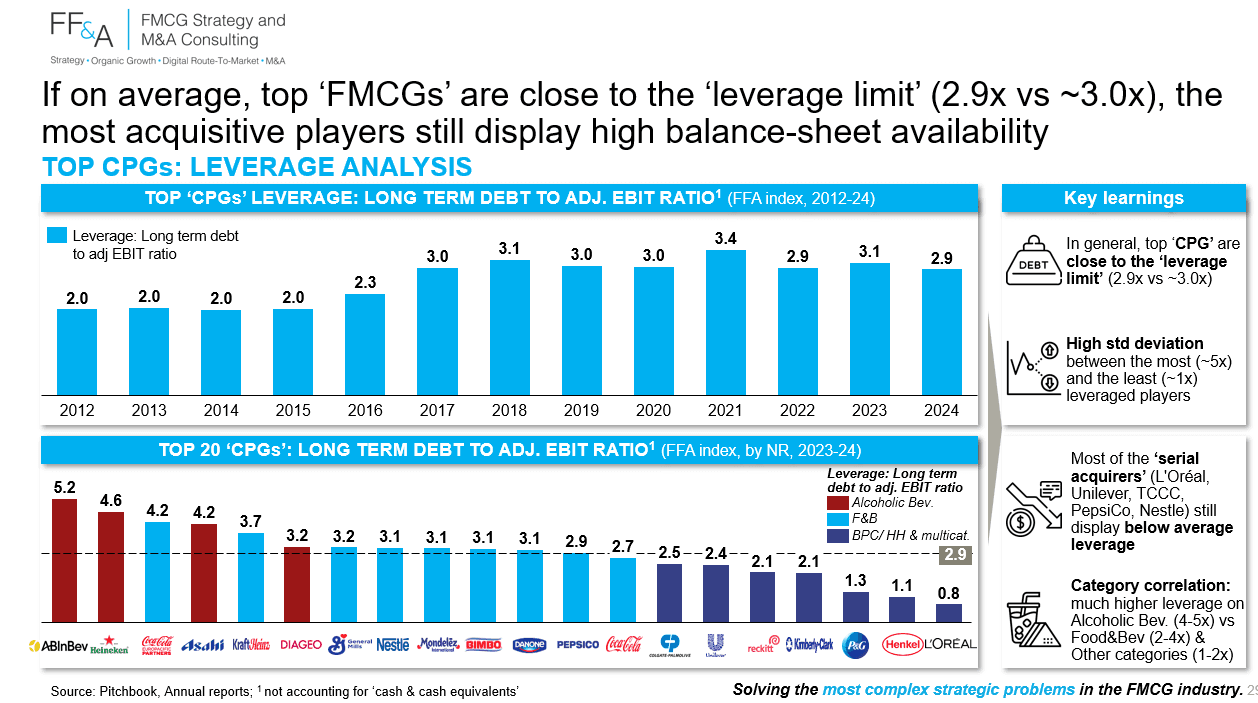
vii) Manage debt without starving the brands — Top FMCGs average ~2.9x leverage. Serial acquirers stay below that to protect brand investment. With ~$15B combined debt, going against the industry tide on A&P would signal cost-first, growth-second
8) Divestitures Matter as Much as Acquisitions: ~$9Bn in disclosed exits in 2025 — but 70% of deals went undisclosed with PE funds playing an increasingly important roles
While acquisitions captured the headlines in 2025, the sell side of the portfolio equation was equally active. FMCGs executed 50 divestitures totalling ~$9Bn in disclosed value. Only 15 had disclosed valuations — 70% were undisclosed, suggesting portfolio simplification is happening more broadly and more quietly than the headline numbers indicate.
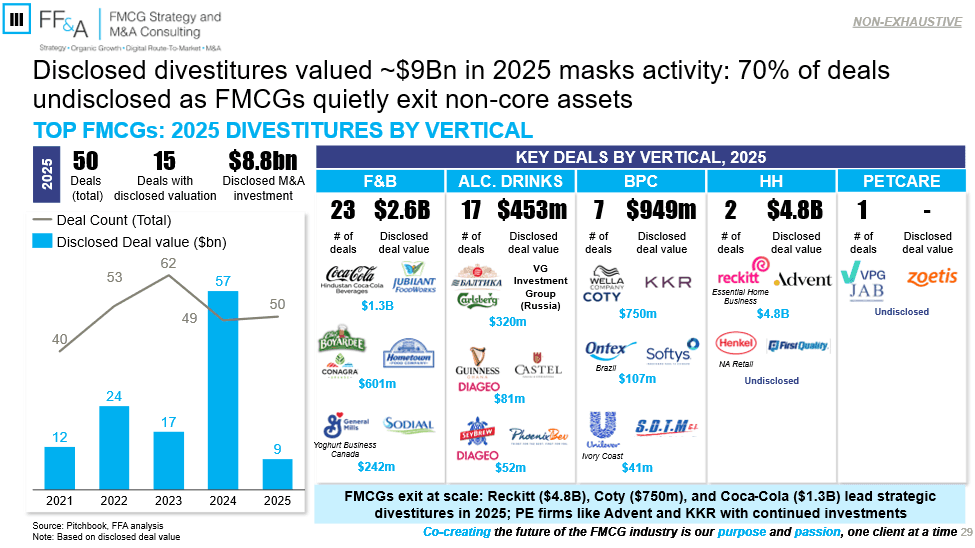
The three landmark announced divestitures of 2025:
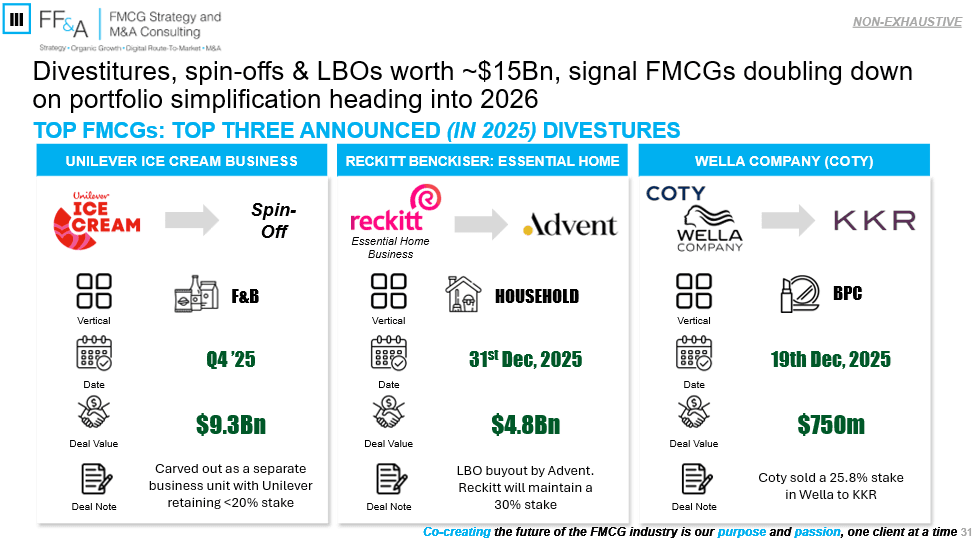
i) Reckitt — Essential Home ($4.8Bn): LBO buyout by Advent International, Reckitt maintaining 30% stake. The largest FMCG divestiture of the year, enabling Reckitt to sharpen its focus on Health & Hygiene
ii) Coty — Wella ($750m): Coty sold a 25.8% stake in Wella to KKR, continuing its strategic exit from mass beauty to concentrate on prestige
iii) Unilever — Ice Cream Business: Carved out as a separate business unit via spin-off, Unilever retaining <20% stake. Unilever’s most significant portfolio simplification move
PE firms as active counterparties: Advent & KKR continue to play both sides — acquiring non-core FMCG assets via LBOs (Advent taking Reckitt’s Essential Home) while also providing exit liquidity (KKR acquiring Coty’s Wella stake). Private equity provides the essential infrastructure for FMCG portfolio reshaping
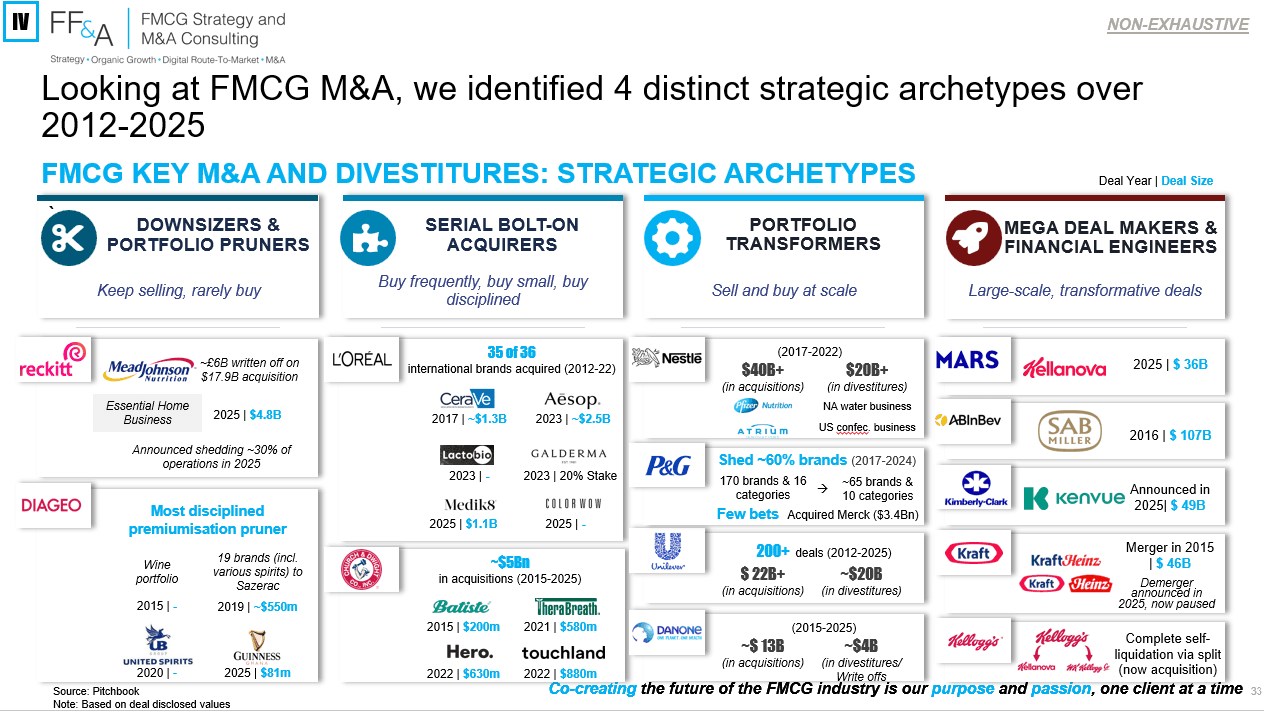
9) Four Strategic Archetypes Define FMCG M&A: every CEO is making a portfolio choice — each with a different risk-reward profile
Looking at FMCG M&A historically, we see 4 distinct strategic playbooks — each carrying a very different risk-reward profile:
i) Serial Bolt-On Acquirers. Buy small, buy often, buy disciplined. L'Oréal is the gold standard — three deals in 2025 alone (Medik8, Galderma, ColourWow) and two decades of surgical portfolio additions behind it. No mega-deals. No integration trauma. Just relentless category deepening that compounds over time.
ii) Downsizers. These are the net sellers — companies that keep pruning and rarely acquire. Reckitt has defined this posture over the last five years, culminating in the $4.8Bn Essential Home exit. Coty and Diageo follow the same logic. The thesis is simple: pruning unlocks focus, and focus drives outperformance.
iii) Portfolio Transformers. They sell and buy at scale — reshaping the entire portfolio. This is the highest-stakes archetype with the widest spread of outcomes. P&G (2017–2024) is the success story: sold ~10% of the company, acquired selectively, delivered sustained value creation. Nestlé is the cautionary tale: divested ~$20Bn, acquired ~$20Bn, now writing off billions. Unilever and Henkel are both mid-journey — each having divested ~10% of net revenue equivalent while making bolt-on acquisitions. The jury is still out.
iv) Mega Dealmakers & Financial Engineers. These are the transformative, bet-the-company moves. Mars deployed $36Bn+ in 2025 alone. Kimberly-Clark announced a $49Bn merger with Kenvue. Ferrero acquired WK Kellogg for $3.1Bn. The line between visionary deal-making and financial engineering is thin — and only time will tell which side these bets fall on.
Companies with clarity on their playbook and the discipline to stay the course create value. Those stuck in the middle, oscillating between postures without conviction, destroy it.
10) M&A Will Accelerate Over 2026-30 (growth underperformance, organic vs. inorganic growth cost inversion) but without discipline, the next cycle will be a bonfire
The evidence is unambiguous:
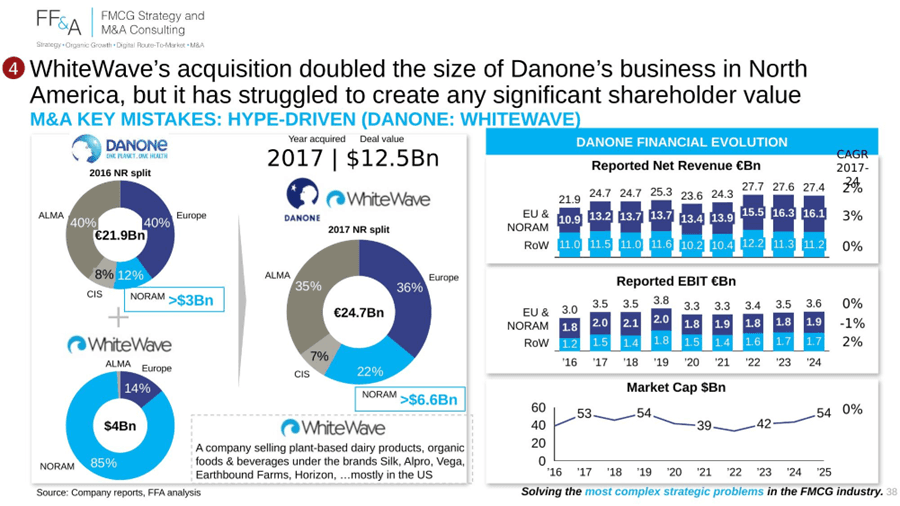
i) Scale deal without a robust growth outperformance playbook failed (cf. Kraft-Heinz, ABI-SabMiller, Reckitt-MJ)
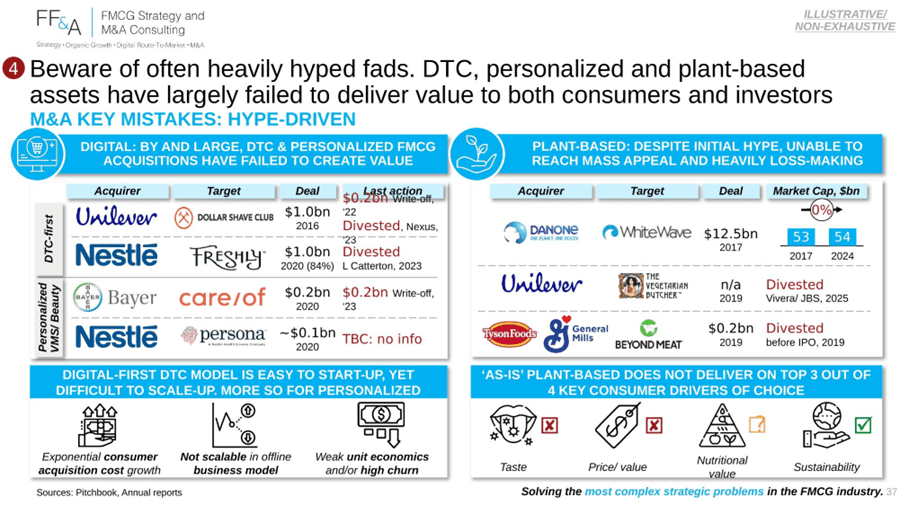
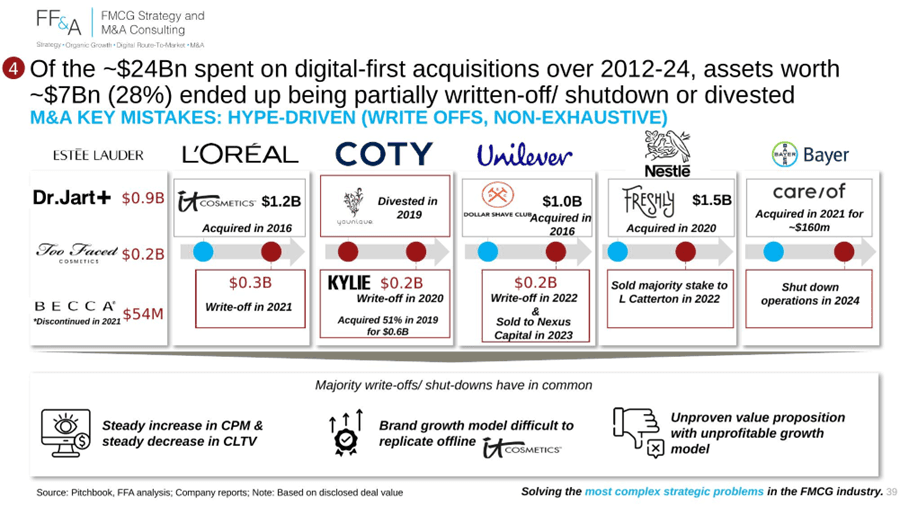
ii) Small deals without mass penetration potential & scalable growth model failed (cf. the myriad of digital assets acquired & written-off/ divested)
iii) Winners are not doing more deals; they are doing fewer, better ones.
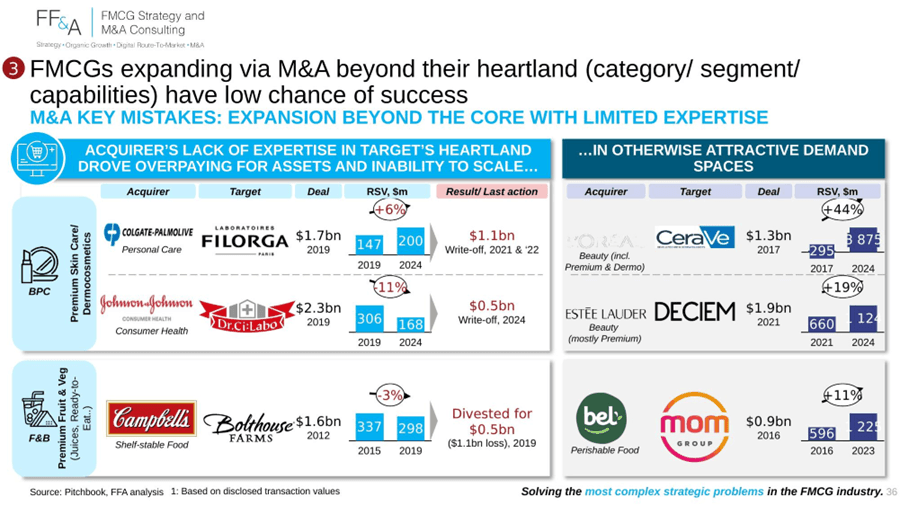
Most strategic M&A mistakes stem from five main drivers (cost synergies driven megadeals, entering structurally declining categories, expansion in categories with insufficient expertise, assets with unscalable growth models, diluting resources across too many small deals)
We have developed a repeatable Best Acquirer Approach® — a rigorous seven-step framework to avoid common M&A pitfalls & ensure successful deal outcomes. The framework covers: strategic clarity on where to play, target identification & screening, valuation discipline, integration design, capability building, post-merger value creation & portfolio architecture.
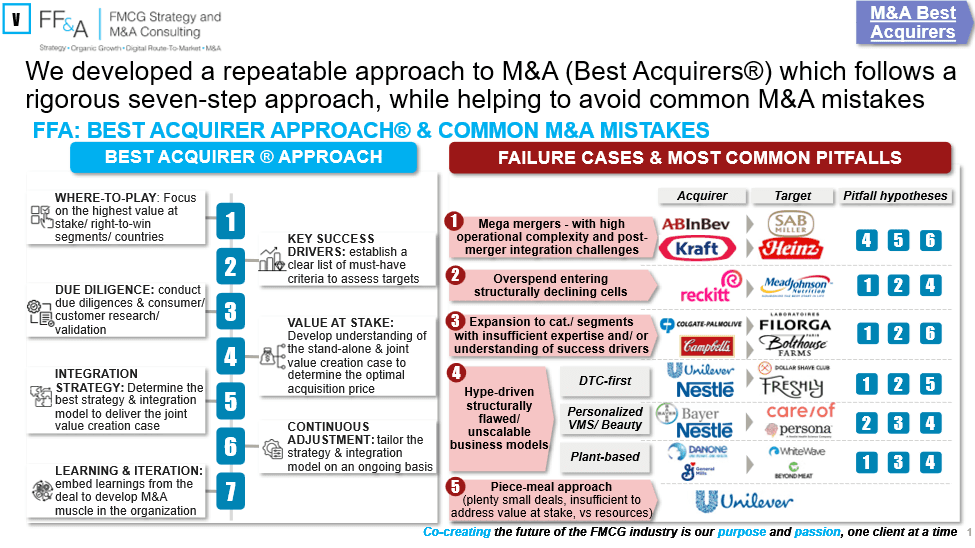
And it all starts with picking the right assets:
i) Target high value-at-stake opportunities with scalable growth model — structurally attractive segments with accretive growth. Not declining categories or hyped niches with broken economics
ii) Have a clear right to win — genuine category expertise & scale advantages they can actually deploy to create value post-acquisition
iii) Target the $0.5–5Bn EV sweet spot — deals large enough to move the needle/ have demonstrated track record but small enough/ with enough scale-up runaway to integrate without organizational trauma, maximizing ROCE while containing risk
More on our view views in our last M&A publication:
Bringing it all together:
We expect M&A to continue its bounce-back in 2026:
i) Mid-sized, scale transactions ($0.5–5Bn) will continue to deliver the highest ROI. Our research consistently shows that mid-sized deals in existing/ similar categories — not mega-deals — are where value is created.
ii) Emerging Markets will be the next battleground. Over 70% of global FMCG share of growth over 2026-30 sits in EMs, yet the world’s largest FMCG companies remain structurally under-represented. M&A is the fastest path to closing this gap, especially in markets with local scale like India
iii) Divestitures & spin-offs will continue. The Kellogg's & Unilever playbooks will be replicated. Portfolio simplification is no longer optional — it is a prerequisite for focused growth
iv) Cross-vertical M&A will increase. The Kimberly-Clark–Kenvue announcement signals a new pattern
v) Private equity will remain an active stakeholder on both ends. Advent, KKR & other PE firms are both sellers & buyers.
The excess of undisciplined M&A doomed many companies in the 2012–2024 period. We need to learn from the last decade mistakes. Otherwise, another M&A bonfire is ahead of us
As Warren Buffet wrote: ‘Be fearful when others are greedy, and be greedy when others are fearful’
Exciting times
Source: Pitchbook, FFA Analysis. FFA Index Top 60+ FMCGs (>$2Bn NR). Analysis based on disclosed deal values. Pharma deals excluded.
To join the >64,000 FMCG executives that follow Frederic on LinkedIn: linkedin.com/in/fredericfernandez
To start a conversation: frederic@fredericfernandezassociates.com
To join the ~38,000 FMCG executives that receive our newsletter: https://www.linkedin.com/newsletters/7045696201089785857/
𝗔𝗯𝗼𝘂𝘁 𝘂𝘀:
FF&A solves the most complex strategic problems of the world largest FMCG companies across:
Corporate Strategy
Organic Growth (cf. our proprietary Zero-Based-Growth® - https://lnkd.in/eWQEmcK3)-
Small Brands Growth (cf. our proprietary approach How Small Brands Grow ® - https://lnkd.in/eyp3Baq5)
Digital RTM (Ecommerce - cf. our proprietary Ecommerce 2.0® - https://lnkd.in/e4-Q69Fi, DTC and EB2B)
M&A (cf. our proprietary approach Best Acquirers® - https://www.linkedin.com/pulse/fmcg-ceos-600bn-ma-bonfire-what-world-largest-get-wrong-fernandez-szrle/?trackingId=jmia3w6tSFKtLCfxrZuI3g%3D%3D)
14 out of the top 20 world largest FMCG companies are repeat Clients
More on FF&A at: www.fredericfernandezassociates.com
No FFA employees own any stocks or financial instruments of any FMCG companies or companies mentioned in the above article. All the above information are public information.
Enjoyed this article?

FMCG CEOs: Managing For Growth
Strategic insights for FMCG/ CPG CEOs