
Corporate Strategy
FMCG CEOs: Q1 2026 Results In Review - The End Of The Beginning?

Author | Managing Director & Partner @ FFA
'Now this is not the end. It is not even the beginning of the end. But it is, perhaps, the end of the beginning' — Winston Churchill
To join the ~42,000 FMCG executives that receive automatically all our FMCG CEOs Insights (publications like this one), sign-up to our newsletter at the following link: https://www.linkedin.com/newsletters/7045696201089785857/
Churchill pronounced those words on November 10th 1942, at the Lord Mayor's Luncheon at the Mansion House in London. It came just after the British victory at the Second Battle of El Alamein in North Africa — the first major Allied land victory of the war — which is the context for the line: the war was far from over, but the tide had finally begun to turn
Q1 2026 was a bit like El Alamein for the world largest listed FMCG companies: a won battle for many after many lost over the last years while the structural challenges (cf. 2025 Results In Review publication) remain or could well worsen driven by the sustained war in Iran & the corresponding consequences. Let us explain:
Q1 2026 showed material improvement for the world largest listed FMCG companies (n=42 this quarter) with a majority beating top- & bottom-line consensus. An unseen development since 2023
Q1 2026 average revenue growth reached 4% (+1.6% volume/ +2.4% pricing), nearly tripled vs. Q1 2025 (+1.4%). If it shows an increasingly more balanced algo in line with long-term FMCG trends, we should highlight that Q1 2025 was the easiest comp of the year (Q2-Q3-Q4 2025 all came out at >2.5% growth, so a >110 bps gap)
Yet, 29% of those 42 companies saw volume decline in Q1 2026, especially on CHC (80%) and on Alcoholic Drinks (40%)
50% of the top FMCGs that report EBIT% on a quarterly basis saw EBIT% decline YoY with 57% that still trade below pre-COVID margins six years on
If on average market cap of the world largest listed FMCG companies bounced back since the beginning of the year (+5% vs. a S&P500 at +10%), the gap between Winners & Losers within each vertical keep widening
Net, it is a positive start of the year but the easy comp, coupled with the challenging profitability picture, the increasing gap between Winners & Losers and the uncertain geopolitical/ macro-economic outlook all call for prudence and sustained focus on:
Organic growth/ volume (cf. Zero-Based-Growth®)
Key growth engines (for most: Ecom - cf. Ecommerce 2.0®, Emerging Markets, premiumization)
Bolt-on complementary M&A (cf. Best Acquirers®)
As usual, here is our detailed views in 19 key messages/ 50+ charts:
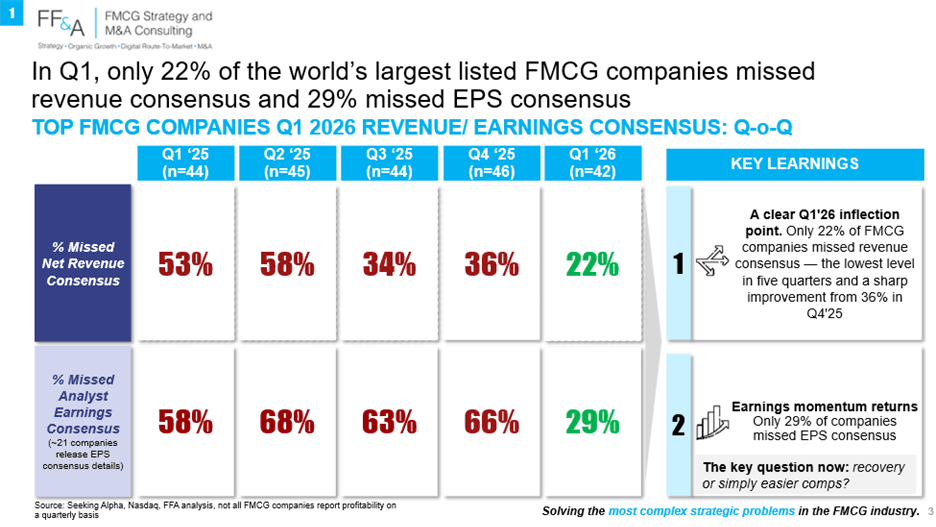
1) A clear Q1'26 inflection
Only 22% of FMCGs missed revenue consensus (vs 53% in Q1'25, the lowest miss-rate in 5 quarters)
Only 29% missed EPS consensus (vs 66% in Q4'25)
2) Volume is finally bouncing-back
Pricing has collapsed from 12.3% in Q1'23 to 2.4% in Q1'26 — back to pre-COVID norms
Volume is back at +1.6% (vs -0.3% in Q1'25)
This is the single most important structural shift in the industry since 2021
Q1 2025 was arguably the easiest comp of the year with Q2-Q3-Q4 2025 with growth >110bps higher than Q1 2025
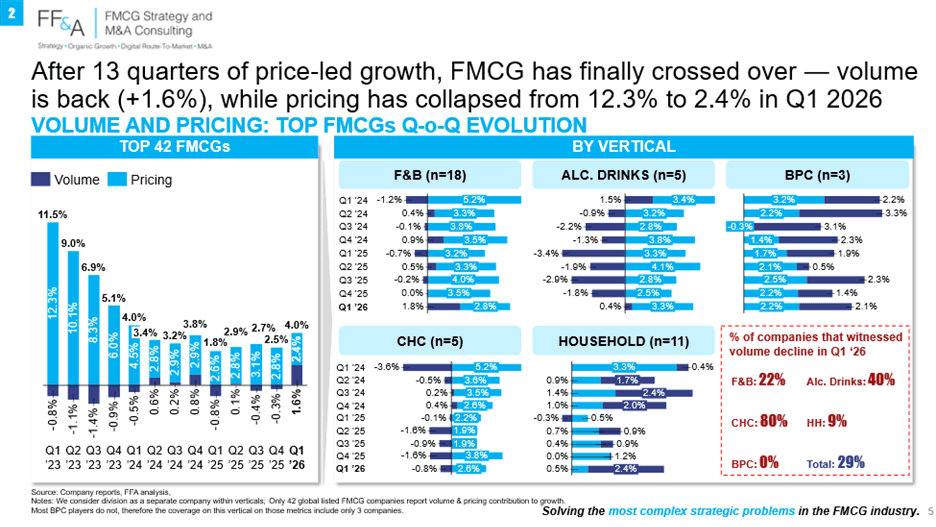
3) Volumes revived in Q1'26 across most FMCGs (71%), but the +1.6% aggregate masks a widening gap between Winners & Losers
Nearly 29% of top FMCG players still saw declining volumes, including Heineken, Kenvue, Mondelez, Kraft Heinz, General Mills, Campbell's, Ontex and Reckitt Health
The pressure remains concentrated in three verticals: CHC (80% declining), Alcoholic Drinks (40%) and US-centric Food & Beverage players (22%)
4) Profitability recovery remains elusive
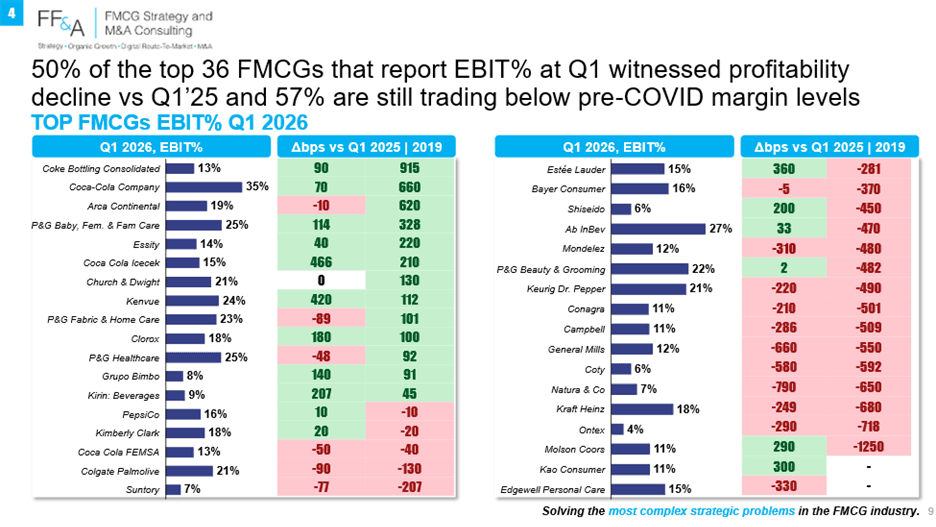
50% of the top 36 reporting FMCGs saw EBIT% decline YoY
57% still trade below pre-COVID margins six years on
Coca-Cola Company (35% EBIT, +660bps vs 2019) & most of its bottlers continue to outperform
Molson Coors (-1250bps), Ontex (-718bps) & Kraft Heinz (-680bps) are the structural laggards
5) FMCG market cap up just ~5% in Q1'26, half the S&P 500's +10%
The market cap of the world largest listed FMCG companies finally bounced back in Q1 2026 (+5%), yet ~65% of the top 51 FMCGs lost market cap
The biggest losses: Unilever (-$22Bn), Estée Lauder (-$12Bn), Reckitt (-$10Bn), L'Oréal (-$9Bn), Diageo & Danone (-$7Bn each), Beiersdorf (-$5Bn)
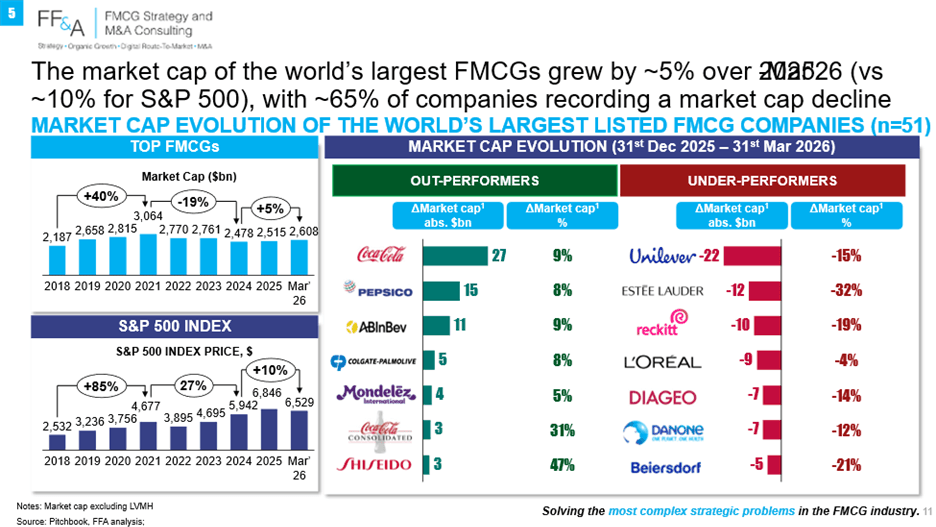
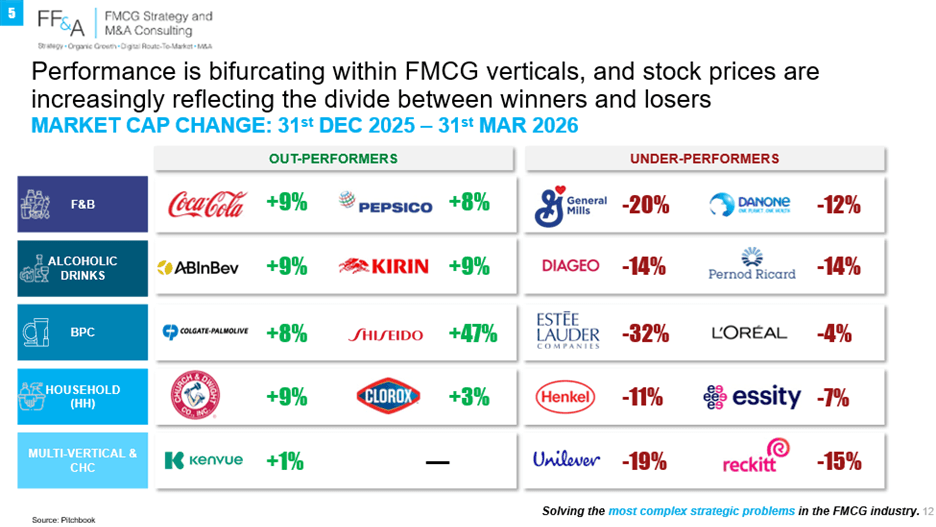
The standard deviation in stock price performance within each FMCG vertical remains across all verticals
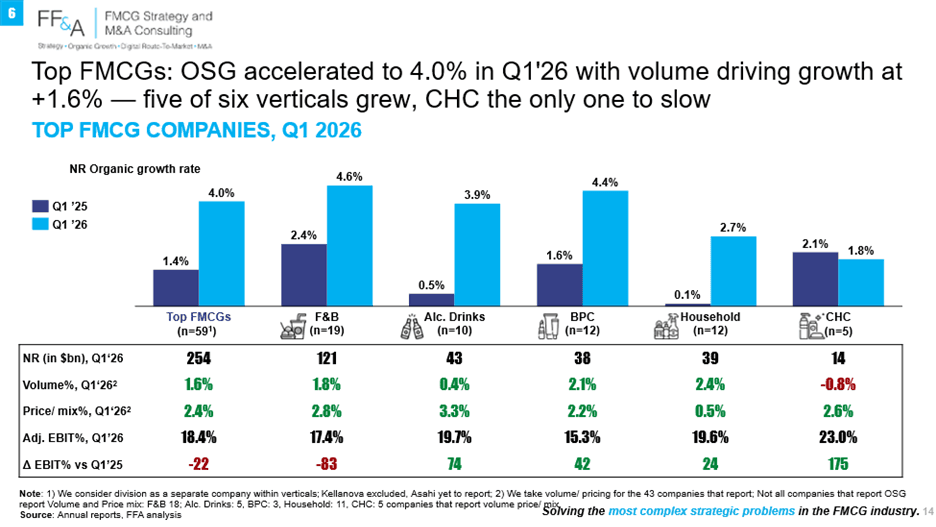
6) Organic Sales Growth nearly tripled YoY to +4.0% (vs +1.4%), volume-led across 5 of 6 verticals
F&B led at +4.6%, followed by BPC (+4.4%), Alc. Drinks (+3.9%) & Household (+2.7%)
CHC was the lone laggard, decelerating from +2.1% to +1.8%
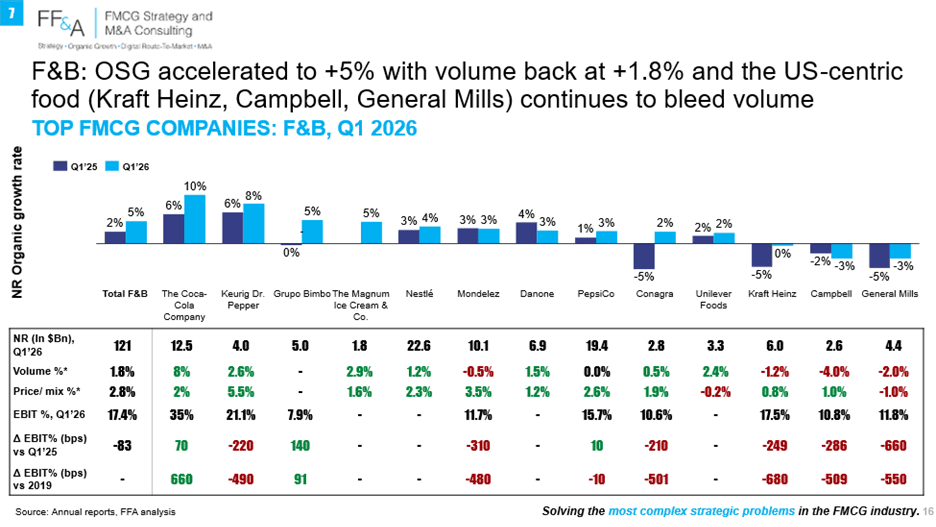
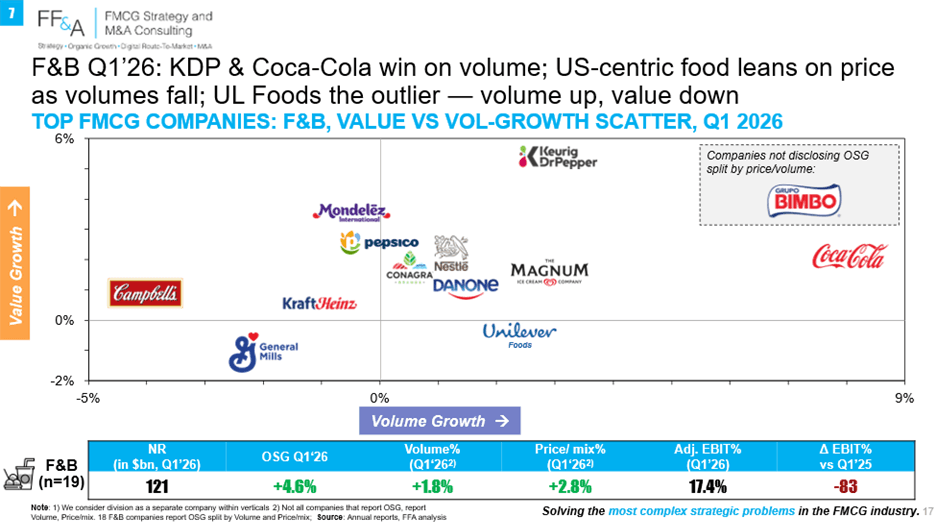
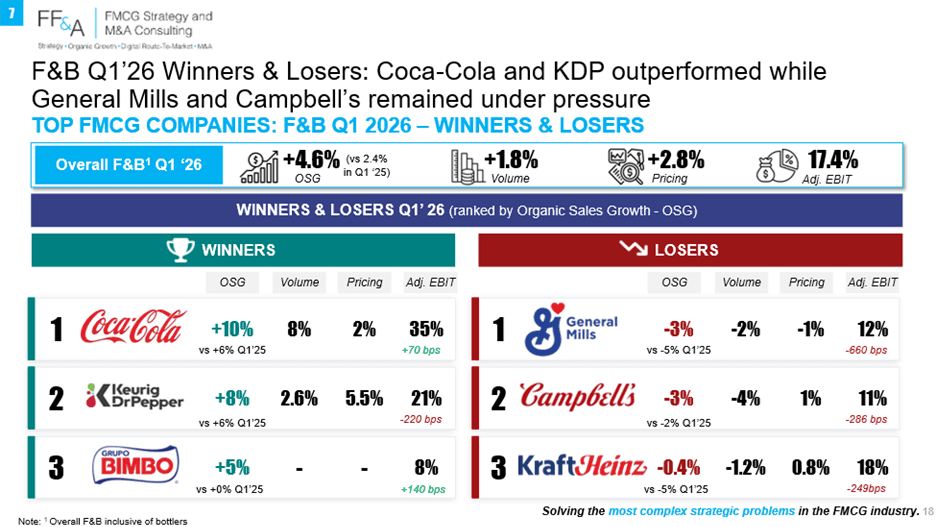
7) F&B: Beverages continue to win while US-centric food companies continue to bleed
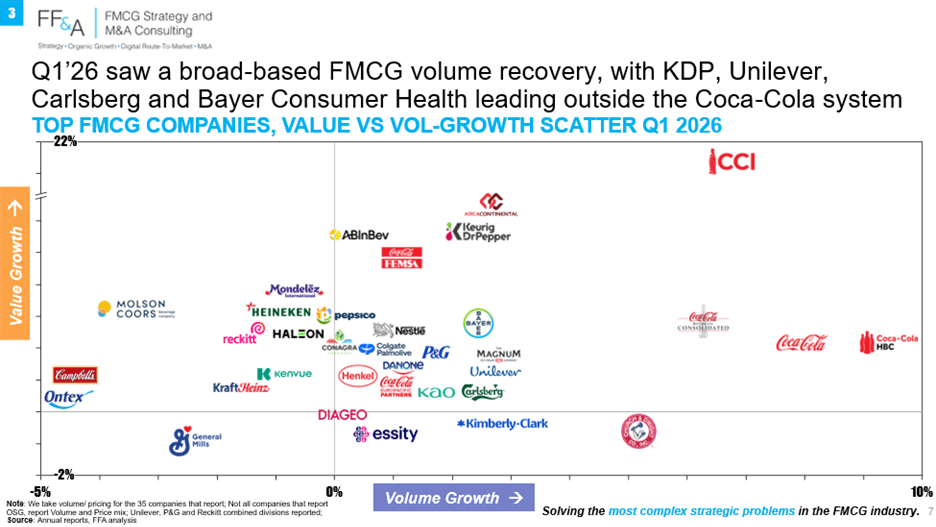
The Coca-Cola Company (+10%) & Keurig Dr Pepper (+8%) lead the rebound
Kraft Heinz (0%), Campbell (-2%) & General Mills (-3%) keep losing volume (-1.2%, -4.0%, -2.0% respectively)
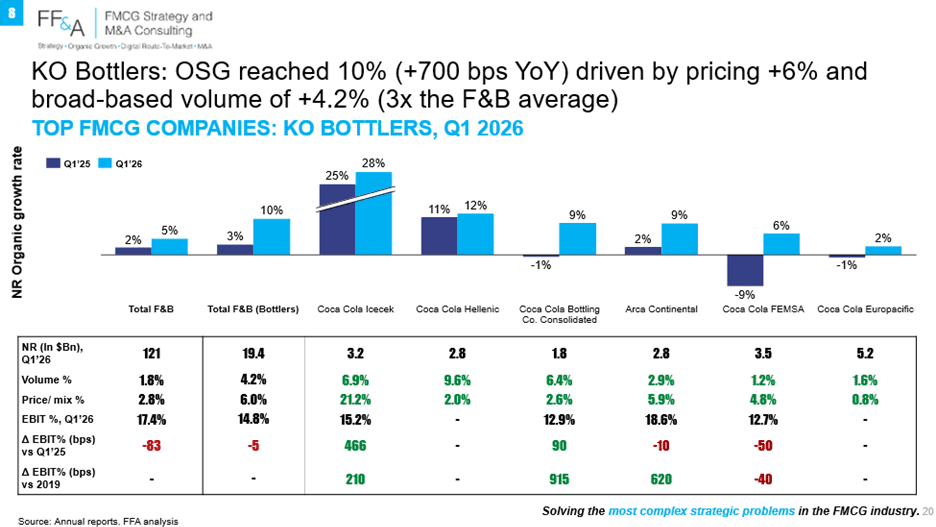
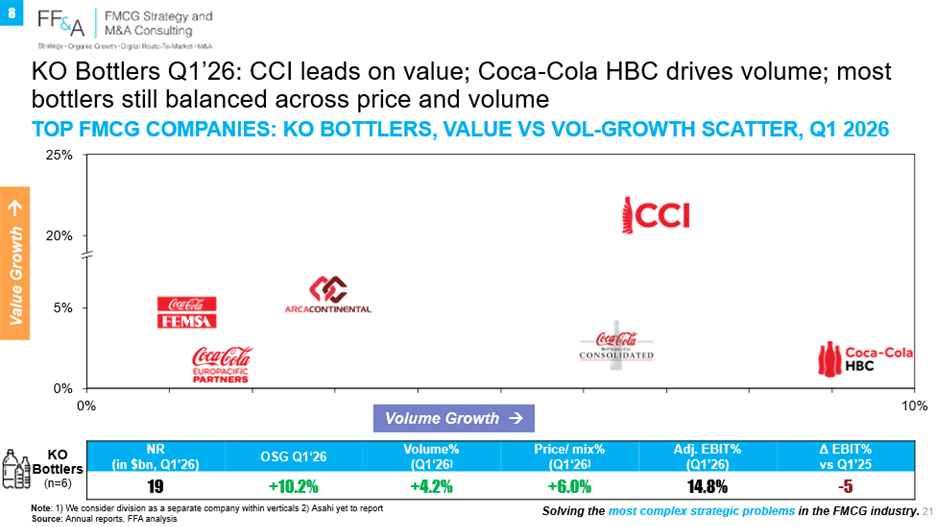
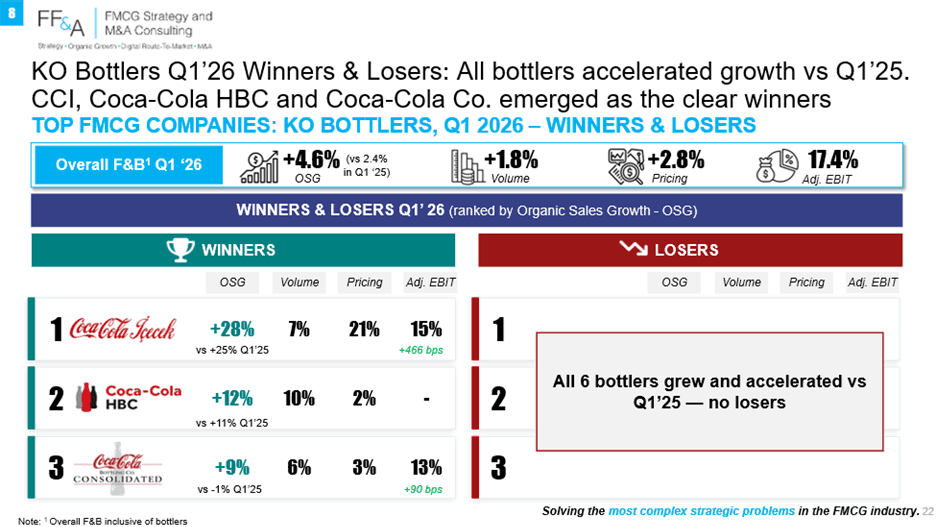
8) KO Bottlers continue to deliver the standout F&B performance: +10% OSG, +700bps YoY
Volume at +4.2% (3x the F&B average), pricing at +6.0%
KO Icecek (+28%), KO Hellenic (+12%) & KO Bottling Consolidated (+9%) all firing
Emerging Markets remain a unique growth engine for the system
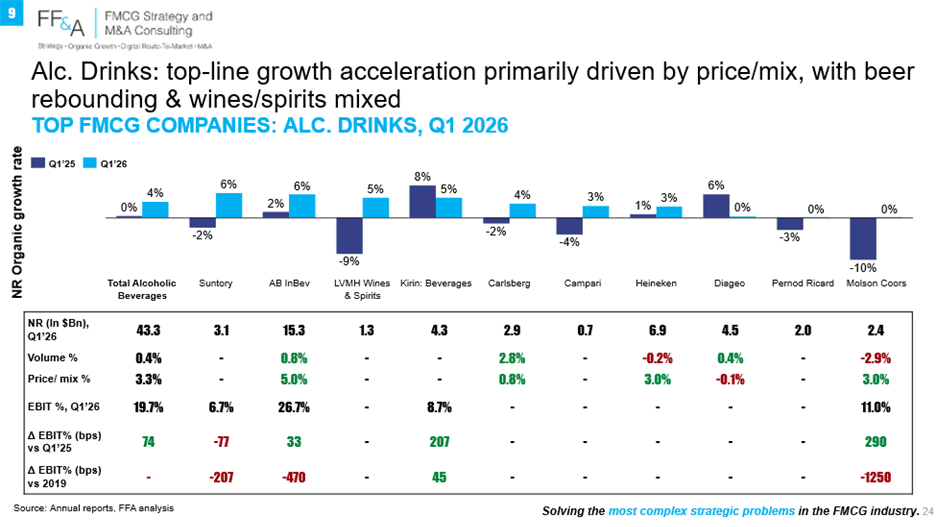
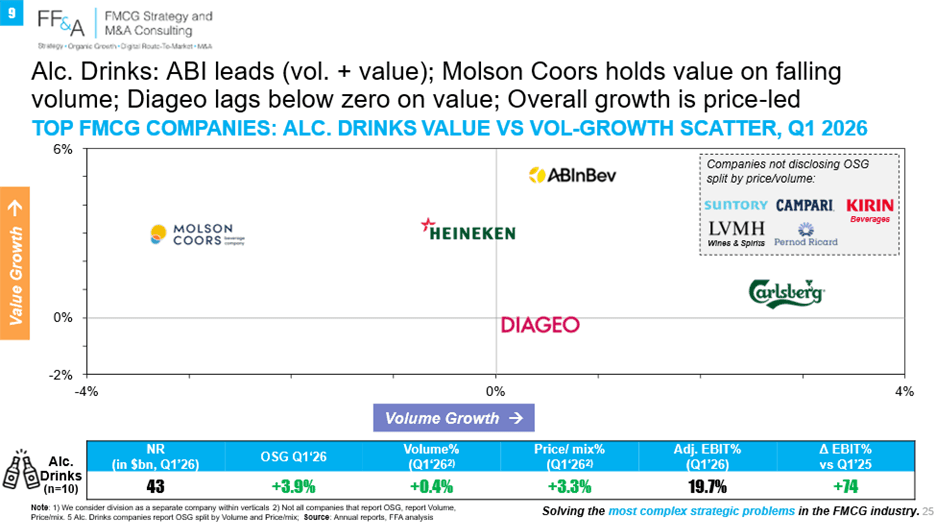
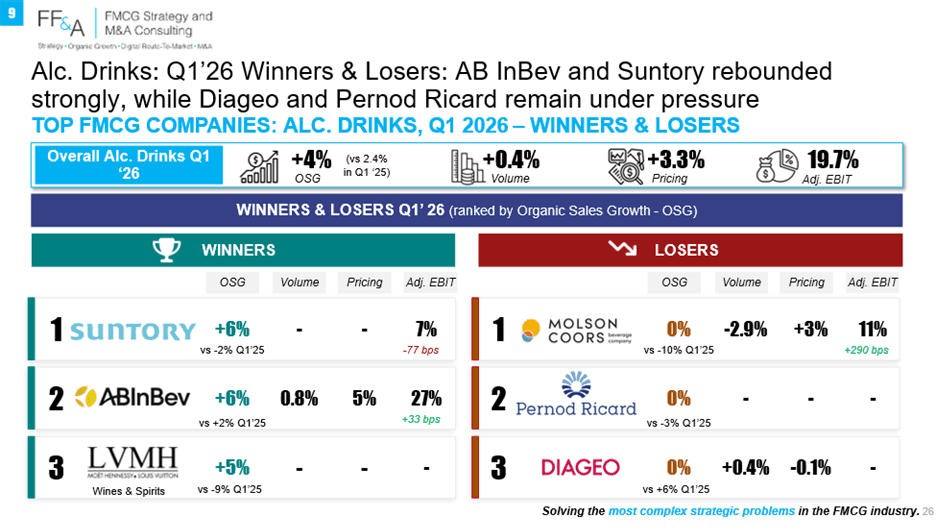
9) Alc. Drinks rebounds to +4% OSG (vs flat Q1'25), price/mix-led
AB InBev (+6%), Suntory (+6%), LVMH Wines & Spirits (+5% vs -9%) & Carlsberg (+4%) all return to growth
But Diageo (0%), Pernod Ricard (0%) & Molson Coors (0%) stay flat
The wine & spirits performance gap versus beer is widening further
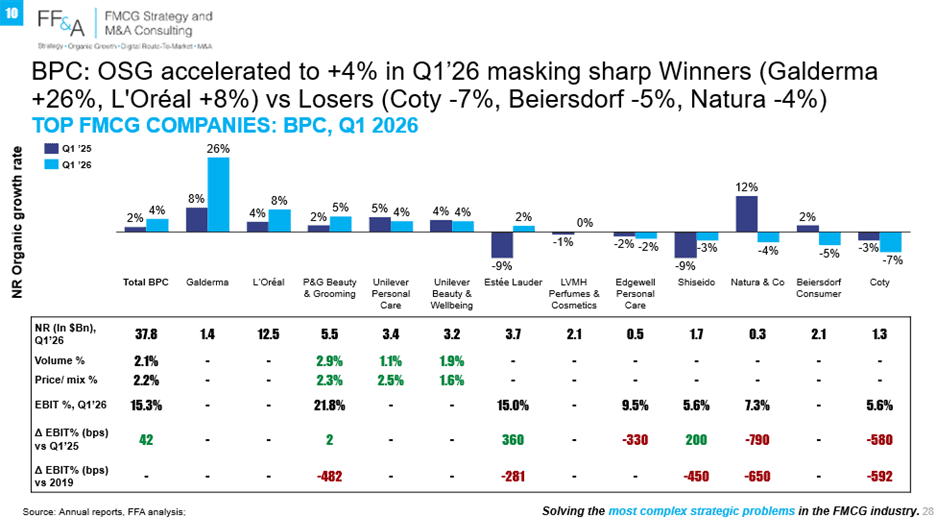
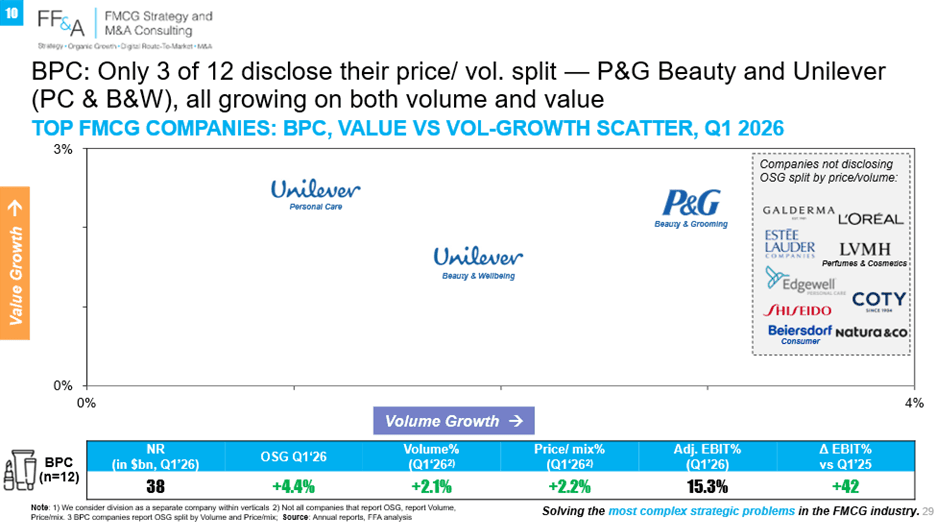
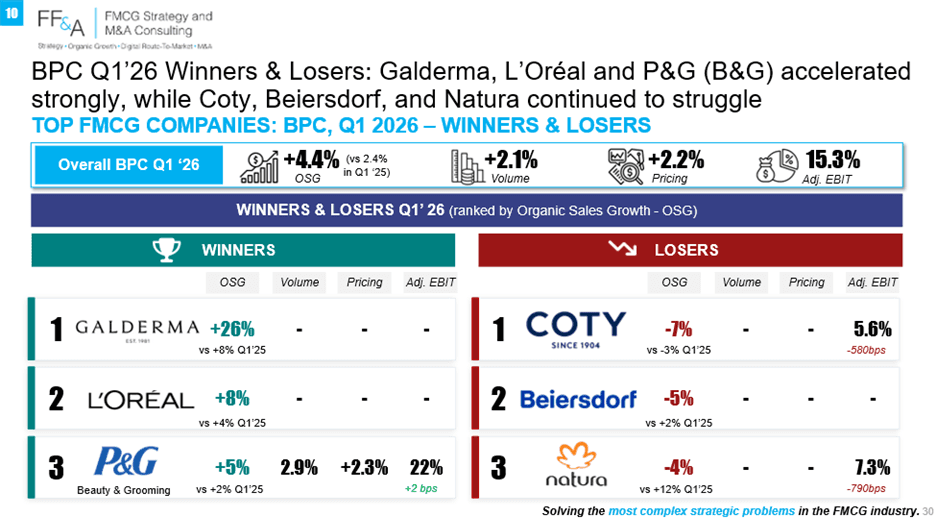
10) Beauty Personal Care (BPC) +4% hides a brutal divide
Galderma (+26%), L'Oréal (+8%), P&G Beauty & Grooming (+5%) on one side
Coty (-7%), Beiersdorf (-5%), Natura (-4%) on the other
The premium-vs-mass & innovation-vs-legacy gap keeps widening
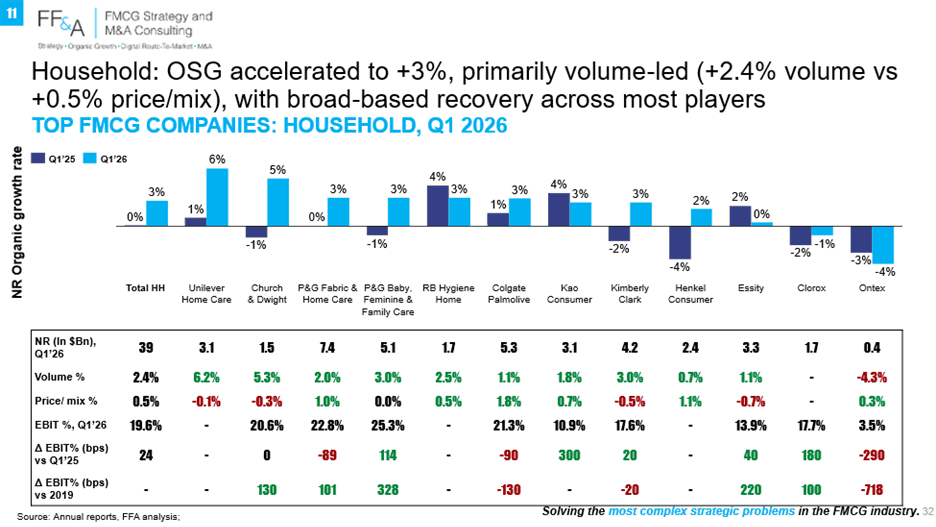
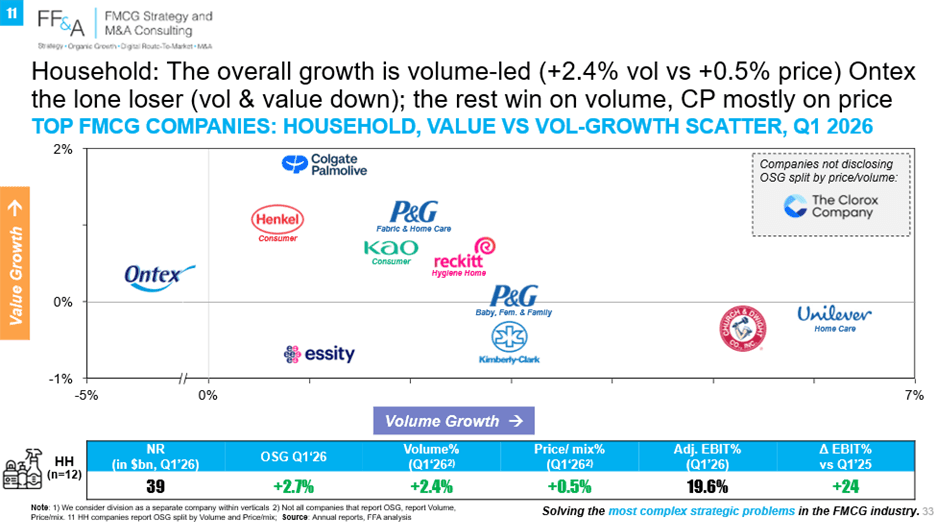
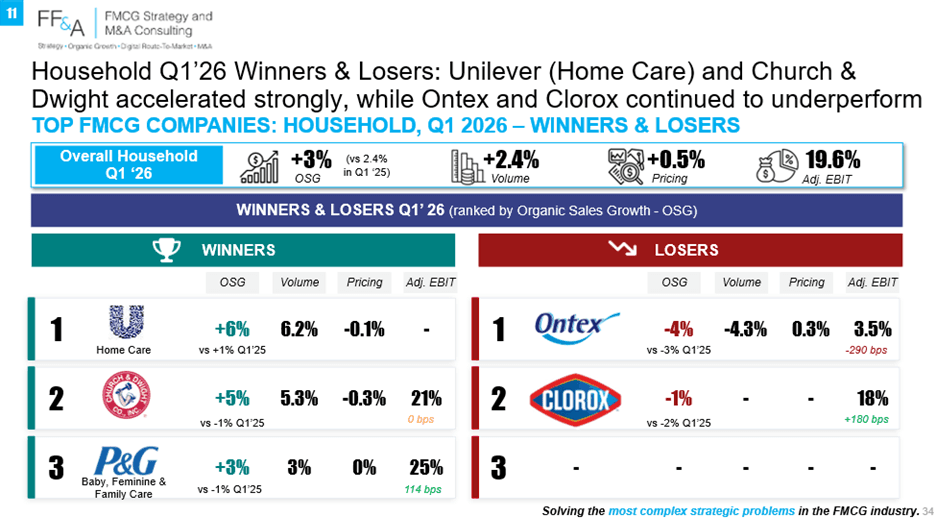
11) Household OSG triples to +3% (vs 0% Q1 2025), mostly volume-led (+2.4% vs +0.5% pricing)
Unilever Home Care (+6%), Church & Dwight (+5%) lead a broad-based recovery
Ontex (-4%) the lone decliner
The most encouraging vertical of Q1'26
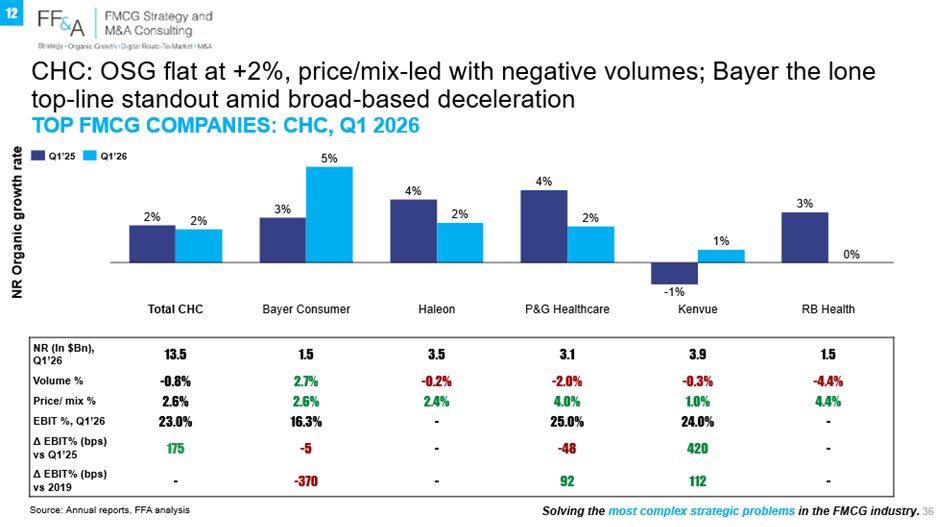
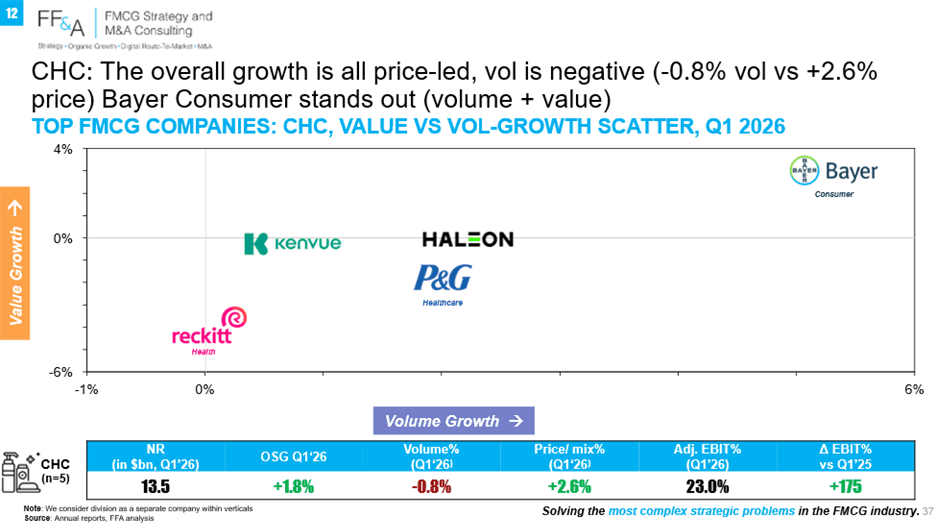
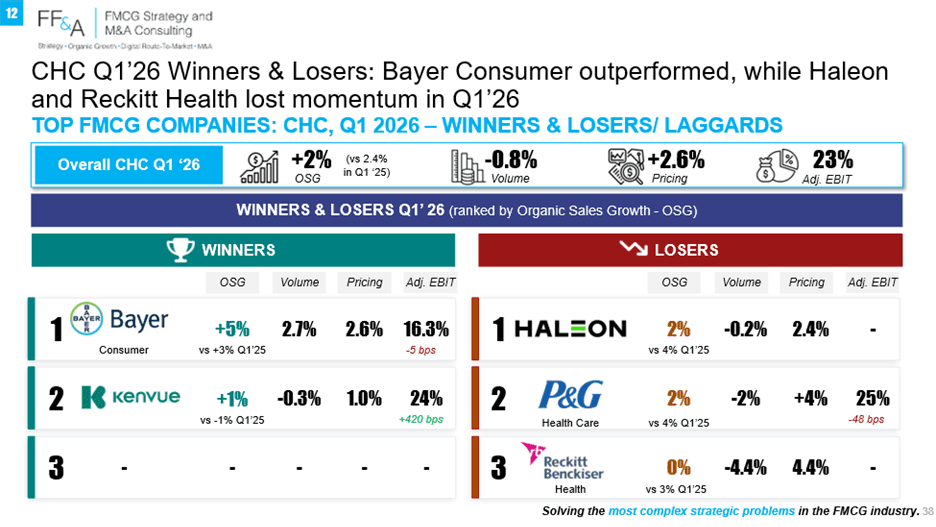
12) CHC: the only vertical to decelerate as a weak cold, flu and allergy season hit seasonal OTC demand
OSG flat at +2% on negative volumes (-0.8%)
Bayer Consumer (+5%) the lone top-line standout
Haleon, P&G Healthcare, RB Health all slowing
The post-pandemic CHC normalization continues — a space to watch
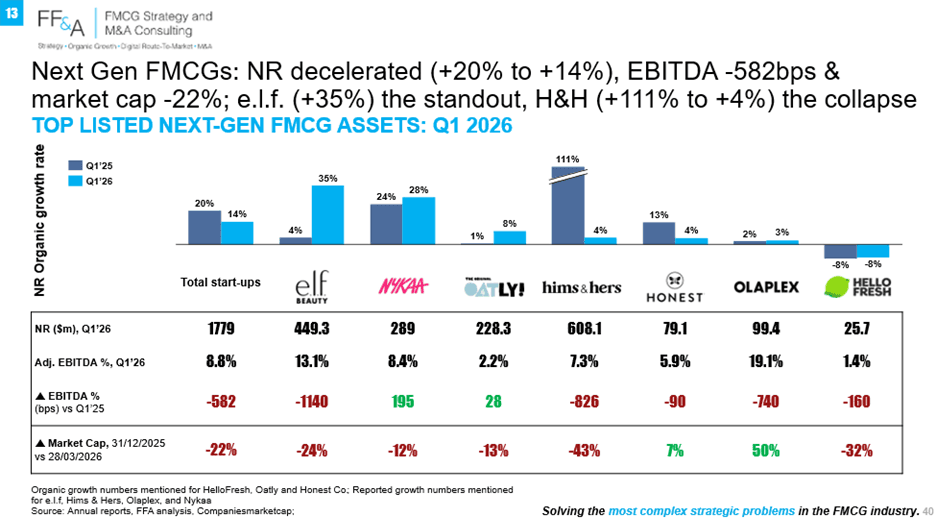
13) The Next-Gen FMCG playbook continues to be under pressure
Aggregate Net Revenue (NR) decelerated from +20% to +14%, EBITDA -582bps, market caps -22%
Hims & Hers collapses from +111% to +4% (Market Cap -43%)
e.l.f. (+35% NR, -1140bps EBITDA, Market Cap -24%) is the only top-line standout
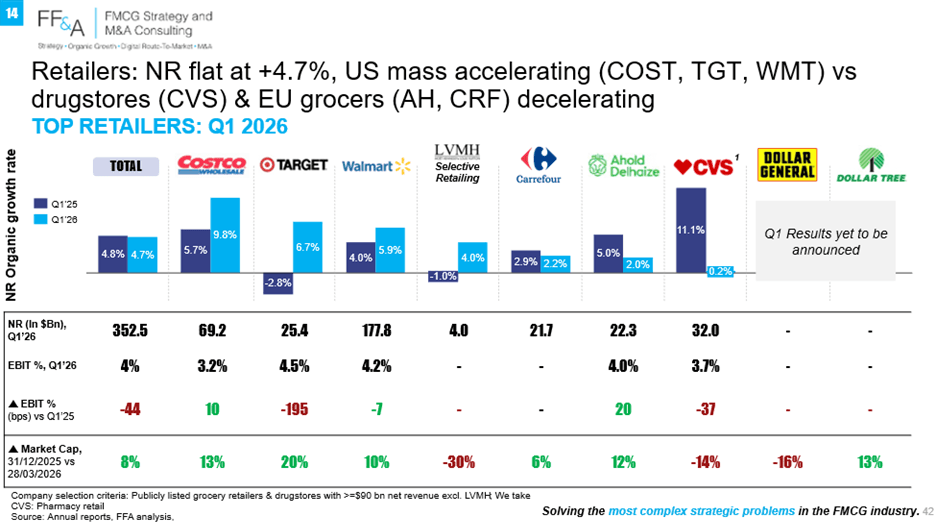
14) Retail is moving in three different directions in Q1'26
US mass accelerating (Costco 5.7% → 9.8%, Walmart 4.0% → 5.9%, Target 6.7%)
EU grocers decelerating (Ahold 5.0% → 2.0%, Carrefour 2.9% → 2.2%)
US drugstores collapsing (CVS 11.1% → 0.2%)
LVMH Selective Retailing is the surprise reversal (-1.0% → +4.0%)
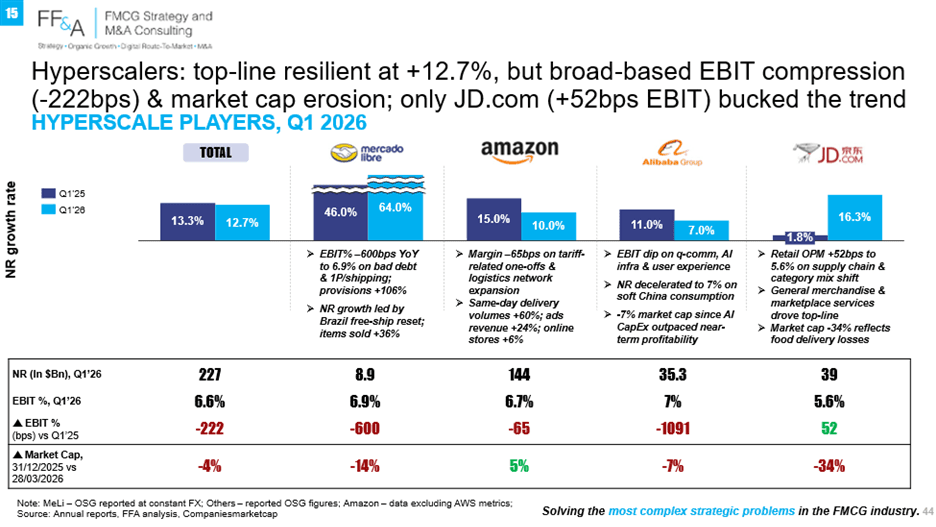
15) The Hyperscaler margin squeeze has begun
Net Revenue (NR) remained resilient at +12.7%, but EBIT fell -222bps
Alibaba took the heaviest hit (-1091bps), with AI CapEx running well ahead of near-term profitability
Only JD.com (+52bps) managed to defend margin
Tariffs, quick commerce losses & AI infrastructure spend are biting all at once
16) Mega-deals are back as predicted
Q1'26 delivered 7 transactions >$1Bn (vs 2 in Q1'25, 1 in Q1'24)
Average deal size jumped to $3.5Bn (4.4x Q1'25's $799m)
Total disclosed value $39Bn (+388% YoY)
The most active Q1 since the 2016-18 M&A super-cycle
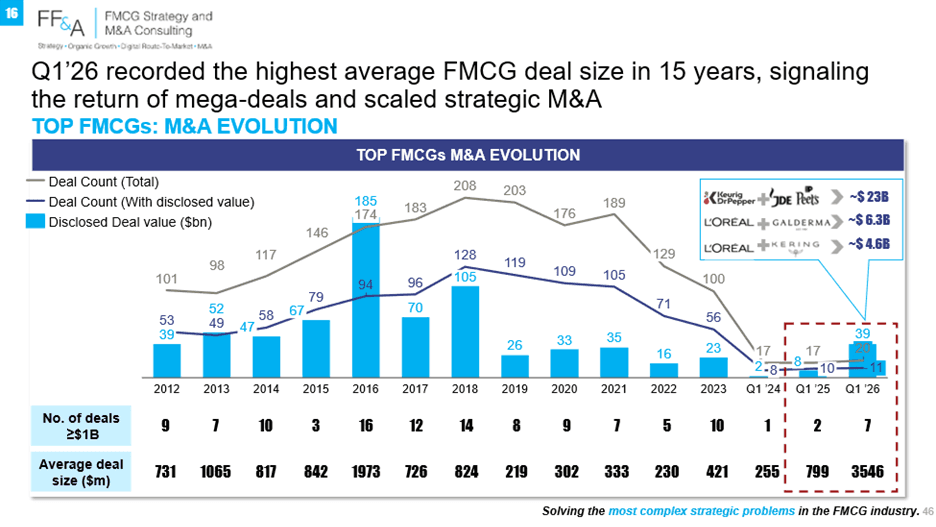
17) Q1'26 marks the return of scale-driven M&A, led by F&B & BPC
Three deals concentrate ~85% of disclosed value: KDP-JDE Peet's ($23Bn), L'Oréal-Galderma ($6.3Bn) & L'Oréal-Kering Beauty ($4.6Bn)
Deal count fell -46% vs Q1'22 but deal value jumped +778% (+378% YoY)
The bolt-on era is winding down
CEOs are betting big on scale, the most ROI-accretive M&A type per our decade-long research on FMCG transactions

With scale M&A back as the dominant playbook, the lessons of the last decade are more critical than ever — read our $600bn M&A Bonfire publication & discover FF&A's Best Acquirers®:
18) Strategic exits have gone mainstream
Q1'26 delivered 12 divestitures across every vertical, totalling $1.3Bn in disclosed value
Unilever's Foods merger with McCormick (~$45Bn, announced/ in-progress) signals large portfolio transformation at unprecedented scale
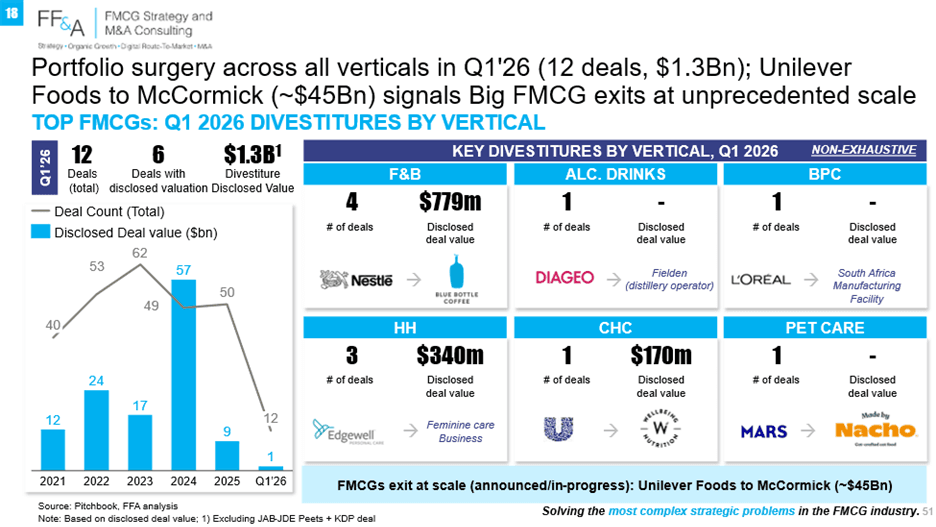
Read more about: Unilever Foods x McCormick Company, the defining transaction of this new exit cycle, decoded in 10 Key Messages
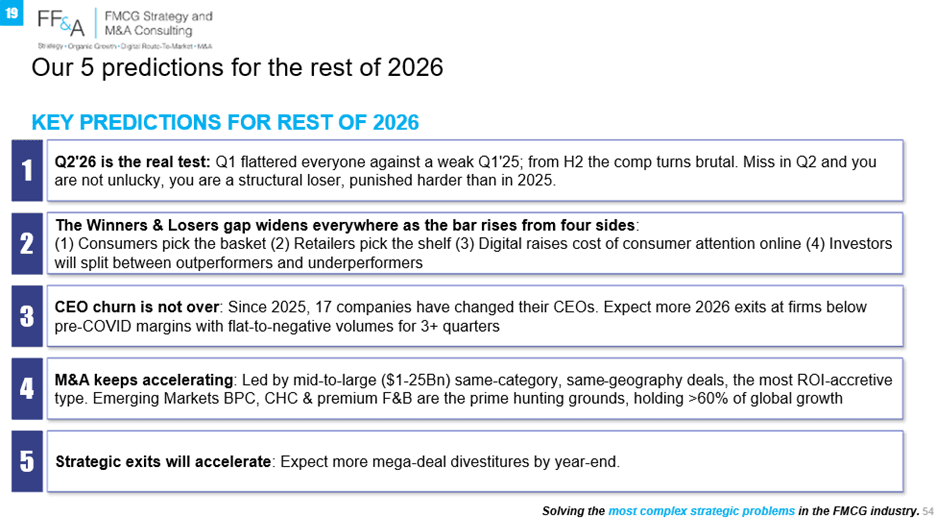
19) Our 5 predictions for the rest of 2026
Q2 is the real stress test: the easy comp disappears from Q2 — misses from here are structural, not cyclical
Dispersion accelerates on three fronts: consumers, retailers & investor capital all start picking sides
More CEO exits coming: 17 changes since 2025, with sub-pre-COVID margins & flat-to-negative volumes the clearest trigger
M&A momentum builds in $0.5-5bn assets on same-category, the transaction displaying the highest ROCE (cf. our research on M&A)
Mega-divestitures follow mega-deals: portfolio surgery becomes the second leg of the cycle
As FMCG CEOs head into the rest of 2026, two questions will define the winners:
1) How to turn this volume recovery into sustainable, profitable growth? The pricing crutch is gone, the margin algo is not yet rebuilt — our Zero-Based Growth® framework remains the most relevant playbook to drive incremental category growth. Read:
FMCG CEOs: Managing Finally For Sustainable (Volume) Growth Or How To Stop Shrinking To Glory - From ZBB to ZBG (Zero-Based-Growth) - Zero-Based-Growth®
2) Where to play to capture the next $1 trillion RSV? Emerging Markets (EM) hold >70% of global FMCG growth — EM will decide the next decade of winners. Read:
3) How to accelerate Ecommerce sales? (22% share of growth total FMCG industry but up to 50% on BPC, VMS, Pet Care)
4) How to turn M&A into a predictable high ROCE machine? (and avoiding the 80% failure rate that led to $600bn shareholder value destruction over the last 15 years)
Bringing it all together: Q1'26 delivered the first signs of a possible inflection — but it would be premature to call it a recovery
The base effect likely did most of the heavy lifting — genuine progress is only verifiable from Q2 onwards when the comps become more challenging
Volume coming back is not the same as growth coming back — the pricing crutch is gone, the margin algo is not yet rebuilt & the aggregate hides the only thing that matters: dispersion
Mega-deals & mega-divestitures signal a clear regime change — but scale M&A executed from a position of weakness, or built on naïve SOTP (Sum Of The Part) analysis & glossy synergy forecasts, will reproduce the last decade's value destruction at greater scale
As Winston Churchill said: 'Now this is not the end. It is not even the beginning of the end. But it is, perhaps, the end of the beginning'
Exciting year ahead
Frederic
Get in touch:
To join the ~69k FMCG executives that follow Frederic on LinkedIn, please click here. To start a conversation, email at: frederic@fredericfernandezassociates.com
To join the ~42k FMCG executives that receive our newsletter and all our CEOs Insights, sign-up at the following link: FMCG CEOs - Managing For Growth
To read all our previous publications, visit our newsletter page: FMCG CEOs - Managing For Growth
About FF&A:
FF&A solves the most complex strategic problems of the world largest FMCG companies across with proprietary approaches developed along with our Clients over the last decade:
Corporate Strategy (Zero-Based-Strategy®)
Organic Growth (Zero-Based-Growth®)
Digital RTM (Ecommerce, DTC and EB2B) (Ecommerce 2.0®)
M&A (Best Acquirers®)
14 out of the world 20 largest FMCG companies are repeat Clients. FF&A team intervenes all across the globe and across all FMCG categories.
To know more, please visit our website: www.fredericfernandezassociates.com
Disclaimers:
No FF&A employees own any stocks or financial instruments of any FMCG companies or companies mentioned in the above article. All the above information is public information
Enjoyed this article?

FMCG CEOs: Managing For Growth
Strategic insights for FMCG/ CPG CEOs