
Corporate Strategy
FMCG CEOs: Q2 Results In 20 Charts - Time To Become A Market-Maker

Author | Managing Director & Partner @ FFA
'The real voyage of discovery consists not in seeking new landscapes but in having new eyes' - Marcel Proust, In Search Of Lost Time
'Now, here, you see, it takes all the running you can do, to keep in the same place. If you want to get somewhere else, you must run at least twice as fast as that!' - Lewis Carol, Alice In Wonderland
To join the ~35,000 FMCG executives that receive automatically all our FMCG CEOs Insights (posts & articles like this one), sign-up to our newsletter at the following link: FMCG CEOs: Managing For Growth
It's a wrap for the (calendar) Q2 2025 earnings season for the world largest listed FMCG companies (n=45 reported in Q2).
Here is our take:
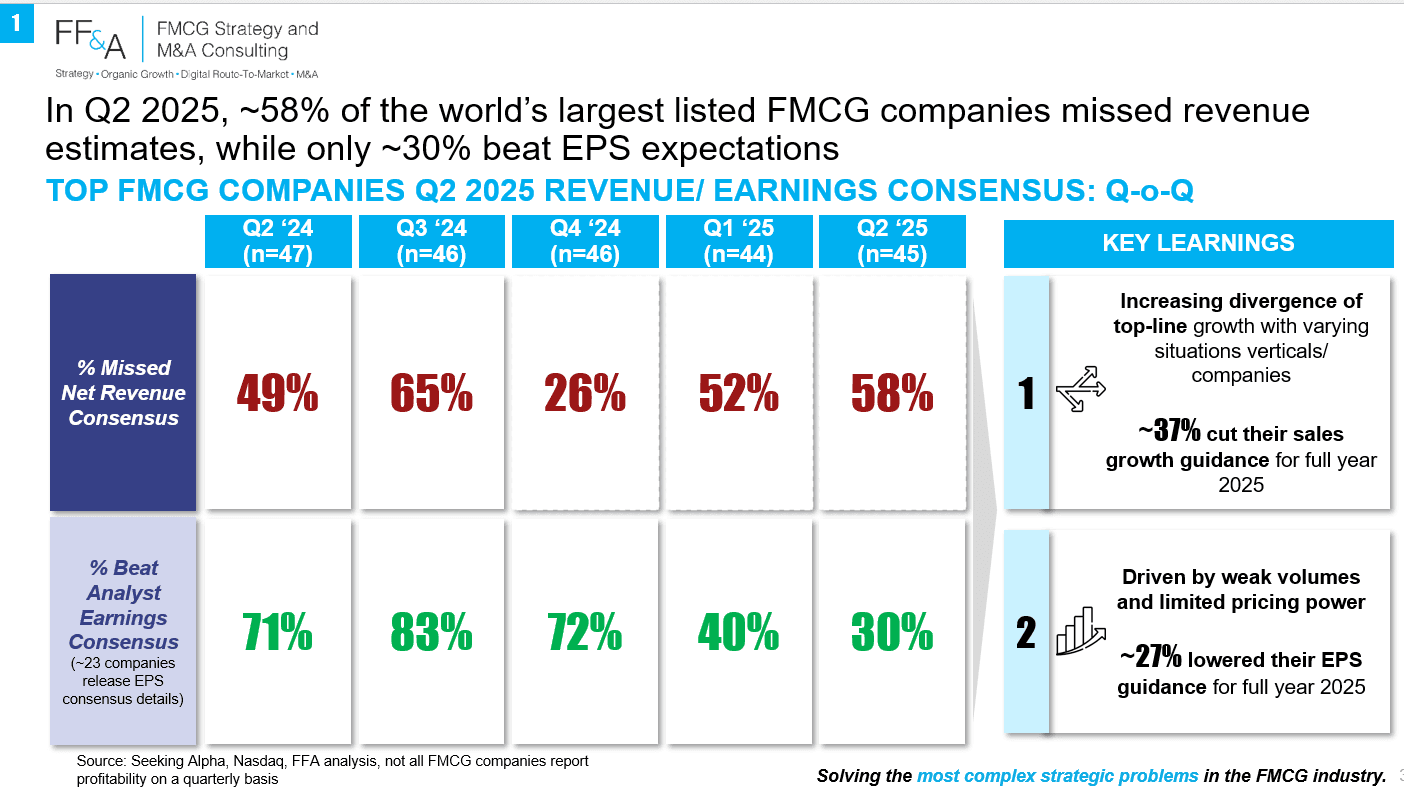
1) Our predicted shift from a 'shrinking-to-glory' era (most missing top-line yet most delivering bottom-line) to a 'shrinking-to-misery' era (most missing both top-/ & bottom-line and reducing guidance) is now largely confirmed. In that regard Q2 marks a real shift (58% top-line miss, 70% bottom-line miss). And It is not a vertical specific trend, it is true across all FMCG verticals. It is the consequence of the end of three super-cycles (end of high pricing, end of China as global tailwind, end of post COVID growth acceleration on few specific categories like VMS, Beauty, Pet, Alcoholic Drinks) along with now a (cyclical) weakness in US/EU consumption. The overall makes objectively a challenging context
2) As predicted Boards are dismissing CEOs at an unprecedented pace in an attempt to respond to those unprecedented times (full details in below chart)
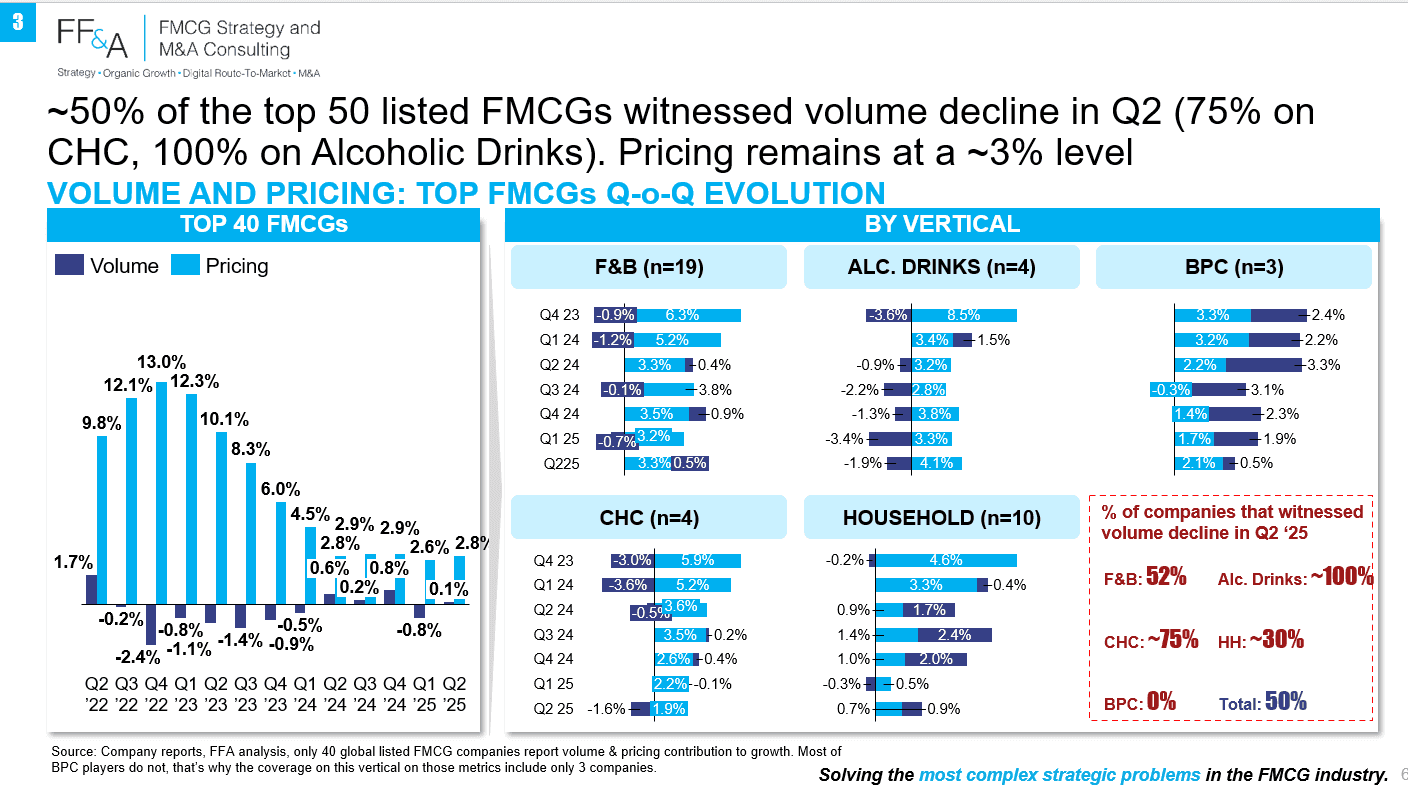
3) Volume development stopped to improve in Q2 with 50% of the world largest FMCG companies recording volume decline. The overall suggests (as shared previously) that volume recovery will be everything except linear. For those that want to blame tariffs, let's not forget that most of the tariff noise was made early Q2 with most delayed in execution by both negotiations & inventory build-up
4) Gap between winners & losers keep increasing. It is true across all verticals (cf. charts below detailing diverging market cap dynamics over the last years & on day of results' release) and reflects the gap in cat/geo footprint, brand portfolio & execution. Difference in price elasticity being the ultimate KPI
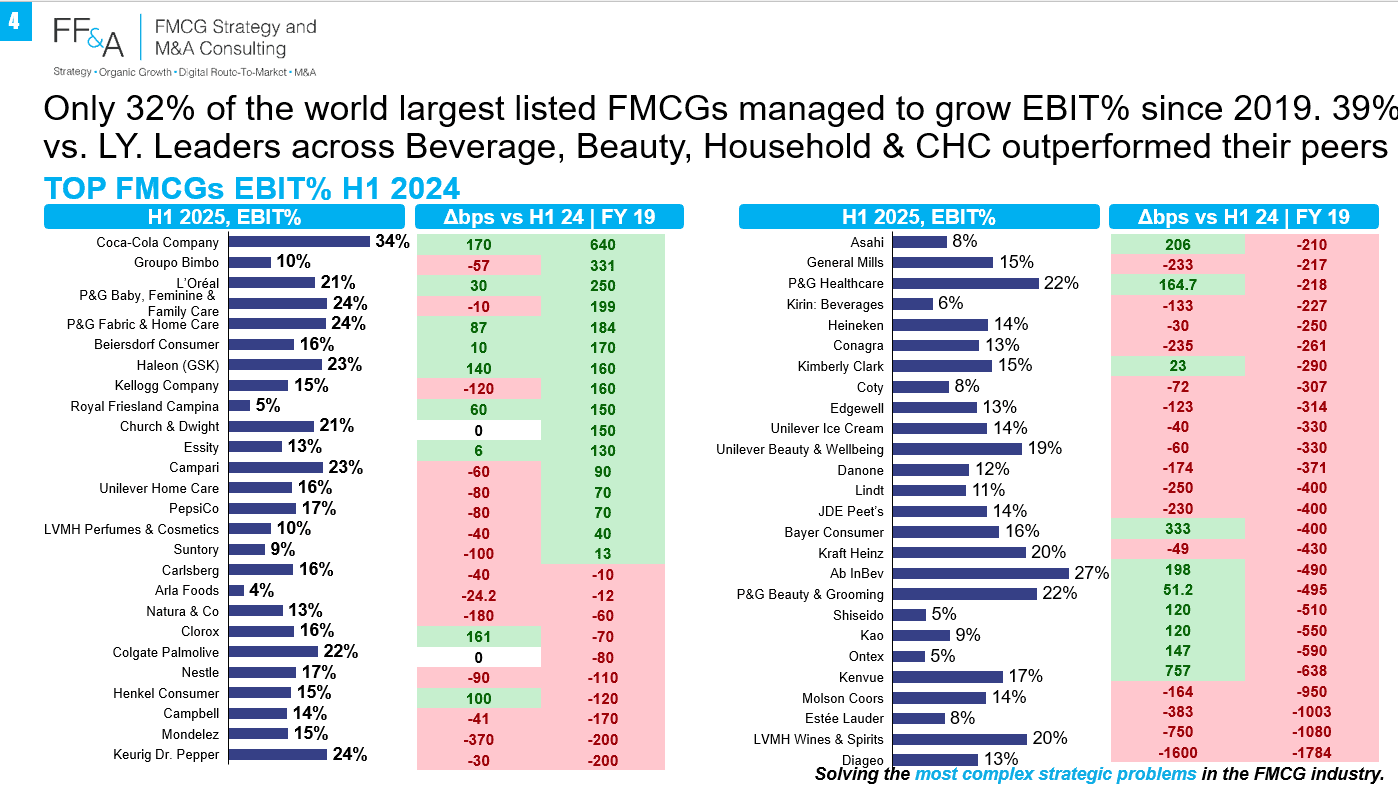
5) Majority of FMCG companies are ill-prepared to manage this situation (68% are yet to recover their pre-covid profitability level, most have been on average steadily losing market share over the last decade). One-off reinvestments into growth are likely to be a negative sum game (most FMCG companies neutralizing each other with increased pace of innovations & increased A&P), the overall translating into profit erosion with little-to-no top-line growth (all o confirmed by Q2 results)
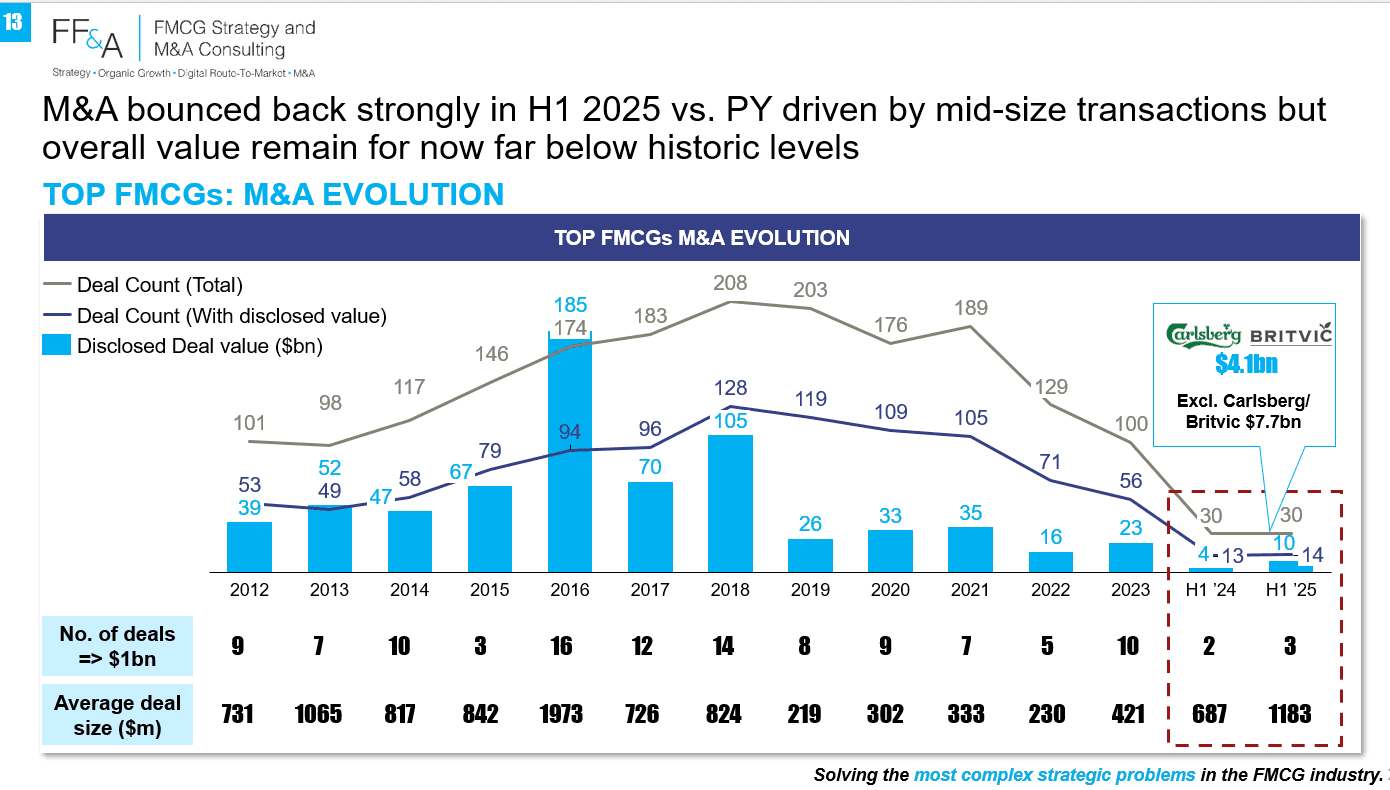
6) The delta between the cost of inorganic growth and the cost of organic growth is progressively reversing driving, as expected, an acceleration in M&A. Unsurprisingly mid-size growth oriented M&A on same categories large developed markets benefiting from GTM synergies are driving this trend (highest ROI deal type over the last two decades in the FMCG industry). We expect an non-linear acceleration in M&A as cost of capital continues to decline & cost of growth continues to increase
7) Divesture remains the #1 lever to adjust growth/ profitability footprint at pace/ scale & boost EPS growth and unsurprisingly value of divesture has now outpaced M&A value for three years in a row
8) Break-outs (cf. Kellogg's, now Kraft-Heinz) are now increasingly seen as a lever to create shareholder value, especially for underperforming assets but not all will work as well as Kellogg's (Kellanova/ Mars and J.K Kellogg's/ Ferrero)
Spotting the above trends are rather obvious. What is interesting is to determine how to go about it. In that respect, our views remain unchanged. Here are our five key thoughts:
1) Generally, let's first fully remember the lessons learnt from the ‘lost last decade’ to prevent ‘shrinking-to-glory’ & resist to the two main 'deadly temptations' (getting wrong the cost take-out vs. top-line balance; solving structural organic growth problems with mega-M&A deals)
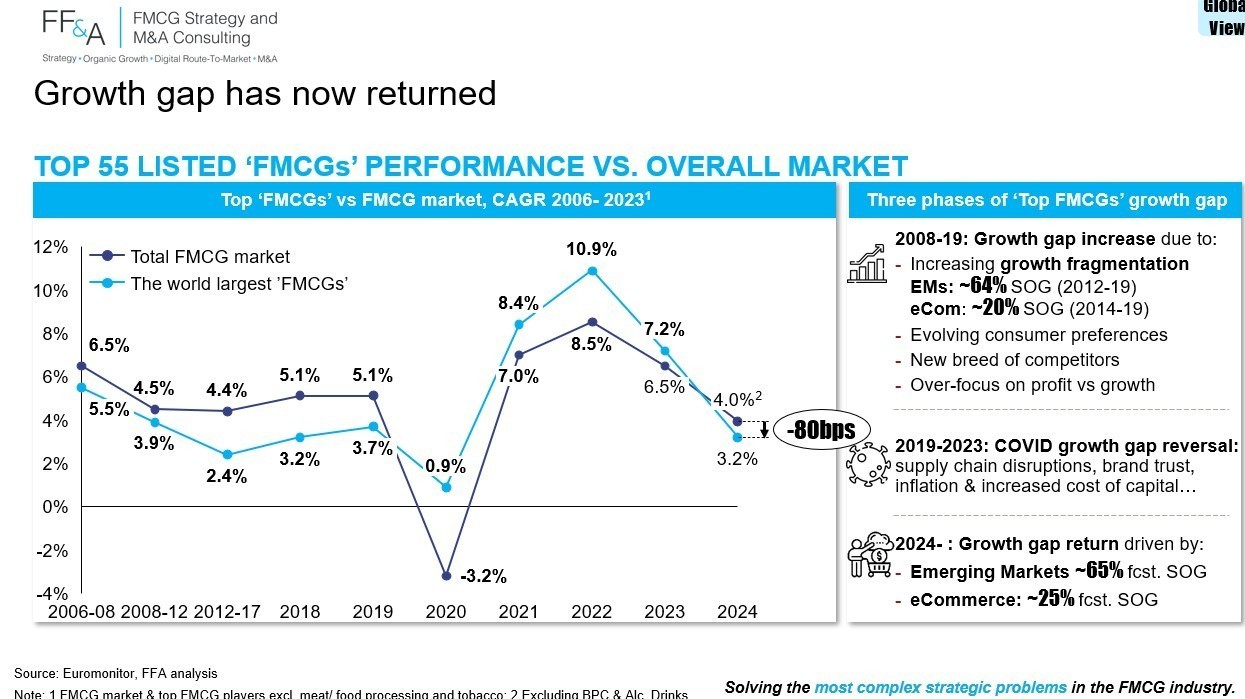
The 'lost last decade' & the expected return of the 'growth gap' from 2024:
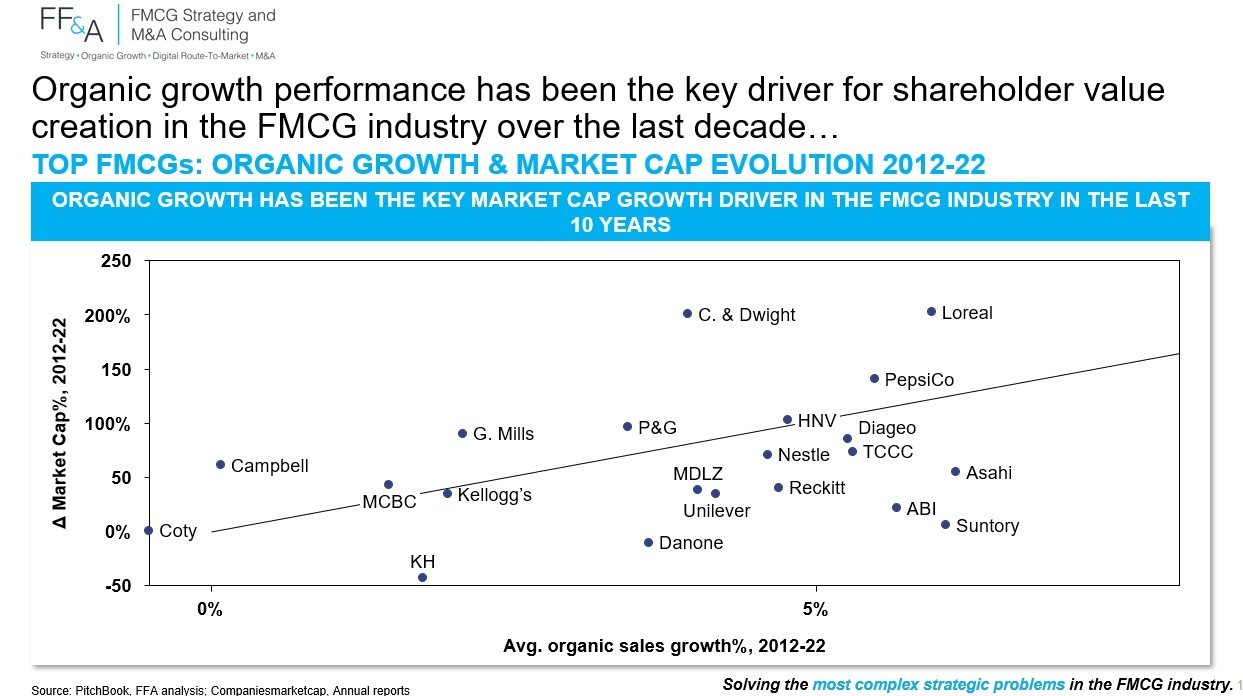
Organic growth as key shareholder value creation driver:
The need to balance top-line & bottom-line growth

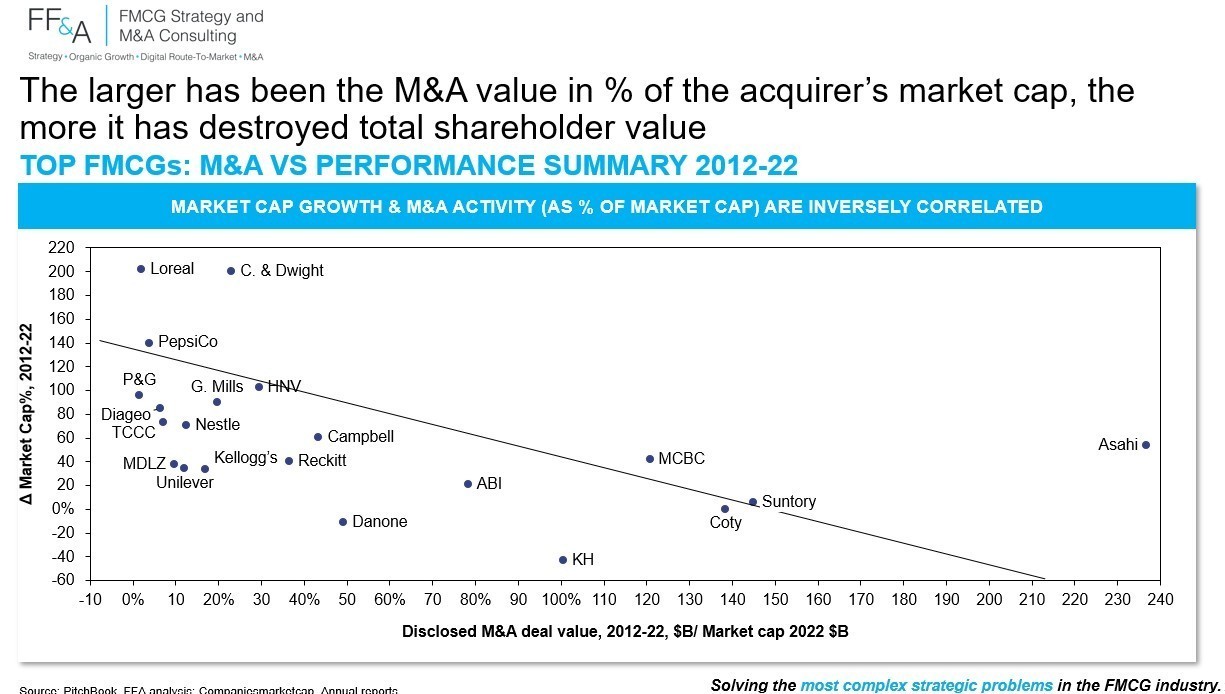
Large M&A as the key driver of shareholder value destruction
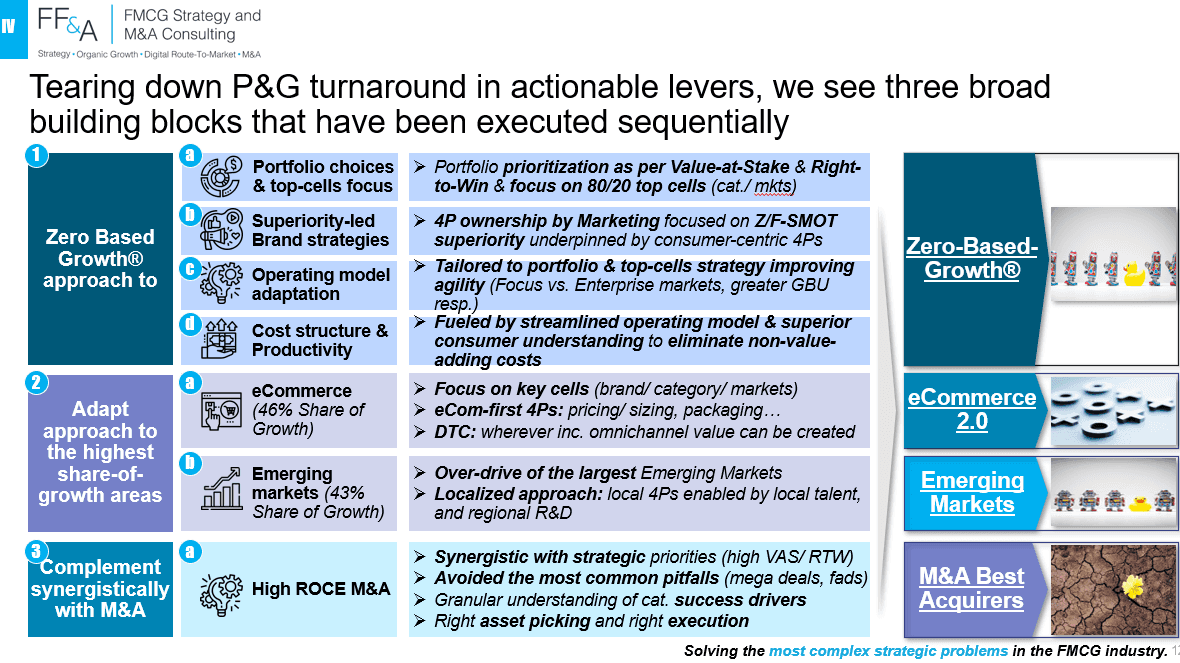
2) While we acknowledge the positive steps taken in 2024 to accelerate organic growth (portfolio optimization/ divesture, increase in marketing & promotion spend, acceleration of innovations, progressive acceleration in bolt-on M&As) & the time it will take to yield results, those one-off steps must be complemented by a holistic & replicable consumer-centric approach to organic growth outperformance that drives sustainably category expandability (vs. just grabbing shares or being obsessed by private labels) & that is deeply embedded in the entire organization. We call it Zero-Based-Growth® (cf. below ZBG® publication explaining in details the approach)
Some companies like P&G offer an interesting proxy (cf. below P&G turnaround case)
More perspective also on how to drive category expandability in our last episode of the Growth FMCG CEO Podcast with Pablo Perversi (President Europe, Danone) (cf. chapter 7 to 10):
Private labels remain for the immense majority of the FMCG industry not only statistically irrelevant but also a strategic distraction (more in our last publication below on Private Labels):
3) In a context Emerging Markets (EMs) are expected to continue to account for ~2/3 of the global share of FMCG growth, it is critical to adapt our global strategies to EMs and specifically to localize our 4Ps to outperform. China structural slowdown pushes us not only to reinvent ourselves in China (because of the sheer size of the market - cf. the now famous 'the next China will be China') but also to dramatically diversify our growth engines in EMs starting with India, Brazil, Mexico & many others. That is what we call the $1 Trillion race (the incremental sell-out value at stake in emerging markets outside China in the coming 5 years). Below a publication with our detailed perspective on how to unlock this $1 Trillion opportunity illustrated with cases
4) In a context Ecommerce contribution remains significant (~22% steady share of growth on average with great standard deviation ranging from ~50% for Pet Food/ Beauty through ~30s% for Consumer Health/ Diapers to ~5-15% for the rest – F&B, Household), external environment becomes more demanding (lower ecommerce growth, higher competition, increasingly fragmented & rapidly evolving e-customers landscape, higher pressure on profitability from the world largest pure players, rise of retail media putting all FMCG companies in a dynamic prisoner dilemma situation that can drastically increase the cost of growth as seen in 2024 in few large retailers) & the Ecommerce strategies of the world top 50 FMCGs still display significant improvement potential (unsustainable targets, out dated where-to-play/ how-to-win choices, insufficient consumer-back approach, unsustainable investment level with insufficient ROI, enhanced risk of omnichannel value destruction):
=> How to update our Ecommerce strategy to outperform & maximize incremental omnichannel value? (cf. the below publication for our detailed perspective)
5) As a result of the increasing cost of organic growth (pricing gains slowdown & muted volume for most, reinvestment into A&P and growth capabilities, increasing pressure from (r)etailers), the decreasing cost of inorganic growth (decreasing interest rate, compressed valuation, increasing assets availability) & increasing balance-sheet availability, we see an increasing case for M&A in 2025 & beyond. But risks remain abundant (majority of M&A transactions over the last decade did not pay-back, majority of current assets on the market have no future-proof value creation case)
In this context, the key strategic question becomes:
=> How to leverage M&A to complement effectively and with high ROCE our organic growth strategy? (cf. the below publication for our detailed perspective)
Our conviction remains: outperforming FMCG companies will be the ones that will be market makers and focus on driving incremental category growth
Exciting times
As usual, full details below on Q2 results in 20 key messages/ charts:
1) From 'shrinking to glory' (missing top-line, beating bottom-line) to now 'shrinking to misery' (missing both top-line & bottom-line)
2) As predicted end last year, we are now witnessing an unprecedented CEOs churn

3) ~50% of the top 50 listed FMCGs witnessed volume decline in Q2 (75% on CHC, 100% on Alcoholic Drinks). Pricing remains at a ~3% level
4) Only 32% of the world largest listed FMCGs managed to grow EBIT% since 2019. 39% vs. LY. Leaders across Beverage, Beauty, Household & CHC outperformed their peers
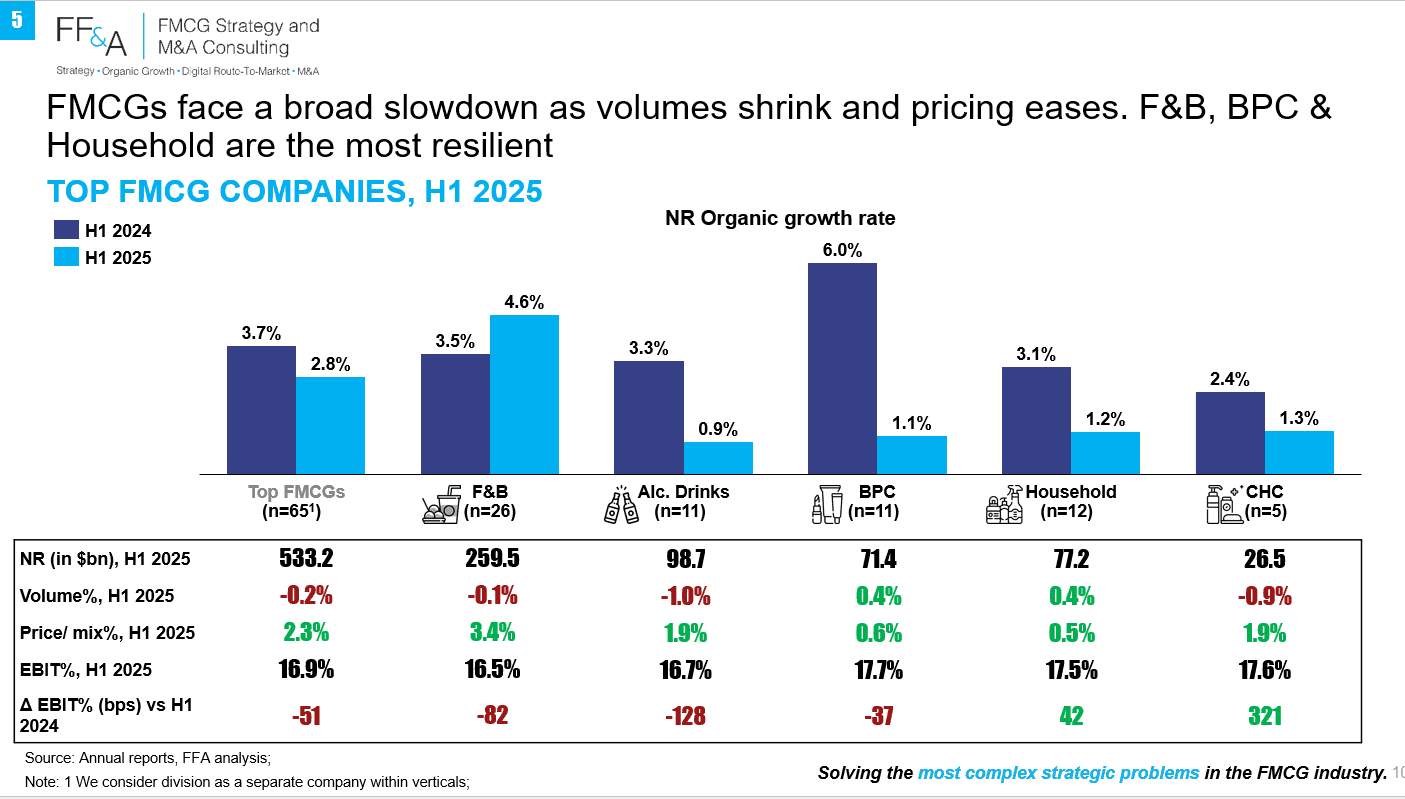
5) FMCGs face a broad slowdown as volumes shrink and pricing eases. F&B, BPC & Household are the most resilient
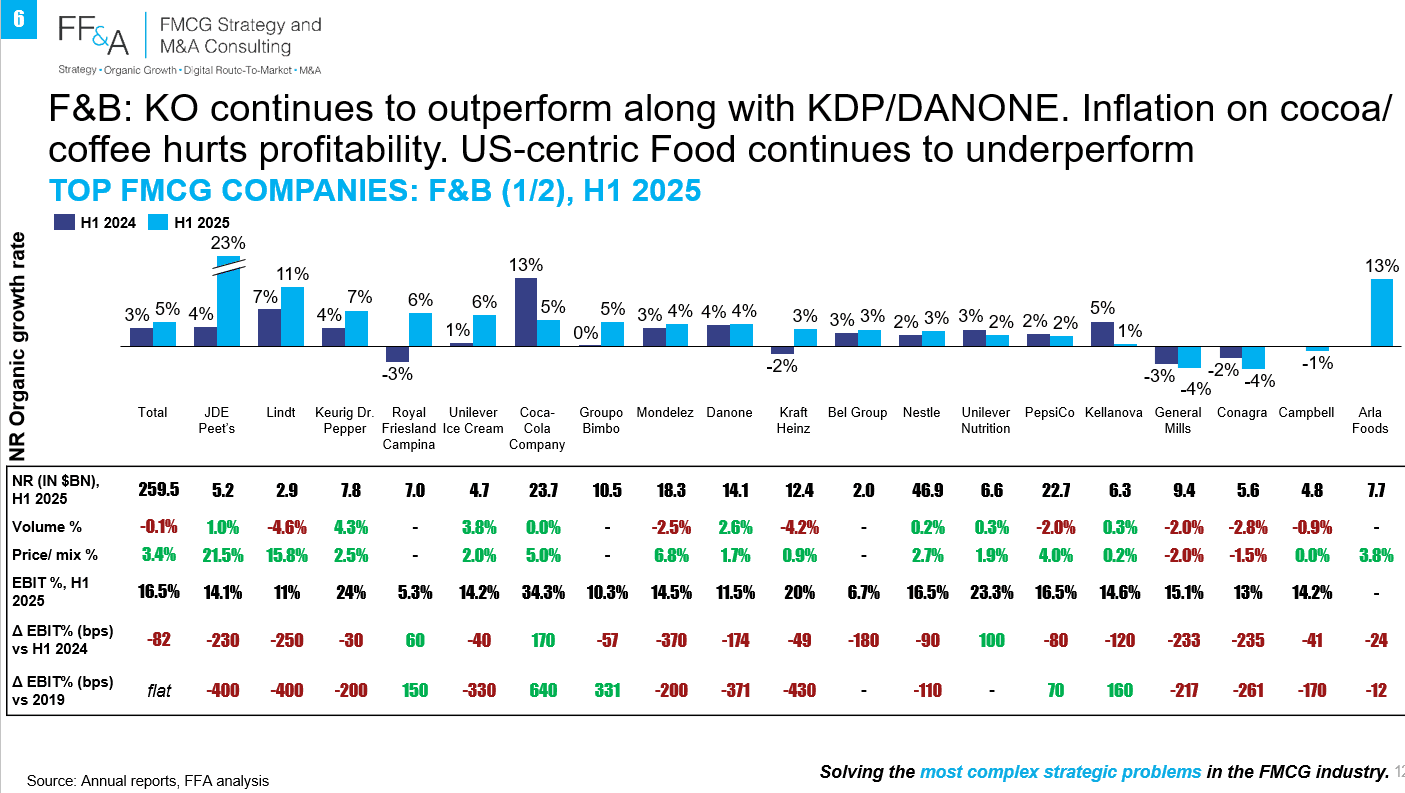
6) F&B: KO continues to outperform along with KDP/DANONE. Inflation on cocoa/ coffee hurts profitability. US-centric Food continues to underperform
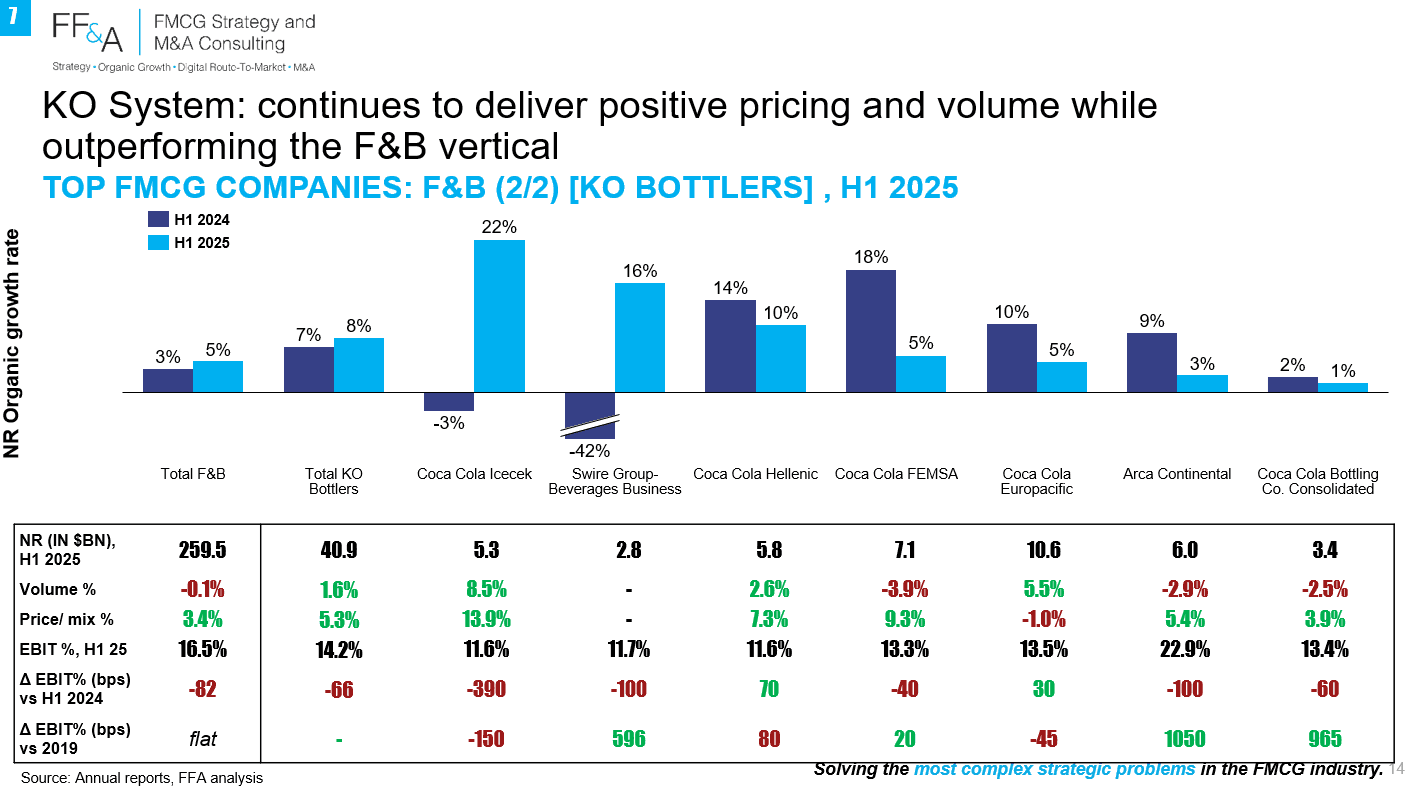
7) KO System: continues to deliver positive pricing and volume while outperforming the F&B vertical
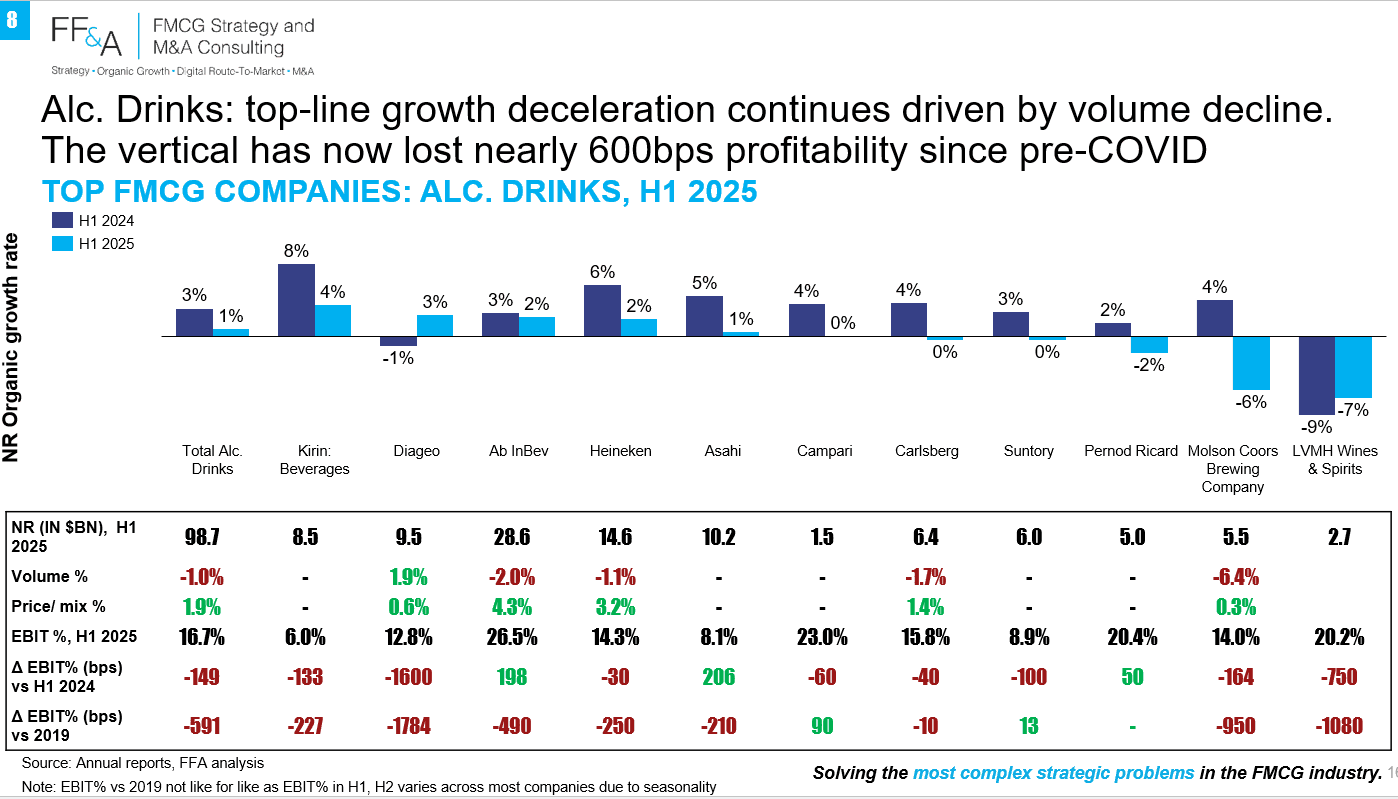
8) Alc. Drinks: top-line growth deceleration continues driven by volume decline. The vertical has now lost nearly 600bps profitability since pre-COVID
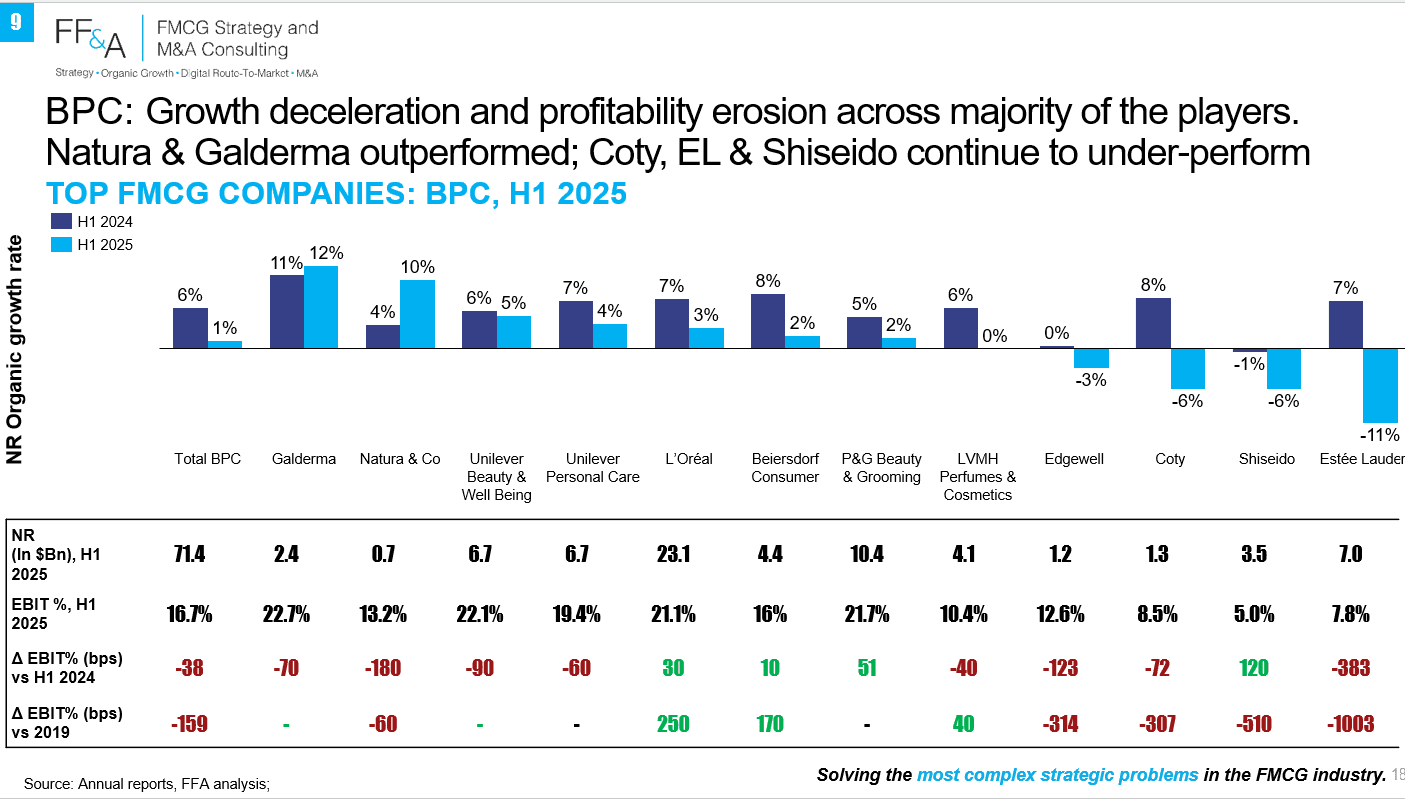
9) BPC: Growth deceleration and profitability erosion across majority of the players. Natura & Galderma outperformed; Coty, EL & Shiseido continue to under-perform
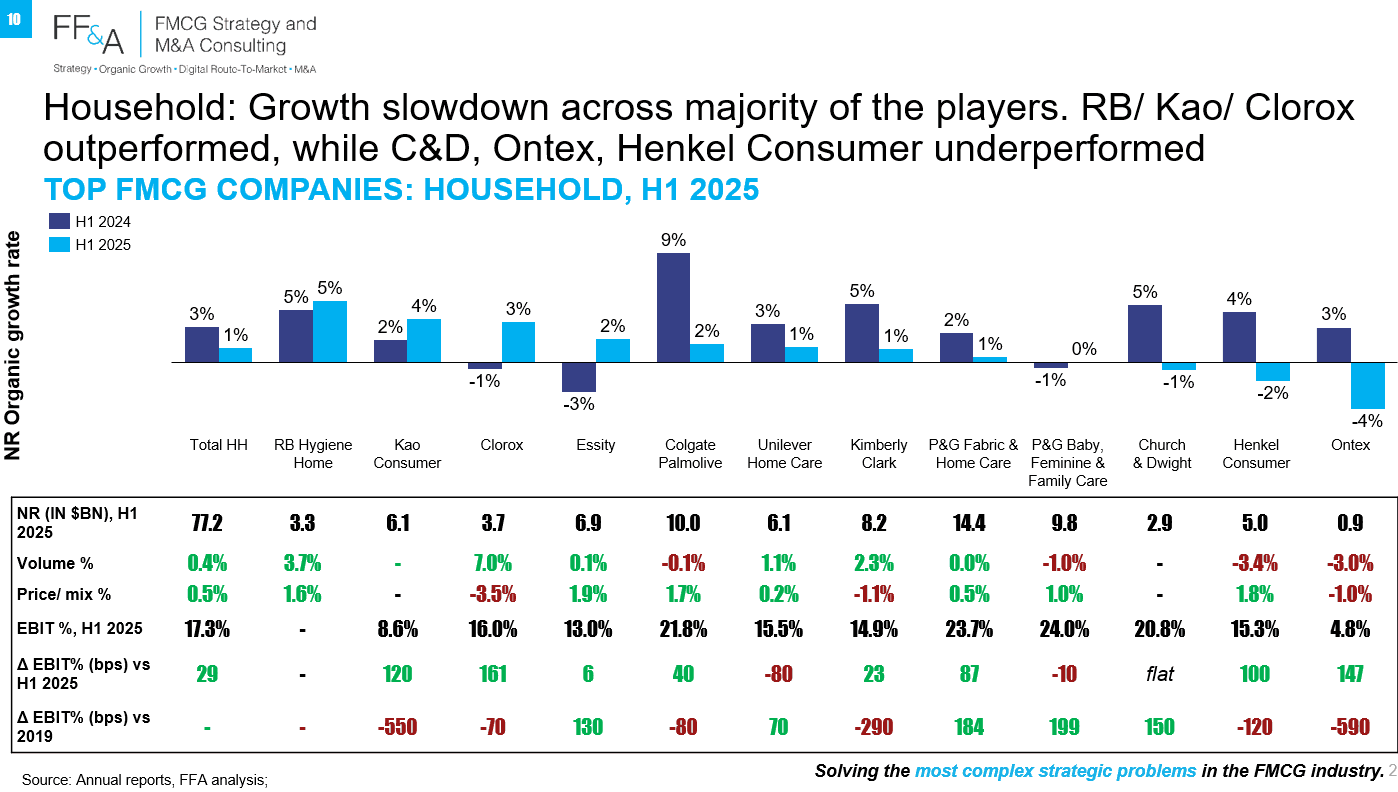
10) Household: Growth slowdown across majority of the players. RB/ Kao/ Clorox outperformed, while C&D, Ontex, Henkel Consumer underperformed
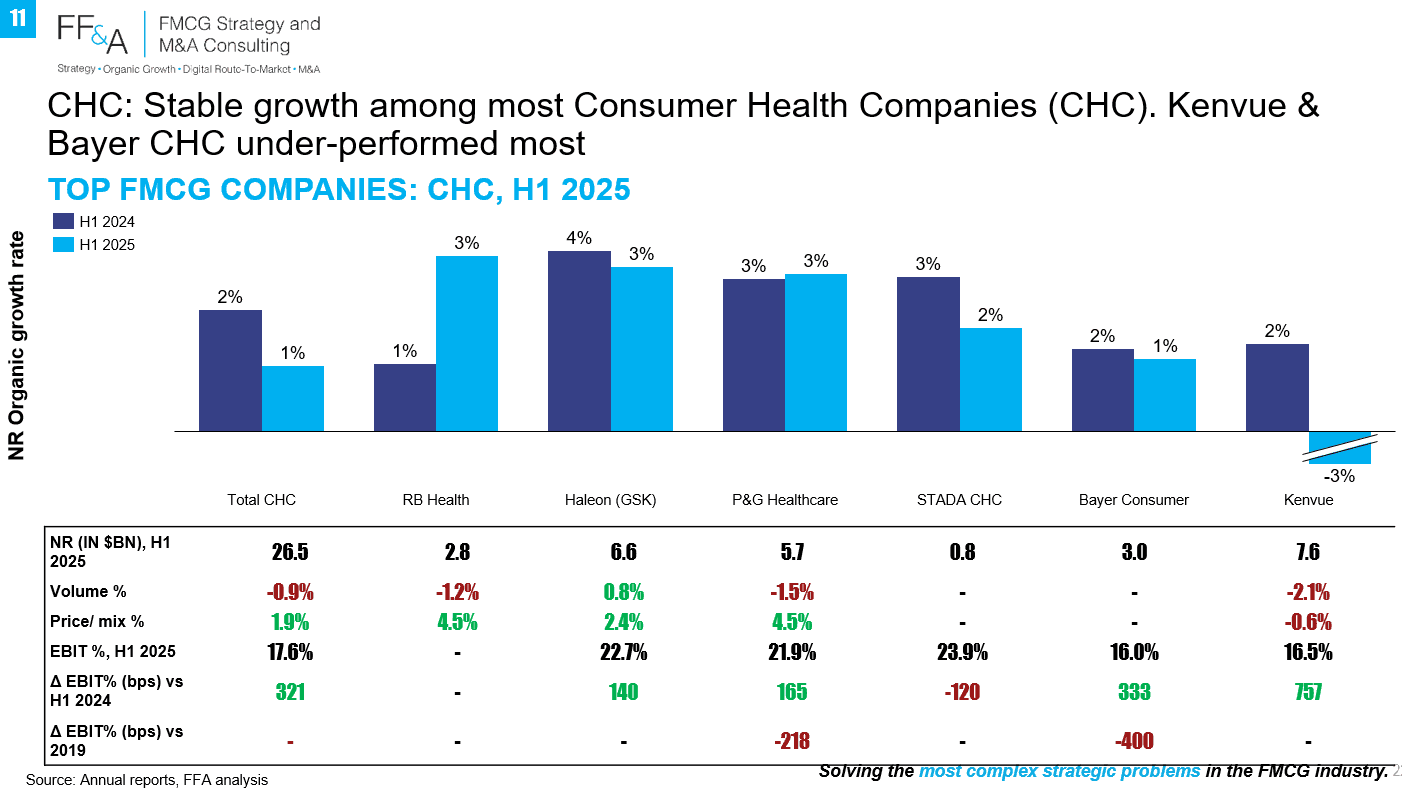
11) CHC: Stable growth among most Consumer Health Companies (CHC). Kenvue & Bayer CHC under-performed most
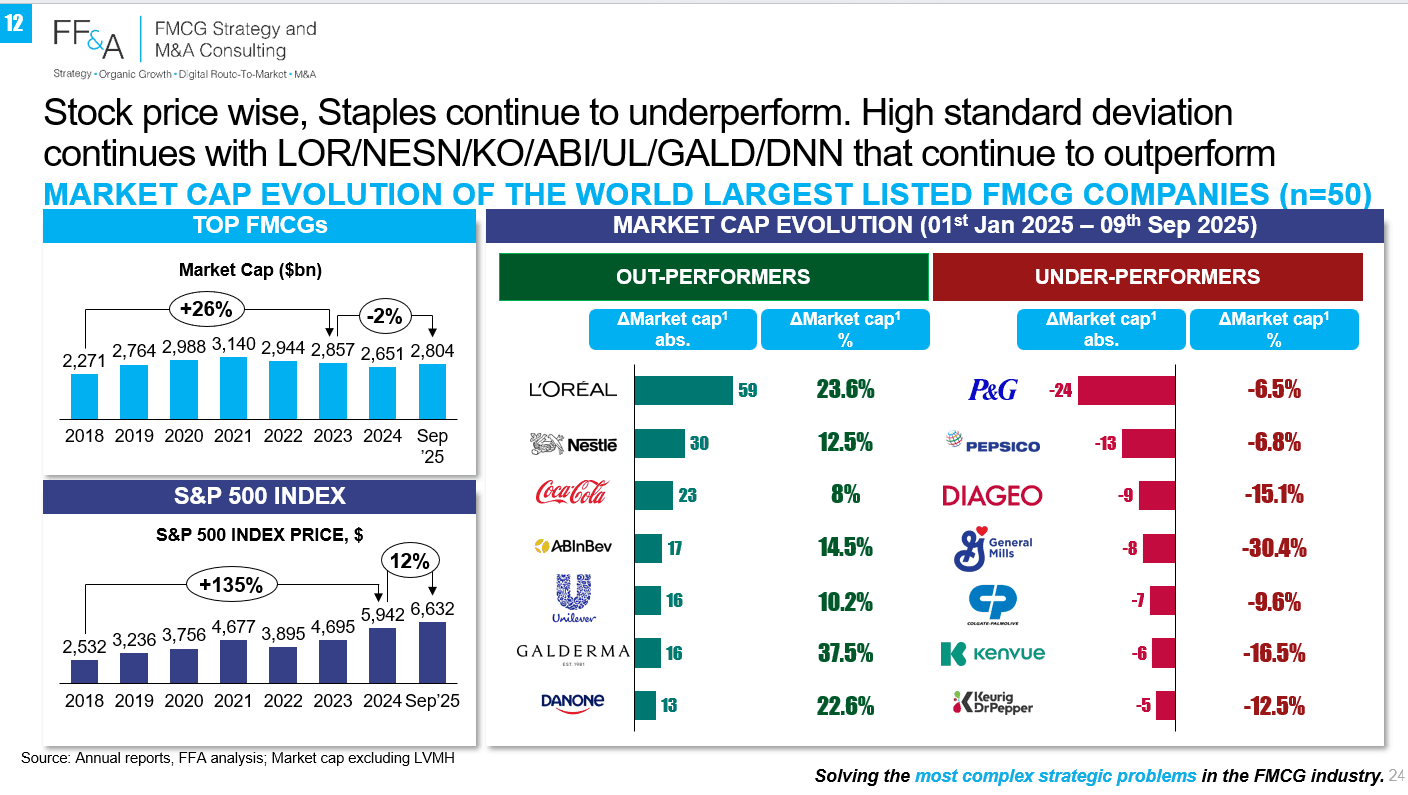
12) Stock price wise, Staples continue to underperform. High standard deviation continues with LOR/NESN/KO/ABI/UL/GALD/DNN that continue to outperform
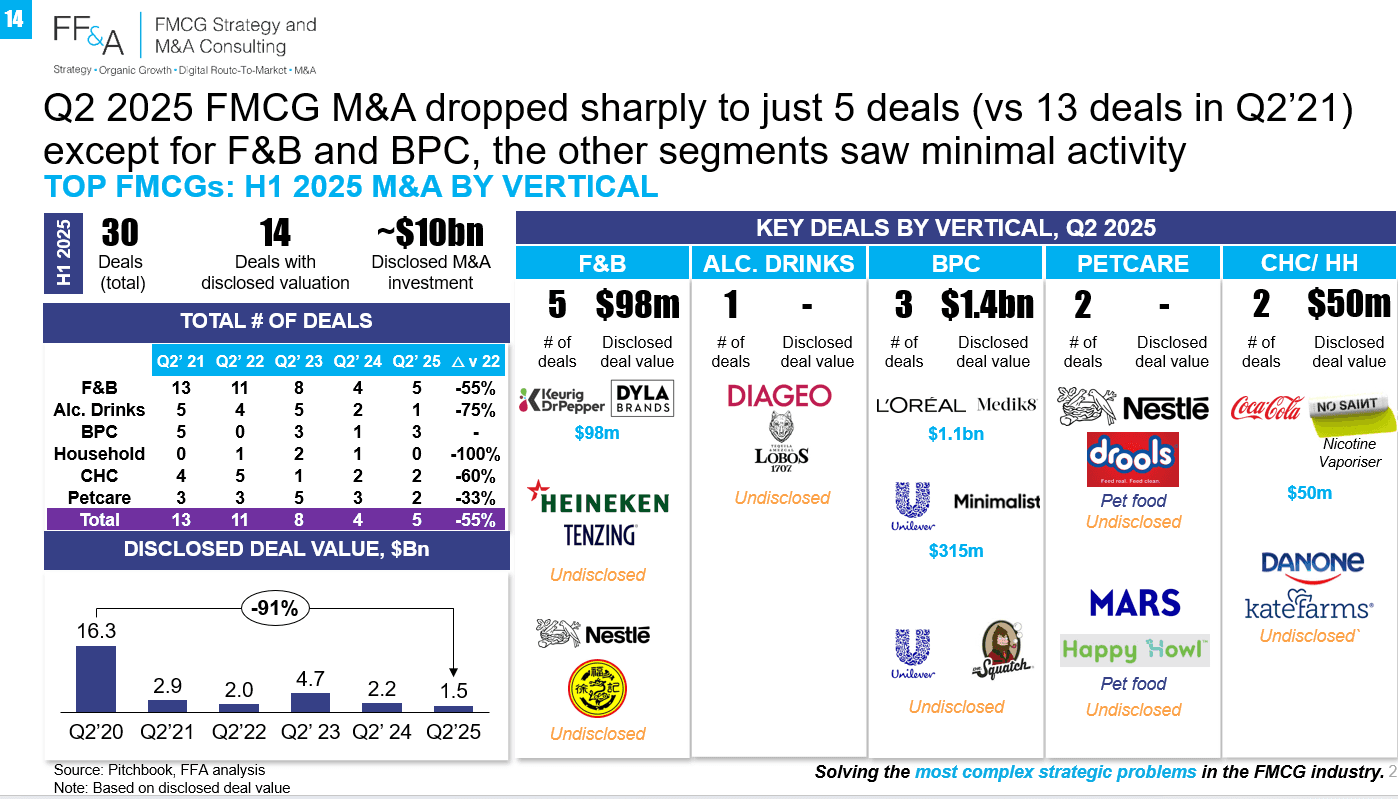
13) M&A bounced back strongly in H1 2025 vs. PY driven by mid-size transactions but overall value remain for now far below historic levels. Q2 in was particularly soft
14) Divesture value remains elevated & continue to exceed M&A value
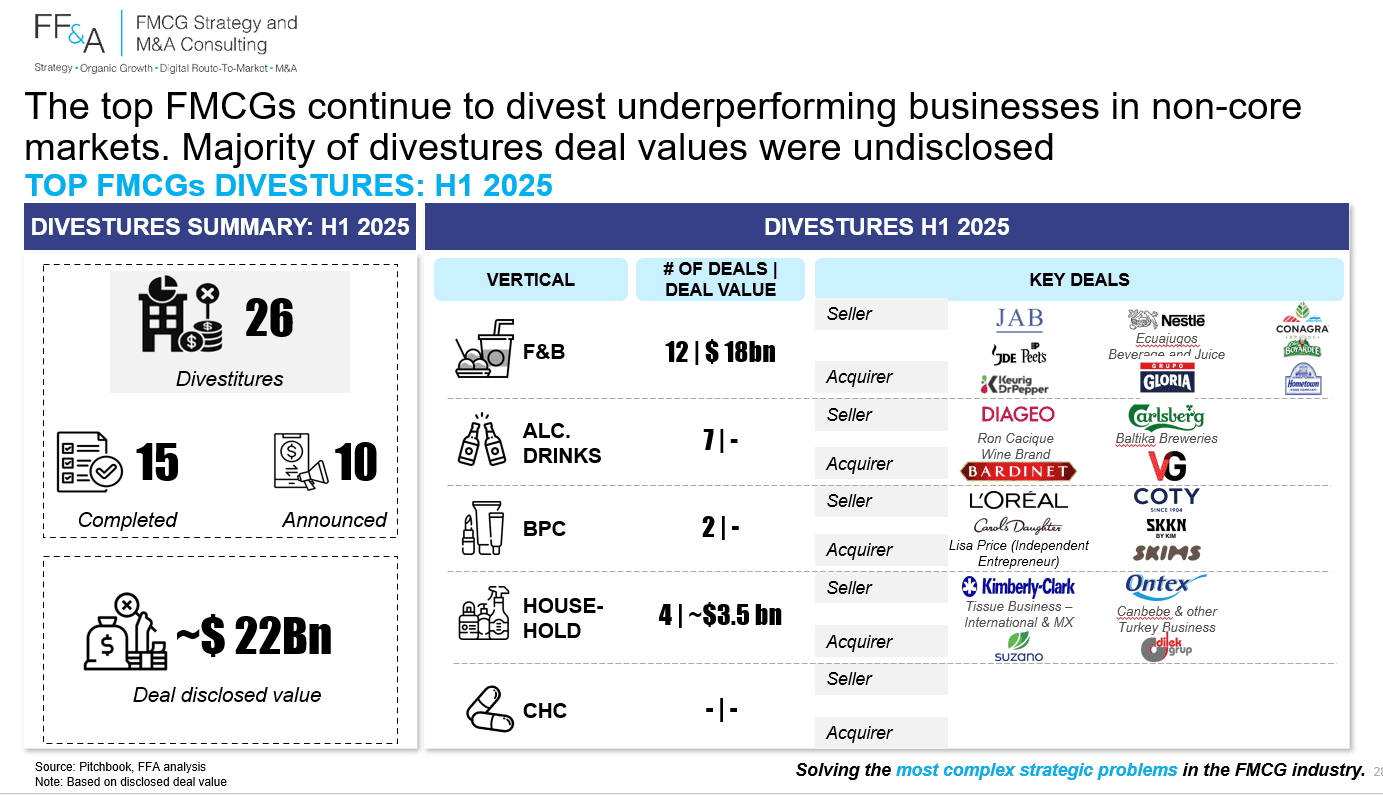
15) Two standout transactions represent it best (Reckitt Essential Home & Unilever Ice Cream)

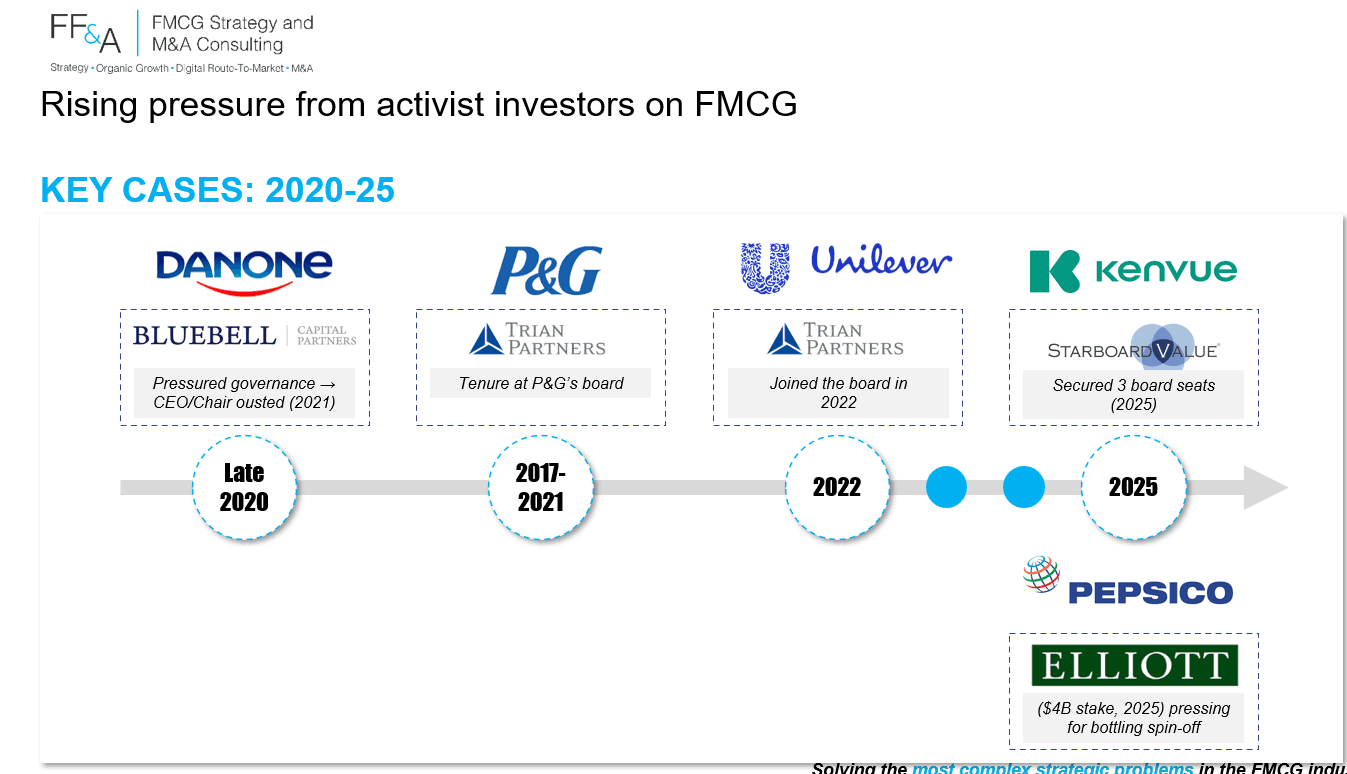
16) The overall in a context pressure from activists investors continue to increase
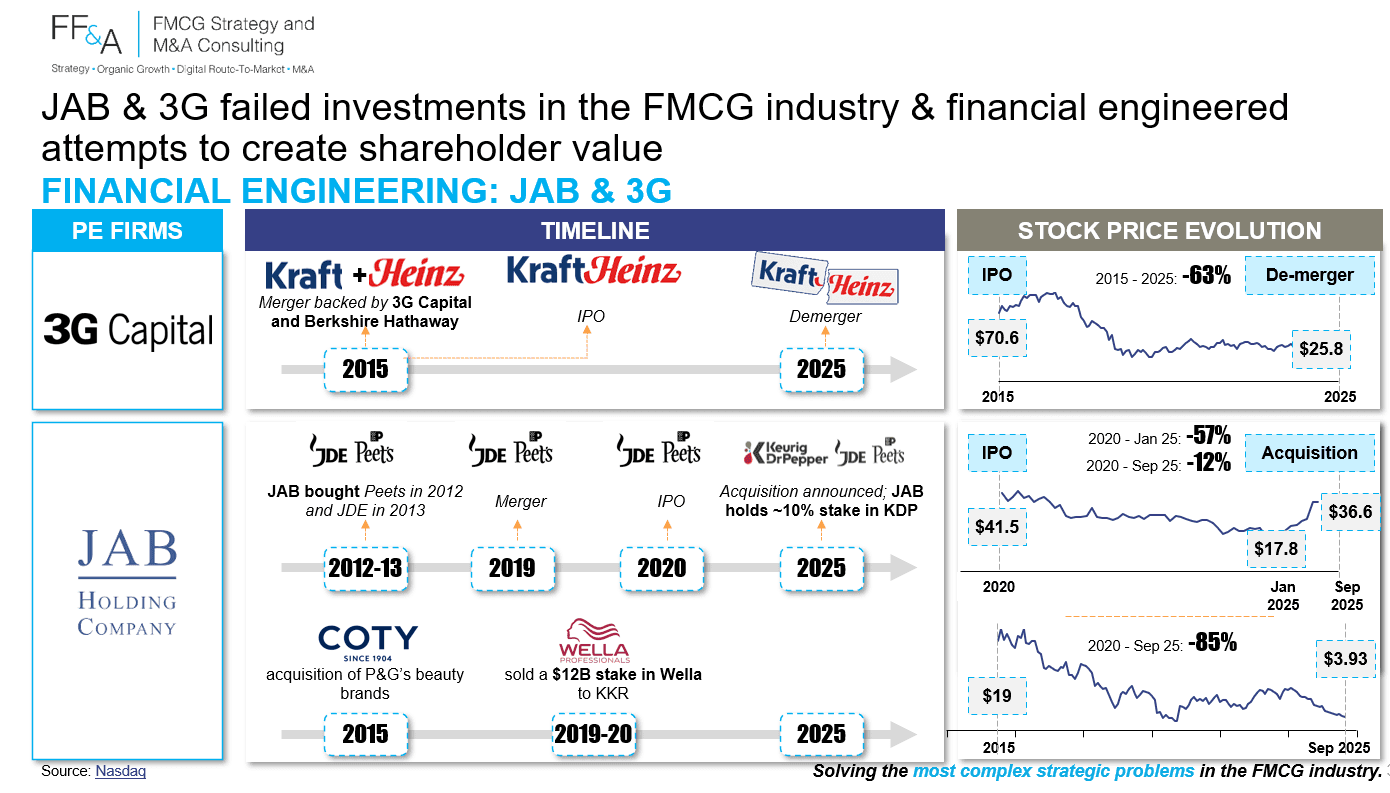
17) Kraft-Heinz and JDE-KDP financially engineered moves are unlikely to create large incremental shareholder value and to step-change the ROCE of two transactions initiated 10 years ago by the now infamous so-called PE disruptors
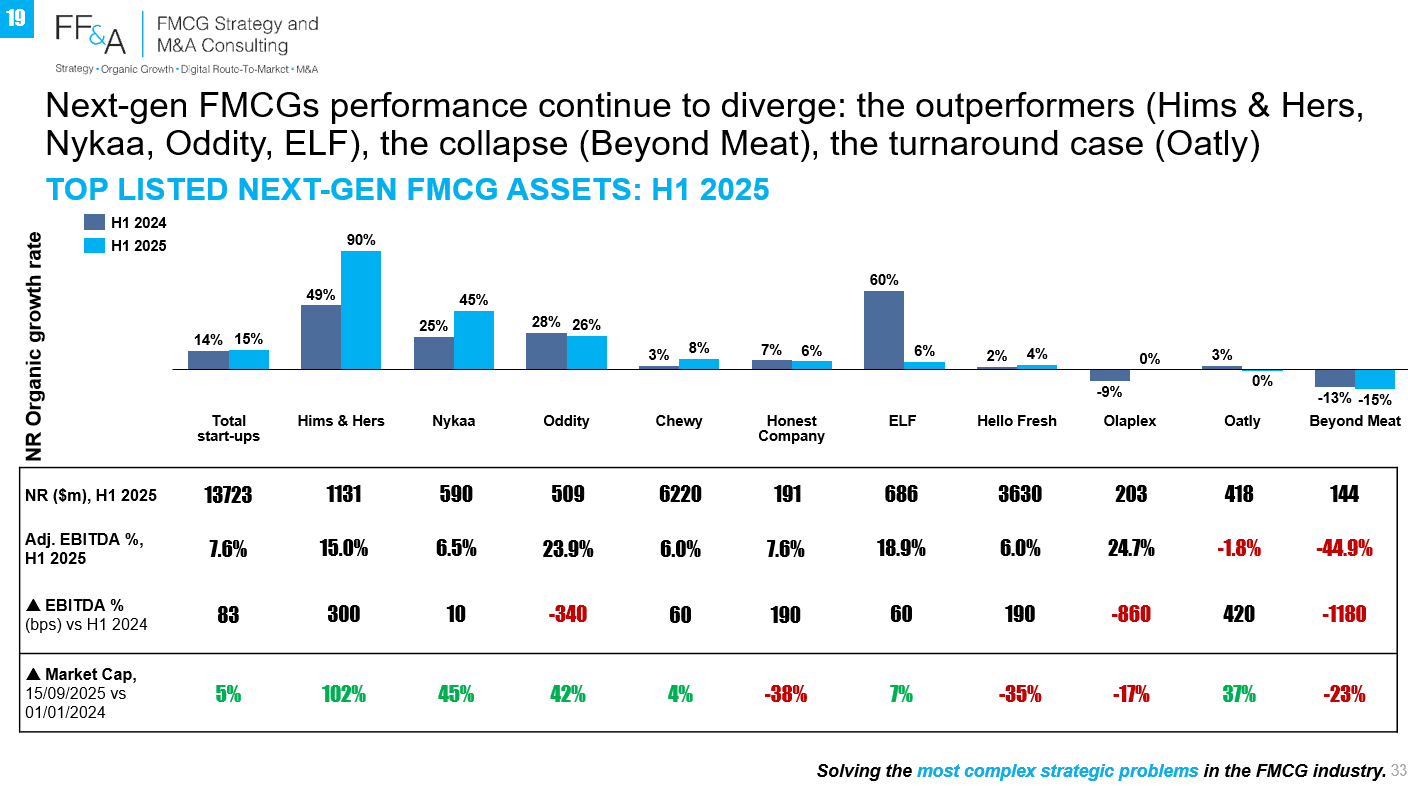
18) Next-gen FMCGs performance continue to diverge: the outperformers (Hims & Hers, Nykaa, Oddity, ELF), the collapse (Beyond Meat), the turnaround case (Oatly)
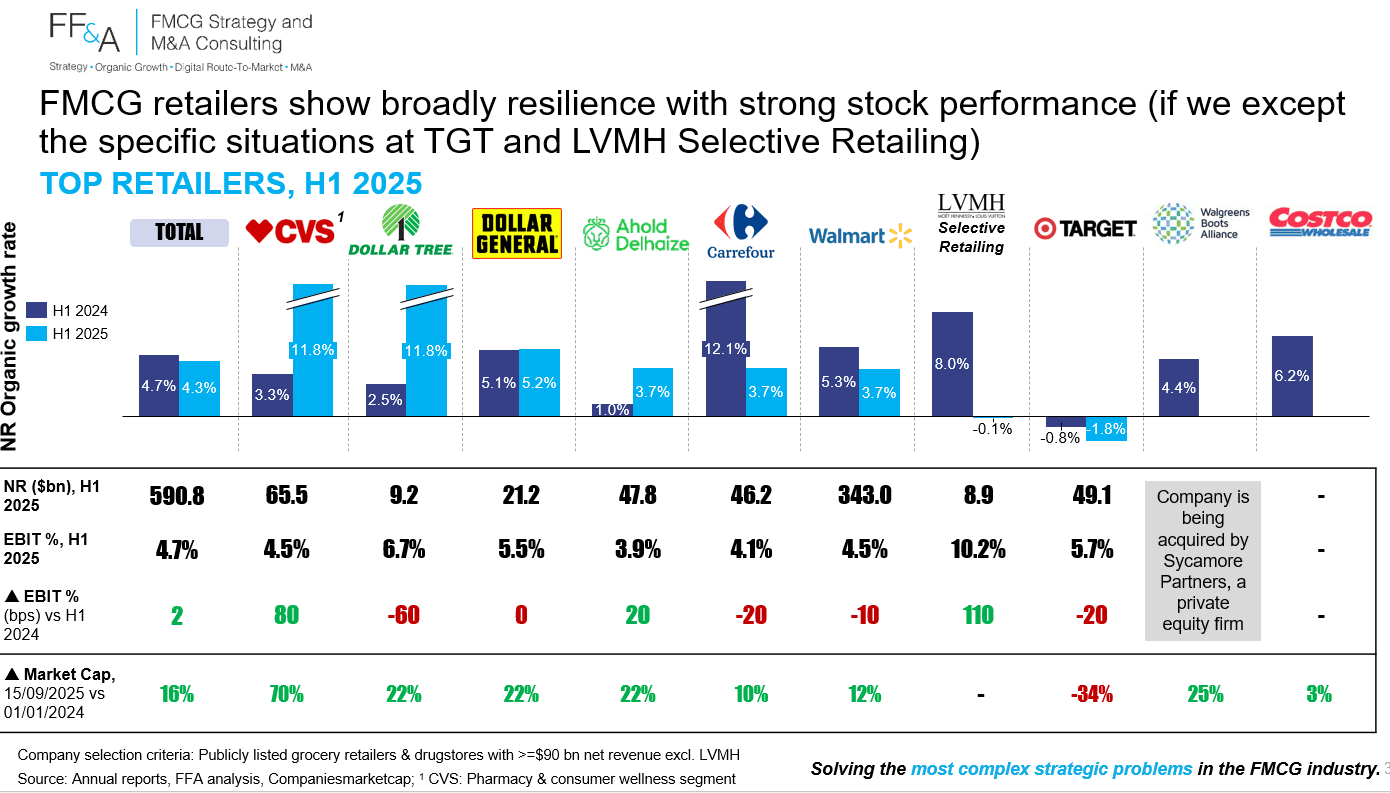
19) FMCG retailers show broadly resilience with strong stock performance (if we except the specific situations at TGT and LVMH Selective Retailing)
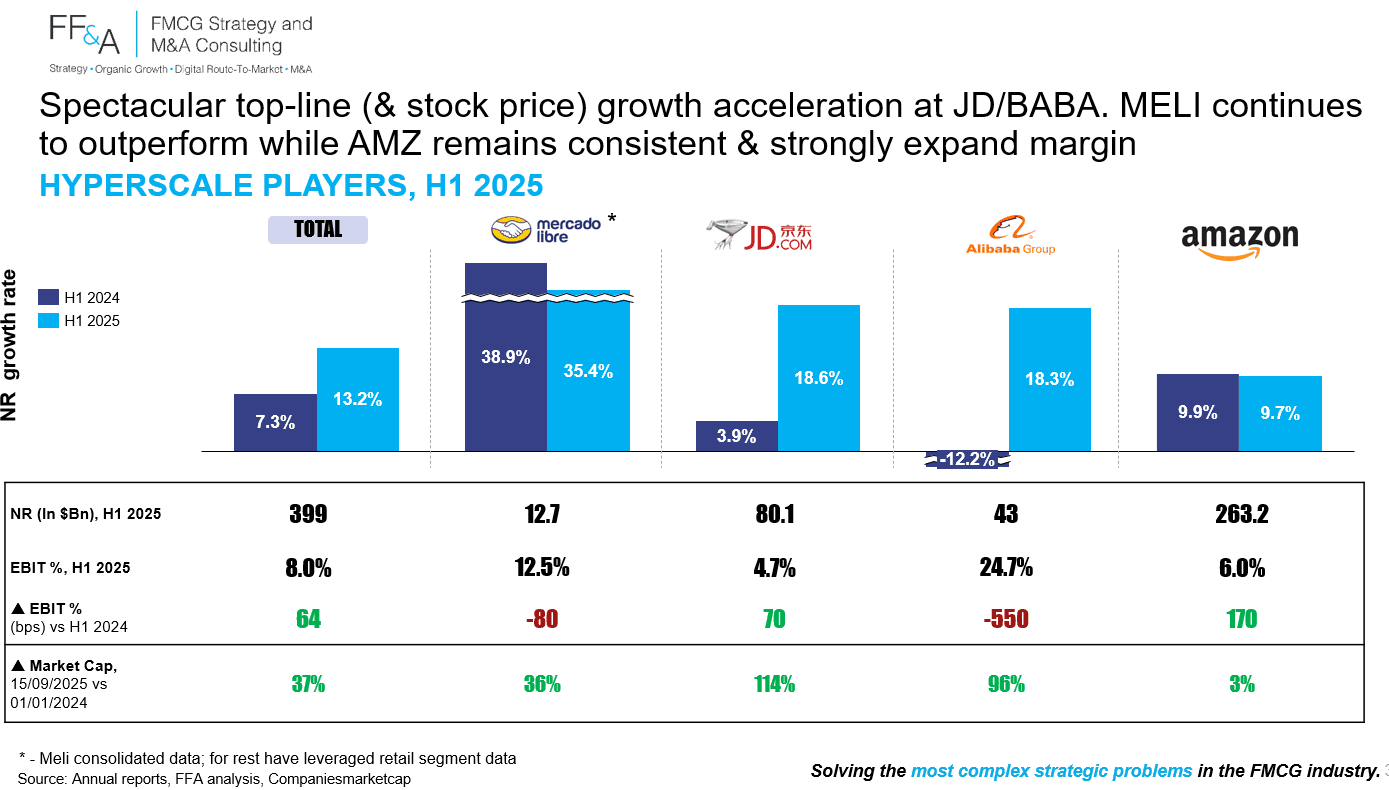
20) Spectacular top-line (& stock price) growth acceleration at JD/BABA. MELI continues to outperform while AMZ remains consistent & strongly expand margin
'The best way to predict the future is to create it' attributed both to Abraham Lincoln and Peter Drucker
Exciting times
Get in touch:
To join the >58,000 FMCG executives that follow Frederic on LinkedIn, please click here. To start a conversation, email at: frederic@fredericfernandezassociates.com
To participate to the Growth FMCG CEO podcast, email at: frederic@fredericfernandezassociates.com
To join the >35,000 FMCG executives that receive our newsletter and all our CEOs Insights, sign-up at the following link: FMCG CEOs - Managing For Growth
To read all our previous publications, visit our newsletter page: FMCG CEOs - Managing For Growth
About FF&A:
FF&A solves the most complex strategic problems of the world largest FMCG companies across Corporate Strategy, Organic Growth, Digital RTM (Ecommerce, DTC and EB2B) and M&A. 14 out of the world 20 largest FMCG companies are repeat Clients
FF&A team intervenes all across the globe and across all FMCG categories. To know more, please visit our website:
www.fredericfernandezassociates.com
Disclaimers:
No FF&A employees own any stocks or financial instruments of any FMCG companies
Enjoyed this article?

FMCG CEOs: Managing For Growth
Strategic insights for FMCG/ CPG CEOs