
Corporate Strategy
FMCG CEOs: Q3 Results In 20 Charts - You Cannot Buy Your Way To Growth

Author | Managing Director & Partner @ FFA
'You cannot cut your way to growth' - Paul Polman famous quote on 3G failed takeover bid on Unilever in 2017. He was prescient in the sense that those words anticipated the large shareholder value destruction driven by 3G/JAB in the FMCG industry over the following decade
'You cannot buy your way to growth' - Reflecting on the current context & the upcoming 2025-35 decade, our views are that the biggest risk may well be to believe that we can (alone) buy our way to growth, either through increasing A&P and accelerating dramatically pace of innovations without holistic growth strategy, and/ or through completing mega M&A deals (>30% EV acquirer) from a position of weakness (underperforming core)
Q3 results are now all out, here is our summarized take in 5 key messages:
1) Volume decline continues, profitability erosion accelerates and gap between winners & losers keep widening (cf. below charts). Throwing more A&P and innovations to the growth problem will not solve it. Mega M&A deals & financially engineered mergers built on naïve investment bankers' SOTP analysis & glossy strategy consultants' synergies forecast will not cut it. Time to wake-up: growth is hard work and cannot be bought it in few quarters
A&P reinvestments/ accelerated pace of innovations alone cannot accelerate organic growth (cf. eroding profitability for >50% of FMCG companies and A&P growth YTD vs. YAG with little to no revenue growth acceleration). Without a holistic consumer-back growth strategy, A&P reinvestments & more innovations will do little to sustainably accelerate growth. All it will do will be to dilute scarce strategic resources (organization time, profit, capital, mental & physical availability...)
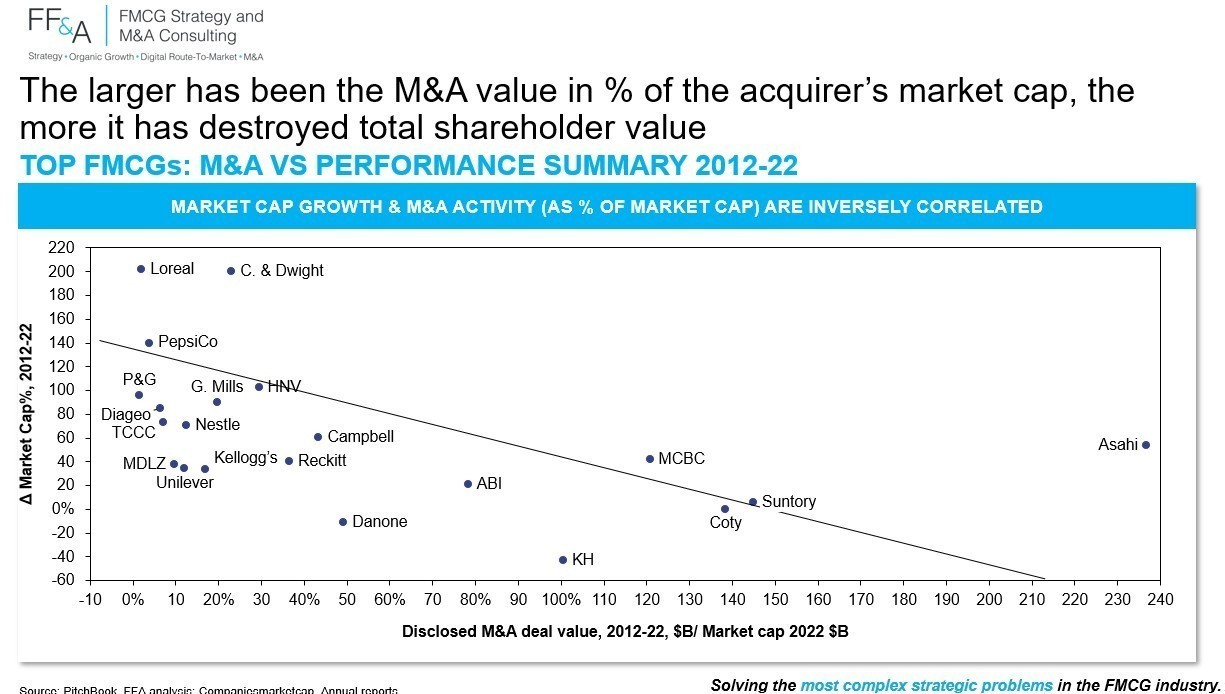
Large M&A deals done from a position of weakness (underperforming core business) in the hope to create shareholder value (cf. JDE-KDP, Kraft-Heinz, Kenvue-Kimberly Clark) will do little to create shareholder value as witnessed the net shareholder value destruction post announcements of each of those deals. M&A create most value when the acquirer has a healthy core and it acquires a synergistic faster growing asset
Saying it differently: you cannot alone buy your way to growth. You need much more (more on this below)
2) H1 results marked a shift from a 'shrinking-to-glory' era (most missing top-line yet most delivering bottom-line) to a 'shrinking-to-misery' era (most missing both top-/ & bottom-line and reducing guidance). It is the consequence of the end of three super-cycles (end of high pricing, end of China as global tailwind, end of post COVID growth acceleration on few specific categories like VMS, Beauty, Pet, Alcoholic Drinks) along with now a (cyclical) weakness in US/EU consumption3
3) Majority of FMCG companies are ill-prepared to manage this situation (>50% are yet to recover their pre-covid profitability level, most have been on average steadily losing market share over the last decade). One-off reinvestments into growth are likely to be a negative sum game (most FMCG companies neutralizing each other with increased pace of innovations & increased A&P), the overall translating into profit erosion with little-to-no top-line growth (all confirmed by Q3 results)
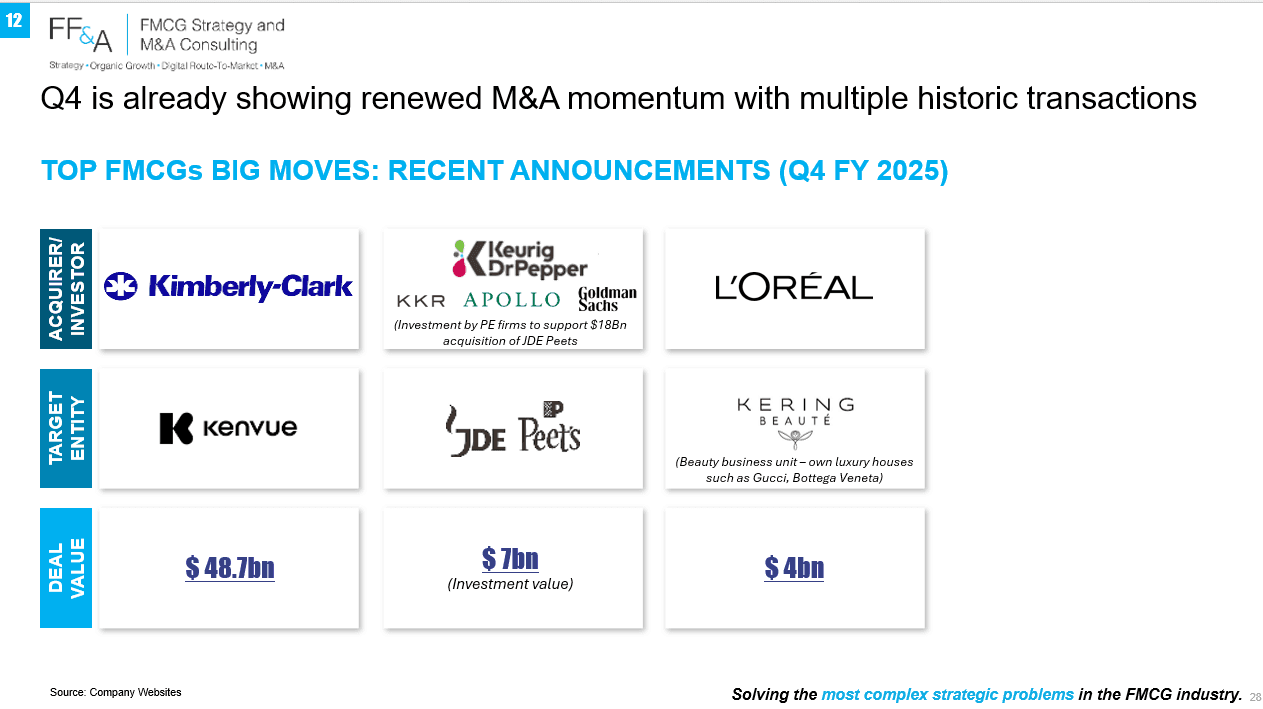
4) The delta between the cost of inorganic growth and the cost of organic growth is progressively reversing driving, as expected, an acceleration in M&A. Unsurprisingly mid-size growth oriented M&A on same categories large developed markets benefiting from GTM synergies are driving this trend (highest ROI deal type over the last two decades in the FMCG industry). We expect an non-linear acceleration in M&A as cost of capital continues to decline & cost of growth continues to increase (cf. Q4 M&A announcements)
5) Divesture remains the #1 lever to adjust growth/ profitability footprint at pace/ scale & boost EPS growth and unsurprisingly value of divesture continue to outpace M&A value for three years in a row
Spotting the above trends are rather obvious. What is interesting is to determine how to go about it. In that respect, our views remain unchanged. Here are our five key thoughts:
1) Generally, let's first fully remember the lessons learnt from the ‘lost last decade’ to prevent ‘shrinking-to-glory’ & resist to the two main 'deadly temptations' (getting wrong the cost take-out vs. top-line balance; solving structural organic growth problems with mega-M&A deals)
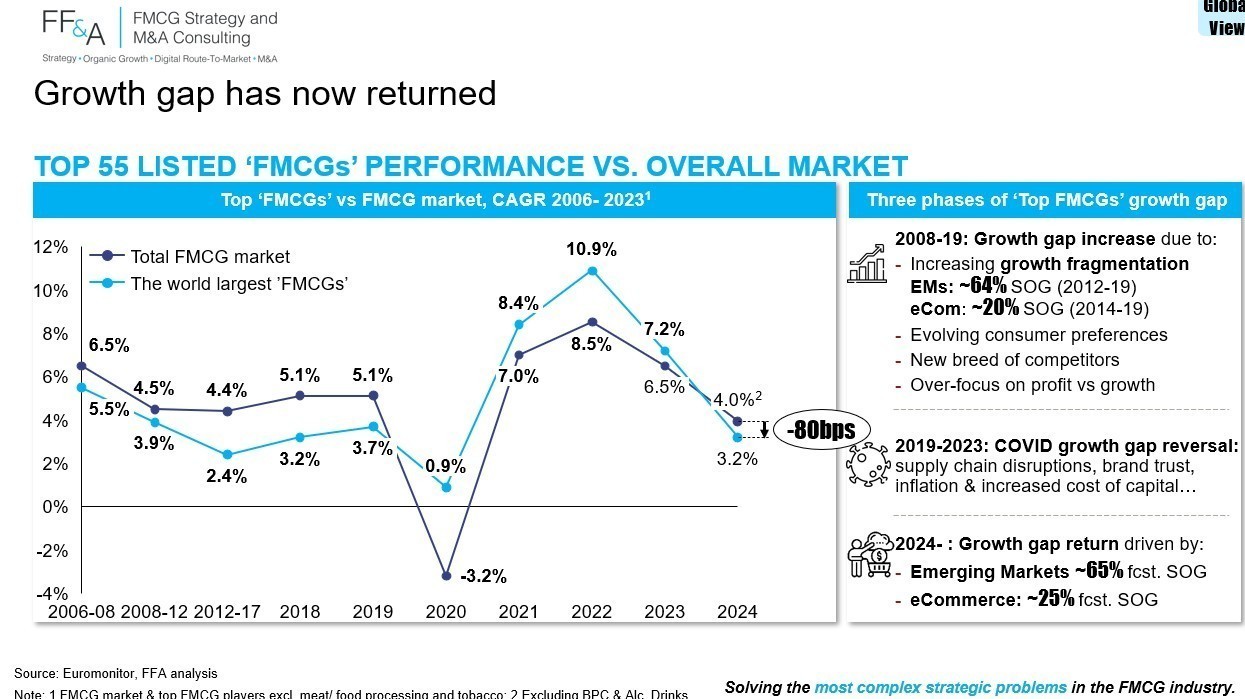
The 'lost last decade' & the expected return of the 'growth gap' from 2024:
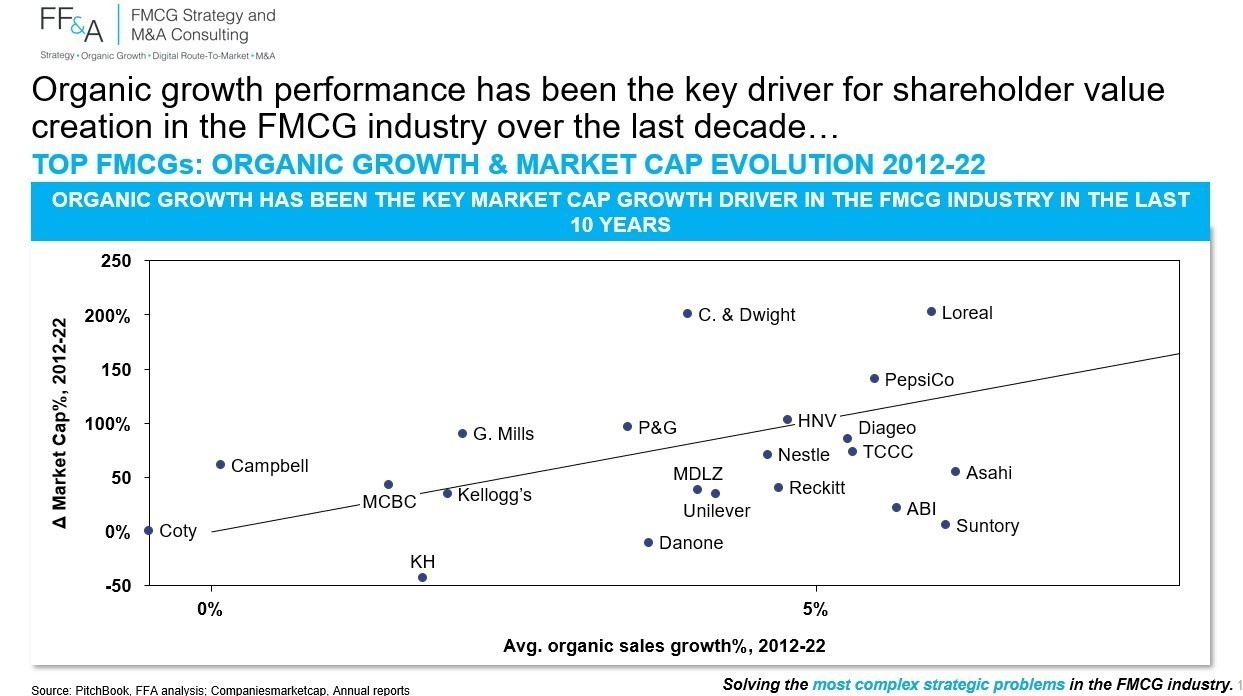
Organic growth as key shareholder value creation driver:
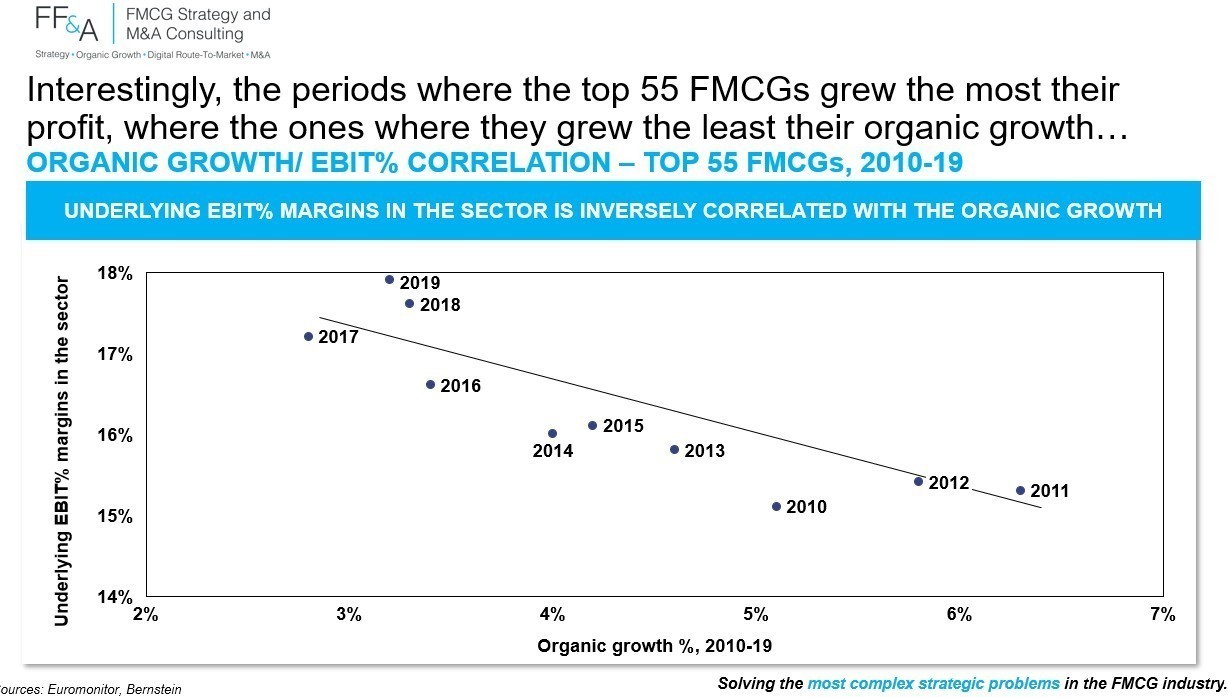
The need to balance top-line & bottom-line growth
Large M&A as the key driver of shareholder value destruction
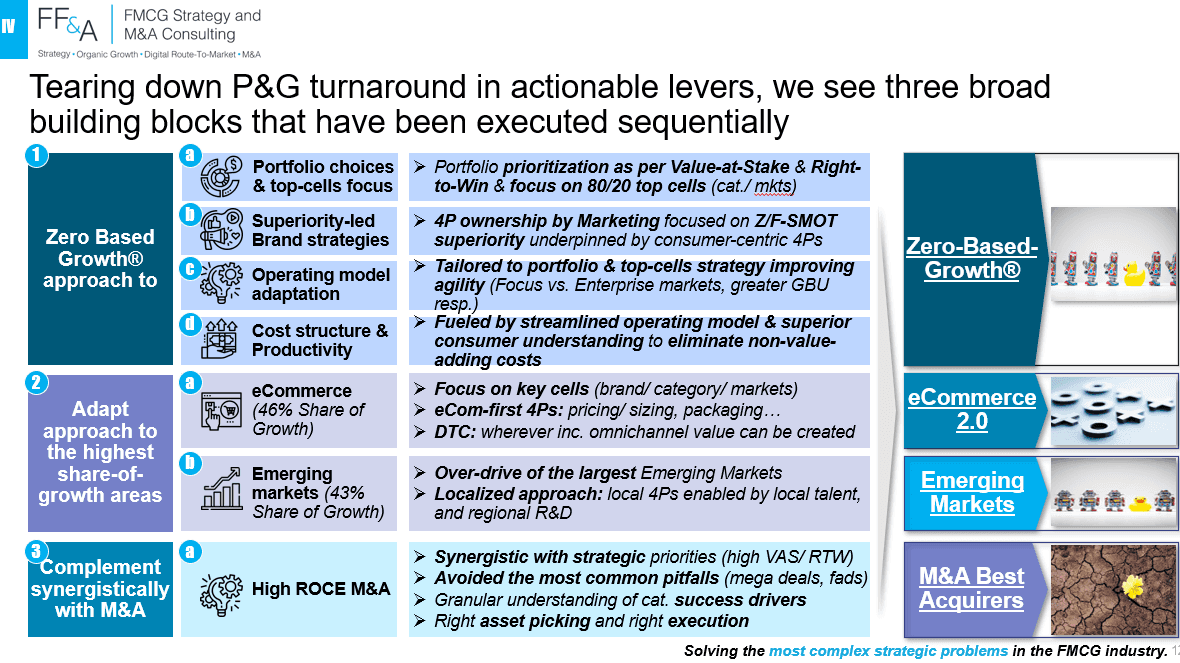
2) While we acknowledge the positive steps taken in 2024 to accelerate organic growth (portfolio optimization/ divesture, increase in marketing & promotion spend, acceleration of innovations, progressive acceleration in bolt-on M&As) & the time it will take to yield results, those one-off steps must be complemented by a holistic & replicable consumer-centric approach to organic growth outperformance that drives sustainably category expandability (vs. just grabbing shares or being obsessed by private labels) & that is deeply embedded in the entire organization. We call it Zero-Based-Growth® (cf. below ZBG® publication explaining in details the approach)
Some companies like P&G offer an interesting proxy (cf. below P&G turnaround case)
More perspective also on how to drive category expandability in our last episode of the Growth FMCG CEO Podcast with Pablo Perversi (President Europe, Danone) (cf. chapter 7 to 10):
Private labels remain for the immense majority of the FMCG industry not only statistically irrelevant but also a strategic distraction (more in our last publication below on Private Labels):
3) In a context Emerging Markets (EMs) are expected to continue to account for ~2/3 of the global share of FMCG growth, it is critical to adapt our global strategies to EMs and specifically to localize our 4Ps to outperform. China structural slowdown pushes us not only to reinvent ourselves in China (because of the sheer size of the market - cf. the now famous 'the next China will be China') but also to dramatically diversify our growth engines in EMs starting with India, Brazil, Mexico & many others. That is what we call the $1 Trillion race (the incremental sell-out value at stake in emerging markets outside China in the coming 5 years). Below a publication with our detailed perspective on how to unlock this $1 Trillion opportunity illustrated with cases
4) In a context Ecommerce contribution remains significant (~22% steady share of growth on average with great standard deviation ranging from ~50% for Pet Food/ Beauty through ~30s% for Consumer Health/ Diapers to ~5-15% for the rest – F&B, Household), external environment becomes more demanding (lower ecommerce growth, higher competition, increasingly fragmented & rapidly evolving e-customers landscape, higher pressure on profitability from the world largest pure players, rise of retail media putting all FMCG companies in a dynamic prisoner dilemma situation that can drastically increase the cost of growth as seen in 2024 in few large retailers) & the Ecommerce strategies of the world top 50 FMCGs still display significant improvement potential (unsustainable targets, out dated where-to-play/ how-to-win choices, insufficient consumer-back approach, unsustainable investment level with insufficient ROI, enhanced risk of omnichannel value destruction):
=> How to update our Ecommerce strategy to outperform & maximize incremental omnichannel value? (cf. the below publication for our detailed perspective)
5) As a result of the increasing cost of organic growth (pricing gains slowdown & muted volume for most, reinvestment into A&P and growth capabilities, increasing pressure from (r)etailers), the decreasing cost of inorganic growth (decreasing interest rate, compressed valuation, increasing assets availability) & increasing balance-sheet availability, we see an increasing case for M&A in 2025 & beyond. But risks remain abundant (majority of M&A transactions over the last decade did not pay-back, majority of current assets on the market have no future-proof value creation case)
In this context, the key strategic question becomes:
=> How to leverage M&A to complement effectively and with high ROCE our organic growth strategy? (cf. the below publication for our detailed perspective)
Our conviction remains: outperforming FMCG companies will be the ones that will be market makers and focus on driving incremental category growth
Reinvestment in A&P/ innovations and large scale M&A done in a position of weakness will not work
You cannot buy your way to growth
As usual, full details below on Q2 results in 20 key messages/ charts:
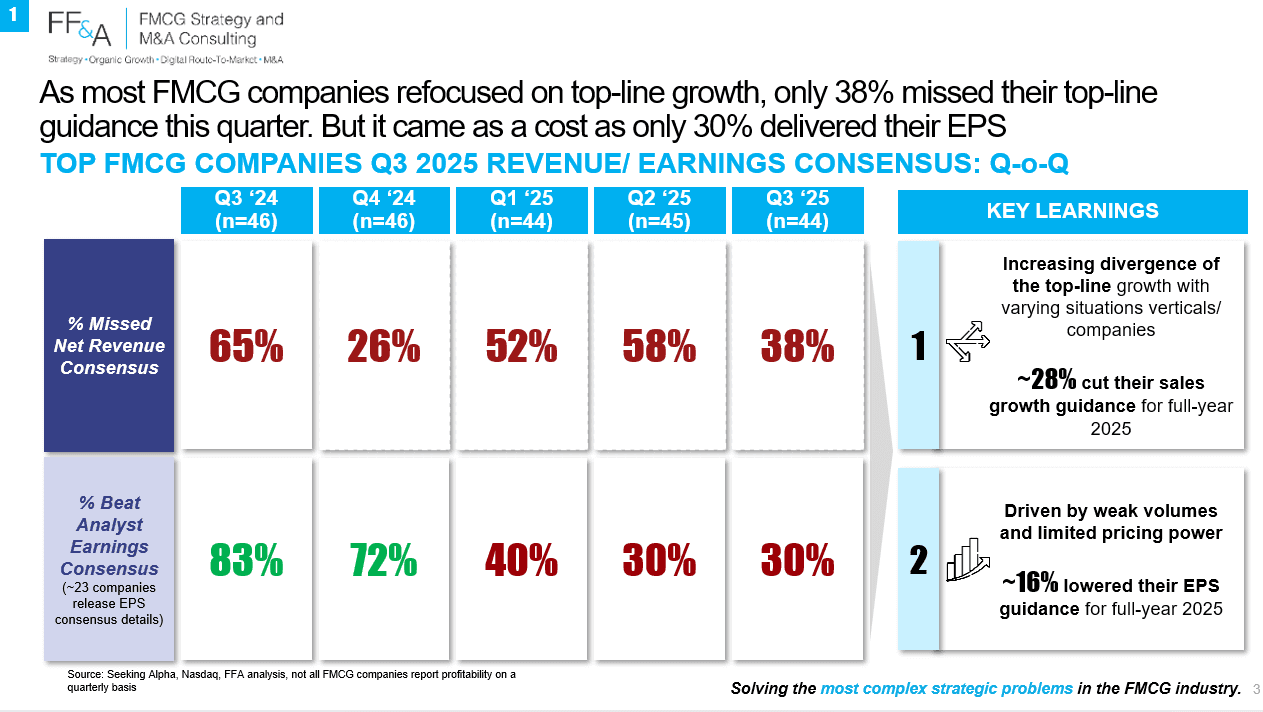
1) As most FMCG companies refocused on top-line growth, only 38% missed their top-line guidance this quarter. But it came as a cost as only 30% delivered their EPS
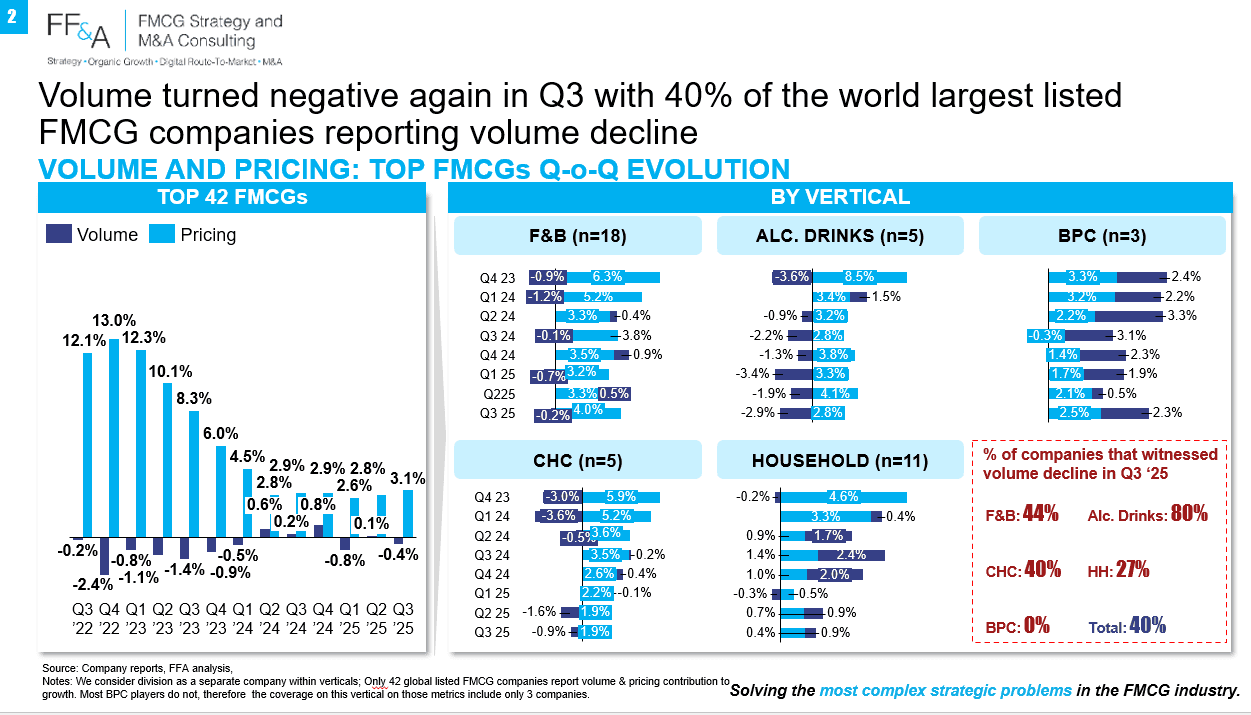
2) Volume turned negative again in Q3 with 40% of the world largest listed FMCG companies that reported volume decline
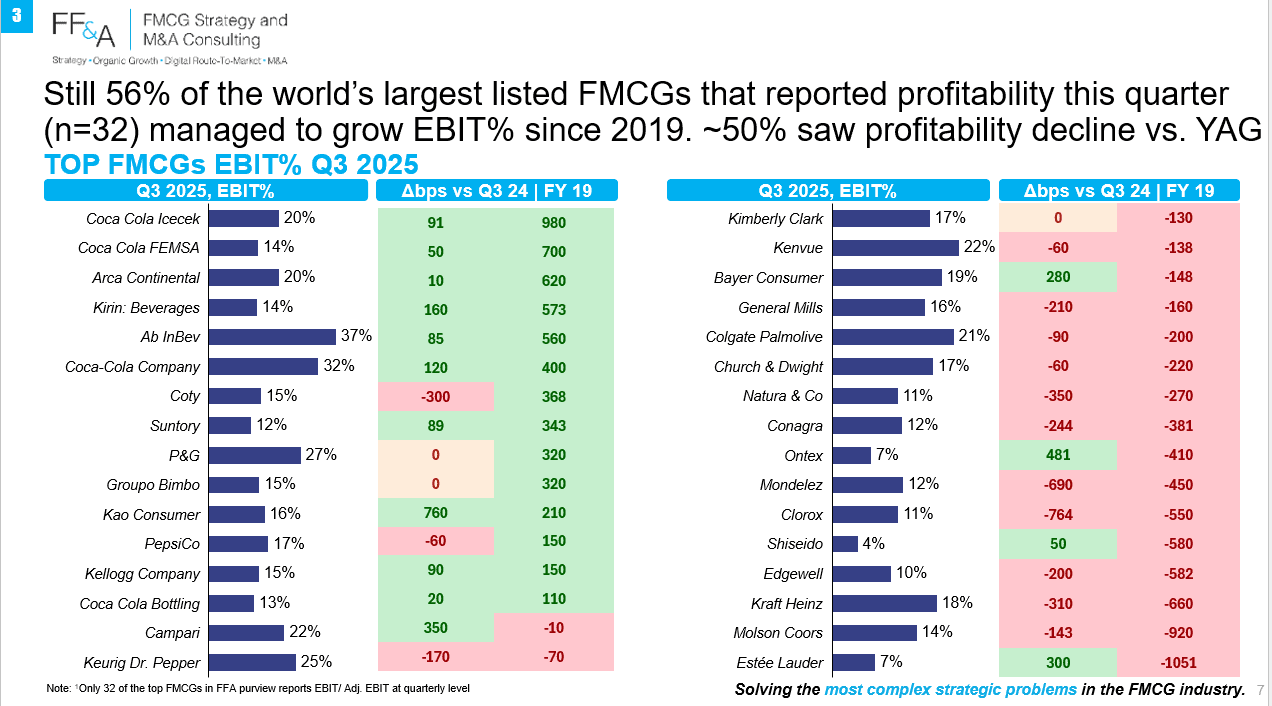
3) Still 56% of the world’s largest listed FMCGs that reported profitability this quarter (n=32) managed to grow EBIT% since 2019. ~50% saw profitability decline vs. YAG
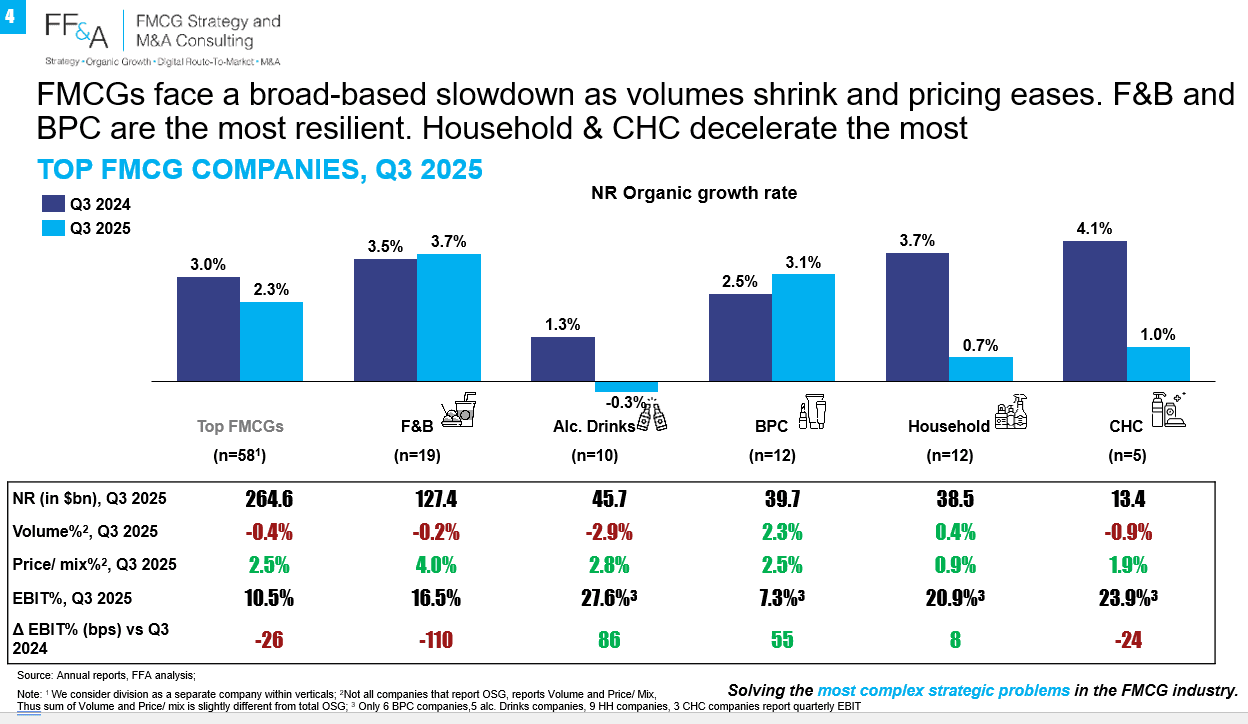
4) FMCGs face a broad-based slowdown as volumes shrink and pricing eases. F&B and BPC are the most resilient. Household & CHC decelerate the most
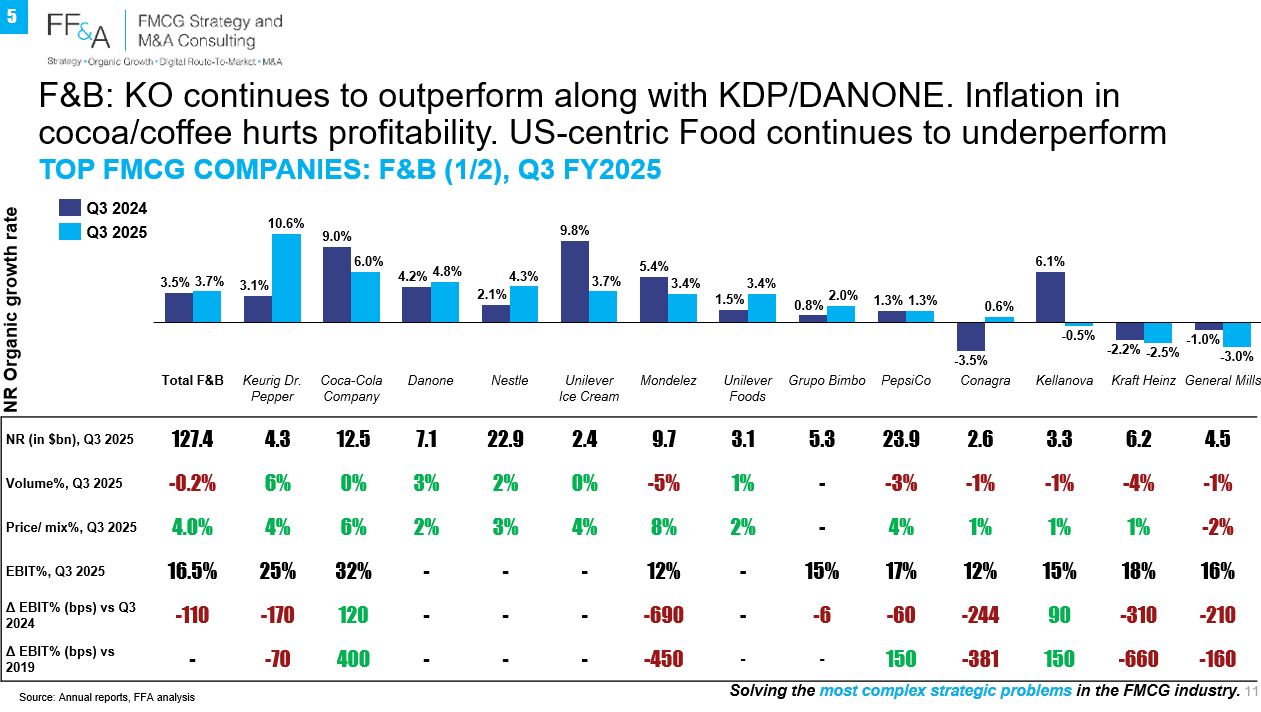
5) F&B: KO continues to outperform along with KDP/DANONE. Inflation in cocoa/coffee hurts profitability. US-centric Food continues to underperform
6) KO System: Strong price-led growth, with Icecek outperforming, while LATAM bottlers (FEMSA, Arca) lag due to now volume declines

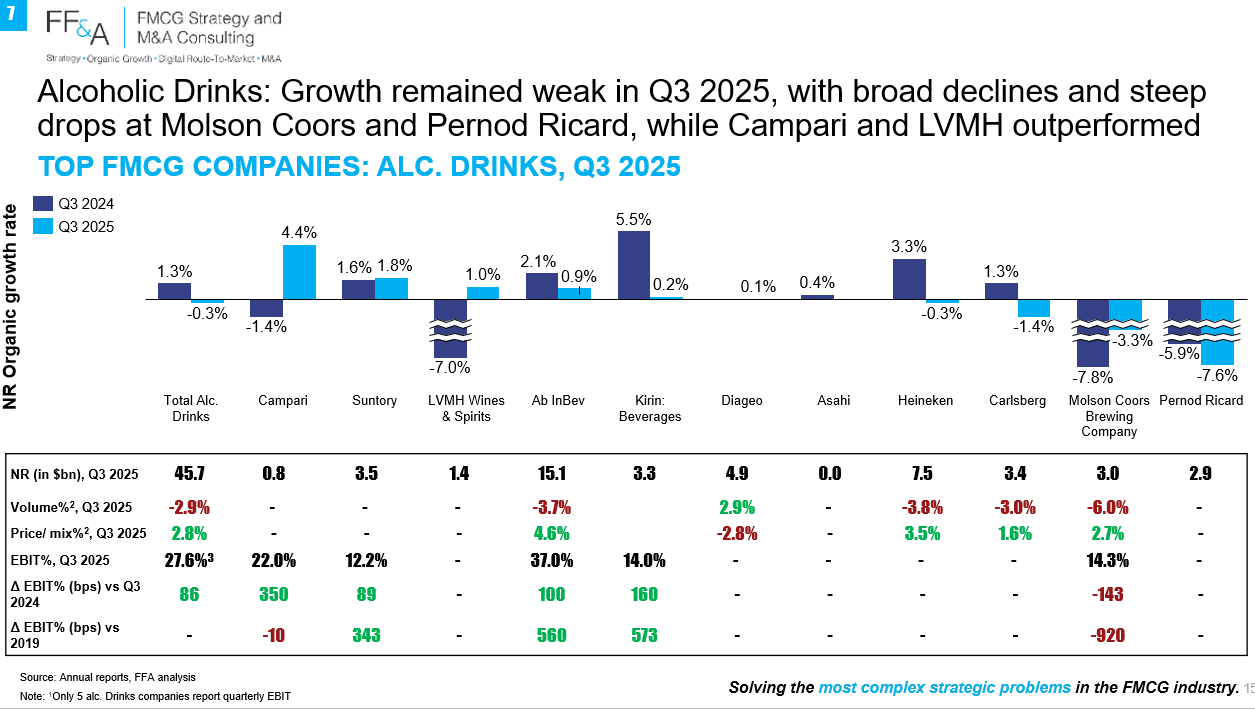
7) Alcoholic Drinks: Growth remained weak in Q3 2025, with broad declines and steep drops at Molson Coors and Pernod Ricard, while Campari and LVMH outperformed
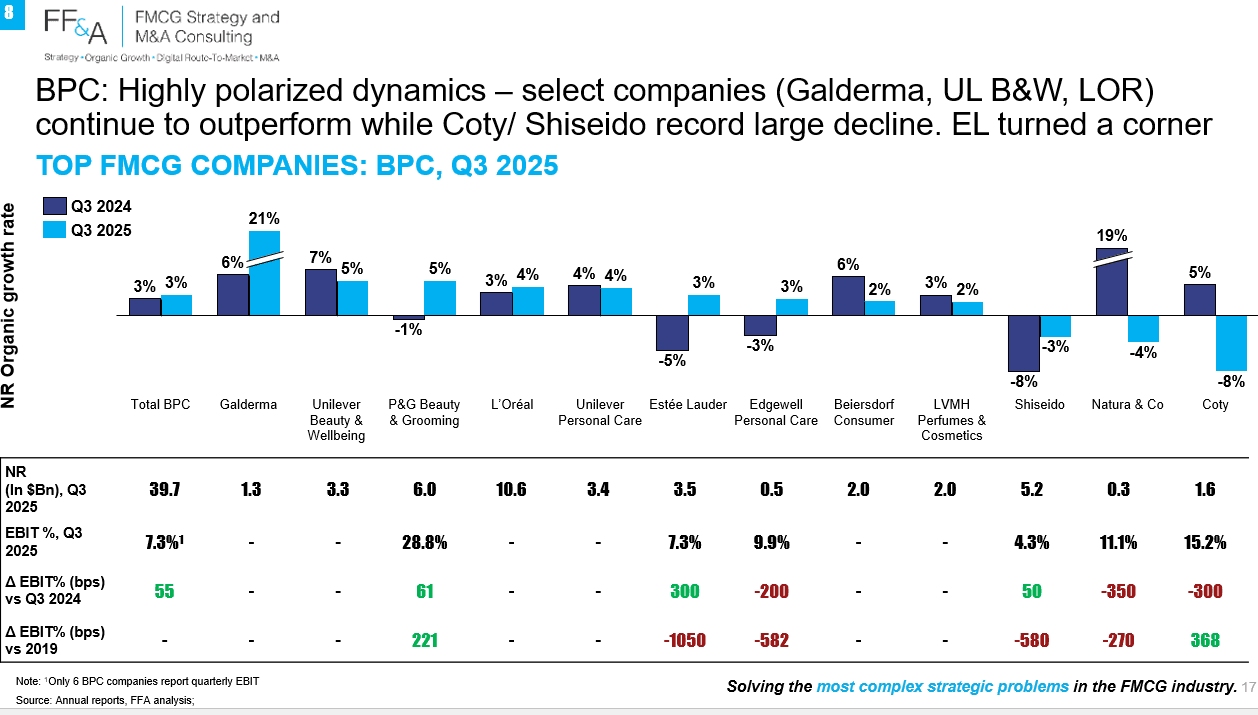
8) BPC: Highly polarized dynamics – select companies (Galderma, UL B&W, LOR) continue to outperform while Coty/ Shiseido record large decline. EL turned a corner
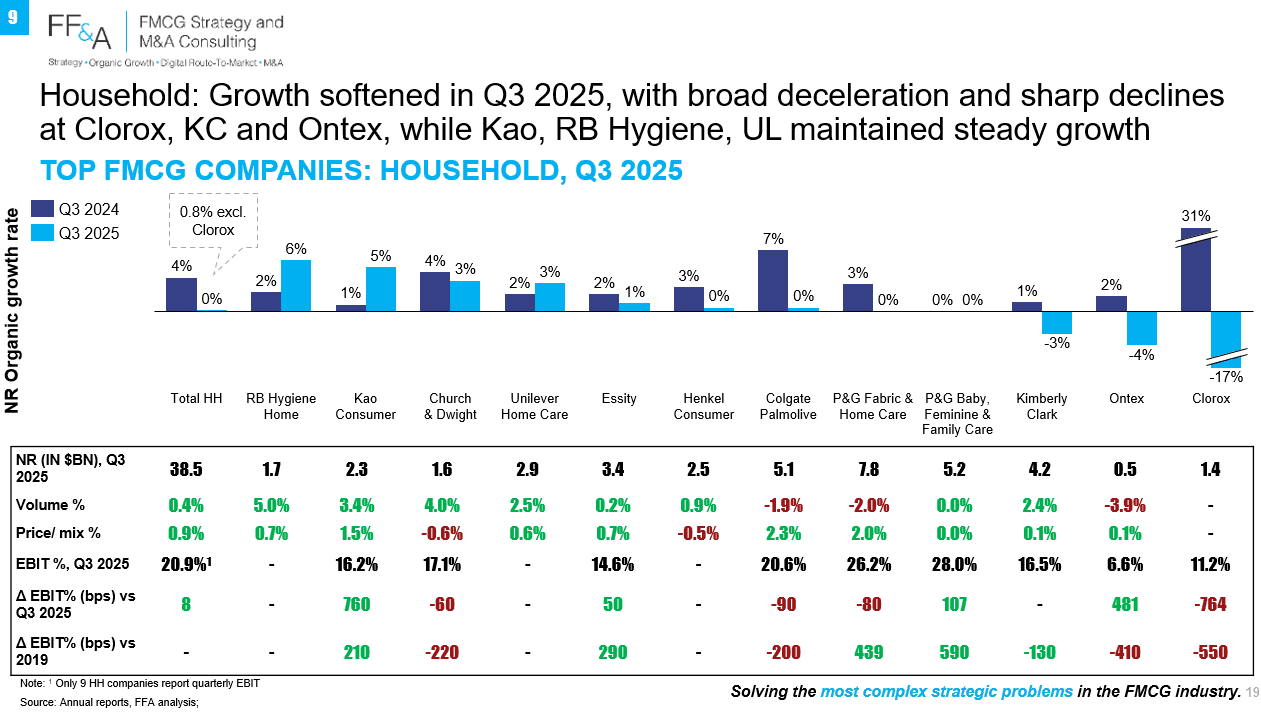
9) Household: Growth softened in Q3 2025, with broad deceleration and sharp declines at Clorox, KC and Ontex, while Kao, RB Hygiene, UL maintained steady growth
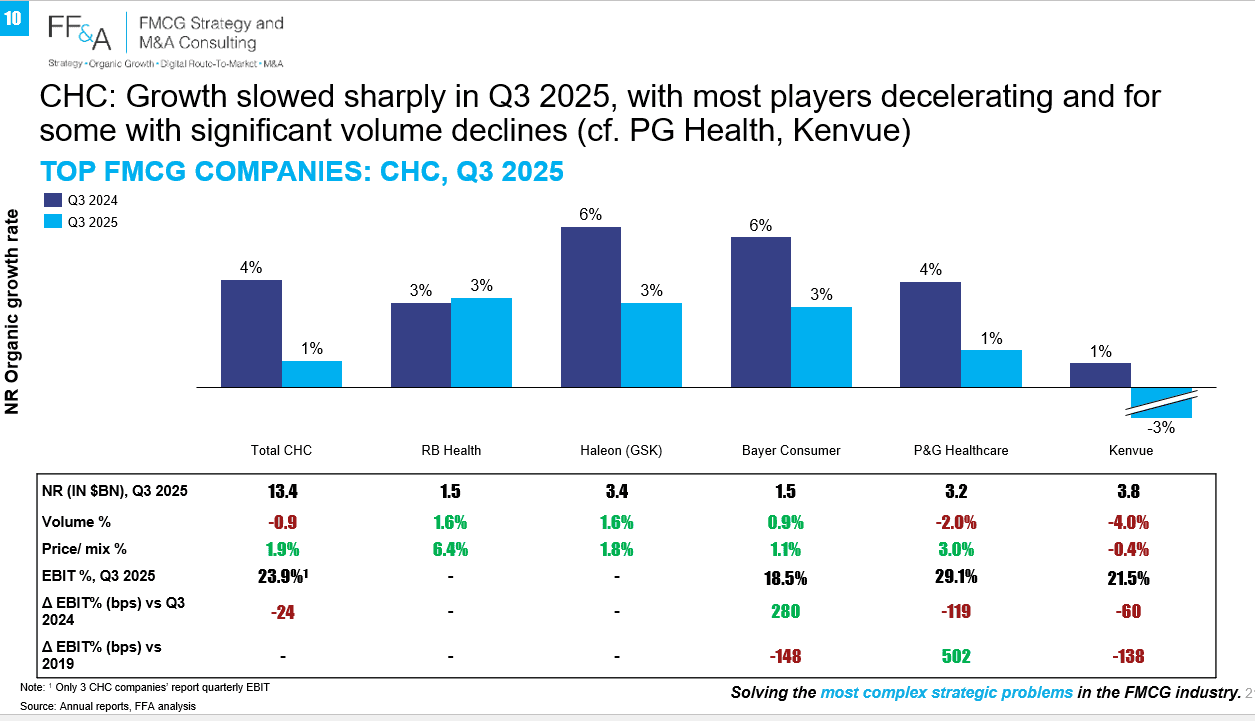
10) CHC: Growth slowed sharply in Q3 2025, with most players decelerating and for some with significant volume declines (cf. PG Health, Kenvue)
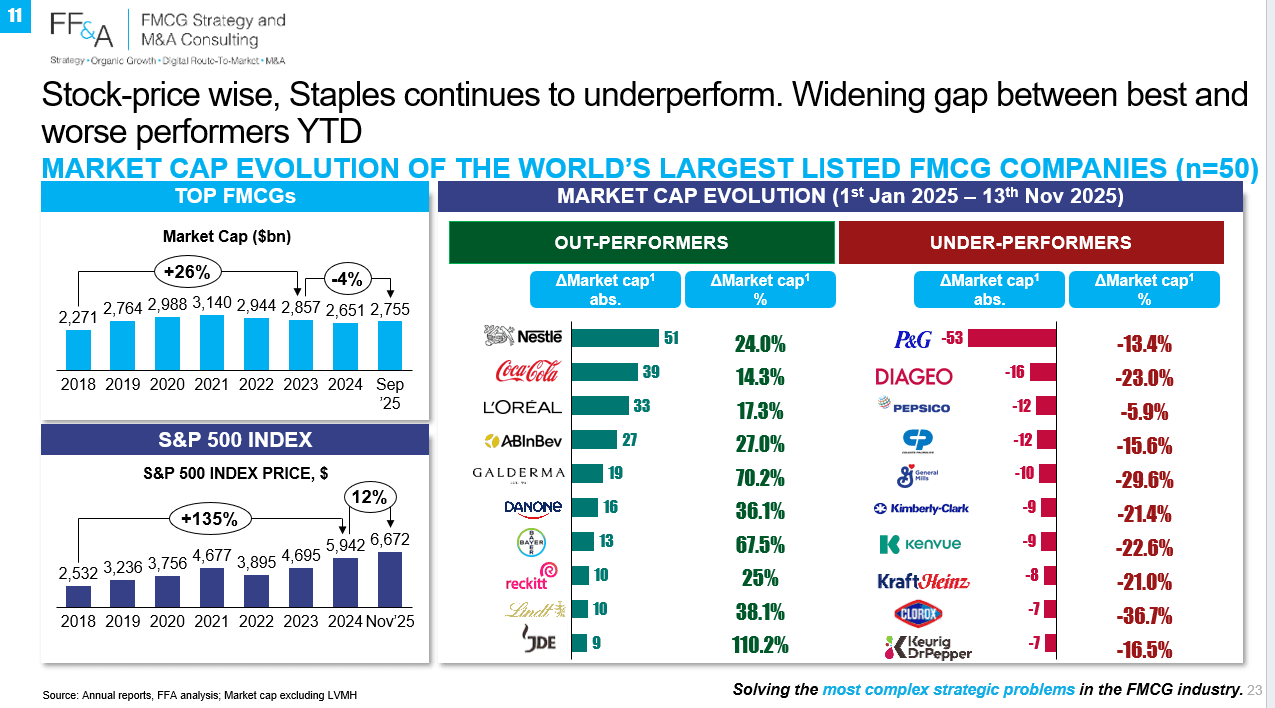
11) Stock-price wise, Staples continues to underperform. Widening gap between best and worse performers YTD
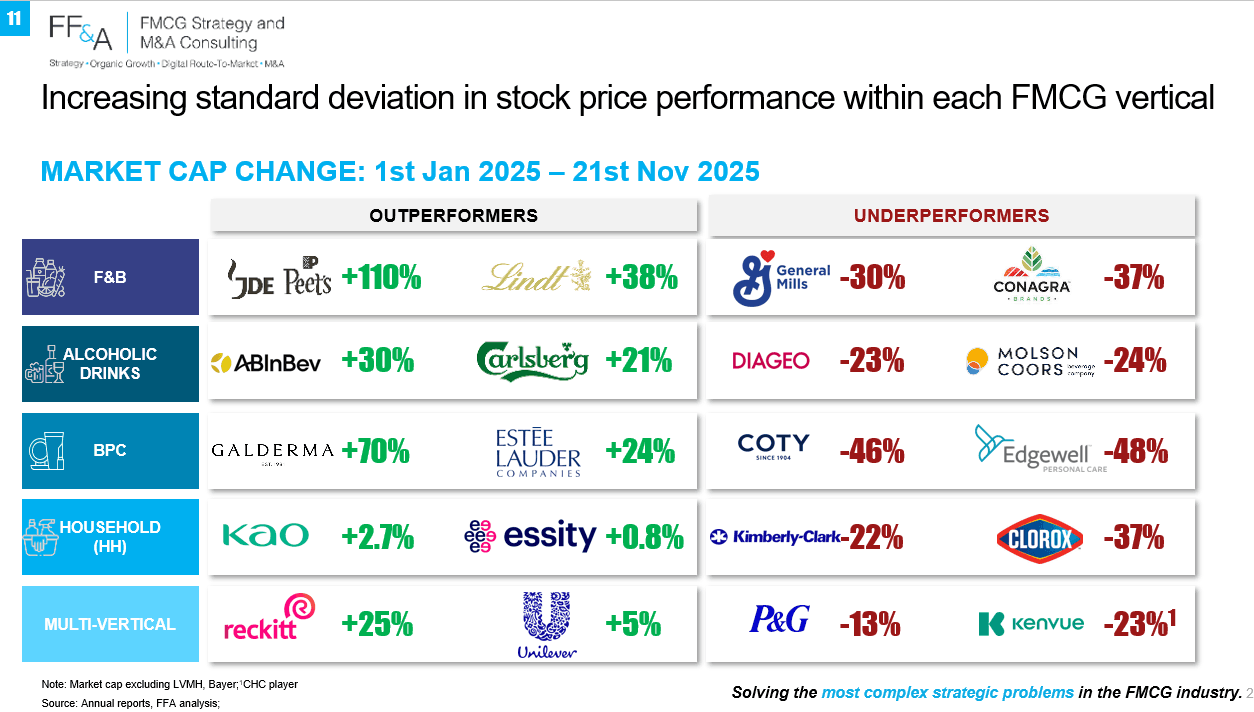
12) Increasing standard deviation in stock price performance within each FMCG vertical
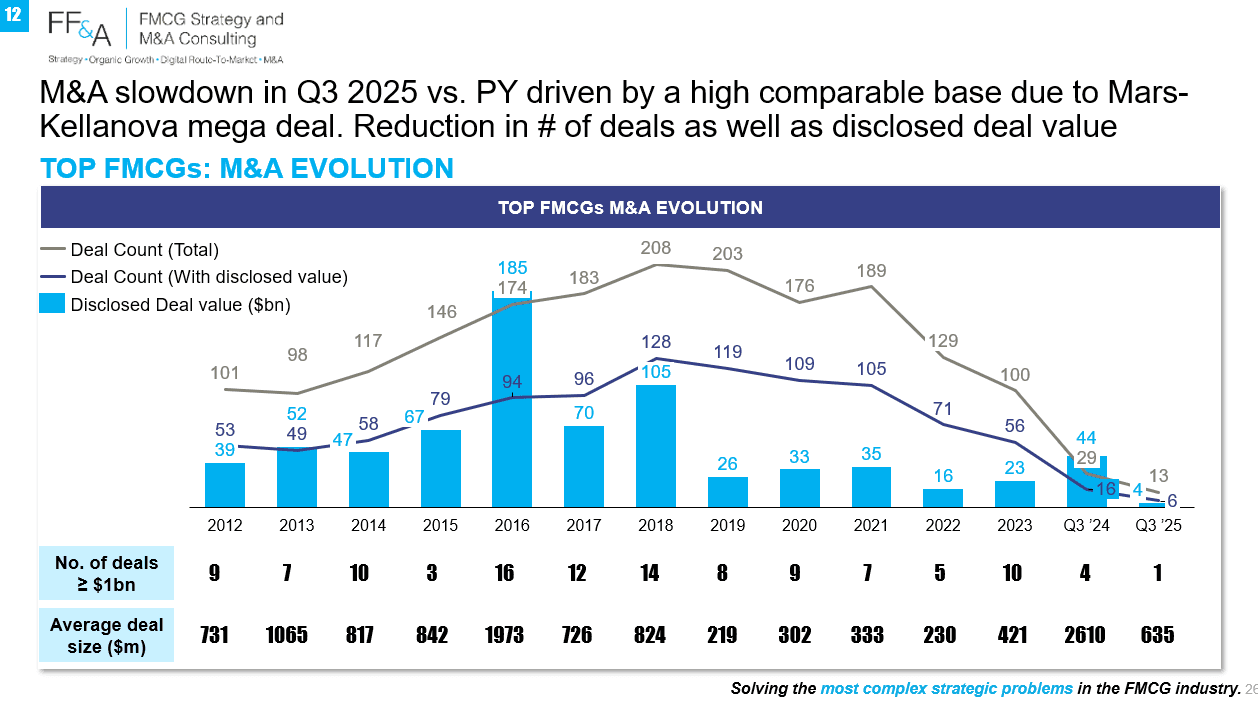
13) M&A slowdown in Q3 2025 vs. PY driven by a high comparable base due to Mars-Kellanova mega deal. Reduction in # of deals as well as disclosed deal value
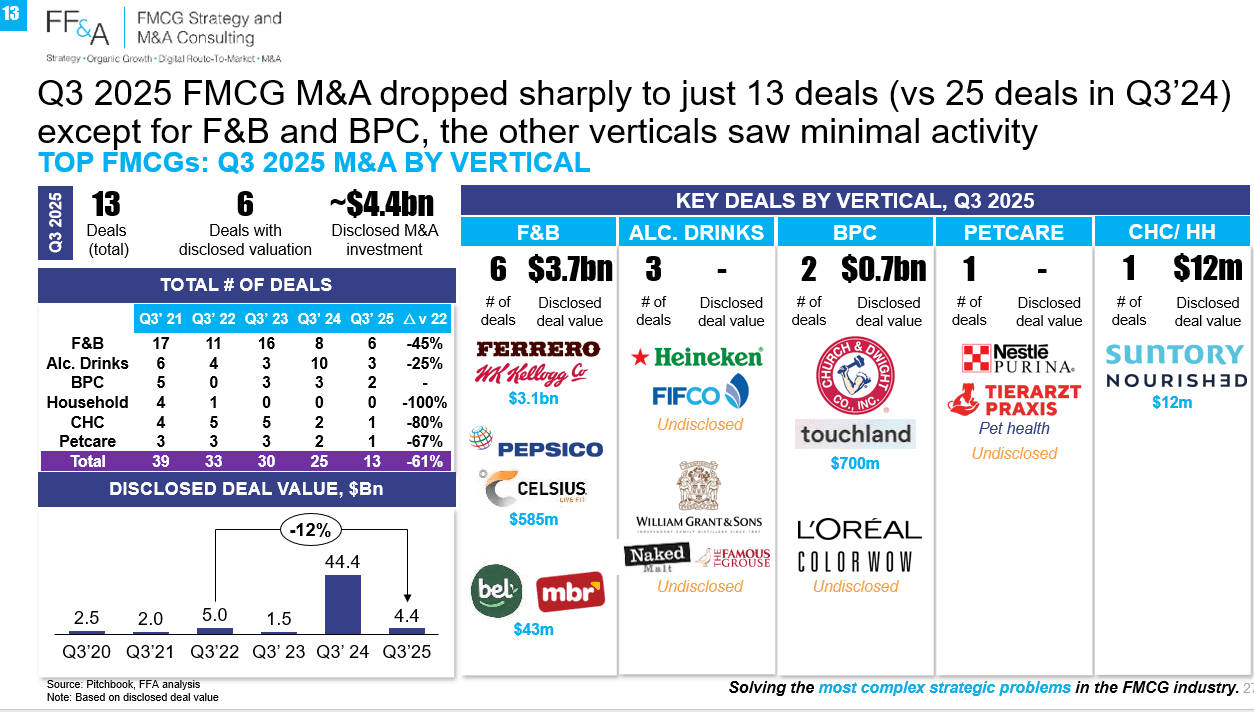
14) Q3 2025 FMCG M&A dropped sharply to just 13 deals (vs 25 deals in Q3’24) except for F&B and BPC, the other verticals saw minimal activity
15) Q4 is already showing renewed M&A momentum with multiple historic transactions
16) The top FMCGs continue to divest underperforming businesses in non-core markets. Majority of divestitures deal values were undisclosed

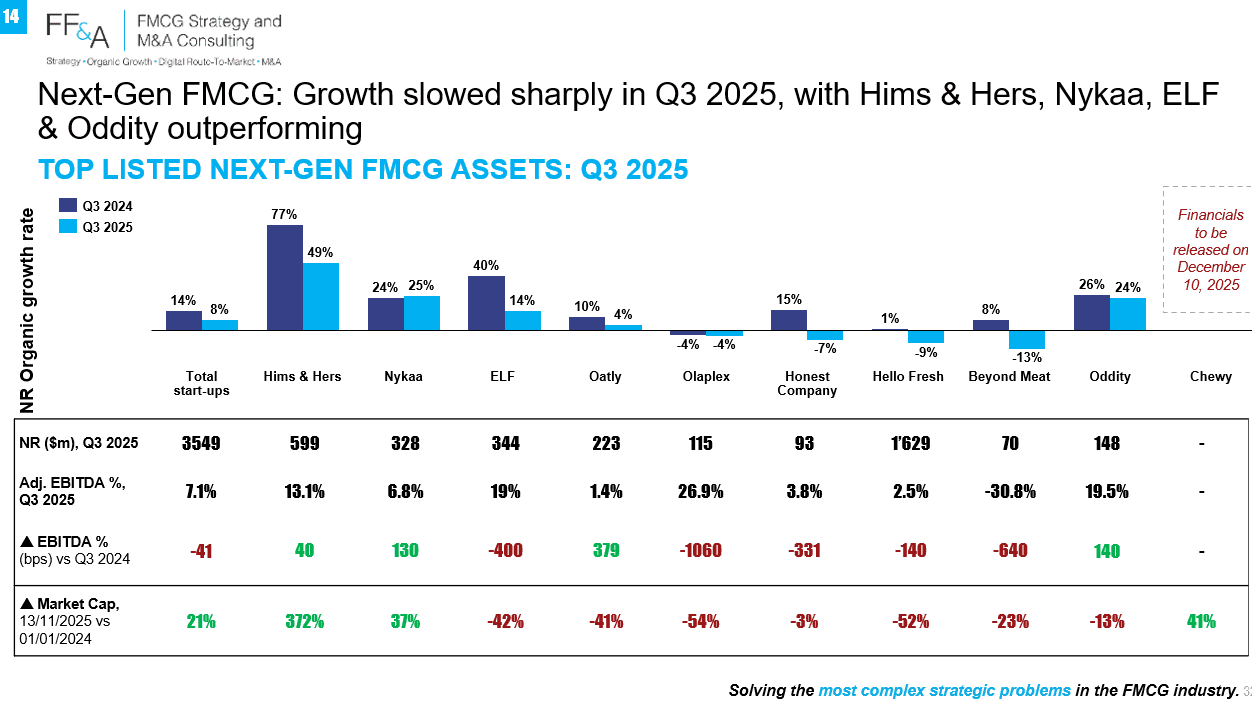
17) Next-Gen FMCG: Growth slowed sharply in Q3 2025, with Hims & Hers, Nykaa, ELF & Oddity outperforming
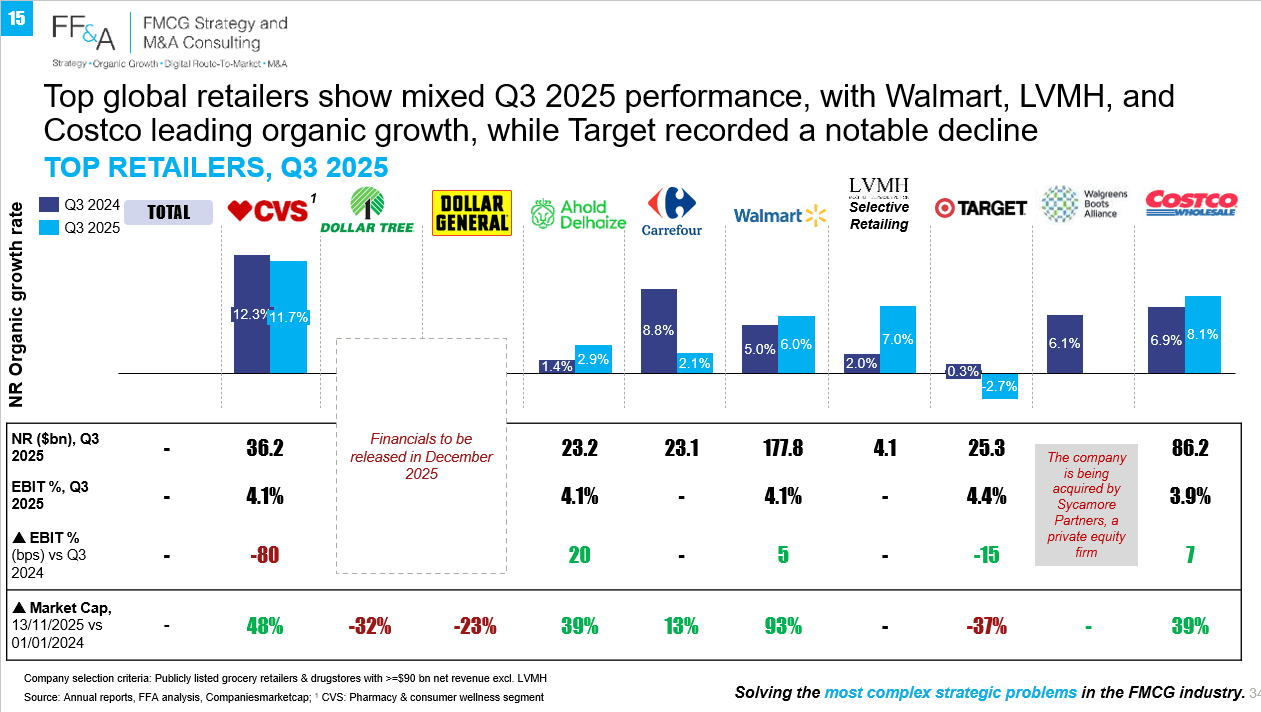
18) Top global retailers show mixed Q3 2025 performance, with Walmart, LVMH, and Costco leading organic growth, while Target recorded a notable decline
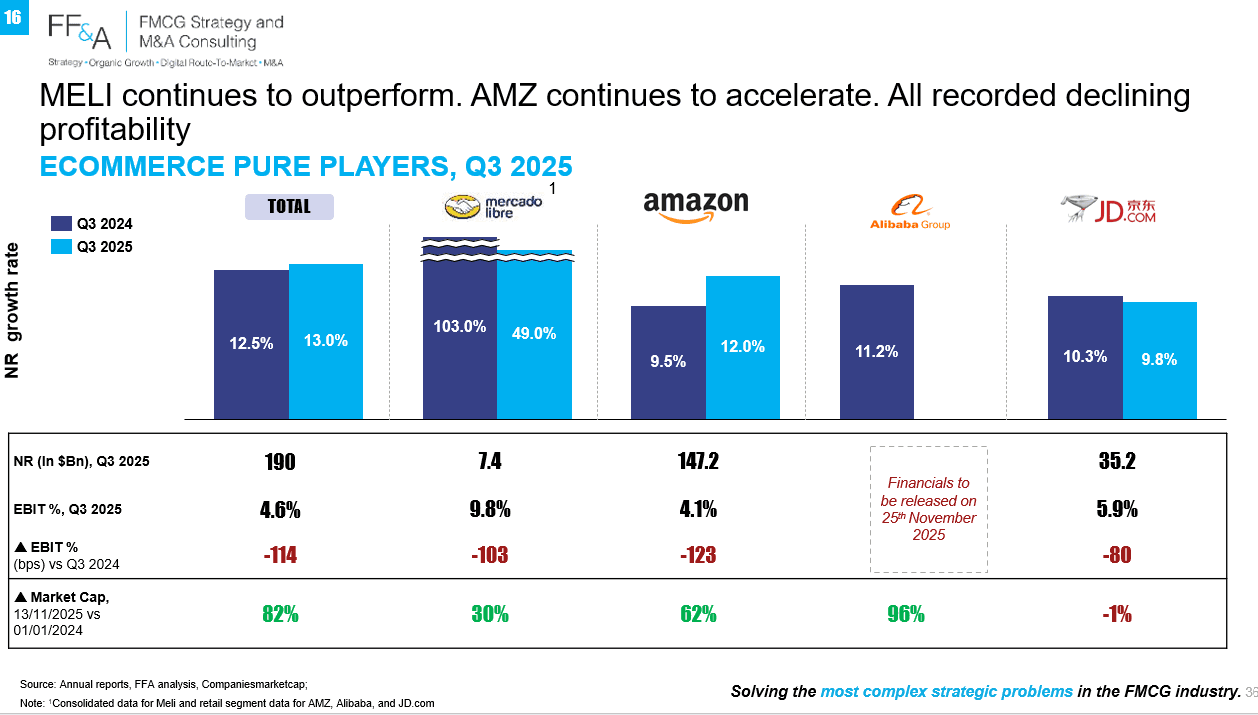
20) MELI continues to outperform. AMZ continues to accelerate. All recorded declining profitability
Bringing it all together: volume decline continues, profitability erosion accelerates and gap between winners & losers keep widening
Alone throwing more A&P and innovations to the growth problem wothout a holistic growth strategy will not solve it
Mega M&A deals & financially engineered mergers built on naïve investment bankers' SOTP analysis & glossy strategy consultants' synergies forecast will not cut it either
Truth is that growth is hard work and it cannot be bought in few quarters
Time for many to wake-up: you cannot buy your way to growth
Exciting & decisive times
Get in touch:
To join the ~60,000 FMCG executives that follow Frederic on LinkedIn, please click here. To start a conversation, email at: frederic@fredericfernandezassociates.com
To participate to the Growth FMCG CEO podcast, email at: frederic@fredericfernandezassociates.com
To join the >36,000 FMCG executives that receive our newsletter and all our CEOs Insights, sign-up at the following link: FMCG CEOs - Managing For Growth
To read all our previous publications, visit our newsletter page: FMCG CEOs - Managing For Growth
About FF&A:
FF&A solves the most complex strategic problems of the world largest FMCG companies across Corporate Strategy, Organic Growth, Digital RTM (Ecommerce, DTC and EB2B) and M&A. 14 out of the world 20 largest FMCG companies are repeat Clients
FF&A team intervenes all across the globe and across all FMCG categories. To know more, please visit our website:
www.fredericfernandezassociates.com
Disclaimers:
No FF&A employees own any stocks or financial instruments of any FMCG companies
Enjoyed this article?

FMCG CEOs: Managing For Growth
Strategic insights for FMCG/ CPG CEOs