
M&A
FMCG CEOs: The $600bn M&A Bonfire - What The World Largest FMCG Companies Get Wrong About M&A - Introducing FF&A's Best Acquirers®

Author | Managing Director & Partner @ FFA
"In consumer goods, the real risk isn't overpaying—it's underdelivering."
— James Quincey, CEO of Coca-Cola
"The best deals are often the ones you don't do."
— Henry Kravis, Co-founder of KKR
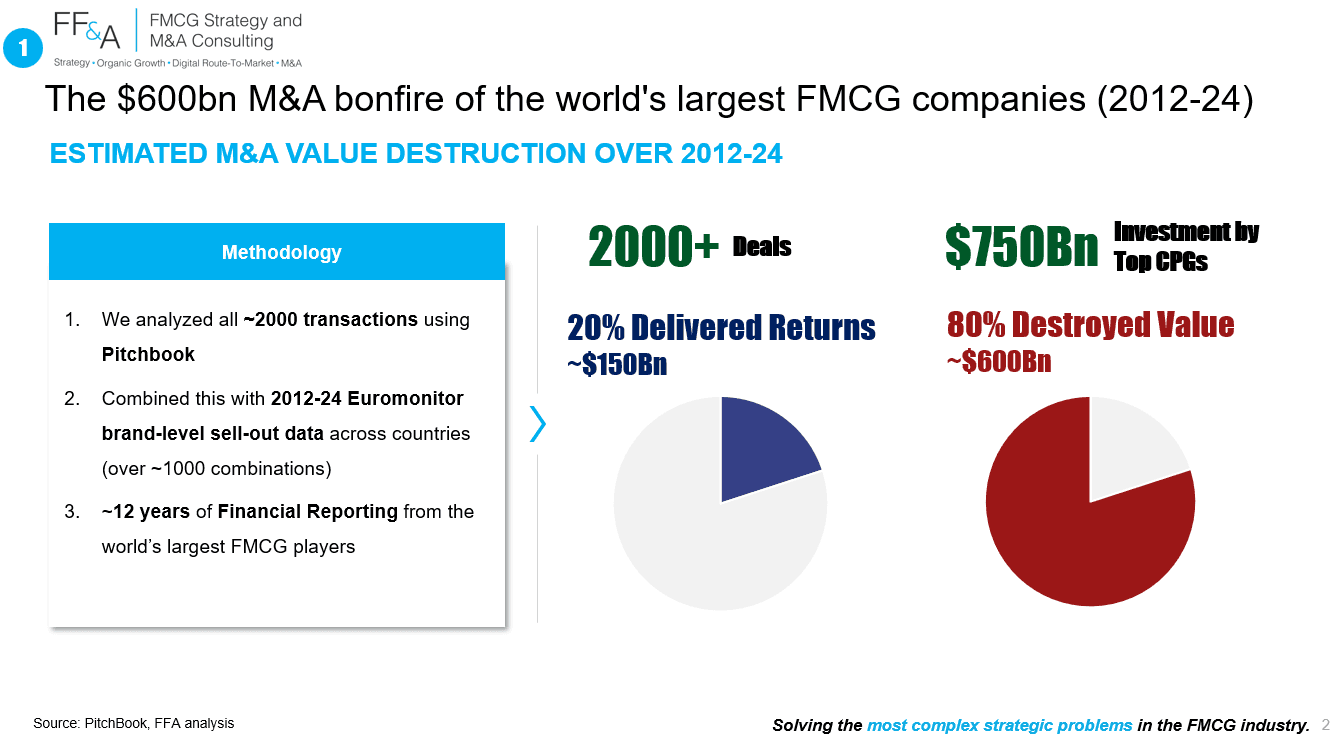
Between 2012 and 2024, the world's 55 largest FMCG companies deployed approximately $750 billion across nearly 2,000 M&A deals.
The result? Roughly $600 billion—80% of that capital—failed to deliver meaningful returns.
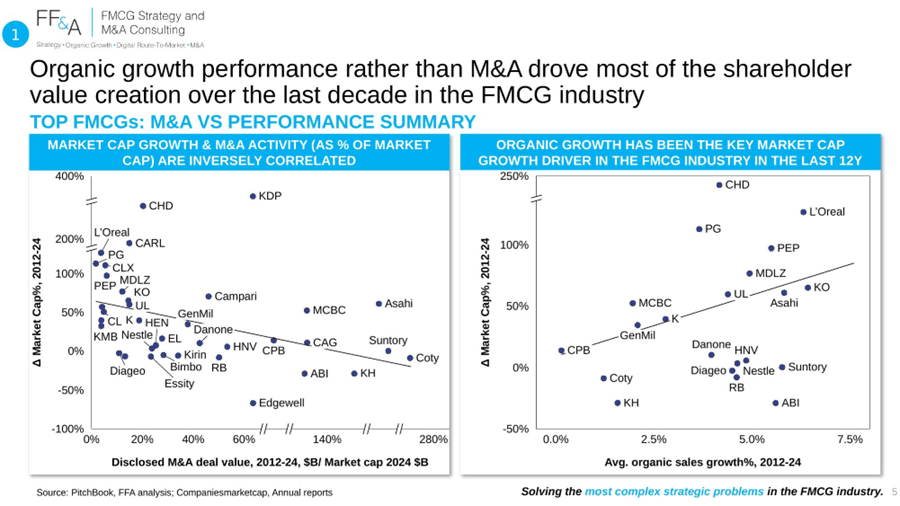
The heaviest acquirers didn't just underperform. They destroyed the most shareholder value. The correlation between M&A intensity and market cap growth wasn't just weak—it was inverse.
The winners? They weren't the deal-makers. They were the disciplined deal-makers.
Here is our views summarized in 9 key messages:
1) THE UNCOMFORTABLE TRUTH - Organic growth—not M&A—drove value creation
The 55 largest FMCG companies spent approximately $750 billion on nearly 2,000 M&A deals between 2012 and 2024—and roughly $600 billion of that capital, about 80%, failed to deliver meaningful returns.
Market cap growth and M&A activity (as % of market cap) are inversely correlated: the companies that spent most aggressively on M&A delivered the worst shareholder returns. Over 2012-24, organic growth—not M&A—was the primary driver of shareholder value creation in FMCG.
2) THE FOUR ERAS OF FMCG M&A - A decade of evolution—from mega-deals to strategic pause
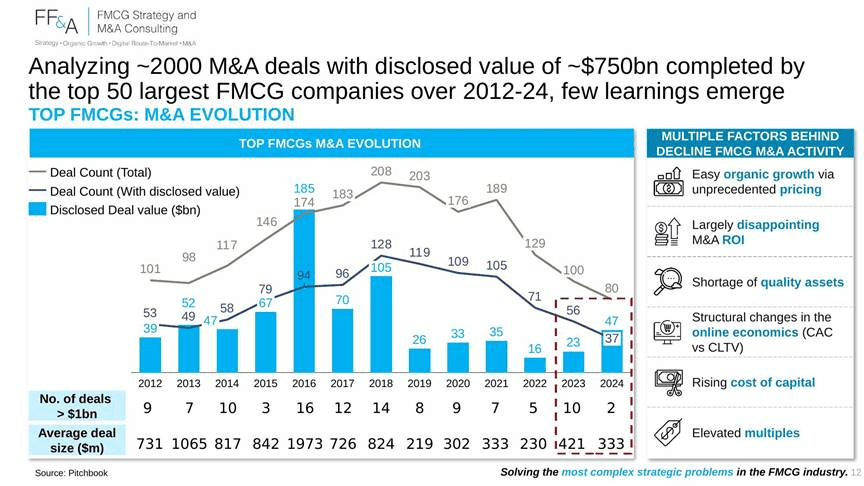
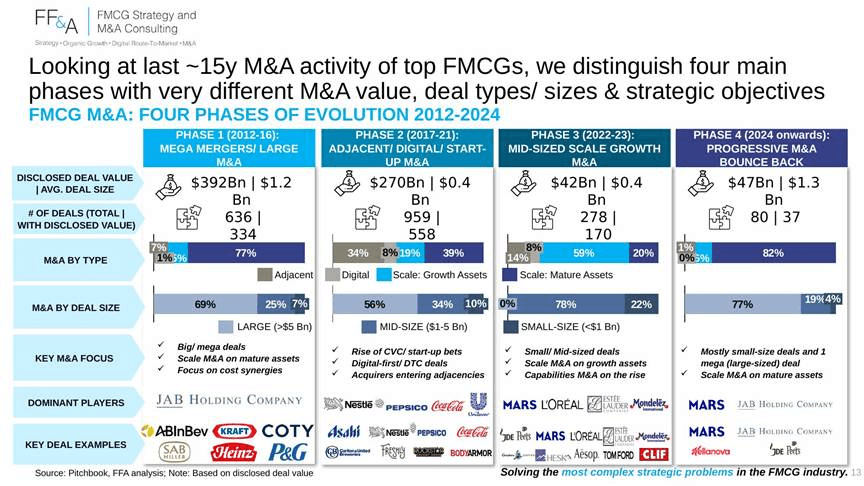
The 2012-16 Mega Merger Era was dominated by blockbuster deals (>$5bn) pursuing market share consolidation and cost synergies, with average deal size of $1.2bn—most destroyed value.
The 2017-21 Digital & Adjacencies Era shifted to smaller capability-driven deals (<$5bn) chasing digital capabilities and growth fragmentation, with average deal size of $0.4bn—many faced broken unit economics where CAC exceeded CLTV.
The 2022-23 Pause saw M&A activity collapse as companies navigated successive crises, an unprecedented pricing environment, rising cost of capital, and limited balance sheet capacity.
From 2024 onwards, M&A is returning as the cost differential between organic and inorganic growth shifts & B/S of the world largest FMCG companies display increasing flexibility —the window is reopening for disciplined acquirers.
3) THE MEGA-MERGER MYTH - Most mega-deal over $10bn failed
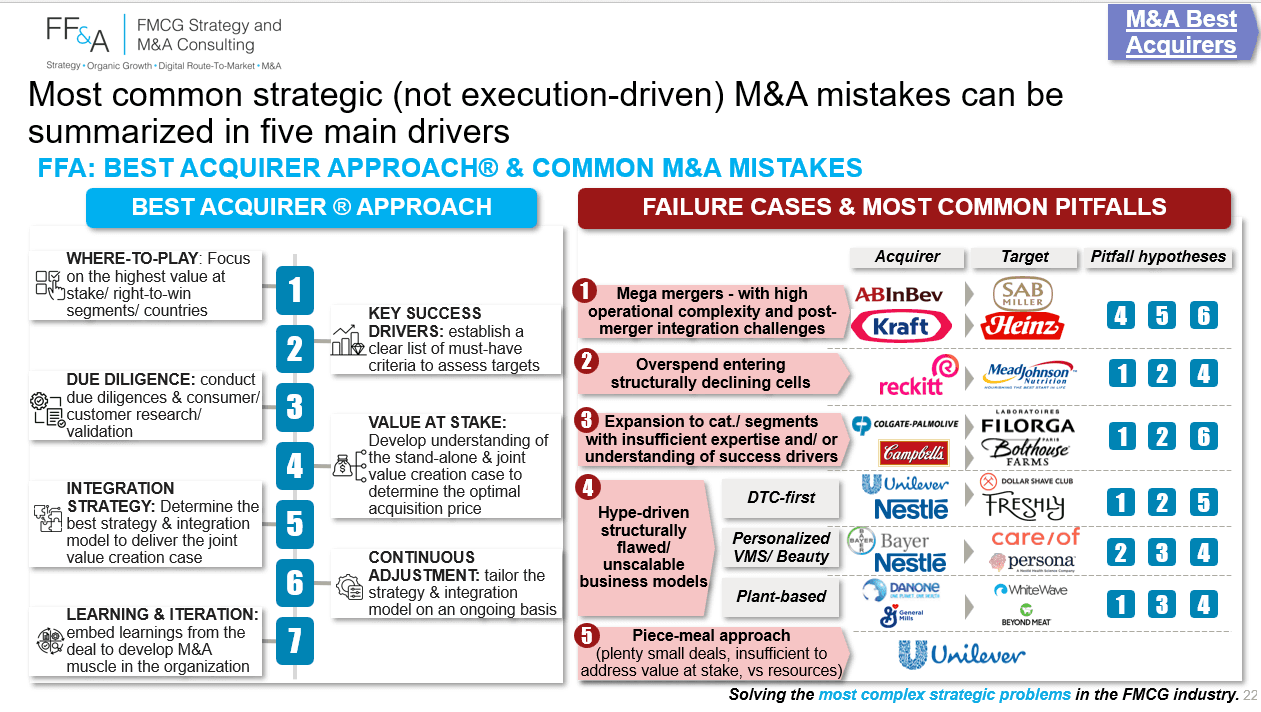
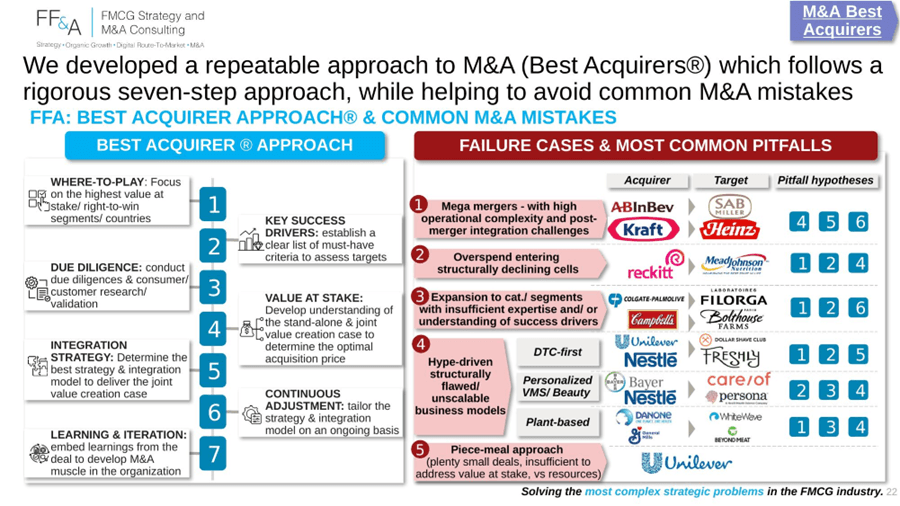
Mega-mergers over $10bn have consistently failed: ABI-SABMiller, Kraft-Heinz, Reckitt-Mead Johnson, and Coty-P&G Beauty all destroyed significant shareholder value as integration complexity overwhelmed synergy capture.
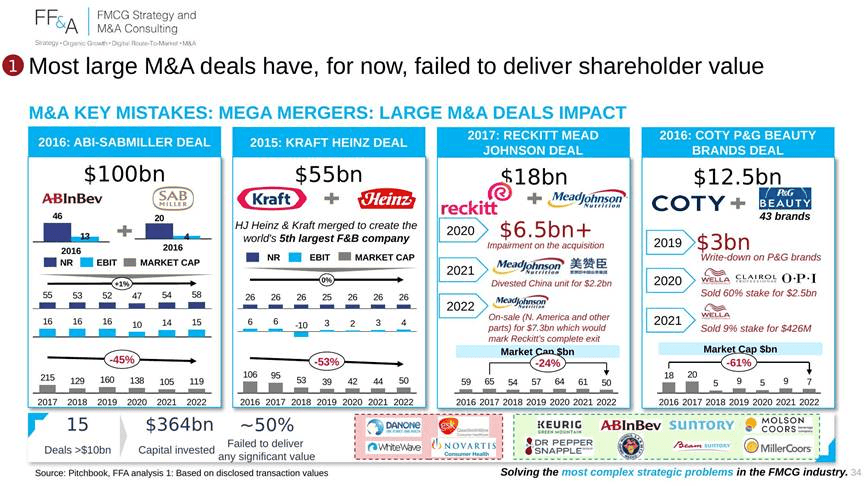
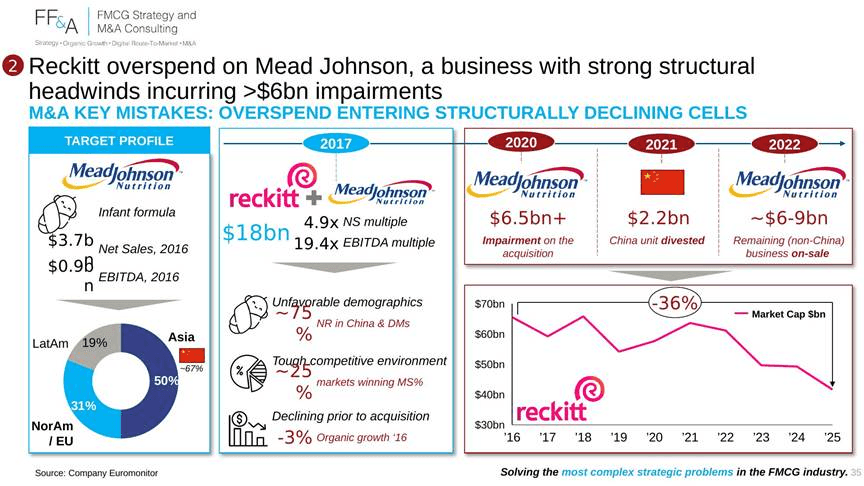
Buying into structural decline destroys value: Reckitt paid $17bn for Mead Johnson facing irreversible China birth rate headwinds, resulting in over $6bn in impairments and strategically distracting Reckitt for the last decade
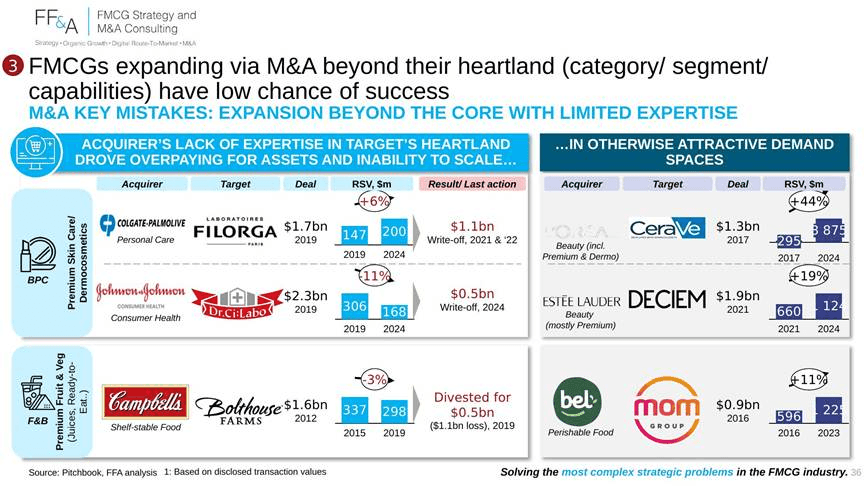
Straying beyond core expertise consistently leads to overpayment and underperformance—companies cannot buy their way to competence in categories they do not understand
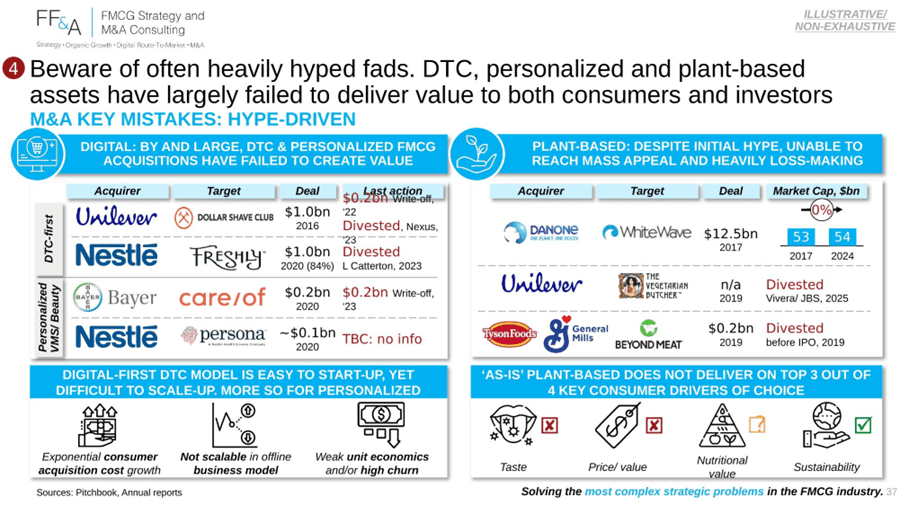
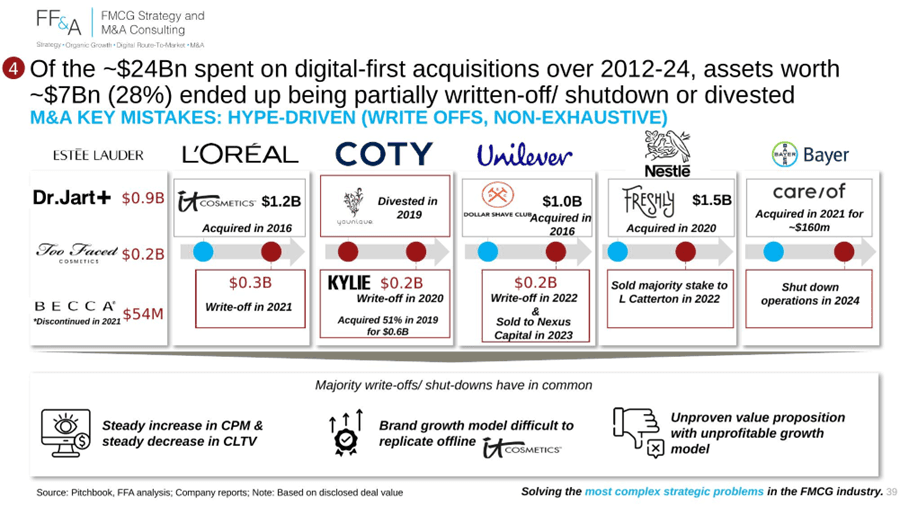
Chasing hype proved expensive: of approximately $24bn spent on digital-first acquisitions (DTC, plant-based, personalized VMS), roughly $7bn (28%) was written off, shut down, or divested.
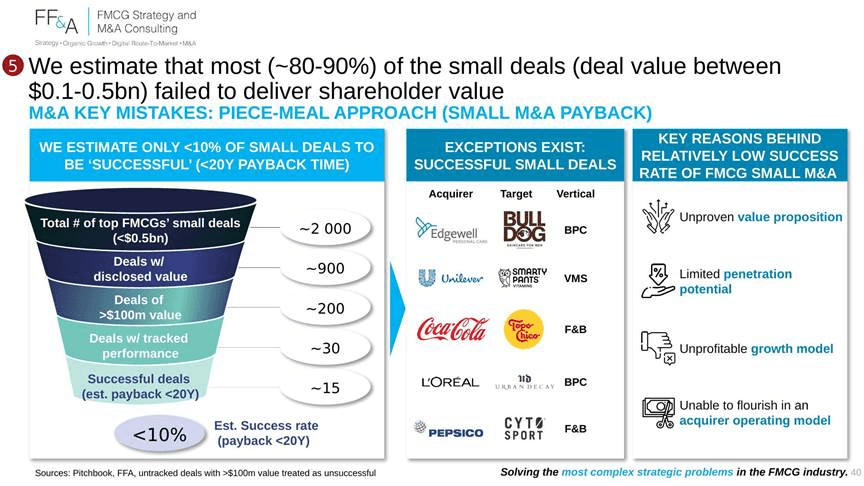
Small deals under $0.5bn failed at an 80-90% rate—too small to move the needle yet consuming disproportionate management attention and integration resources.
4) THE HIDDEN PATTERNS - Probability of success varies dramatically across deal types & transactions highlighting clear M&A Do's & Don't
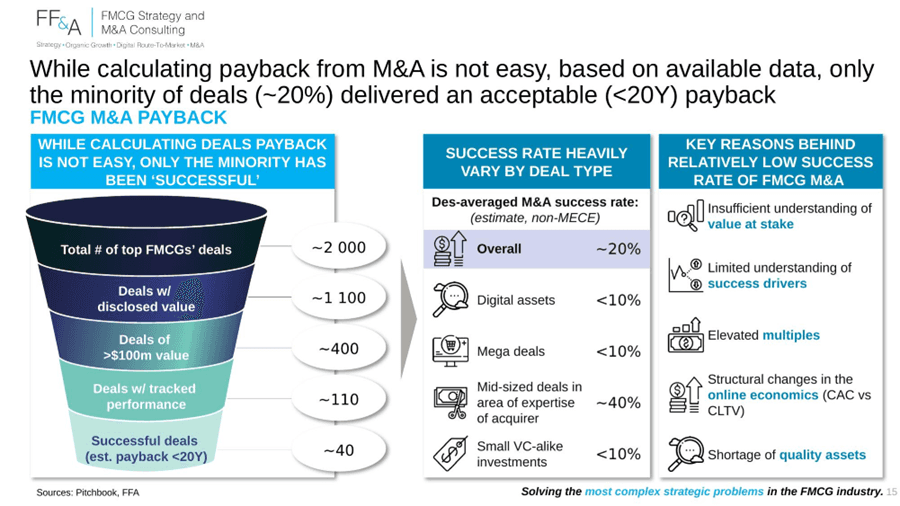
Minority of M&A deals completed by the world largest FMCG companies deliver an acceptable ROI (20%). Mega-deals, digital assets & small deals (<$500m EV) display all a less than 10% probability of chance to succeed. On the contrary, probability of success for mid-size assets ($0.5-5bn EV) on categories where acquirers have expertise & GTM capabilities shoot up to 40%.
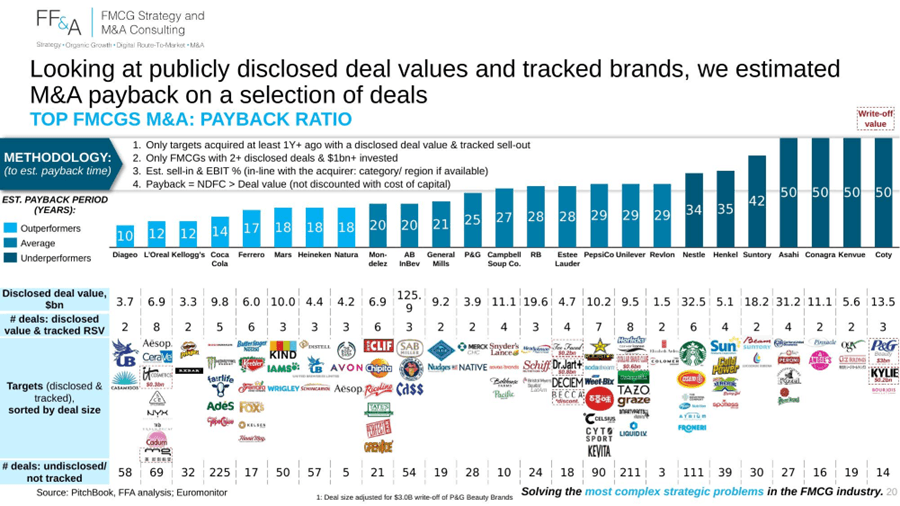
Strategic misreads were common: acquirers consistently failed to understand category dynamics, competitive intensity, and the true drivers of success in target businesses. Integration failures destroyed value post-close: one-size-fits-all playbooks suffocated the brand equity, entrepreneurial culture, and speed that acquirers had paid premiums for.
5) THE GREAT REVERSAL - Divestitures equal acquisitions for the first time
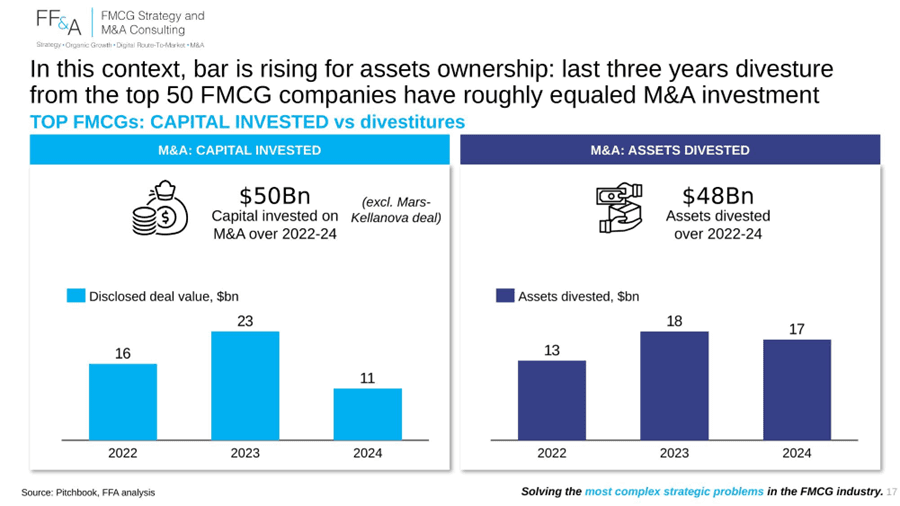
For the first time since 2012, divestitures have nearly equaled acquisitions: FMCG incumbents invested approximately $50bn in M&A while divesting approximately $48bn over 2022-24 (excluding the exceptional Mars-Kellanova deal).
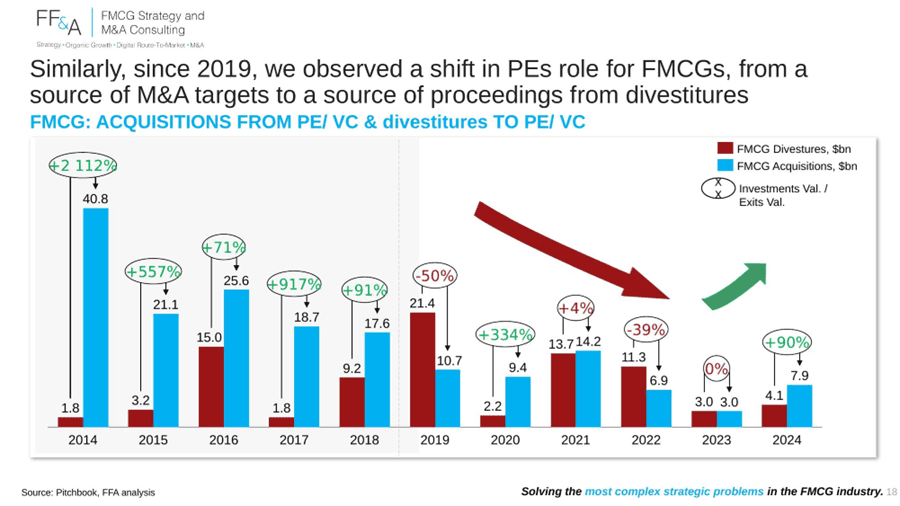
Private equity's role has completely reversed—from being the primary source of M&A targets a decade ago to now being the primary buyer of FMCG divestitures.
6) THE WINDOW REOPENS - Economics shifting in favour of disciplined acquirers
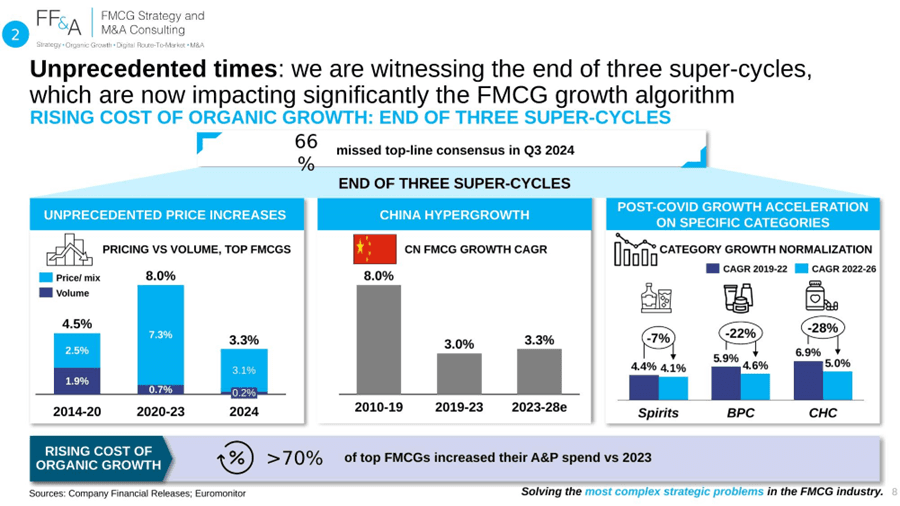
Organic growth is getting harder: pricing tailwinds are fading, volumes remain flat, A&P reinvestment is required just to hold share, and retailer pressure continues to intensify.
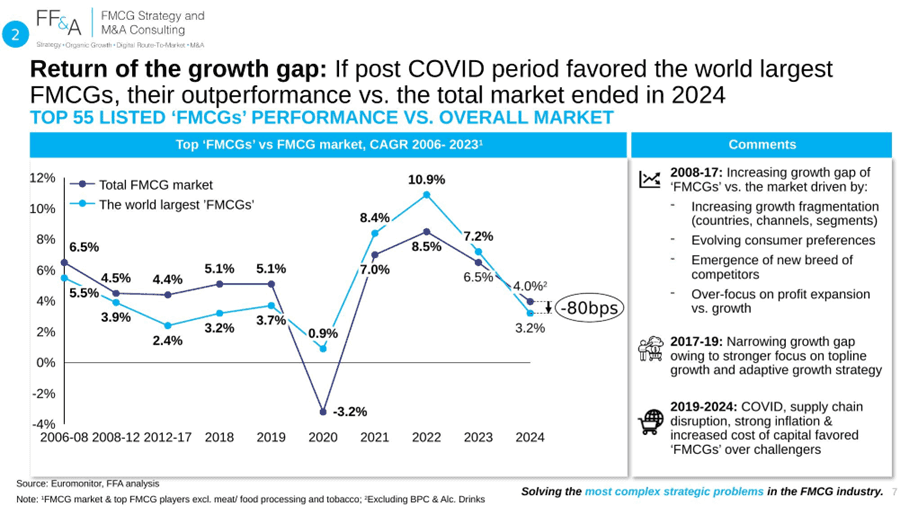
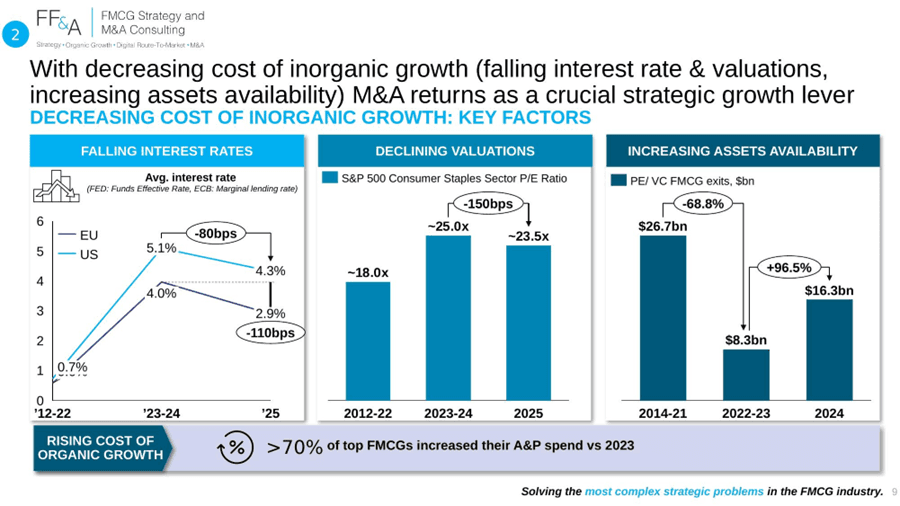
Inorganic growth is getting cheaper: interest rates are falling, valuations have compressed from peak levels, and asset availability is increasing as PE seeks exits.
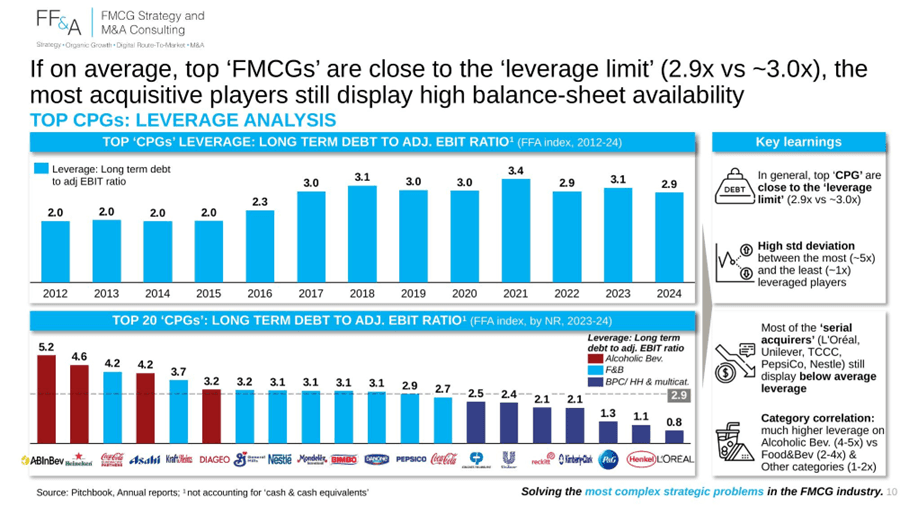
Balance sheets are ready: serial acquirers including L'Oréal, Unilever, Coca-Cola, PepsiCo, and Nestlé all maintain below-average leverage with significant M&A capacity. If B/S is a pre-requisite for M&A acceleration, organic growth track record & trust from the financial community will be critical to predict future M&A acceleration
7) WHAT BEST ACQUIRERS DO DIFFERENTLY - Three characteristics of winning deals
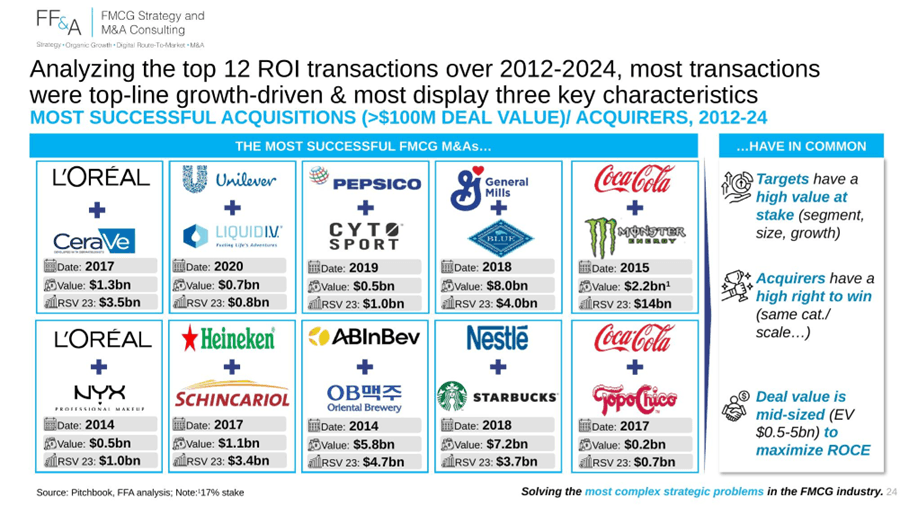
Winning acquirers target high value-at-stake opportunities: structurally attractive segments with durable, sustainable growth—not declining categories or hyped niches with broken economics.
Winning acquirers have a clear right to win: genuine category expertise and scale advantages they can actually deploy to create value post-acquisition.
Winning acquirers target the $0.5-5bn sweet spot: deals large enough to move the needle but small enough to integrate without organizational trauma, maximizing ROCE while containing risk.
8) TWO PATHS TO WINNING - L'Oréal and P&G—opposite strategies, same discipline
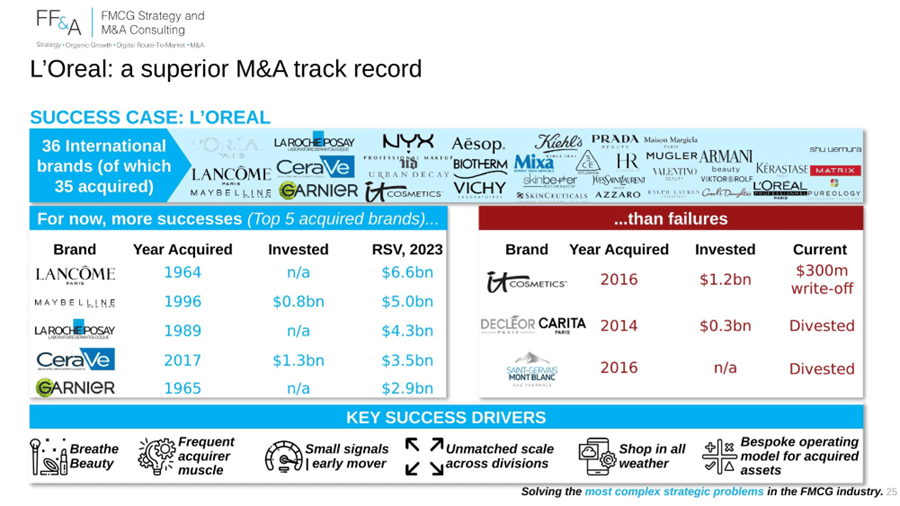
Path 1 is building world-class M&A capability like L'Oréal, where 35 of 36 international brands were acquired: shop in all weather, stay in right-to-win zones, deploy bespoke operating models, and treat M&A as organizational muscle.
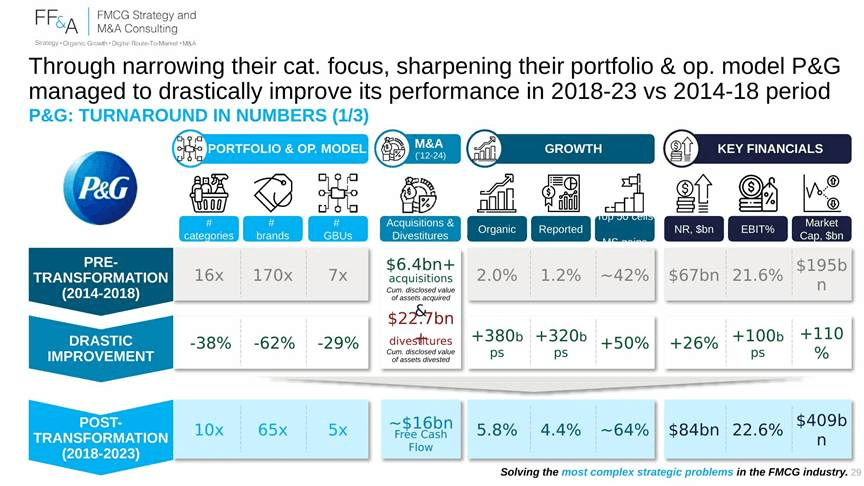
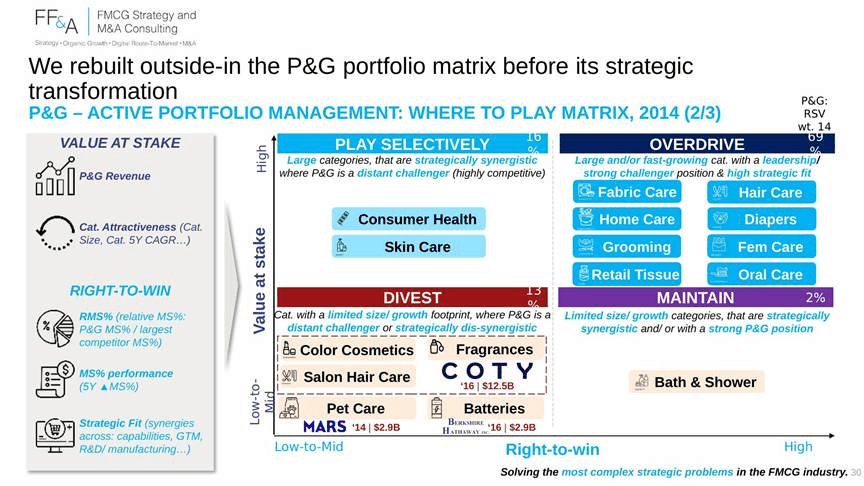
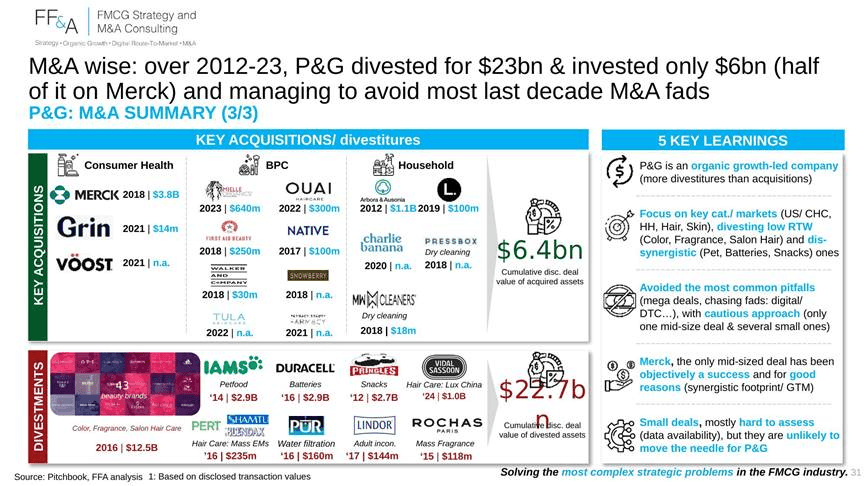
Path 2 is focusing relentlessly on organic growth like P&G: from 16 to 10 categories, from 170 to 65 brands, organic growth improved from 2.0% to 5.8%, market cap more than doubled from $195bn to $409bn, divested $22.7bn while acquiring only $6.4bn—both paths require discipline.
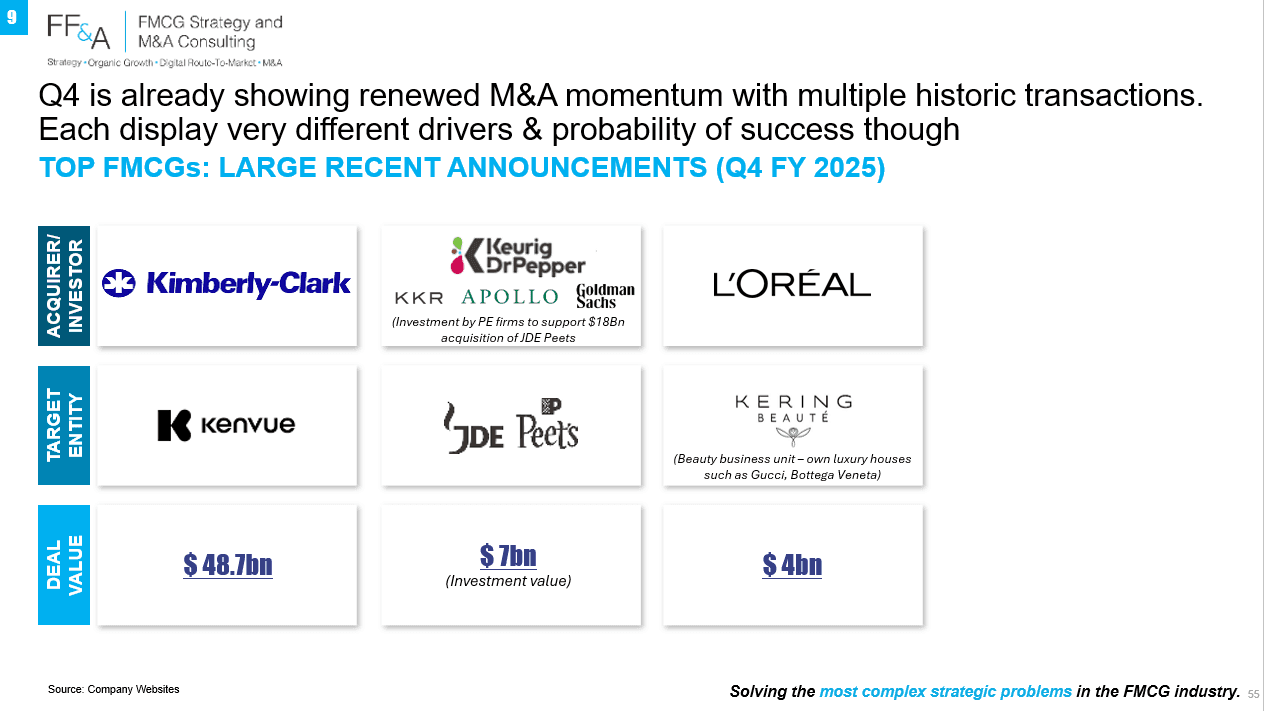
9) LOOKING AHEAD - Progressive M&A bounce-back expected driven by large-scale M&A from a 'position of weakness' (e.g. Kimberly-Clark/ Kenvue), M&A engineering to attempt to create value in the absence of growth outperformance (Kraft-Heinz, JDE-KDP), mid-size M&A from a 'position of strength' (e.g. L'Oréal)
Bringing it all together:
The verdict is clear: ~$600bn of the $750bn deployed on FMCG M&A over 2012-24 failed to create value. Yet this isn't a case against M&A—it's a case for doing it right.
Winners share a common DNA: Winners didn't just buy assets—they built M&A muscle. They shop in all weather, stay within their right-to-win zones, target the $0.5-5bn sweet spot, and deploy bespoke operating models that let acquired brands thrive rather than suffocate.
Losers fall into predictable traps: mega-mergers that promise synergies but deliver complexity; chasing hype (DTC, plant-based) without unit economics; overpaying for structurally declining categories; and death by a thousand small deals that distract more than they deliver.
The window is opening: With organic growth getting harder (pricing headwinds, retailer pressure), inorganic growth getting cheaper (lower rates, compressed valuations, PE exits), the increasing temptation for mega-deals to solve organic growth underperformance, the next 3-5 years will separate the Best Acquirers from the rest.
The question isn't whether to pursue M&A—it's whether you have the discipline, capability, and framework to be a Best Acquirer.
"In consumer goods, the real risk isn't overpaying—it's underdelivering."
— James Quincey, CEO of Coca-Cola
"The best deals are often the ones you don't do."
— Henry Kravis, Co-founder of KKR
Exciting & decisive times.
Frederic
——————————————————————————————
To join the 60,000+ FMCG executives that follow Frederic on LinkedIn: linkedin.com/in/fredericfernandez
To start a conversation: frederic@fredericfernandezassociates.com
To join the ~37,000 FMCG executives that receive our newsletter: https://www.linkedin.com/newsletters/7045696201089785857/
𝗔𝗯𝗼𝘂𝘁 𝘂𝘀:
FF&A solves the most complex strategic problems of the world largest FMCG companies across:
Corporate Strategy
Organic Growth (cf. our proprietary Zero-Based-Growth® - https://lnkd.in/eWQEmcK3)-
Small Brands Growth (cf. our proprietary approach How Small Brands Grow ® - https://lnkd.in/eyp3Baq5)
Digital RTM (Ecommerce - cf. our proprietary Ecommerce 2.0® - https://lnkd.in/e4-Q69Fi, DTC and EB2B)
M&A
14 out of the top 20 world largest FMCG companies are repeat Clients
Enjoyed this article?

FMCG CEOs: Managing For Growth
Strategic insights for FMCG/ CPG CEOs