
Organic Growth
FMCG CEOs: Time to stop the BS about Private Labels, to understand the tsunami of de-consumption & to focus on driving incremental category growth

Author | Managing Director & Partner @ FFA
'When the wise man points to the moon, the fool looks at the finger' - Chinese proverb
To join the ~23,000 FMCG executives that receive automatically all our FMCG CEOs Insights (publications like this one), sign-up to our newsletter at the following link: FMCG CEOs - Managing For Growth
We have a weird hobby: not only we analyze every quarter the releases of the world largest 50 listed FMCG companies but we also read all the transcripts.
There is something we have noticed now for almost 18 months: how much private labels (PLs) were quoted in quarterly calls across many categories as a key reason for market share losses & volume poor performance.
It is also aligned with the doxa we read in some management consulting reports:
PLs are gaining shares in the FMCG industry
FMCG companies need in priority to develop a strategy to counter PLs
The above has not been necessarily aligned with our experience with our Clients across most FMCG categories & geographies, so we decided to analyze the last 10 years of private labels performance in the FMCG industry to understand the facts, specifically, we reviewed:
~$55Tr of sell-out data over 2014-23 across 120+ markets & 100+ segments
We identified the following five myths:
1) MYTH: PLs account for a large portion of the FMCG industry: WRONG.
REALITY: PLs accounted for only 7.9% of the FMCG industry ($0.5Tr sell-out) in 2023
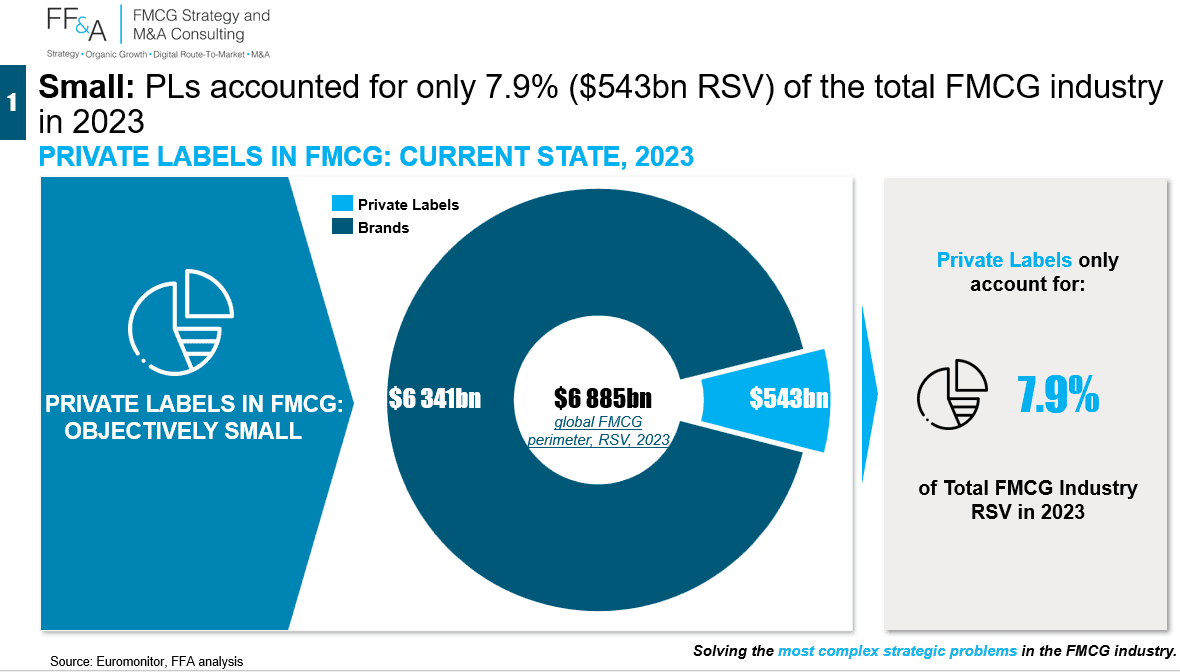
2) MYTH: PLs account for a significant share of growth of the total FMCG industry: WRONG. REALITY: It accounted over 2014-23 for only 7% of the growth of the industry
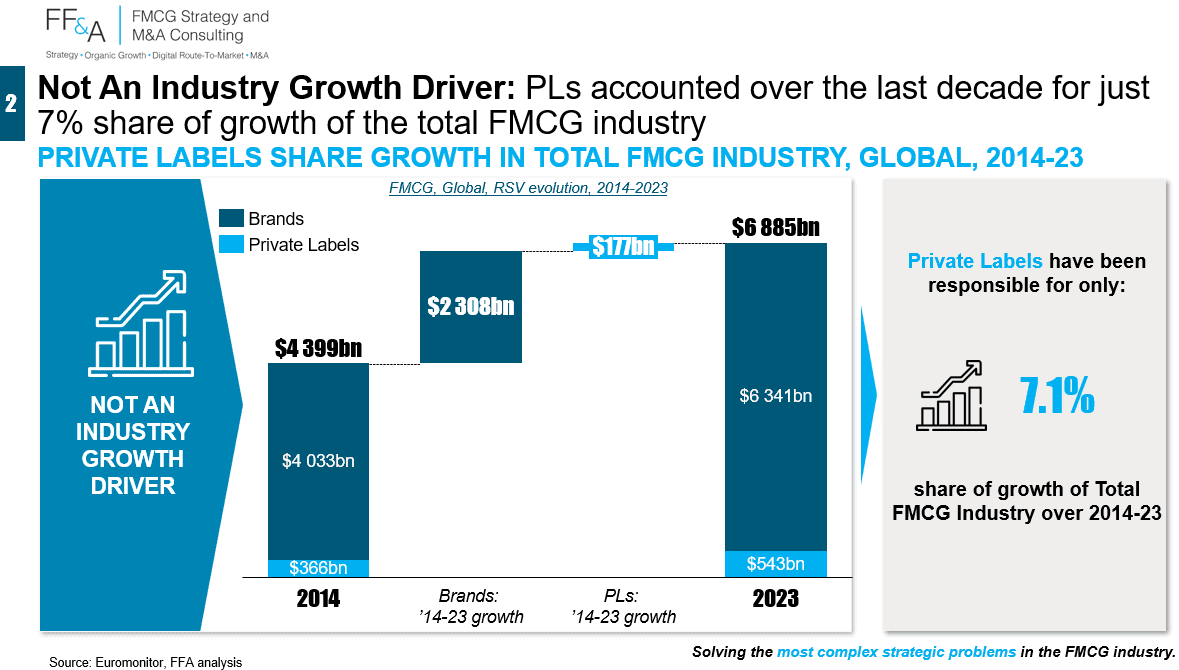
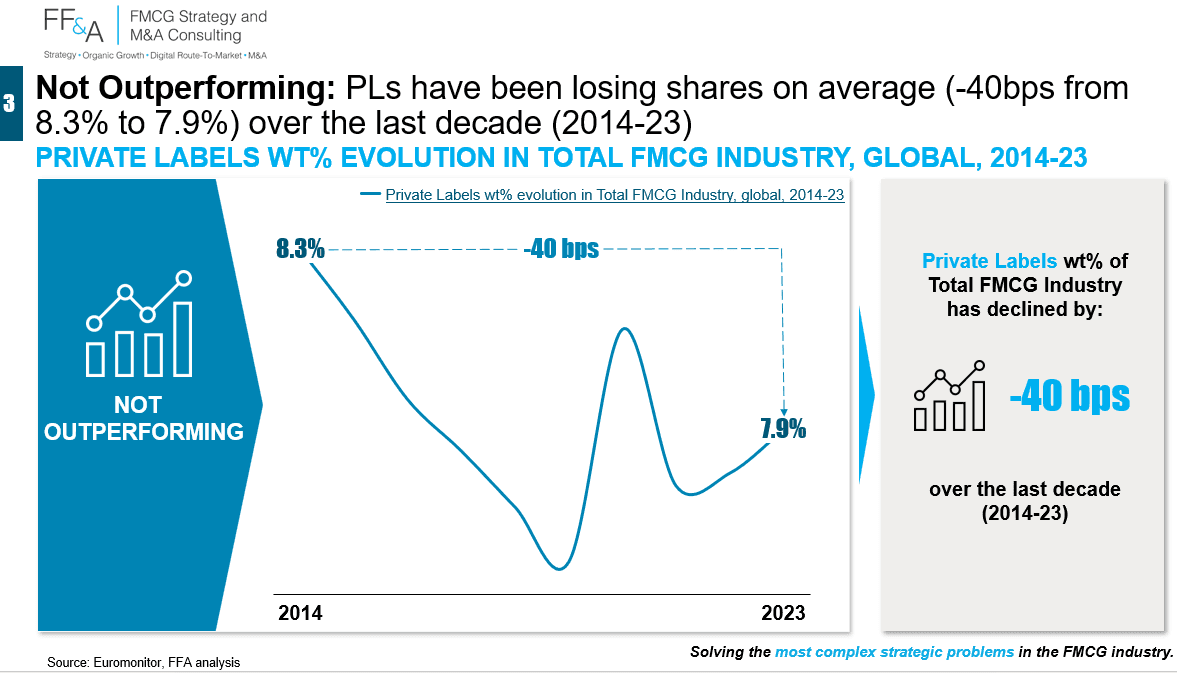
3) MYTH: PLs are gaining consistently market shares vs. brands: WRONG.
REALITY: PLs market shares are actually slightly eroding (from 8.3% to 7.9% MS over 2014-23, ie -40bps MS), despite benefiting from significant mix tailwinds (discounters & retailers with a greater share of PLs have been often gaining market shares across most markets driving up PL weight in the overall FMCG mix - e.g. Aldi/ Lidl where they operate, Leclerc in FR, Mercadona in ES, etc...)
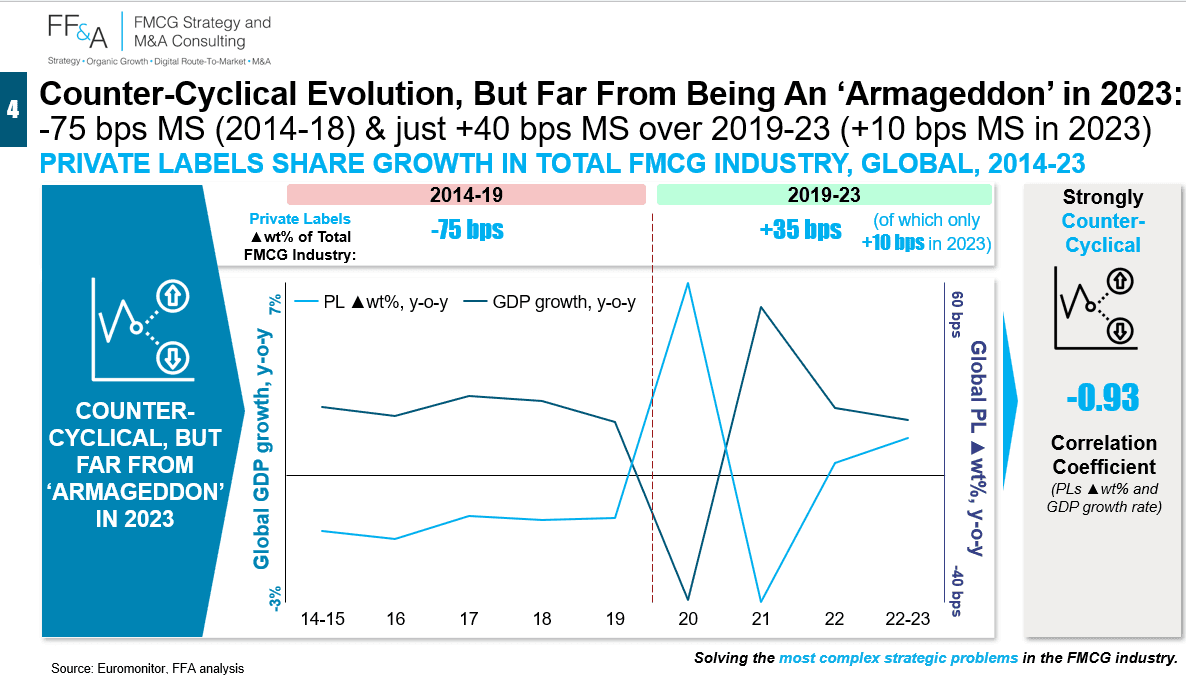
4) MYTH: Owing to the economic crisis, 2023 saw an exponential increase in PLs, explaining the deteriorating MS performance of the world largest FMCG companies: WRONG
REALITY: PLs are counter-cyclical: they grow slower in boom cycles (e.g. PLs lost 75bps MS over 2014-18) and they grow faster in bust cycles (e.g. PLs won 45bps MS over 2019-23) but they gained only 10bps MS globally in 2023, far from the 'Armageddon' many predicted
5) MYTH: PLs are relevant across most category/ country couples: WRONG
REALITY: They are only relevant across a minority of country/ category couples: mostly on essential categories (e.g. Tissue & Hygiene and Core Food) in WEU & in NA. Those couples account for less than 18% weight/ 14% share of growth of the global FMCG industry
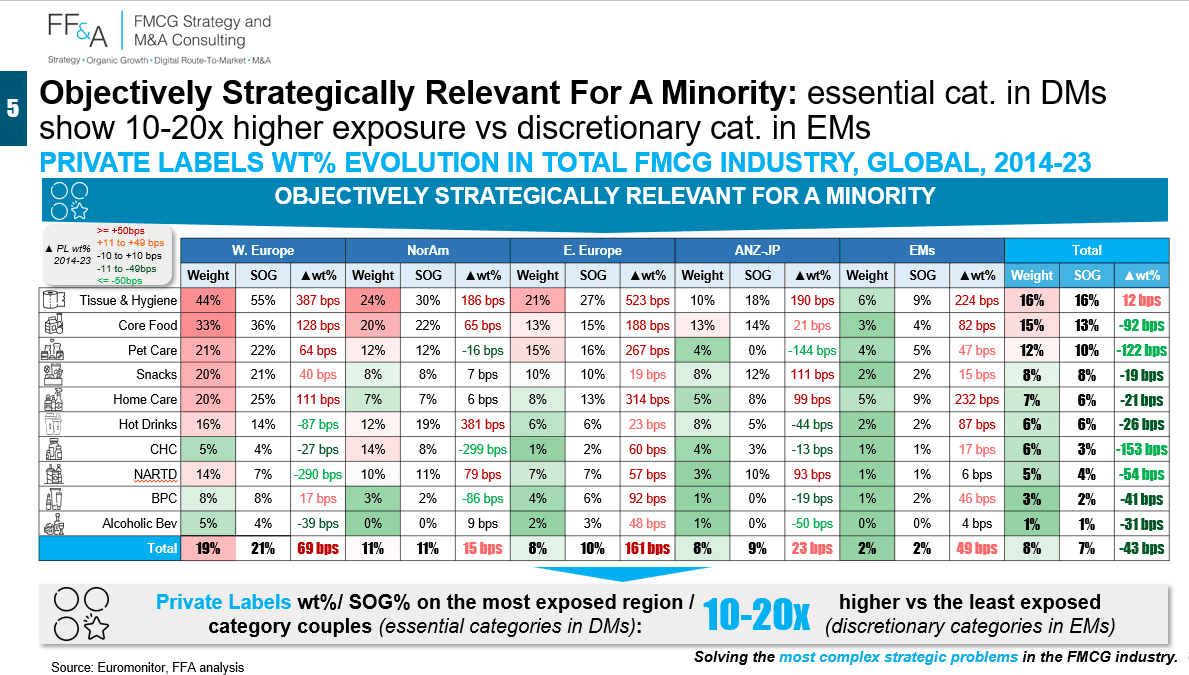
So if PLs have played a minor role in the FMCG industry for most, what is currently happening? To answer, this question, we then decided to review the evolution of volume/ pricing across all markets/ categories over the last decade to find out.
Here are our key findings:
1) The unprecedented price increase taken since 2020 (on average +24% for the overall FMCG industry, slightly more for the world largest listed FMCG companies with +26% - since 2019, those numbers are >32%) has modified (broken?) the long-term FMCG industry algorithm:
=> Long-term algo (also verified over 2014-20): ~+4.5% CAGR (+2% volume driven by population growth & penetration/ frequency gains; +2.5% driven by inflation & mix)
=> 2020-23 algo: +8% CAGR (+7.3% pricing & +0.7% volume growth), the overall displaying a delta of 125 bps of volume growth per year over the last 3 years
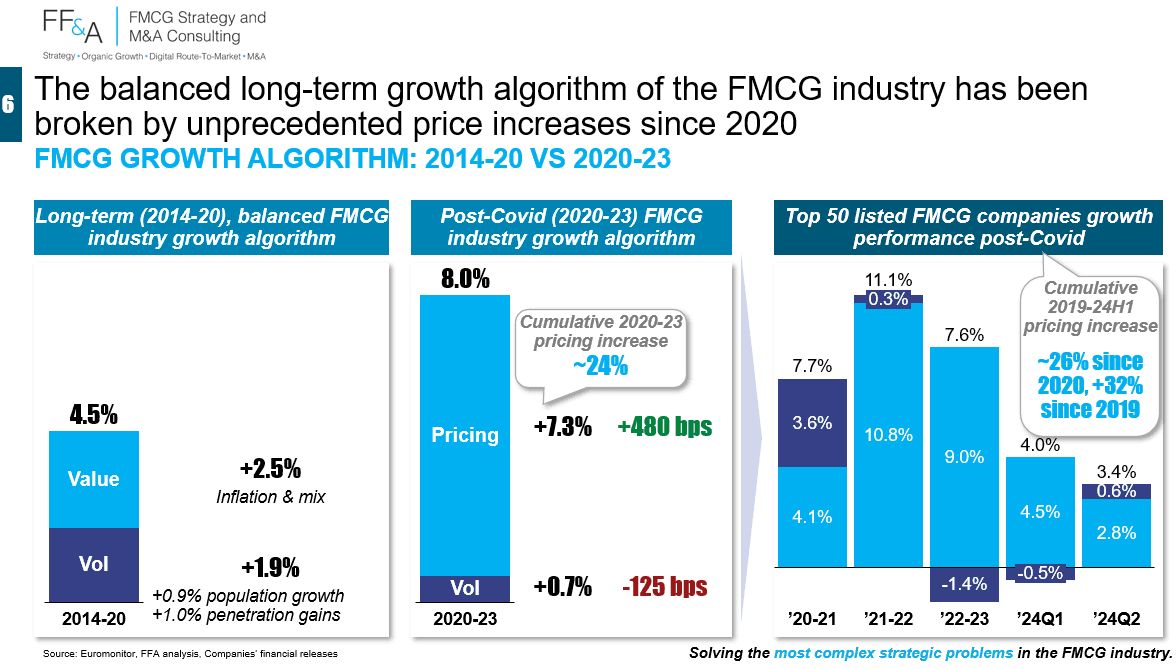
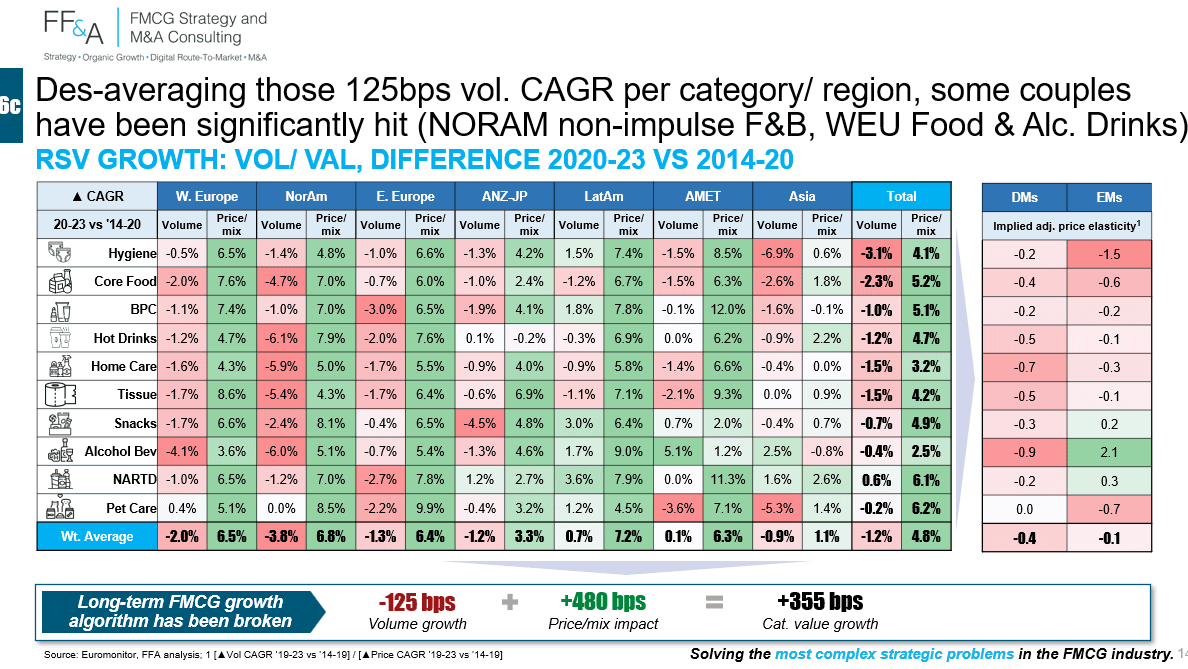
2) Des-averaging this 125bps yearly volume loss:
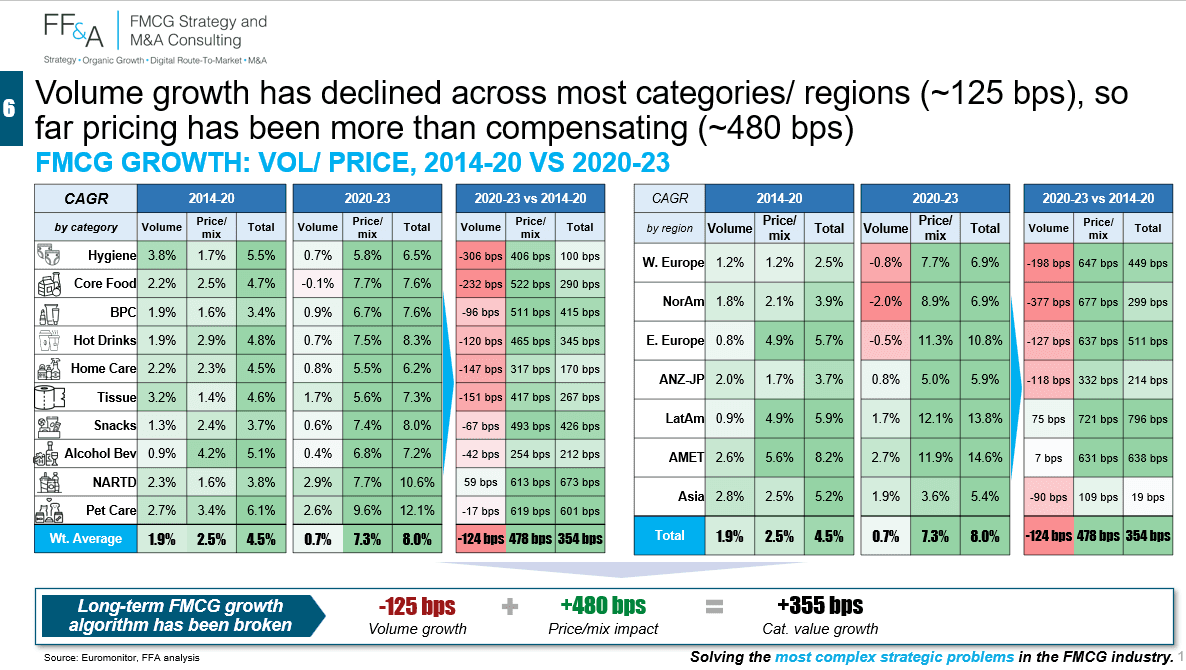
=> Categories wise, the 'essentials/ low emotionally involving' categories (Hygiene, Core Food, Tissue, Home Care) have been more impacted (>150-300bps volume decline p.a. vs. pre-COVID) than the more emotionally involving categories (Pet Care, Snacks, NARTD or even Alcoholic Drinks) - saying it differently (and with a bit of provocation) consumers have not been willing to compromise with their addictions (salt, sugar, alcohol, love from pets). Worth noting, NARTD is the only category to be globally positive
=> Regions wise, North America is the region that suffered the most followed by Western Europe (respectively -377bps & -198bps volume p.a. vs. pre-COVID) vs. Emerging Markets. The volume slowdown in NORAM is objectively abyssal

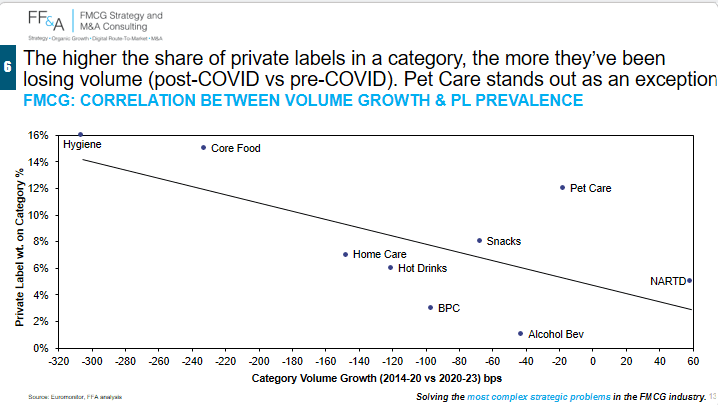
3) The categories with the highest share of private labels are actually the ones that have been declining volume the most since post COVID. Of course those categories are other things being equal less emotionally involving, hence more price elastic. But in addition, our hypothesis is that PLs do not drive category growth (less promotions, less out of shelf visibility, less innovations, no ATL...)
4) Des-averaging those 125bps volume CAGR loss per category/ region, some couples have been significantly hit (NORAM Non-Impulse F&B, WEU Food & Alc. Drinks). The overall translating into negative price elasticities of -0.4 in DMs & -0.1 in EMs with great standard deviation across categories
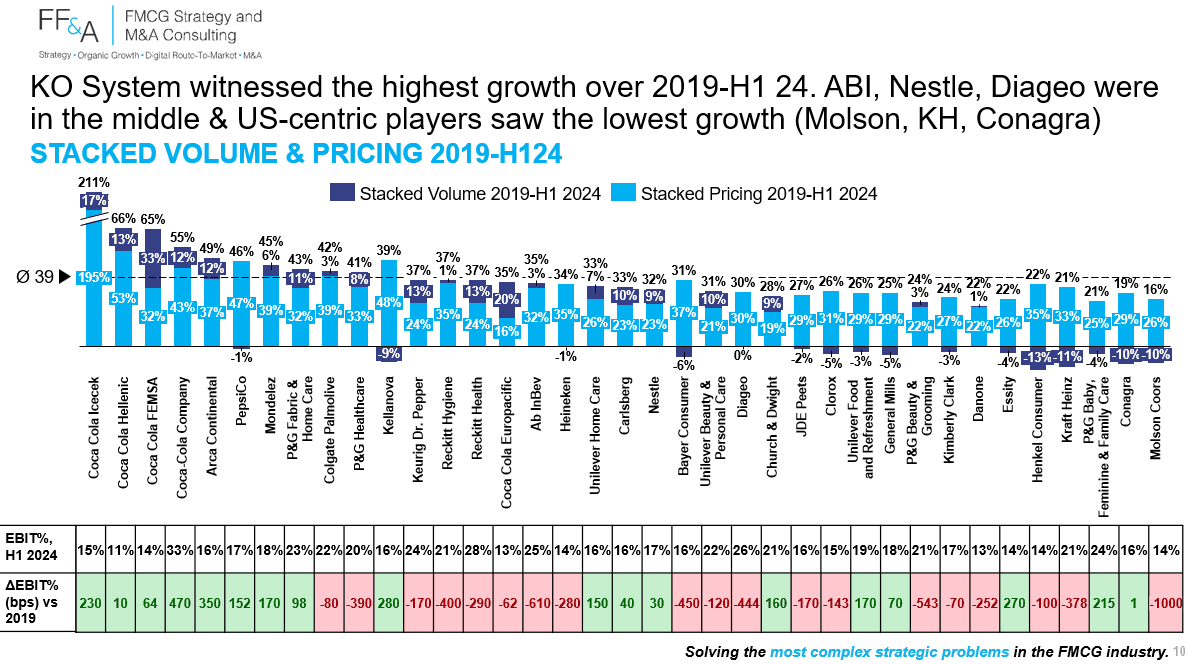
5) Unsurprisingly, the FMCG companies the most exposed to those most price elastic couples, are the ones that have underperformed the most revenue & profit since pre-COVID (key players the most exposed to US/WEU non-impulse F&B, tissue & hygiene, alcoholic drinks). Unsurprisingly, The Coca--Cola System (TCCC & Bottlers) have outperformed
Bringing it all together:
PL is not the key driver of the volume decline for most of the world largest FMCG companies
The unprecedented pricing taken post-COVID is & has disrupted for now the long-term growth algo of the FMCG industry
Focus (for the immense majority) should not be to gain shares versus PLs (which would often trigger a race to the bottom) but rather to drive incremental category volume growth through addressing consumers barriers/ drivers
In this context, we continue to advocate for:
1) A radically ambitious approach to portfolio management & organic (volume) growth acceleration focused on driving incremental category growth that is more granular, more holistic, more consumer-centric, more omnichannel & more actionable (Zero-Based-Growth®- cf. below publication for more details)
2) Tailored strategies truly adapted to Emerging Markets that continue to account on average for 2/3 of the global FMCG growth (cf. below publication)
3) A sharper approach to Ecommerce (Ecommerce 2.0®) that is designed to identify rigorously & rapidly breakthrough improvement across the e4Ps in a context ecommerce still accounts for 20% share of global FMCG growth (and up to ~50% on Beauty, CHC and Pet Care) - cf. below publication
4) A sharper M&A strategy that is deeply embedded in the acquirer strategic framework, that granularly understands the success drivers of the targeted space & that leverages the last two decades of FMCG M&A learnings to maximize ROCE (cf. Best Acquirer® approach in the below publication)
'When the wise man points to the moon, the fool looks at the finger' - Chinese proverb
PLs are often the 'finger'.
Time for all FMCG companies to refocus on the 'moon': driving incremental category (volume) growth
Exciting times
Get in touch:
To join the ~40,000 FMCG executives that follow Frederic on LinkedIn, please click here. To start a conversation, email at: frederic@fredericfernandezassociates.com
May you want to become a Business Intelligence Client, receive all our PDF publications with more granular insights tailored to your company's needs & get the opportunity to discuss it with the FF&A team to understand key strategic implications, please email at: frederic@fredericfernandezassociates.com
Considering the huge volume of emails received, please note that the deck of this publication will be from now on available only for FF&A Clients (Strategic Projects Or Business Intelligence) through sending an email to: contact@fredericfernandezassociates.com
To subscribe to our newsletter and receive all our CEOs Insights, sign-up at the following link: FMCG CEOs - Managing For Growth
To read all our previous publications, visit our newsletter page: FMCG CEOs - Managing For Growth
About FF&A:
FF&A solves the most complex strategic problems of the world largest FMCG companies across Corporate Strategy, Organic Growth, Digital RTM (Ecommerce, DTC and EB2B) and M&A. 14 out of the world 20 largest FMCG companies are repeat Clients
FF&A team intervenes all across the globe and across all FMCG categories. To know more, please visit our websites:
www.fredericfernandezassociates.com
Disclaimers:
No FF&A employees own any stocks or financial instruments of any FMCG companies or companies mentioned in the above article. All the above information are public information
Enjoyed this article?

FMCG CEOs: Managing For Growth
Strategic insights for FMCG/ CPG CEOs