
Corporate Strategy
FMCG CEOs: Winning In Unprecedented & Bifurcating Times, 10 Thoughts On How To Deliver Repeatable Growth Outperformance & 10 Predictions For 2026-30

Author | Managing Director & Partner @ FFA
‘The real voyage of discovery consists not in seeking new landscapes but in having new eyes’ — Marcel Proust (In Search Of Lost Time)
To join the ~40,000 FMCG executives that receive automatically all our FMCG CEOs Insights (posts & articles like this one), sign-up to our newsletter — ‘FMCG CEOs: Managing For Growth’ — at the following link: https://www.linkedin.com/newsletters/7045696201089785857/
The FMCG industry’s growth algorithm is broken. 110 basis points of annual volume growth have gone missing since pre-COVID. Three super-cycles — historic pricing, China hypergrowth & post-COVID category acceleration — are ending simultaneously. 55% of the top 38 listed FMCGs witnessed volume decline in Q4 2025. Only 29% missed their top-line guidance whilst 54% beat their EPS (Earnings Per Share) consensus — a balanced improvement, yet the structural challenges remain. The gap between winners & losers is widening at an unprecedented pace.
But within this disruption lies extraordinary opportunity. The companies that crack the new growth code — desirability at scale, consumer segment precision, bespoke emerging market playbooks & disciplined M&A — will separate from the pack in ways not seen in a generation.
Here below are our 10 thoughts on how to deliver repeatable growth outperformance in these unprecedented times — and 10 predictions for 2026-30. Enjoy the read
1) Unprecedented & More Discriminating Times: the growth gap has returned, three super-cycles are ending & the gap between winners and losers is widening
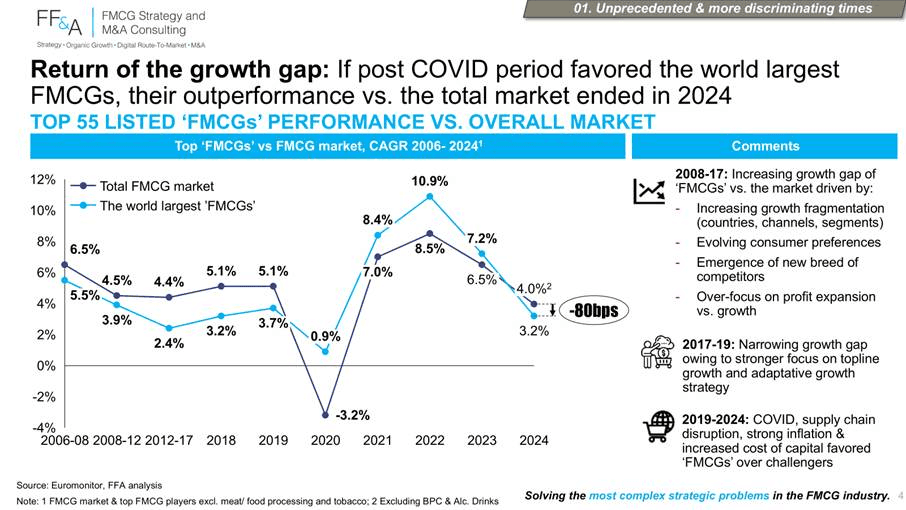
The post-COVID tailwind is over. The growth gap between the top 55 listed FMCGs & the total FMCG market has returned to -80bps — echoing the 2008-17 era where fragmentation, evolving consumer preferences & the emergence of new competitors structurally disadvantaged incumbents.
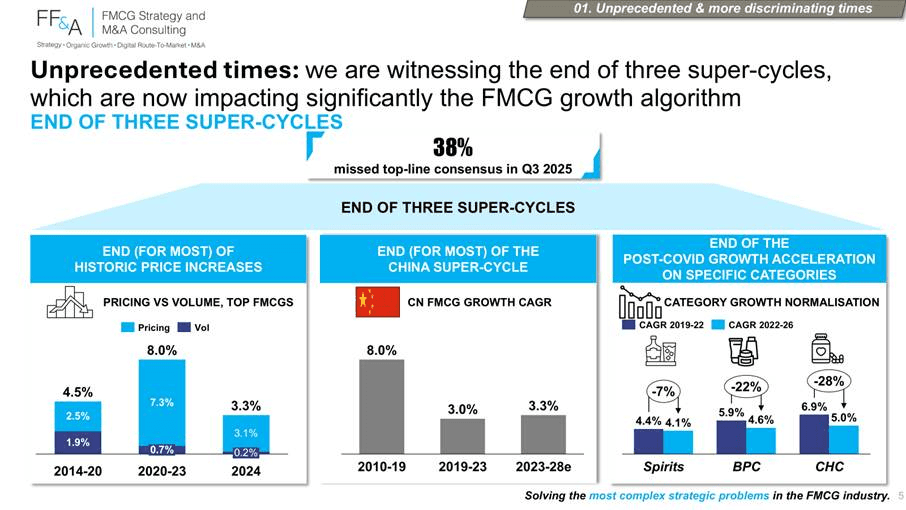
Three super-cycles are ending simultaneously. Pricing contribution dropped from 7.3% (2020-23) to 3.1% in 2024 while volumes sit at 0.2%. China FMCG growth has decelerated from 8.0% (2010-19) to 3.0% (2019-23). Post-COVID category acceleration has normalised — Spirits (-7%), BPC (Beauty & Personal Care, -22%) & CHC (Consumer Healthcare, -28%) vs. their 2019-22 peaks.
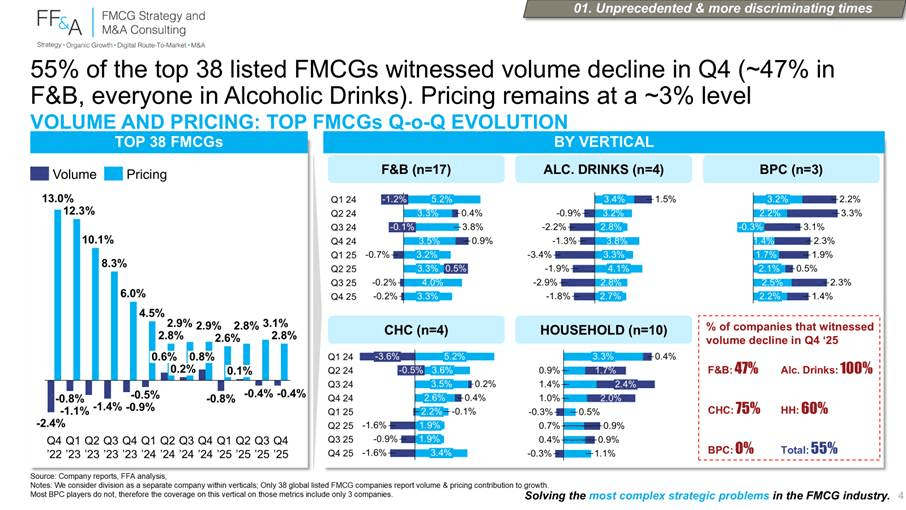
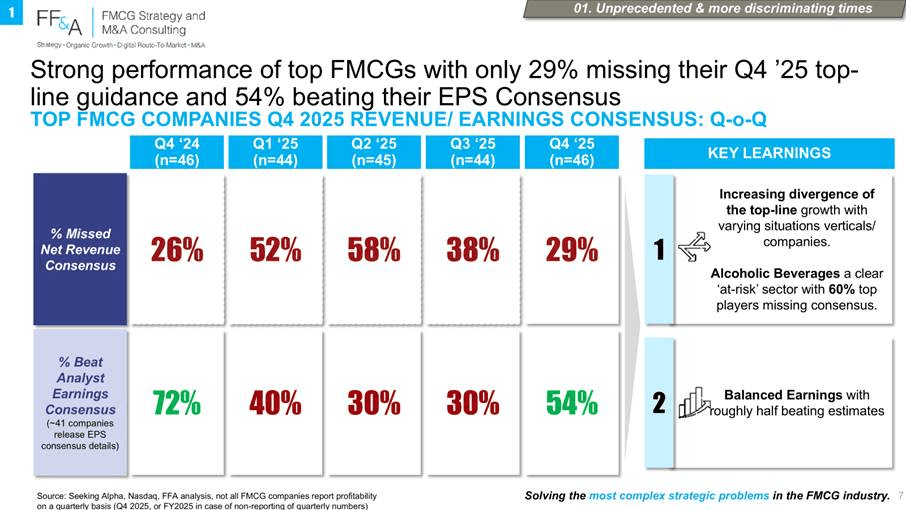
The quarterly data tells the story. 55% of the top 38 listed FMCGs witnessed volume decline in Q4 (~47% in F&B, 100% in Alcoholic Drinks). By Q4 2025, top-line performance improved — only 29% missed their revenue guidance (vs. 26% in Q4 2024) — but Alcoholic Beverages remained a clear ‘at-risk’ sector with 60% of top players missing consensus. On earnings, 54% beat analyst EPS consensus in Q4, a meaningful recovery from the 30% level in Q2-Q3 2025. The root cause of the broader pressure remains: weak volumes & limited pricing power.
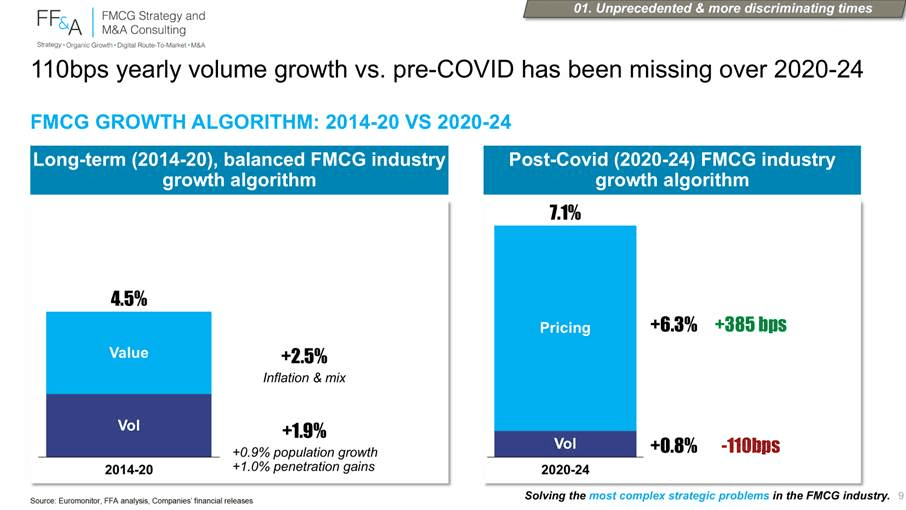
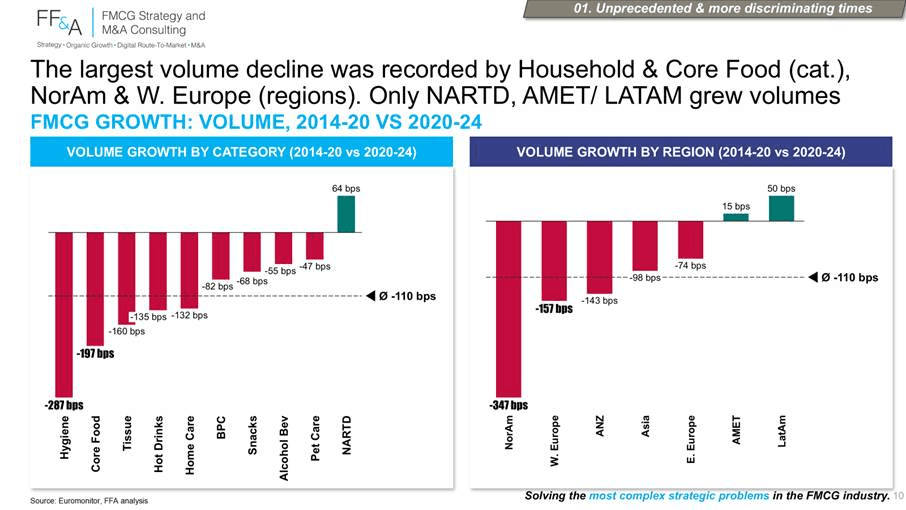
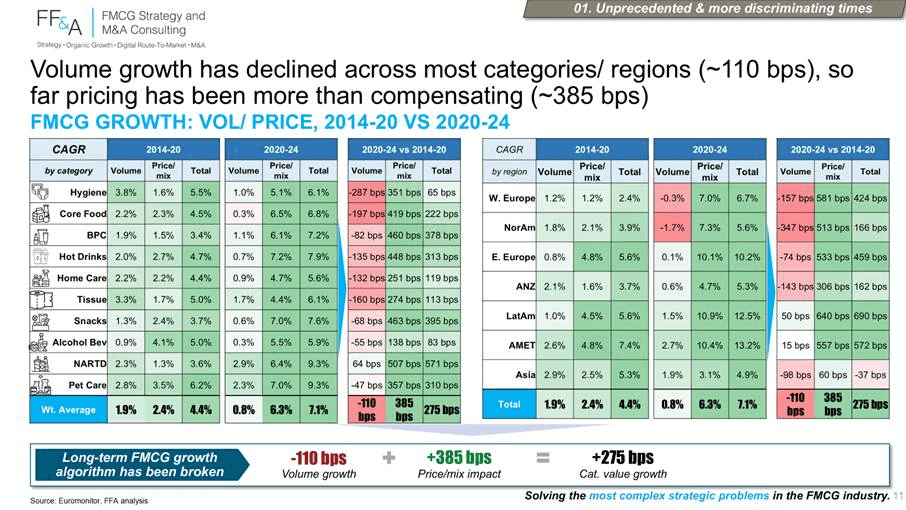
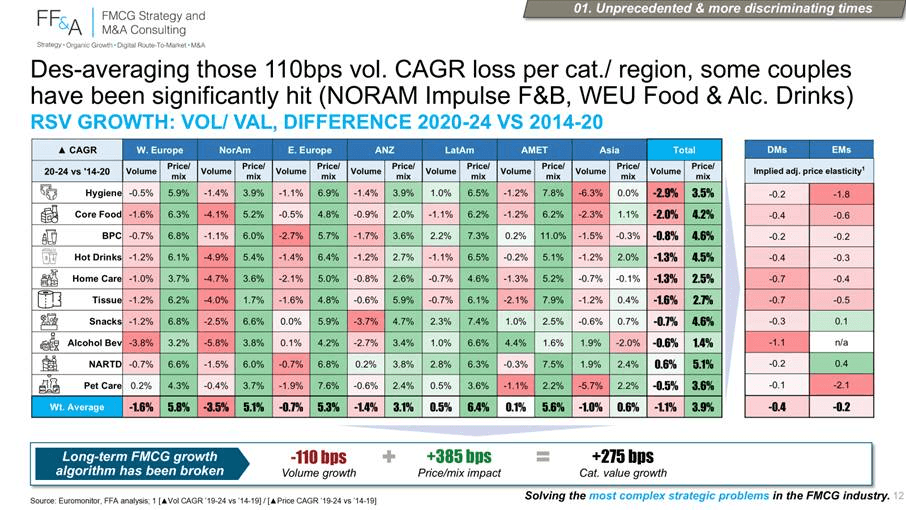
The long-term FMCG growth algorithm has fundamentally shifted. Between 2014-20, the industry grew at a balanced 4.5% (1.9% volume + 2.5% pricing). Post-COVID (2020-24), growth accelerated to 7.1% — but 385bps came from pricing while volume dropped 110bps to just 0.8%. Cumulated +36% pricing (5.3% CAGR) & only +3.7% volume (0.6% CAGR) taken since 2019. When pricing fades, volume-less growth becomes margin-less growth. Read more about it on our publication: FMCG CEOs: Q3 Results In 20 Charts - You Cannot Buy Your Way To Growth (https://lnkd.in/g7yep8mH)
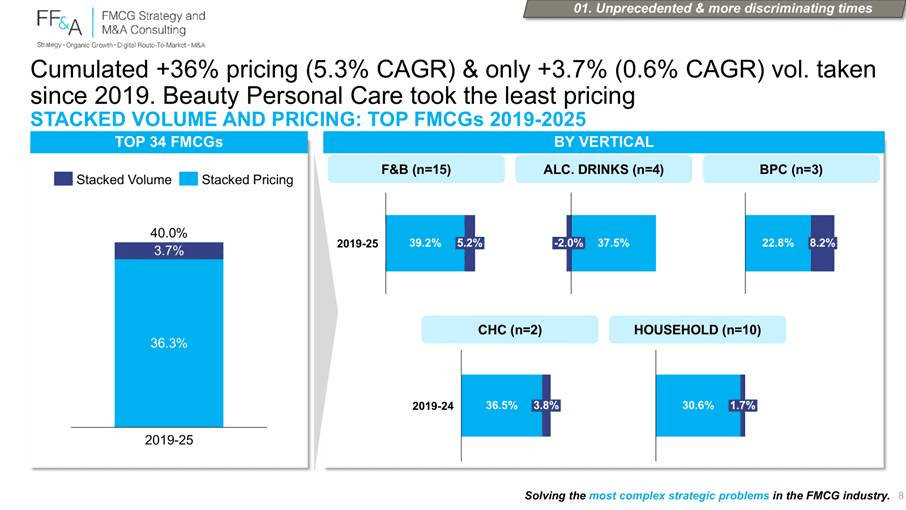
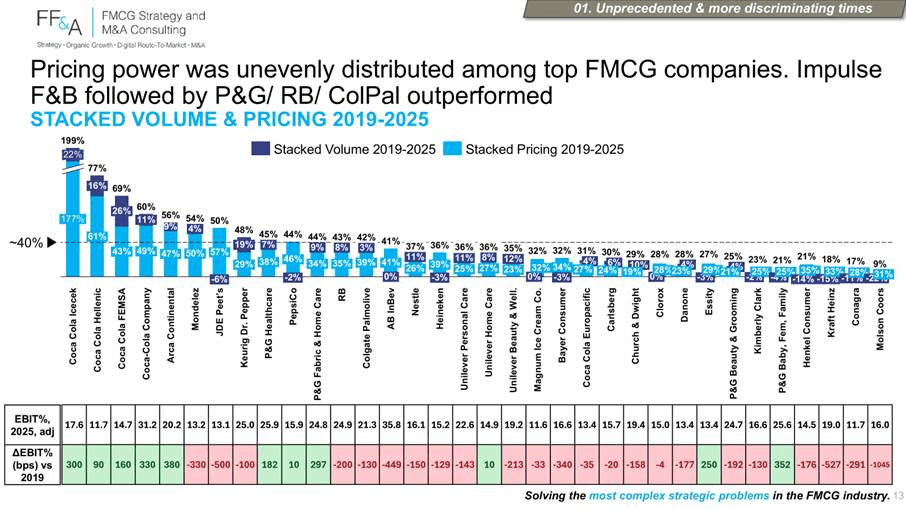
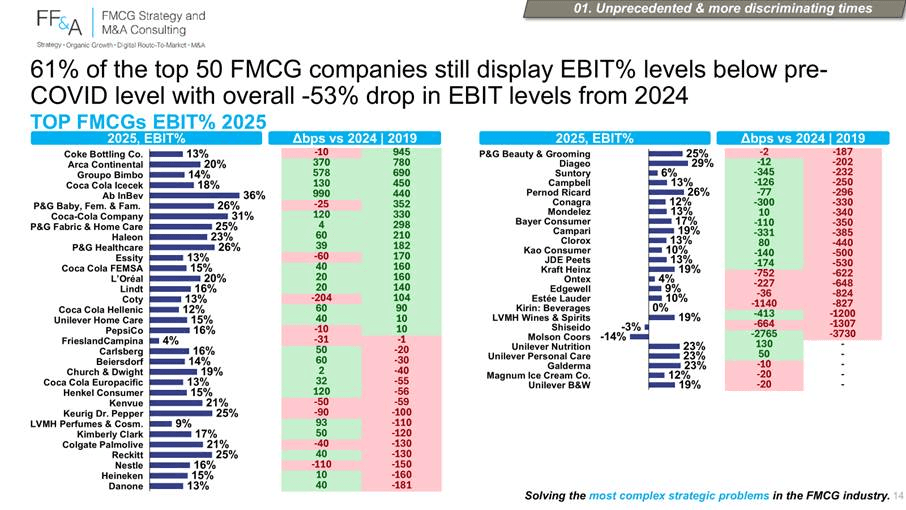
Pricing power has been unevenly distributed among top FMCG companies. Impulse F&B bottlers followed by P&G, Reckitt & Colgate-Palmolive have outperformed. 61% of the top 50 FMCG companies still display EBIT% levels below pre-COVID level.
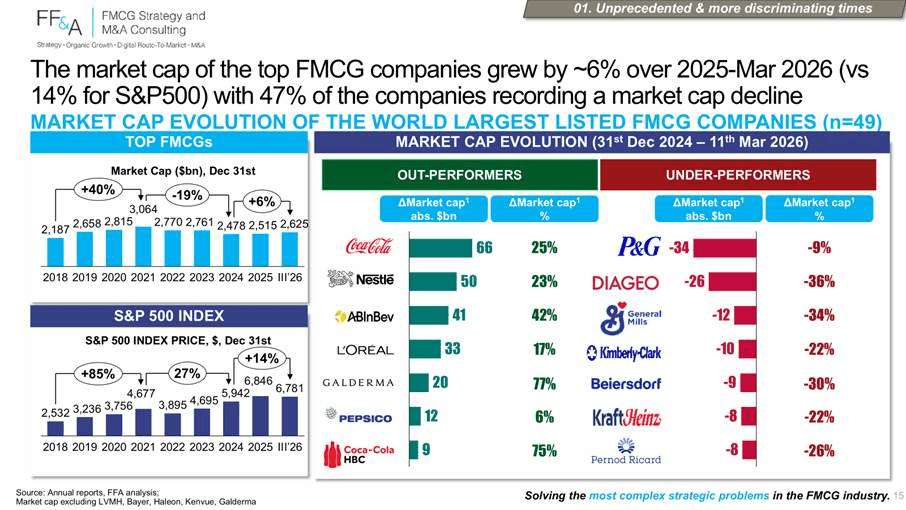
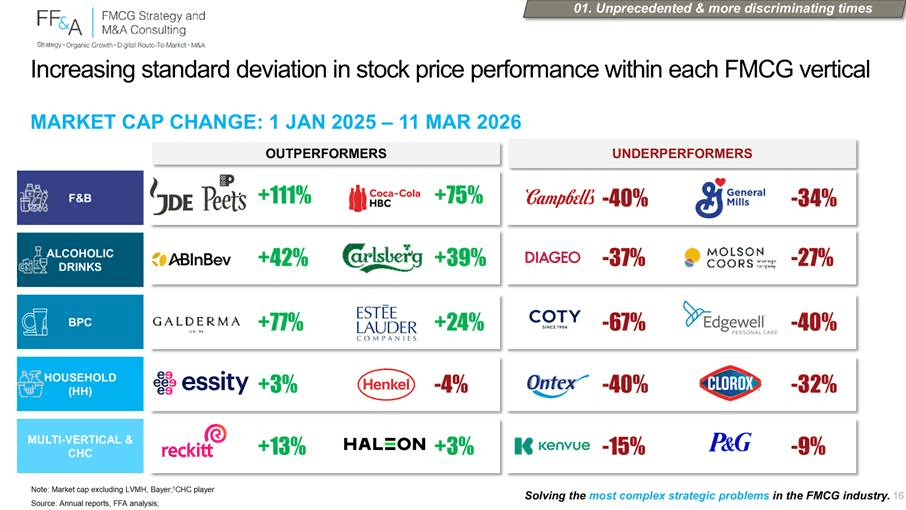
The result: a widening gap between winners & losers. The market cap of the top FMCG companies grew by ~6% over 2025-March 2026 (vs. 14% for the S&P 500) with 47% of companies recording a market cap decline. Among the top 50 listed FMCGs, outperformers posted market cap gains of up to +111% (JDE Peet’s) while underperformers saw declines of up to -67% (Coty). The standard deviation in stock price performance within each vertical is increasing — this is structural, not cyclical.
2) Breaking Down The Outperformance Algorithm: organic growth drives shareholder value, the profit/growth trade-off is real & large M&As have been the #1 driver of shareholder value destruction
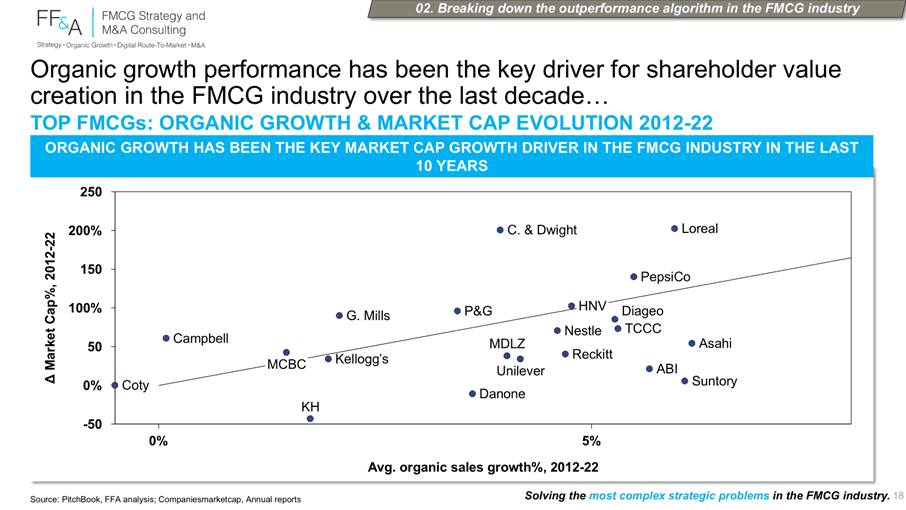
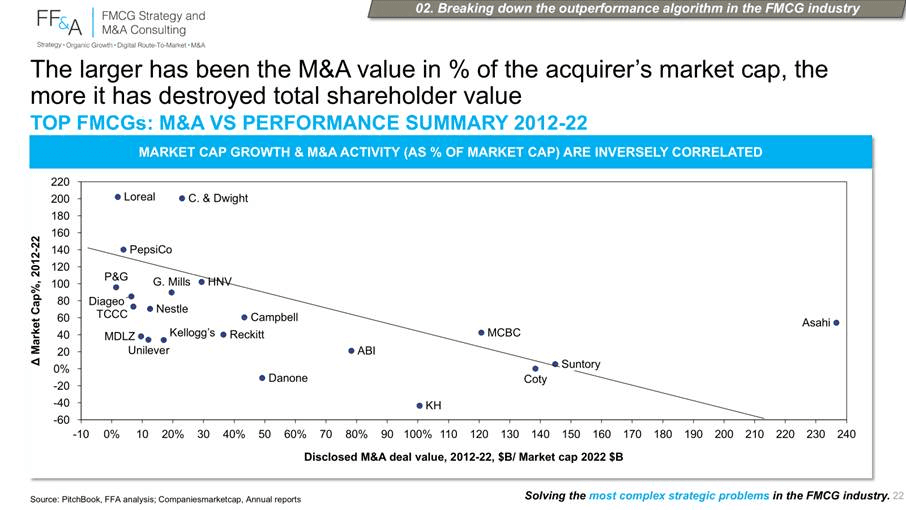
Organic growth — not M&A — has been the primary driver of shareholder value creation in FMCG. Plotting organic sales growth against market cap change (2012-22) reveals a clear positive correlation. L’Oréal, Church & Dwight & PepsiCo lead. Kraft Heinz & Coty trail.
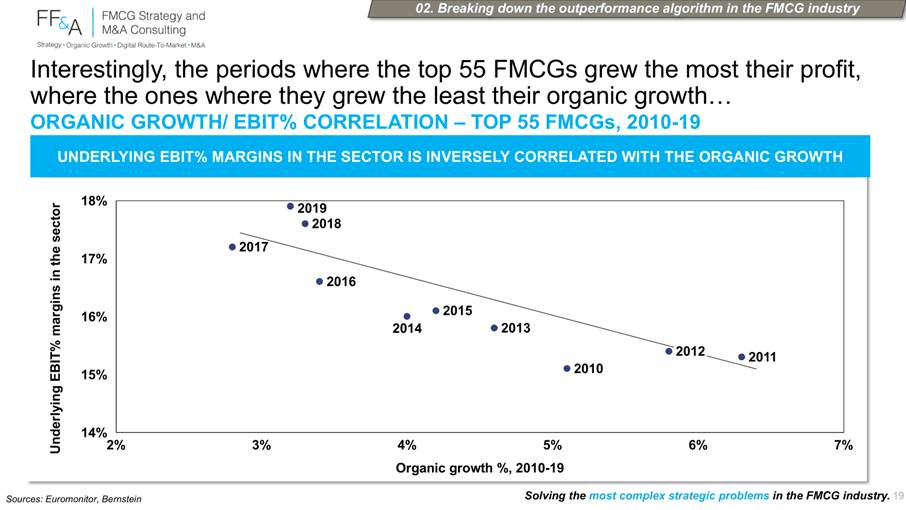
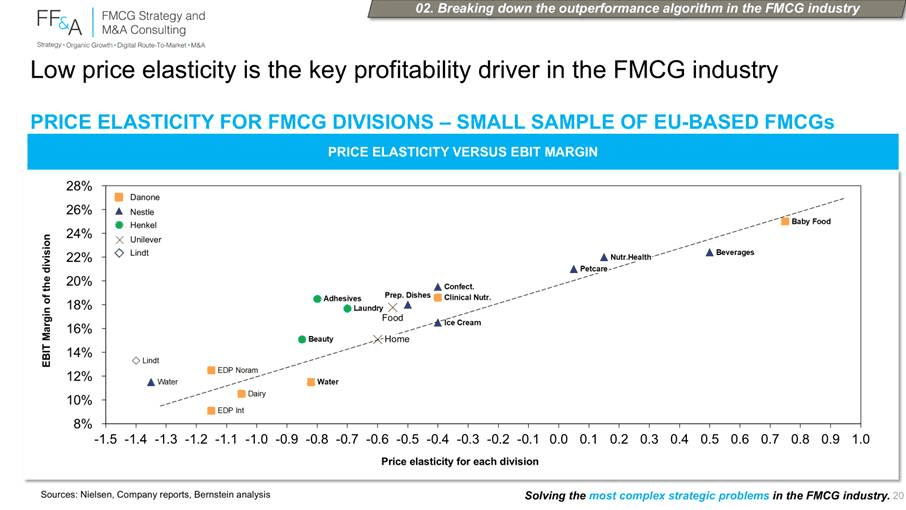
Critically, the periods where the top 55 FMCGs grew their profit the most were the ones where they grew their organic growth the least. Margin improvement at the expense of brand investment destroys long-term competitiveness. Low price elasticity is the key profitability driver in the FMCG industry.
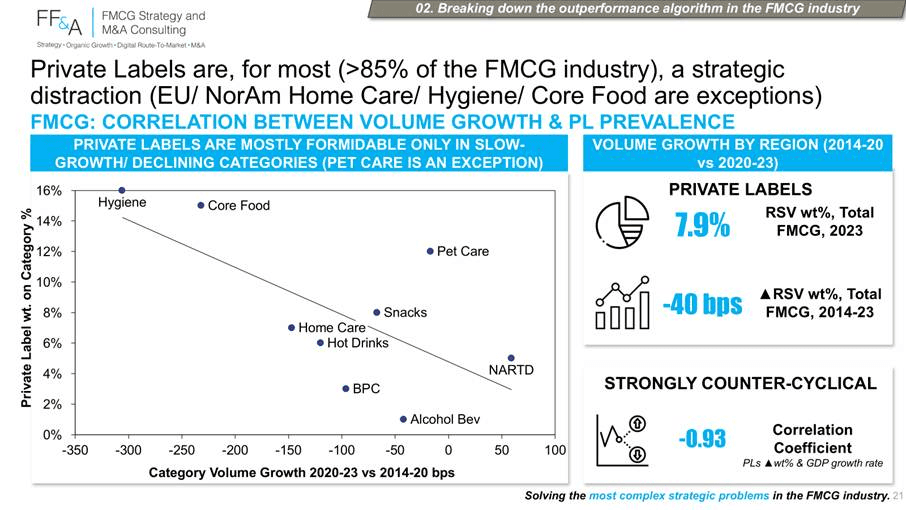
Private labels are, for most (>85% of the FMCG industry), a strategic distraction. They are formidable only in slow-growth/declining categories — EU/NorAm (North America) Home Care, Hygiene & Core Food being the exceptions. PLs are strongly counter-cyclical (correlation coefficient of -0.93 with GDP growth rate).
Meanwhile, the larger the M&A investment (as % of market cap), the more it destroyed total shareholder value. Discipline, not deal volume, creates value.
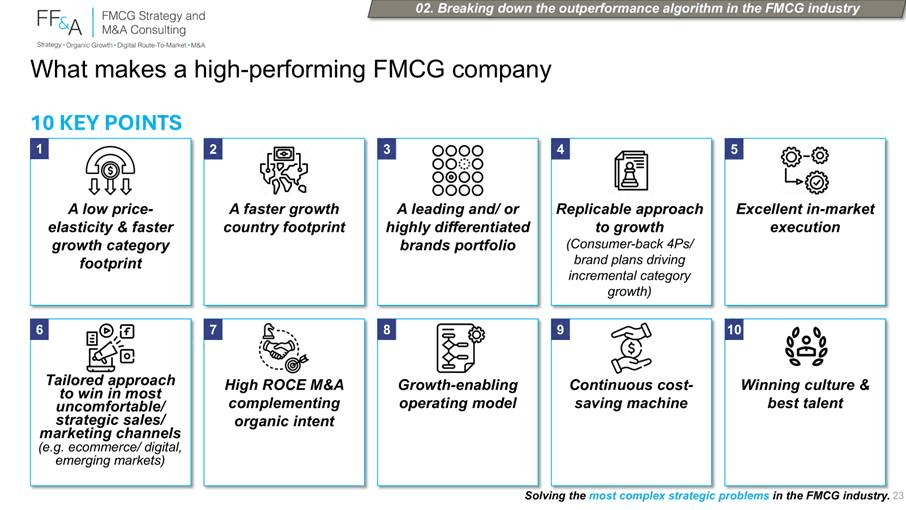
What makes a high-performing FMCG company? Ten characteristics: a low price-elasticity & faster growth category footprint, a faster growth country footprint, leading/differentiated brands, a replicable consumer-back approach to growth, excellent in-market execution, a tailored approach to win in strategic channels, high-ROCE (Return on Capital Employed) M&A, a growth-enabling operating model, continuous cost-saving & a winning culture with best talent. FMCG companies are never as strong as the weakest of those ten links
3) The Great Bifurcation: consumer markets have fundamentally split — every strategic choice must now be made twice
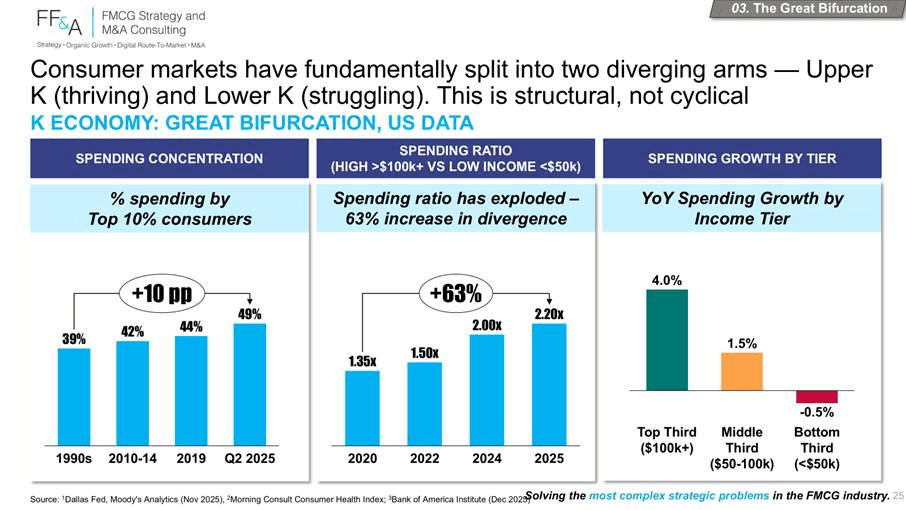
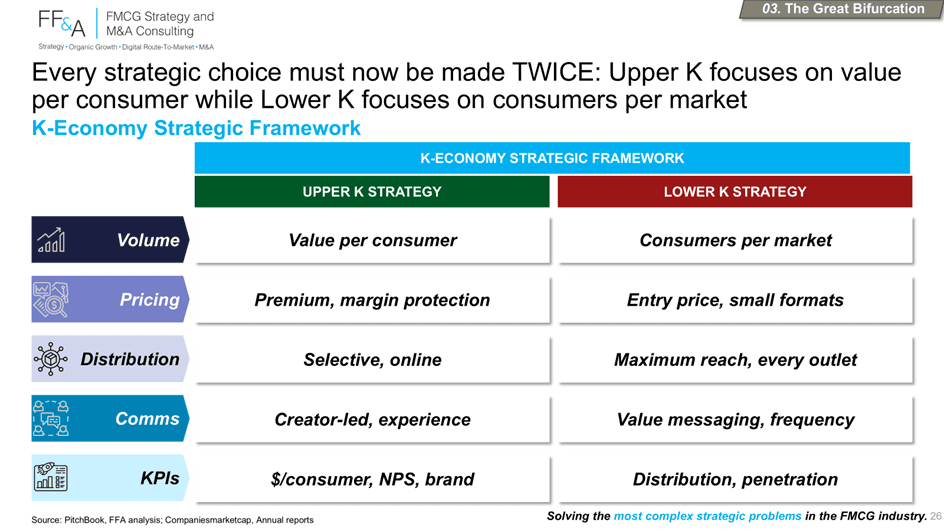
Consumer markets have split into Upper K (thriving) & Lower K (struggling). This is structural. In the US, spending by the top 10% has risen from 39% to 49% of total. The high-to-low income spending ratio has exploded by 63%. Top-third income growth runs at 4.0% while the bottom third is declining at -0.5%.
Every strategic choice must now be made TWICE. Upper K = value per consumer (premium, selective, creator-led, $/consumer KPIs). Lower K = consumers per market (entry price, maximum reach, value messaging, volume KPIs). A single playbook for both guarantees underperformance in both.
4) The Art & Science Of Driving Repeatable Growth (ZBG® — Zero-Based Growth): becoming a market maker
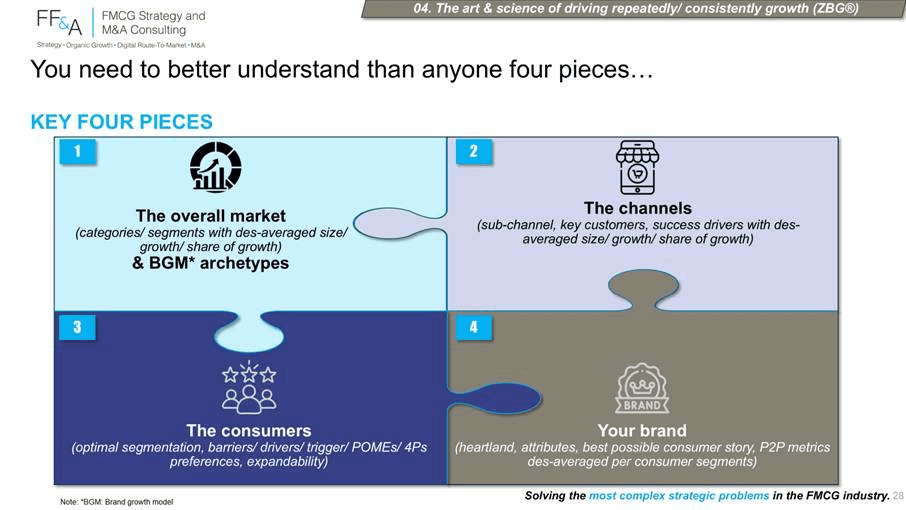
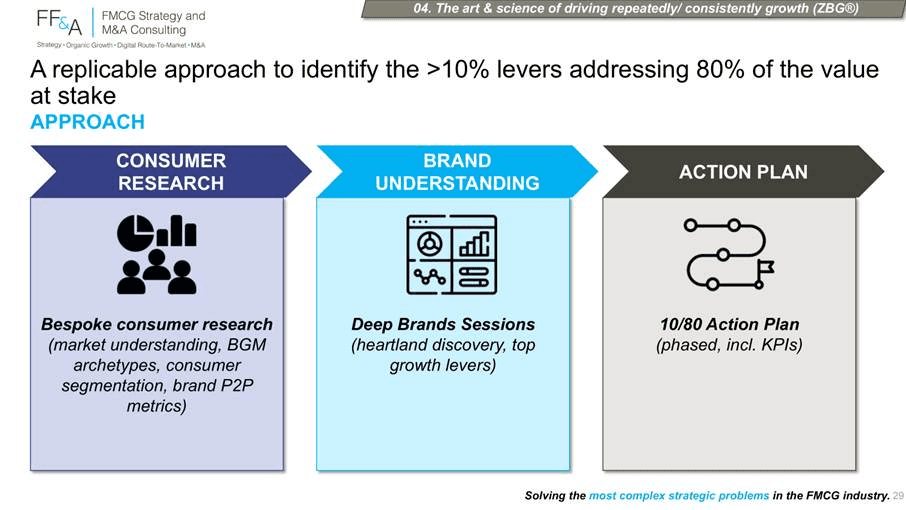
Driving repeatable growth outperformance requires understanding four pieces better than anyone else: the overall market (des-averaged by category/segment), the channels (sub-channel/key customer success drivers), the consumers (optimal segmentation, barriers, drivers, triggers) & your brand (heartland, attributes, best possible consumer story). A replicable approach identifies the >10% levers addressing 80% of the value at stake.
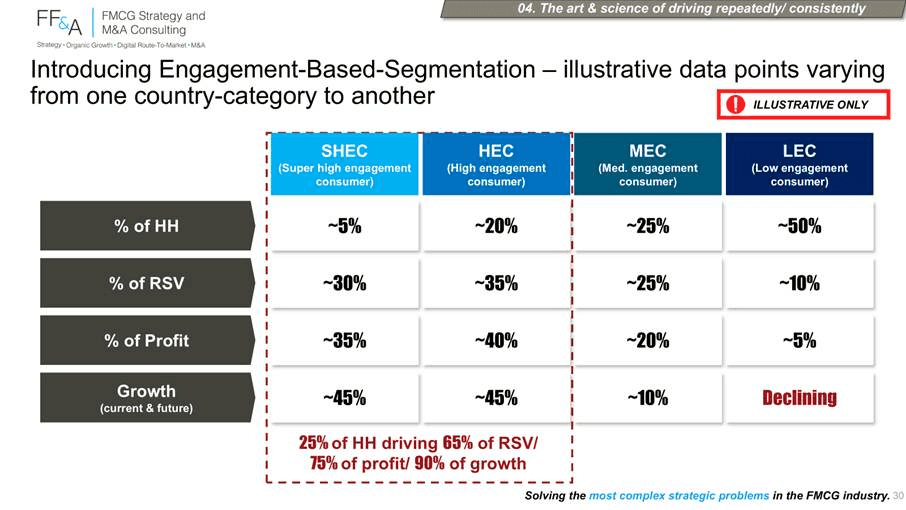
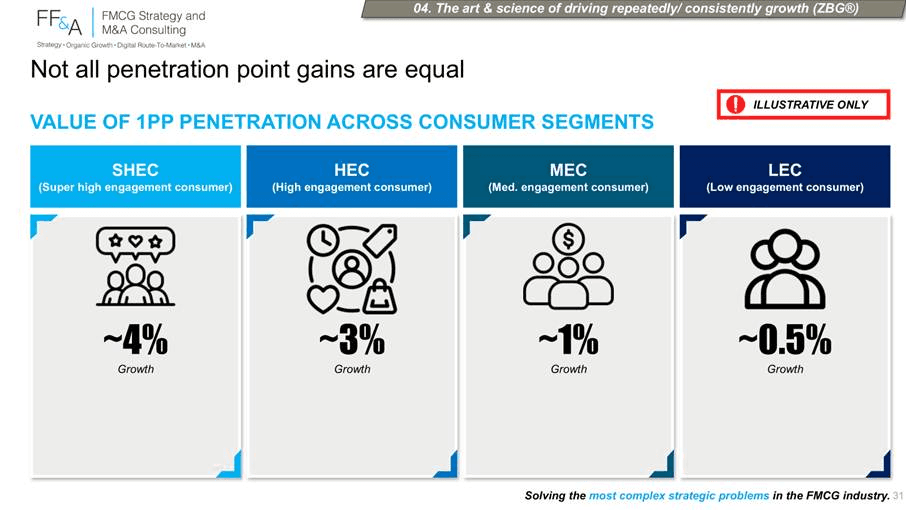
Not all consumers — nor all penetration points — are created equal. SHECs (Super High Engagement Consumers, ~5% of households) drive ~30% of RSV, ~35% of profit & ~45% of growth. Together with HECs (High Engagement Consumers), 25% of households drive 65% of RSV, 75% of profit & 90% of growth. LECs (Low Engagement Consumers, 50% of households) drive just ~10% of RSV & are declining. Consumer segment mix is a key strategic input for brand prioritisation.
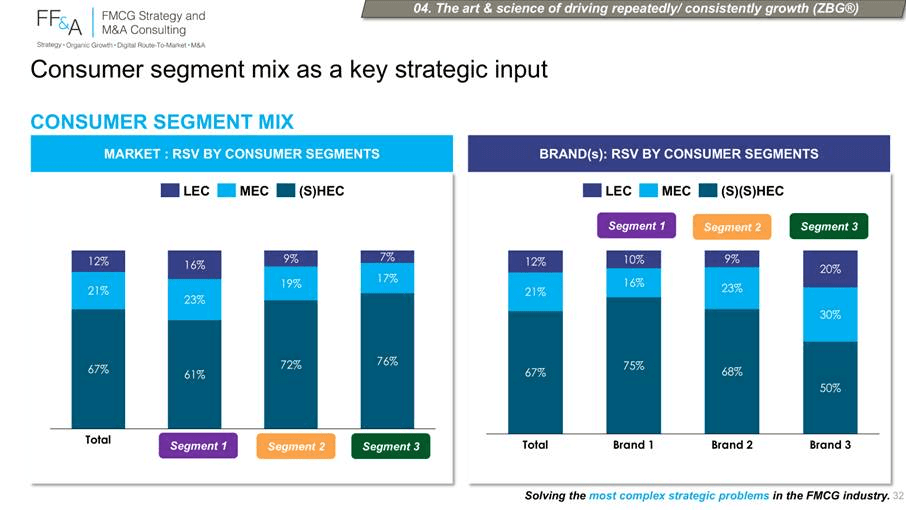
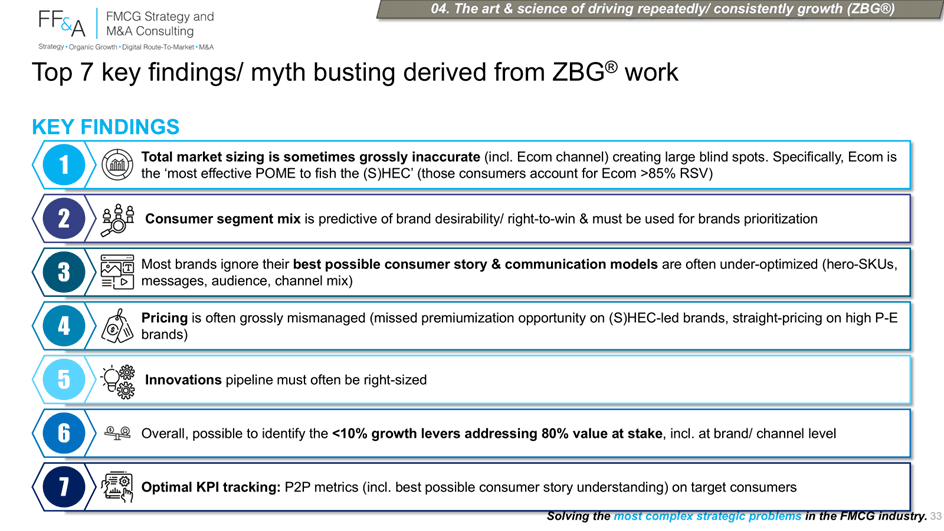
Seven findings from ZBG® work: total market sizing is sometimes grossly inaccurate (ecom is the most effective POME (Point of Market Entry) to fish (S)HECs — they account for >85% of online RSV), consumer segment mix is predictive of brand desirability, most brands ignore their best possible consumer story, pricing is often grossly mismanaged, innovation pipelines must be right-sized & it is possible to identify the <10% growth levers addressing 80% of value at stake.
Read more about our pathway to organic growth in our publication: FMCG CEOs: Managing Finally For Sustainable (Volume) Growth Or How To Stop Shrinking To Glory - From ZBB to ZBG® (Zero-Based-Growth) (https://lnkd.in/eWQEmcK3)
5) The Most Under-Leveraged Type Of Innovation: our product innovation obsession is a complexity tax
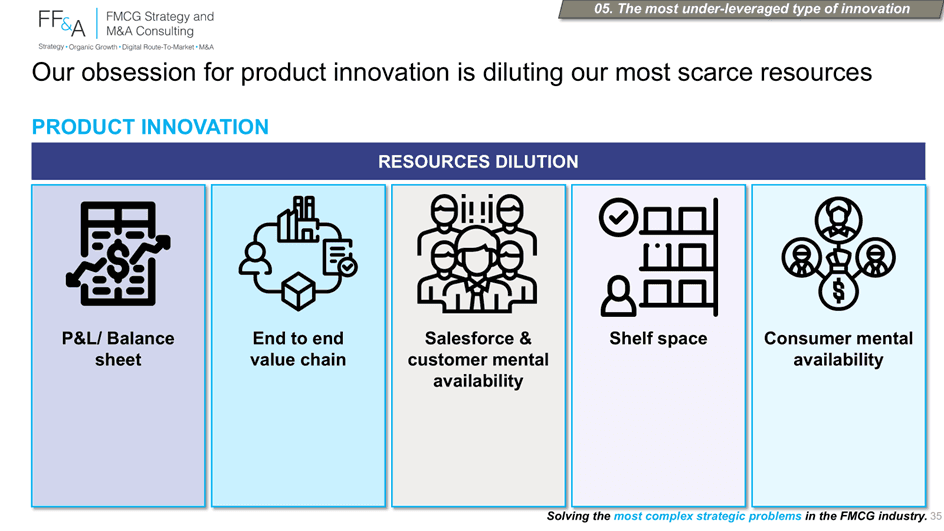
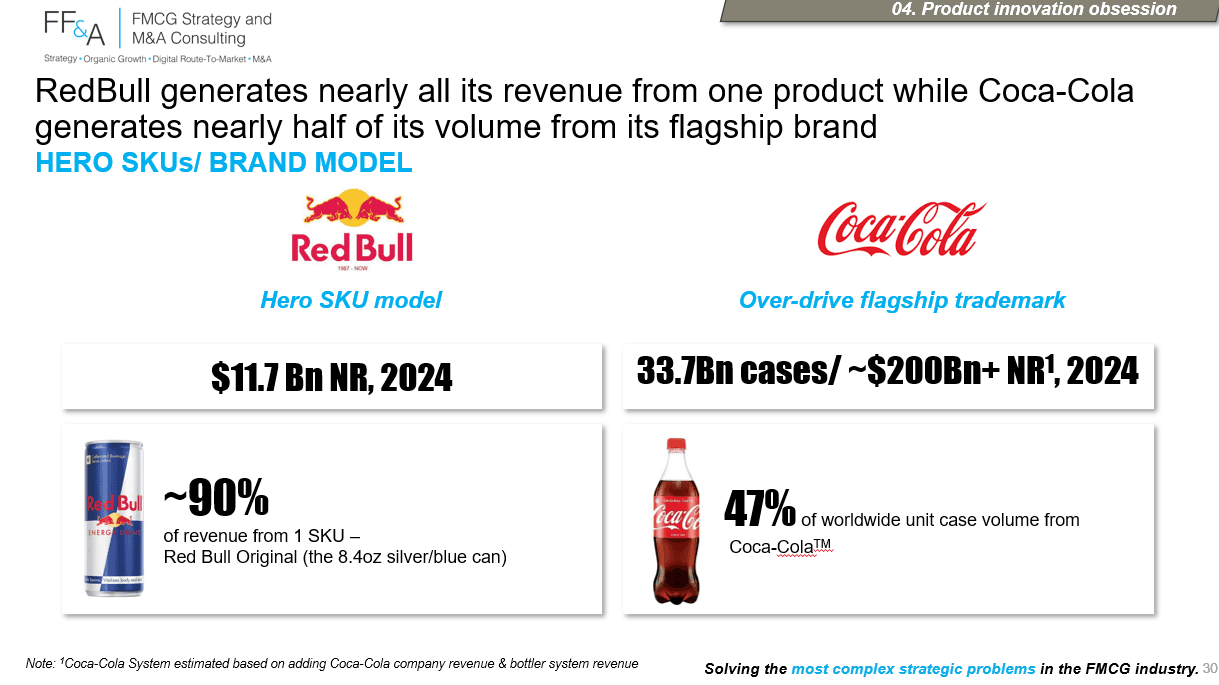
Product innovation obsession dilutes the five most scarce resources: P&L, value chain, salesforce/customer mental availability, shelf space & consumer mental availability. The biggest under-leveraged type of innovation is marketing innovation — how do we recruit consumers? Some of the best-performing brands are mono-SKU businesses that grow by investing relentlessly in consumer recruitment rather than portfolio proliferation.
6) Filling The In-Market Execution Gap
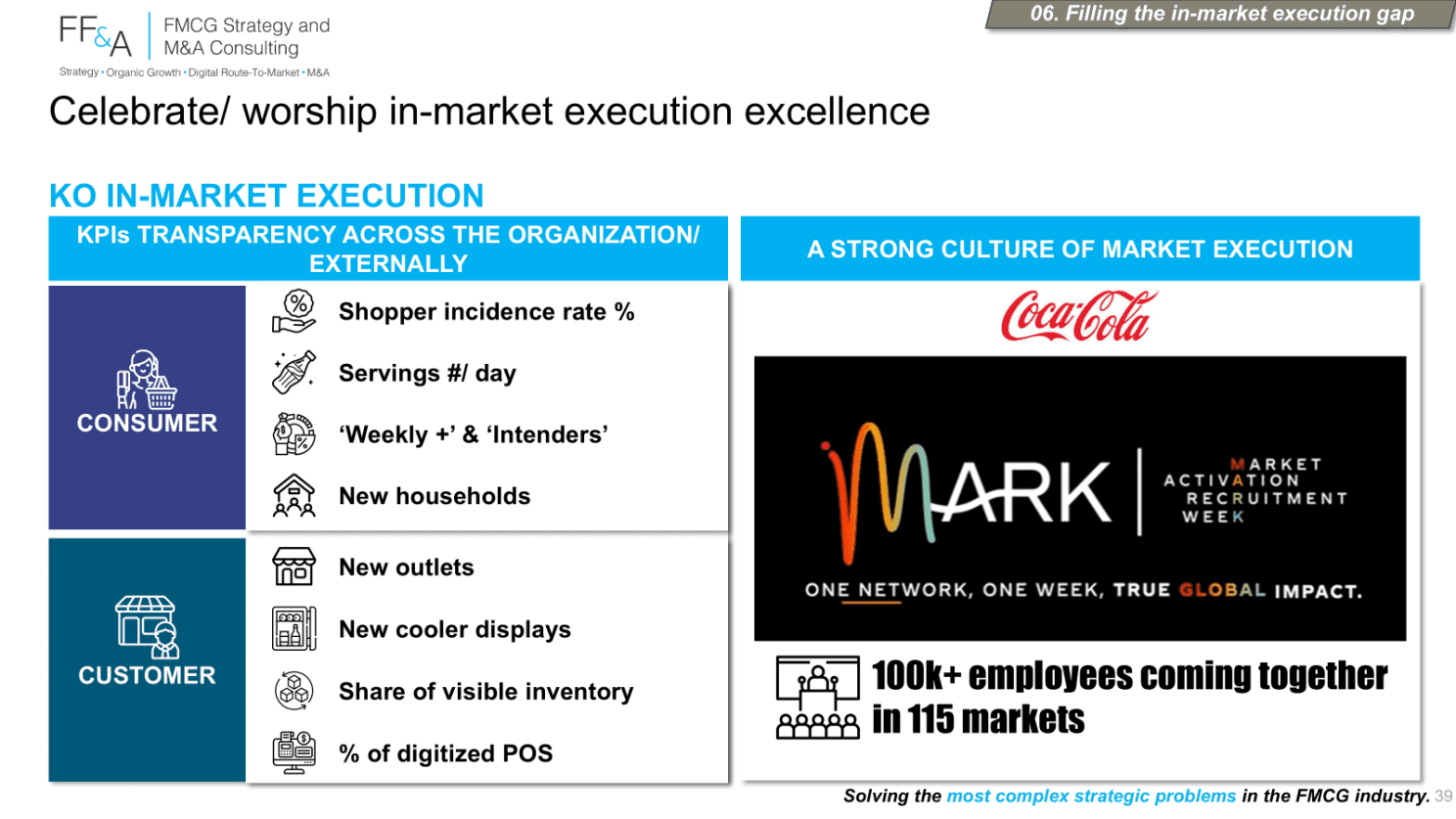
In-market execution value is too often underestimated. Our analysis reveals a consistent pattern: more value sits on in-channel execution than on portfolio/ innovations. Companies that worship execution excellence with transparent KPIs consistently outperform.
7) Ecommerce: an increasing value at stake
Ecommerce value at stake is increasing across all verticals. Pet Care leads at 37% weight by 2030 (48% SOG (Share of Growth)), followed by BPC (33%, 47% SOG). The critical insight: the K-economy’s (S)HECs — the most premium consumers — over-index massively online, accounting for ~80% of online RSV. Ecommerce is not a channel strategy — it is the most effective POME to reach your highest-value consumers.

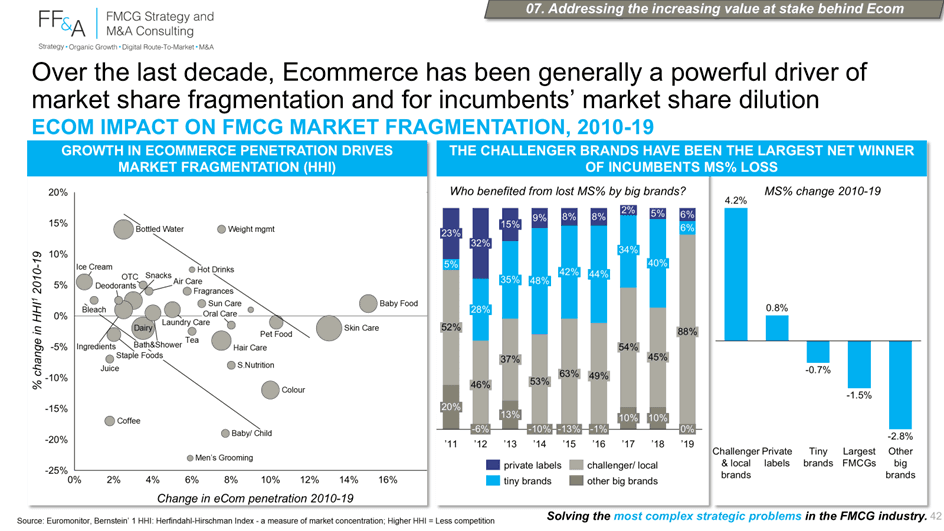
Over the last decade, ecommerce drove market share fragmentation — challengers & local brands were the largest net winners. Without a disciplined approach, scale advantages erode.
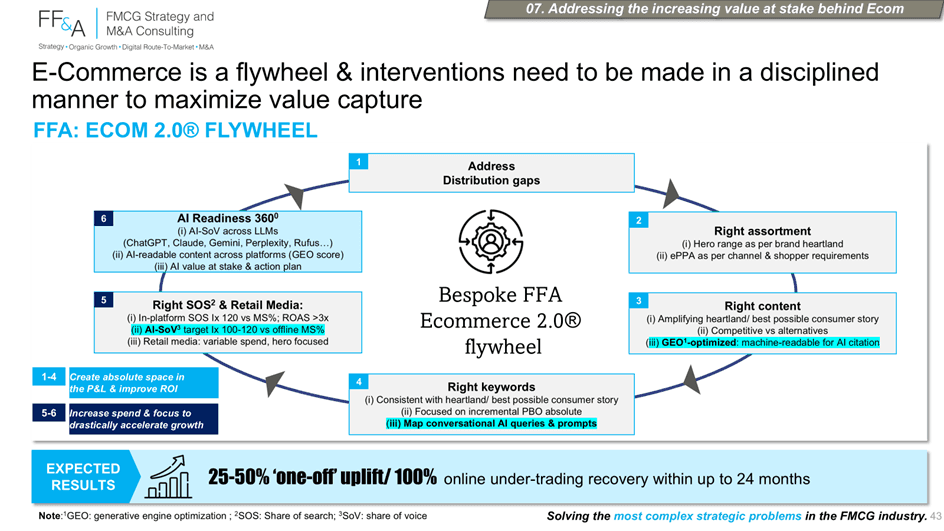
Our Ecommerce 2.0® flywheel provides the disciplined approach: create P&L space through right assortment, content, keywords & share of search first — then accelerate spend through right retail media.
Read more on our E-Commerce publication:
8) Finally Cracking Emerging Markets: >70% of growth — radically different playbooks required
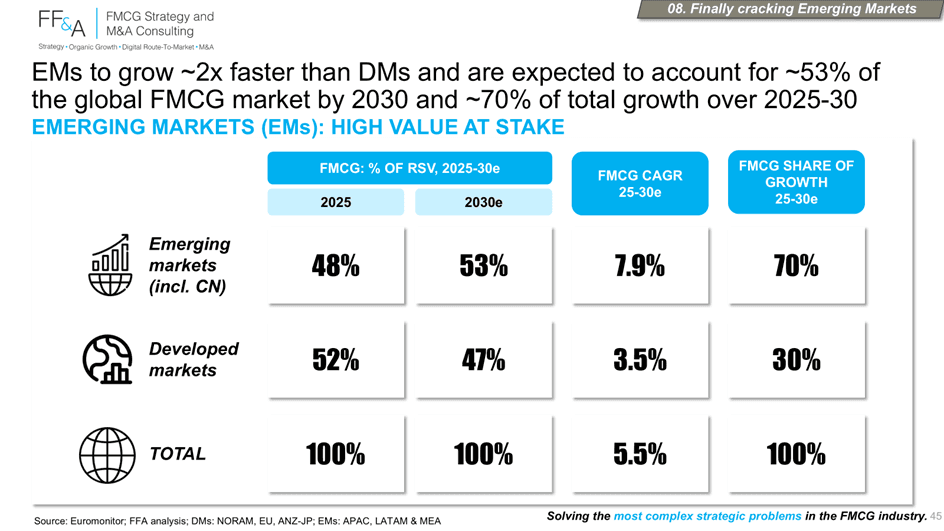
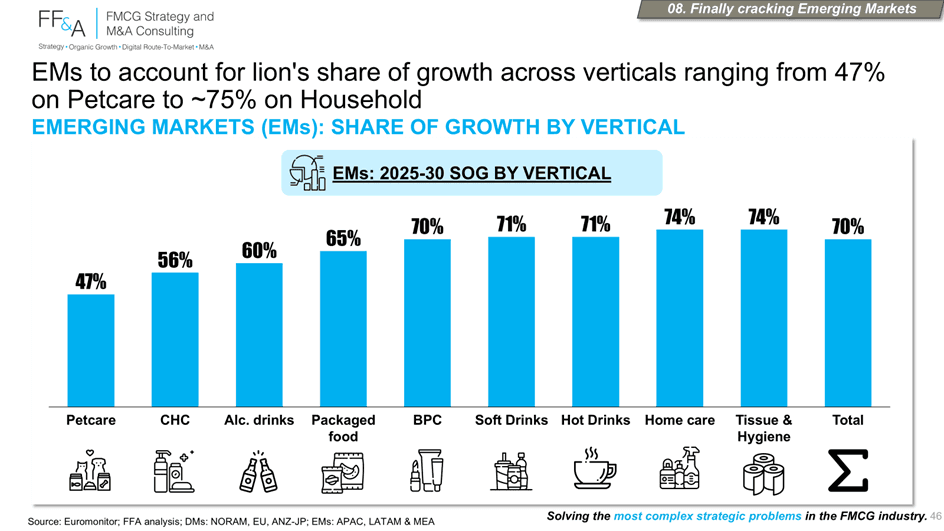
EMs (Emerging Markets) will grow ~2x faster than DMs (Developed Markets) (7.9% vs. 3.5% CAGR, 2025-30e) & account for ~53% of global FMCG by 2030 & ~70% of total growth. This is the defining strategic reality of the next decade. EMs account for the lion’s share of growth across verticals — from ~47% in Pet Care to ~75% in Household.
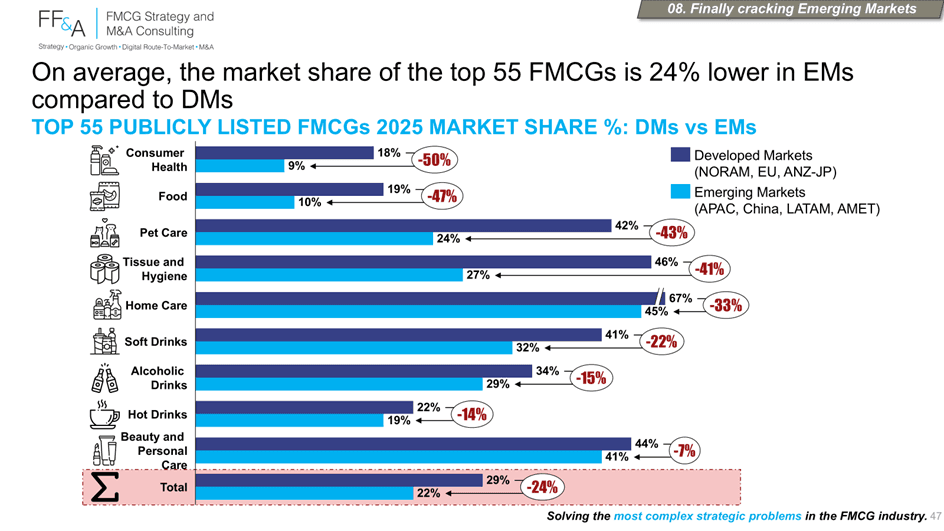
Yet the top 55 FMCGs’ market share is 24% lower in EMs vs. DMs. The gap is most acute in Consumer Health (-50%), Food (-47%) & Pet Care (-43%).
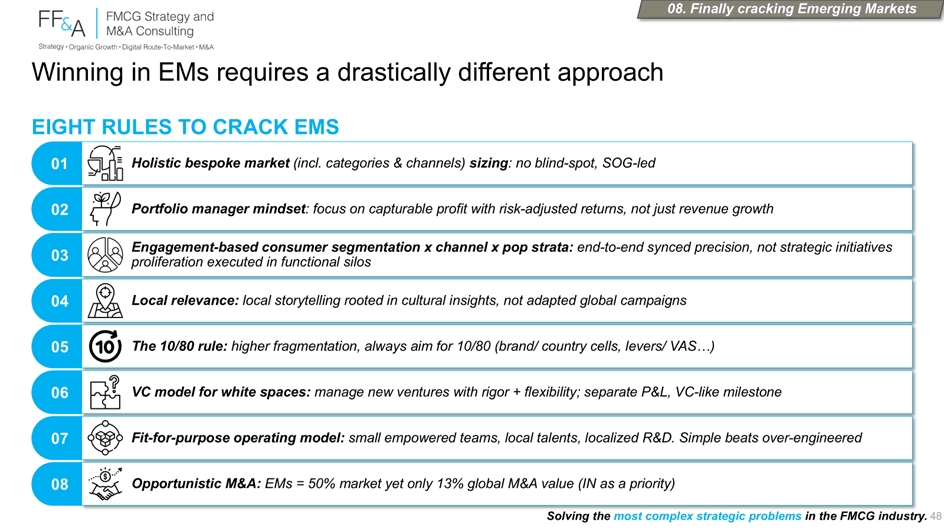
Winning requires eight rules: holistic market sizing, portfolio manager mindset, engagement-based segmentation synced across channel & pop strata, local cultural relevance, the 10/80 rule, VC model for white spaces, fit-for-purpose operating models & opportunistic M&A (EMs = ~50% market, only 13% of M&A value).
9) The High-ROCE M&A Machine: discipline is the differentiator
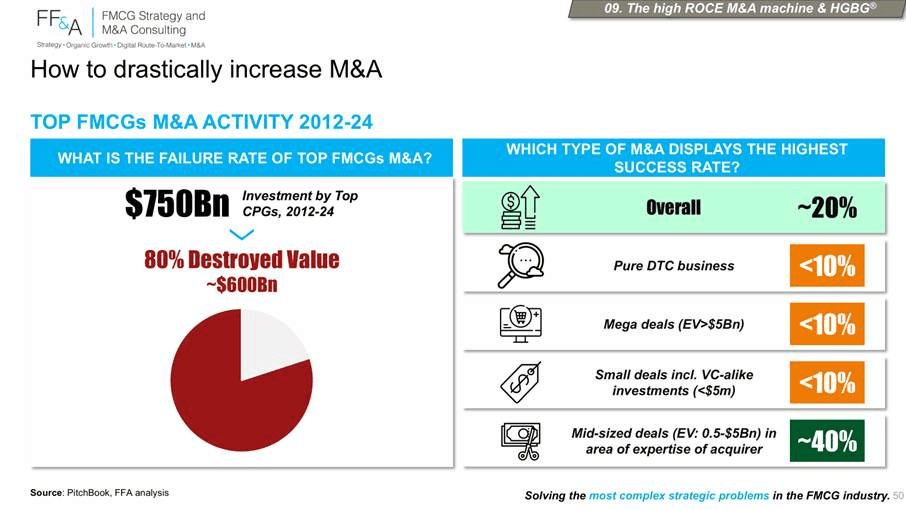
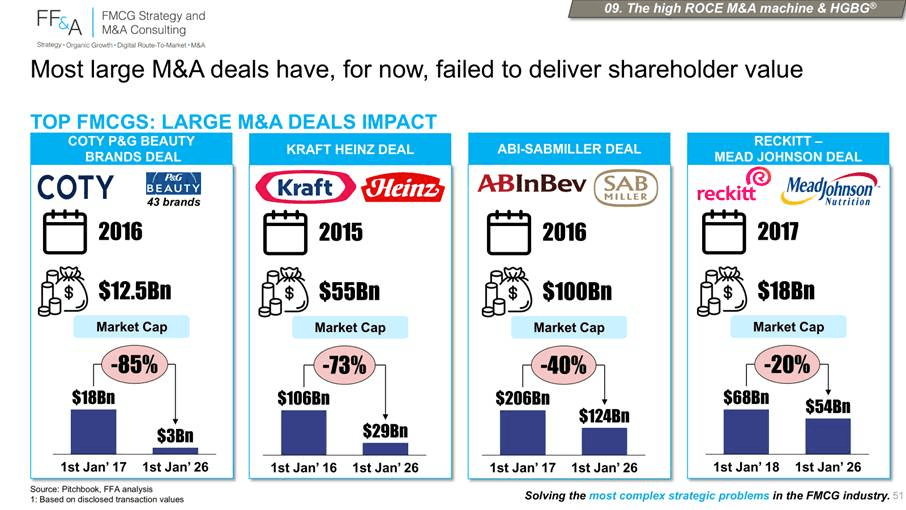
Only ~20% of FMCG M&A over 2012-24 created value. Of $750Bn deployed, ~$600Bn failed. The sweet spot: mid-sized deals ($0.5-5Bn EV) in the acquirer’s area of expertise — ~40% success rate. Pure DTC (Direct-to-Consumer), mega-deals & small deals all display <10% success rates. Most large M&A deals have, for now, failed to deliver shareholder value.
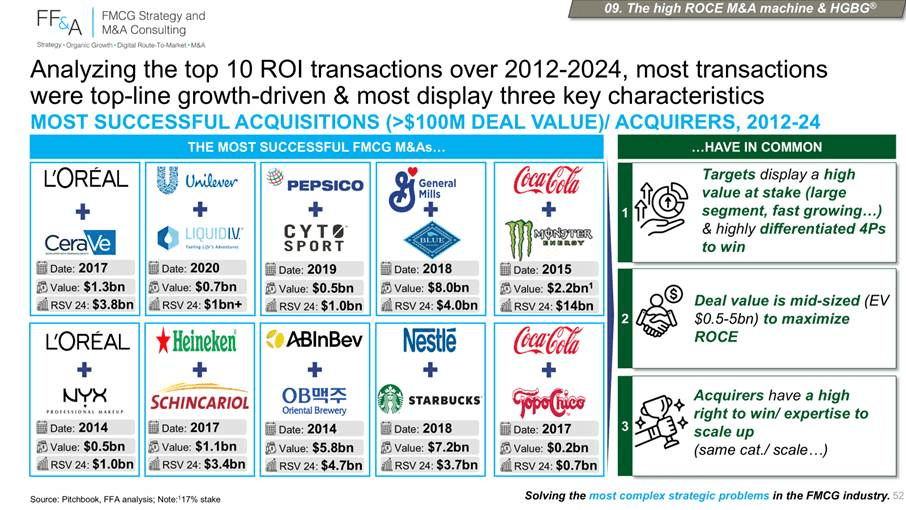
Winners share three traits: targets with high value at stake & differentiated 4Ps, mid-sized deal values to maximise ROCE & acquirers with genuine right to win (same category expertise/scale).
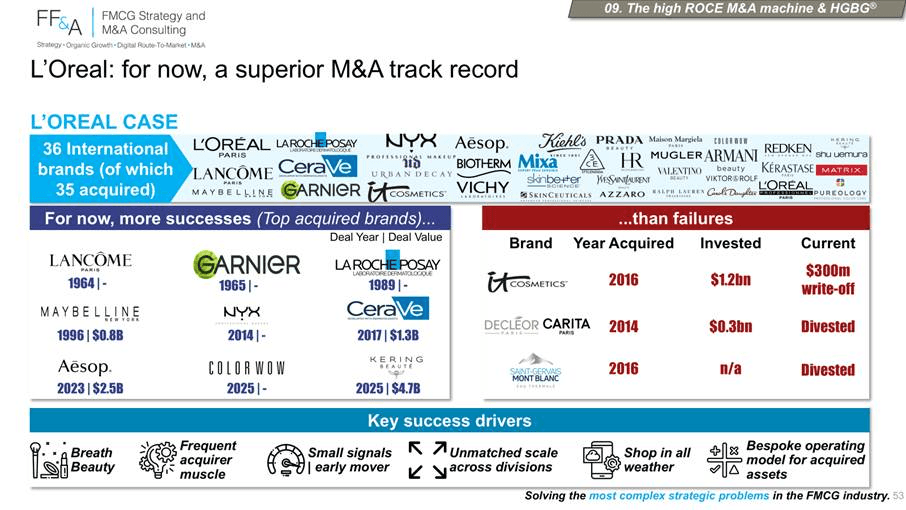
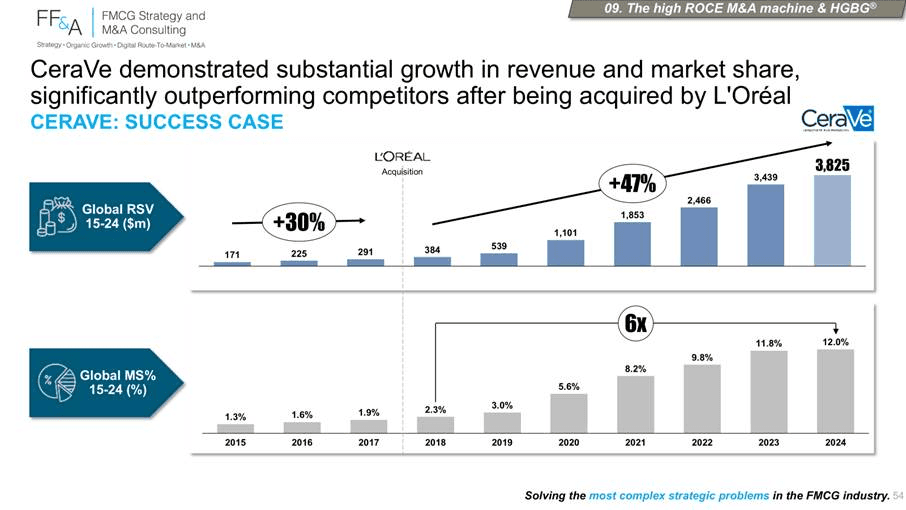
L’Oréal is the gold standard — 35 of 36 international brands acquired. Key drivers: early mover on small signals, shopping in all weather, unmatched divisional scale & bespoke operating models for acquired assets. CeraVe demonstrates the model in action — substantial growth in revenue & market share post-acquisition.
Learning from top M&A successes & failures, we developed a rigorous seven-step Best Acquirers® approach. We also see a path for a replicable approach to start-up/scale-up brands — minimising cash burn, time & overall risks. The most successful scale-ups share three traits: the right value proposition, distinct & consistent 4Ps choices & phased brand growth models. All underpinned by our proprietary ZBG® approach.
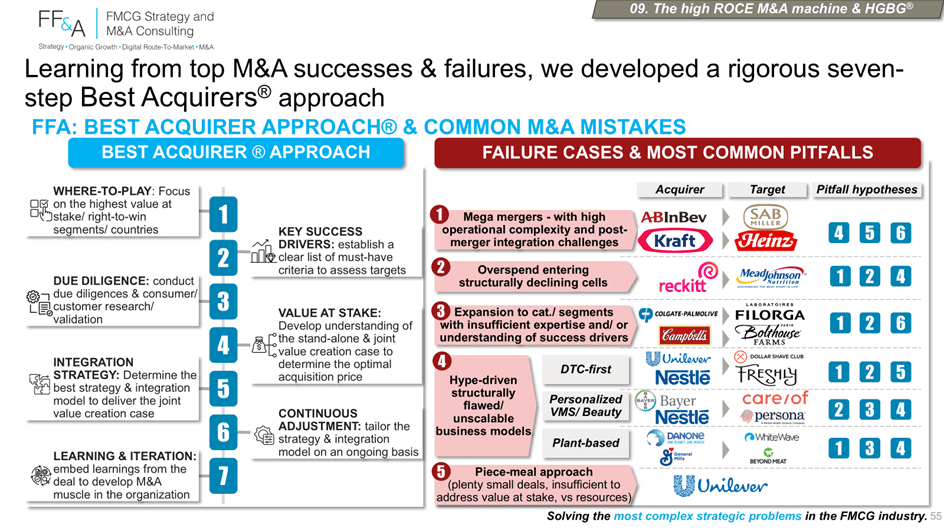
More on our views in our last M&A publication: FMCG CEOs: The $600bn M&A Bonfire — What The World Largest FMCG Companies Get Wrong About M&A — Introducing FF&A’s Best Acquirers®
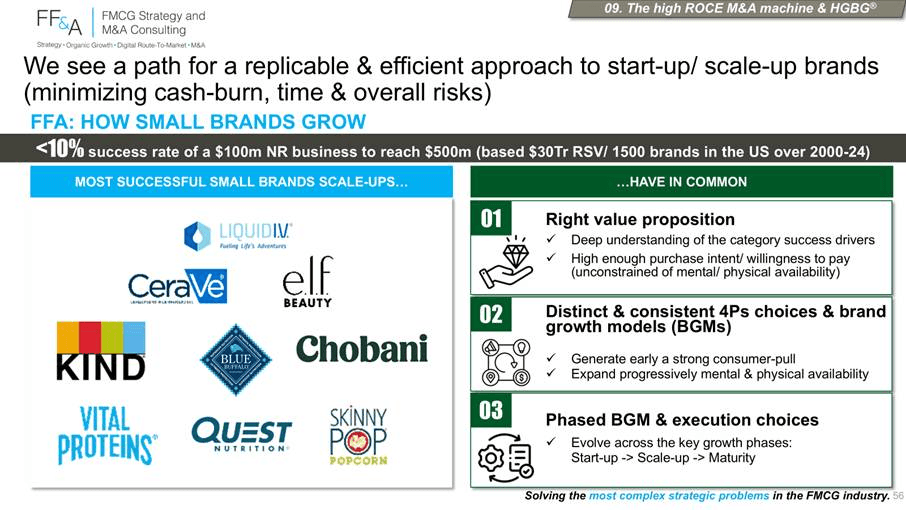
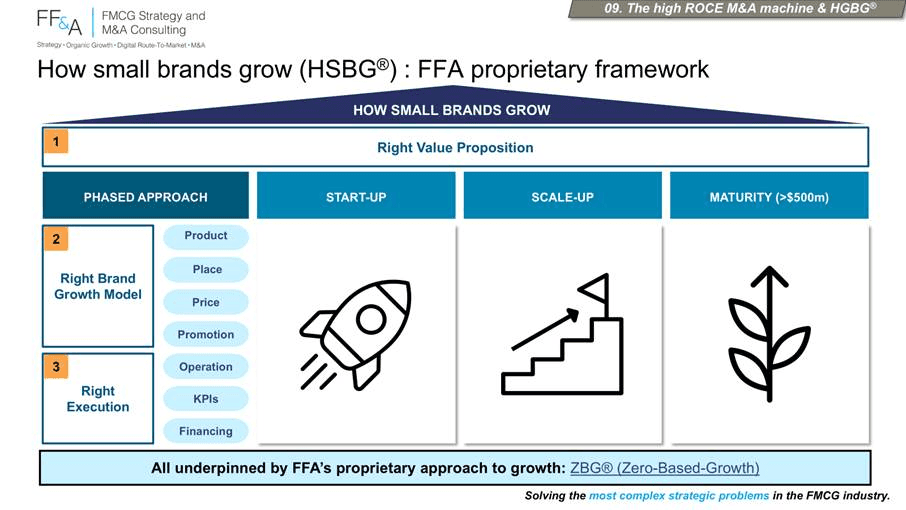
More on our views on small brands: FMCG CEOs: How Small Brands Grow - A Replicable Approach to Efficiently Start & Scale Brands
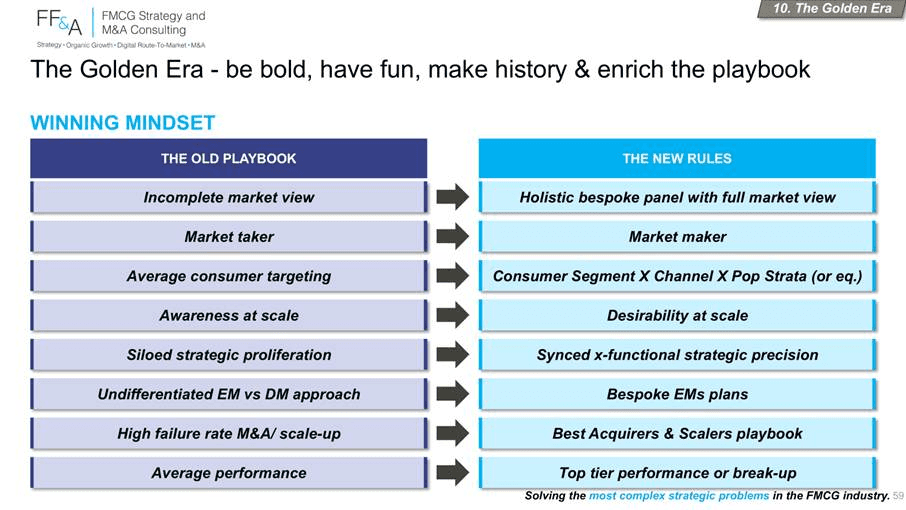
10) The Golden Era: be bold, have fun, make history & enrich the playbook
The old playbook — incomplete market views, average consumer targeting, awareness at scale, siloed strategic proliferation, undifferentiated EM approaches — is dead. The new rules demand: holistic market views, market-making, consumer segment x channel x pop strata precision, desirability at scale, synced cross-functional strategic precision, bespoke EM plans, Best Acquirers & Scalers playbooks & top-tier performance or break-up. There is no middle ground.
TEN KEY PREDICTIONS FOR 2026-30
1) No Rapid Return To The FMCG Long-Term Growth Algorithm — Increasing Deflation Risks
The structural volume erosion (-110bps vs. pre-COVID) will not reverse quickly. Pricing tailwinds have faded to ~3% and will compress further as retailer pushback intensifies & consumer fatigue deepens. In several developed markets & categories, deflation risks are emerging — a scenario most FMCG companies have not managed in a generation. The growth algorithm has structurally shifted from “volume + moderate pricing” to “limited volume + decelerating pricing.” Companies still budgeting on the old model will find themselves in a structural trap.
2) “Market Makers” Will Crush “Share Takers”
Companies that create incremental category growth — through consumer recruitment, occasion expansion & genuine innovation — will dramatically outperform those fighting for static share. The gap between top & bottom quartile FMCGs will widen further. Share-taking through trade promotion & pricing games is a race to the bottom.
3) The Great Bifurcation Will Accelerate — Increasing The Premium For Desirability At Scale
The K-economy divergence will deepen. Brands that achieve genuine desirability among (S)HEC consumers will command pricing power & margin resilience. Those in the “average consumer targeting” paradigm will be squeezed between premiumisation at the top & private label at the bottom.
4) Retail Consolidation + Retail Media + PL Proliferation = Margin Compression For The Unprepared
The triple squeeze of retail consolidation, explosive retail media growth & private label proliferation will compress margins for companies that fail to build genuine consumer pull. For the ~15% of the industry where PLs are structurally dominant (EU/NorAm Household, Hygiene, Core Food), pressure will intensify.
5) EMs To Account For >60% SOG — But Require Radically Different Playbooks
EMs will drive the lion’s share of growth across every vertical. The companies that crack EMs with bespoke approaches — localised segmentation, fit-for-purpose operating models & opportunistic M&A (particularly India) — will drive disproportionate value creation. DM playbooks applied to EM realities will continue to underperform.
6) Ecommerce Will Dilute Incumbents — Unless You Crack The (S)HEC Code
Ecommerce will reach ~19% of total FMCG by 2030 with ~34% share of growth. Its structural bias toward fragmentation will persist. The path to ecommerce profitability runs through the (S)HEC code — these consumers drive ~80% of online RSV.
7) M&A To Accelerate — But 80% Will Fail (Again)
The economics are shifting decisively: organic growth is getting harder (pricing exhaustion, volume stagnation, rising A&P just to hold share), while inorganic growth is getting cheaper (falling interest rates, compressed valuations from ~25x to ~18x P/E, increasing asset availability as PE seeks exits). Balance sheets are ready. M&A will accelerate. But without discipline — targeting the $0.5-5Bn sweet spot, staying within right-to-win zones, deploying bespoke integration models that let acquired brands thrive — the 80% failure rate of 2012-24 will repeat. The $600Bn bonfire should serve as the industry’s most expensive lesson.
8) Value Destruction Will Claim 4-5 Large FMCGs That Will Be Entirely Dismantled
The Kellogg split, Unilever ice cream spin-off & Reckitt Essential Home exit are early signals of a structural trend. Over the next 3-5 years, we expect 4-5 large FMCG companies to be entirely dismantled through break-ups, spin-offs & forced divestitures. The common thread: chronic growth underperformance, bloated cost structures, portfolio incoherence & mounting activist pressure. These dismantlings will create significant M&A opportunity for disciplined acquirers & fuel further divestiture activity across the industry.
9) Activist Investors & CEO Churn To Accelerate
Widening performance gaps, increasing data transparency & compressed valuations will drive a wave of activist campaigns. CEO tenures at underperforming companies will shorten. The FMCG C-suite has never been under more scrutiny.
10) Winning Cultures Will Be Built On Bold Moves, Not Incremental Improvement
The Golden Era belongs to CEOs who make bold, conviction-led moves — transformative portfolio choices, radically different EM approaches, genuine consumer segment precision, market-making brand strategies. Incremental improvement on the old playbook will not close the gap. The organisations that will define the next era will be those that embrace discomfort, reward entrepreneurship & treat every market, category & consumer segment as a distinct business to be won — not a territory to be defended.
Exciting times ahead
‘We do not succeed in becoming someone else but in becoming the best version of ourselves & in changing selectively. It is your challenge. Exciting times’
Frederic
——————————————————————————————
To join the 64,000+ FMCG executives that follow Frederic on LinkedIn: linkedin.com/in/fredericfernandez
To start a conversation: frederic@fredericfernandezassociates.com
To join the ~39,000 FMCG executives that receive our newsletter: https://www.linkedin.com/newsletters/7045696201089785857/
𝗔𝗯𝗼𝘂𝘁 𝘂𝘀:
FF&A solves the most complex strategic problems of the world largest FMCG companies across:
Corporate Strategy
Organic Growth (cf. our proprietary Zero-Based-Growth® - https://lnkd.in/eWQEmcK3)-
Small Brands Growth (cf. our proprietary approach How Small Brands Grow ® - https://lnkd.in/eyp3Baq5)
Digital RTM (Ecommerce - cf. our proprietary Ecommerce 2.0® - https://lnkd.in/e4-Q69Fi, DTC and EB2B)
M&A (cf. our proprietary approach Best Acquirers® - https://www.linkedin.com/pulse/fmcg-ceos-600bn-ma-bonfire-what-world-largest-get-wrong-fernandez-szrle/?trackingId=jmia3w6tSFKtLCfxrZuI3g%3D%3D)
14 out of the top 20 world largest FMCG companies are repeat Clients
More on FF&A at: www.fredericfernandezassociates.com
No FFA employees own any stocks or financial instruments of any FMCG companies or companies mentioned in the above article. All the above information are public information.
Enjoyed this article?

FMCG CEOs: Managing For Growth
Strategic insights for FMCG/ CPG CEOs