M&A
The Deal The Market Got Wrong? Unilever Foods x McCormick In 10 Key Messages

Author | Managing Director & Partner @ FFA
'The real voyage of discovery consists not in seeking new landscapes but in having new eyes'
— Marcel Proust, In Search Of Lost Time
To join the ~40,000 FMCG executives that receive automatically all our FMCG CEOs Insights (publications like this one), sign-up to our newsletter at the following link: FMCG CEOs: Managing For Growth
After covering in September 2024 the historic Mars-Kellanova deal (publication here), we continue our Historic M&A Transaction Series with a deep-dive into the Unilever Food x McCormick deal.
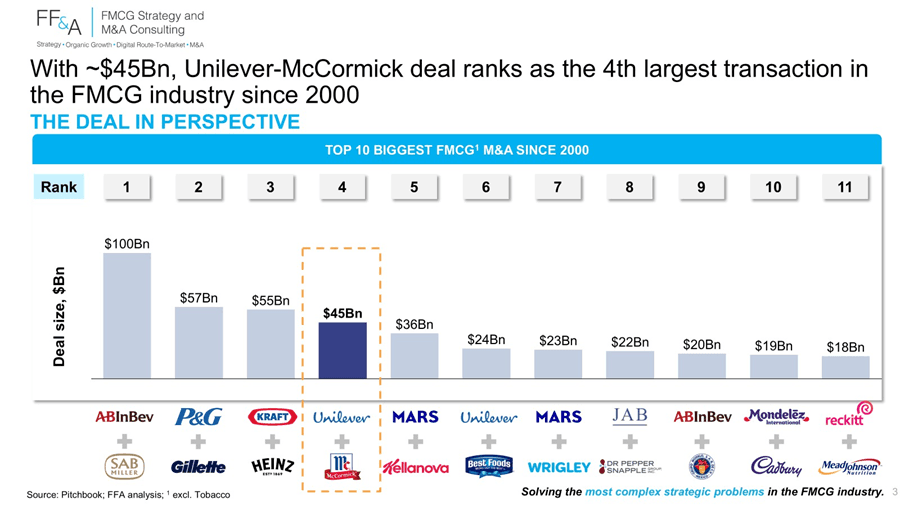
10d ago, Unilever announced the separation of its Foods division via a Reverse Morris Trust transaction with McCormick & Company. At ~$44.8bn enterprise value ($15.7bn in cash plus $29.1bn in McCormick equity), this deal ranks #4 among the largest FMCG transactions since 2000.
Many observers were quick to share their concerns (most mega-deals in the FMCG industry fail, this transaction is not a ‘clean’ & rapid exit from Food, execution risk & transition time both create an overhang on the stock...) with UL & MCC stocks losing both ~10% since the news broke mid-March.
Historically, the stock market has not always been right over the short-term when it comes to assessing large M&A deals in the FMCG industry: Kraft, ABI & SAB Miller stocks’ prices all surged post announcement whereas those companies are notorious for having led large M&A transactions that ended up destroying huge shareholder value (-70% market cap for Kraft-Heinz & -42% for ABI-SABM)
While we are notoriously skeptical on large M&A deals in the FMCG industry (cf. our extensive research in the area - The $600bn M&A Bonfire), we think this deal has good chances to create value for all stakeholders. Here is our summarized perspective in 10 brief points:
1) A historic transaction
• $44.8bn enterprise value, which places it as the 4th largest FMCG M&A deal since 2000 (excluding Tobacco), behind only AB InBev/SABMiller (~$100bn), P&G/Gillette (~$57bn) and Kraft/Heinz (~$55bn)
• Largest food deal since Mars/Kellanova ($36bn, 2024) — and nearly double what the combined top 50 FMCG companies have spent on M&A over the last two years excl. Mars/ Kellanova
• Structured as a Reverse Morris Trust, intended to be tax-free in the US — making it one of the most efficiently structured mega-deals in FMCG history
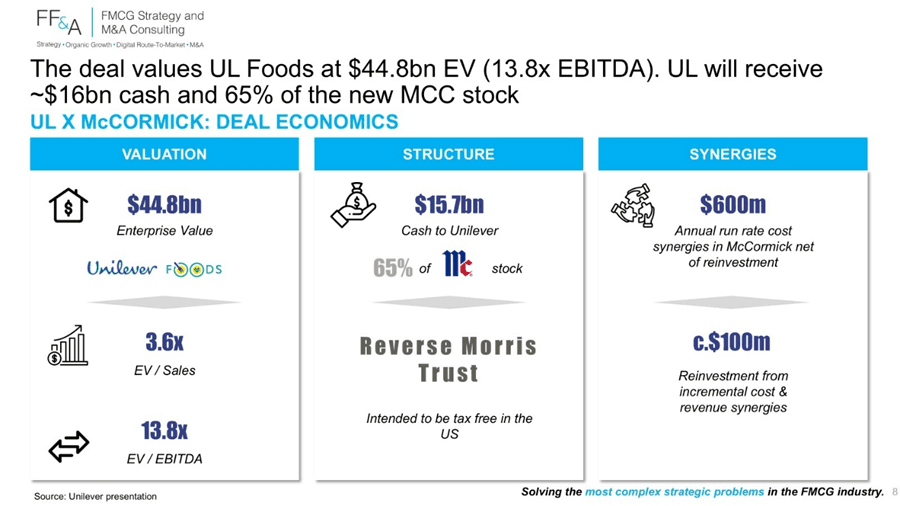
• Unilever shareholders to receive $15.7bn in cash + 65% of the new McCormick stock
2) The creation of a $20bn revenue global flavour powerhouse positioned on a uniquely attractive Food segment
Knorr. Hellmann's. McCormick. Frank's RedHot. Cholula. French's. OLD BAY. One company. One mission. Flavour — at global scale, across every cuisine, channel, and occasion.
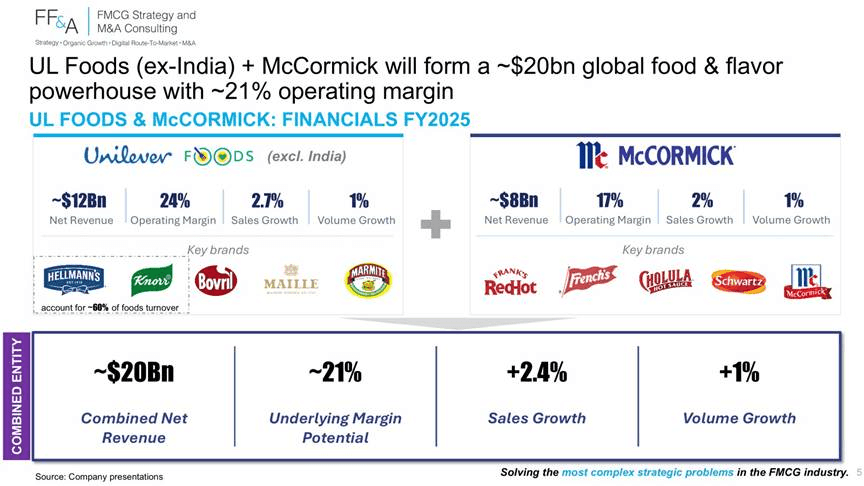
• UL Foods (ex-India): ~$12Bn Net Revenue | 24% Operating Margin | 2.7% Sales Growth | 1% Volume Growth
• McCormick: ~$8Bn Net Revenue | 17% Operating Margin | 2% Sales Growth | 1% Volume Growth
FY2025 financials of the combined entity:
• ~$20Bn Combined Net Revenue
• ~21% Underlying Operating Margin Potential
• +2.4% Sales Growth
• +1% Volume Growth
This is not a consolidation play. This is the birth of a new category leader on an attractive vertical with strong tailwinds (convenience, affordability, desire, GLP1) that is extremely profitable (>20% EBITDA) and that displays a lot of expandability potential. A footprint that is very different from most US Food companies
3) A deal struck from a position of strength — on both sides
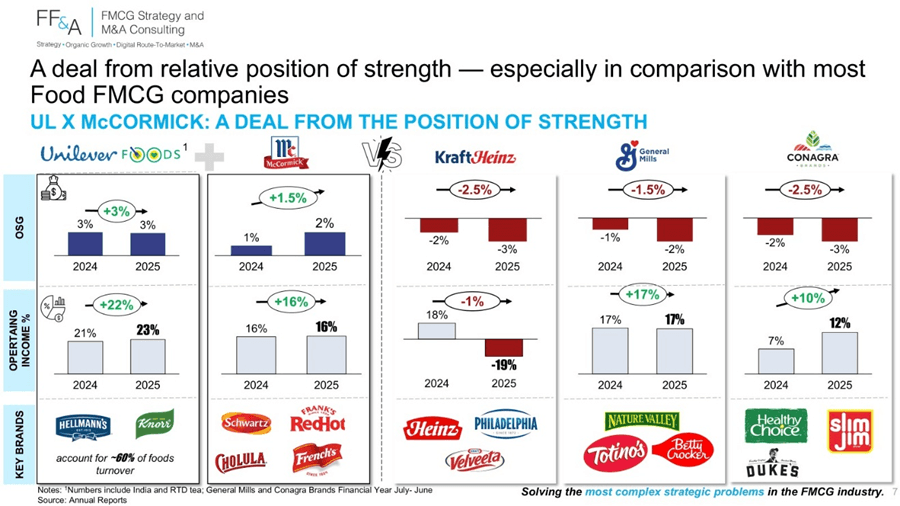
This is one of the rare large food transactions where both buyer and seller are growing — in a category where most large peers are bleeding volume.
• Both growing volume +1% and OSG +1.5% to 3%, in a peer set where most large food companies are running at -1.5% to -2.5% OSG
• Valued at 3.6x EV/Sales and 13.8x EV/EBITDA — top range multiples for a mature food asset, in line with the most attractive food company valuations
• No distressed seller. No stretched acquirer. This is what a balanced, value-maximizing transaction looks like.
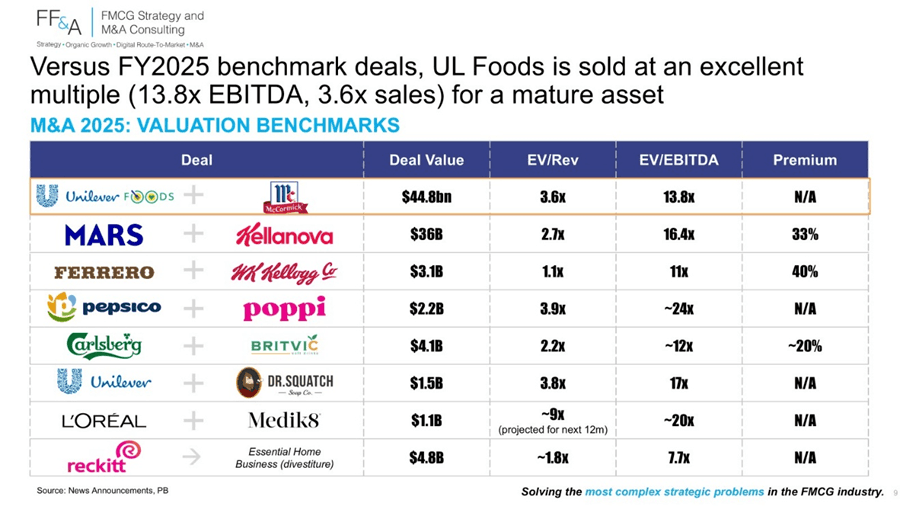
Versus FY2025 benchmark deals (Mars/Kellanova at 2.7x Sales / 16.4x EBITDA, Ferrero/WK Kellogg at 1.1x / 11x, KMB/Kenvue at ~1.8x / 7.7x), UL Foods is sold at an excellent multiple — reflecting the quality of its brands, the strength of its margin profile, and the rarity of its growth-led foods footprint.
More on FMCG M&A deals in 2025 in our latest publication: FMCG CEOs: M&A FY 2025 In Review In 10 Key Messages - The Return Of Mega-Deals, The Rise of Strategic Exits & What Lies Ahead
4) The best home for UL Foods — irrespective of the path considered - with MCC displaying best-in-class track record in M&A integration
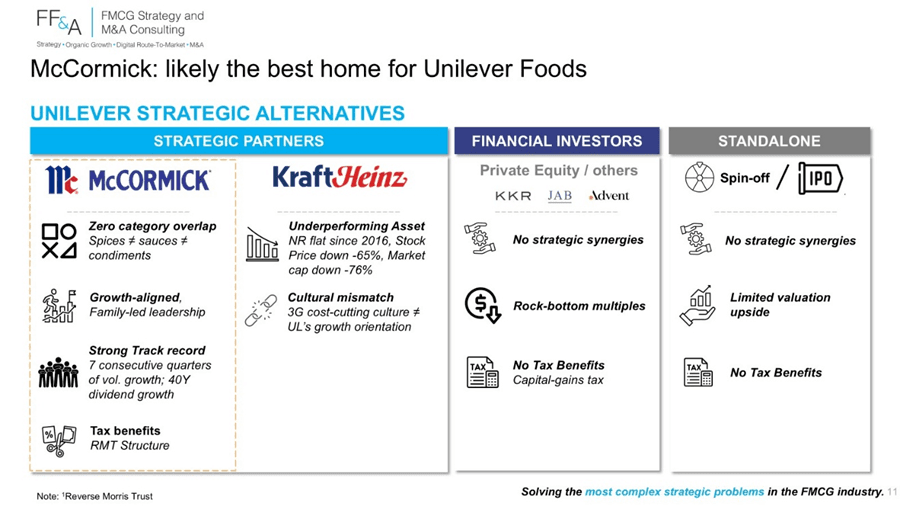
IPO? Kraft-Heinz? Financial investors? All comparing unfavorably vs. McCormick:
• Kraft-Heinz: Cultural mismatch (3G's cost-cutting culture ≠ Unilever's growth orientation), and KHC itself is an underperforming asset — net revenue flat since 2016, stock price down -70%
• Private Equity/Other Investors: No strategic synergies, rock-bottom multiples, no tax benefits (capital-gains tax exposure)
• Spin-off / IPO: No strategic synergies, limited valuation upside, no tax benefits
• McCormick : Zero category overlap (spices ≠ sauces ≠ condiments), growth-aligned family-led leadership, a strong operational track record (consistent volume-led growth and 40 years of dividend growth), a positive M&A integration track record and tax benefits via the RMT structure
Of all the alternatives Unilever could have pursued, McCormick is uniquely placed to be the best home for the Foods business.
5) An exceptional growth-led opportunity — with a real shot at beating the large-deal curse
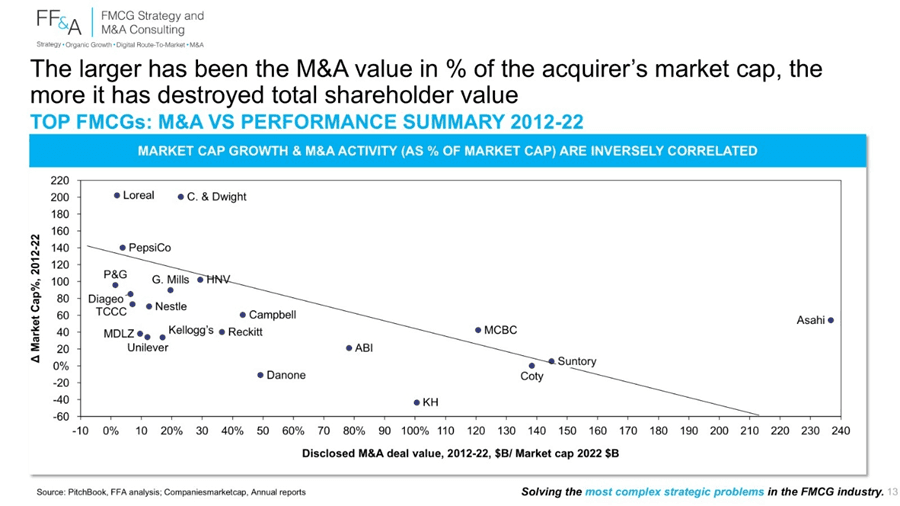
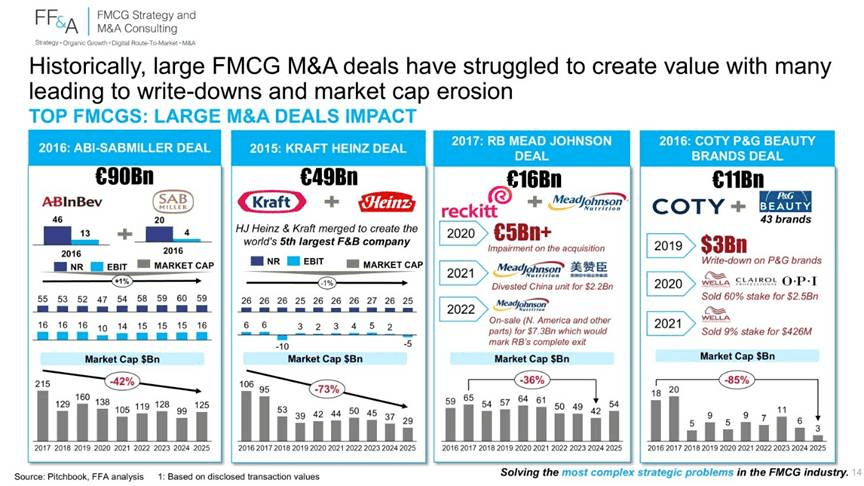
Historically, the larger the M&A value as a percentage of the acquirer's market cap, the more it has destroyed total shareholder value. Across the top 50 FMCGs over 2012-22, M&A intensity and market cap growth are inversely correlated. Most large FMCG M&A deals have struggled to create value because most are cost-synergies led involving assets with growth challenges
• ABI/SABMiller (€90bn, 2016): -42% market cap eroded
• Kraft Heinz (€49bn, 2015): -73% market cap eroded
• Reckitt/Mead Johnson (€16bn, 2017): -36% market cap eroded
• Coty/P&G Beauty (€11bn, 2016): -85% market cap eroded
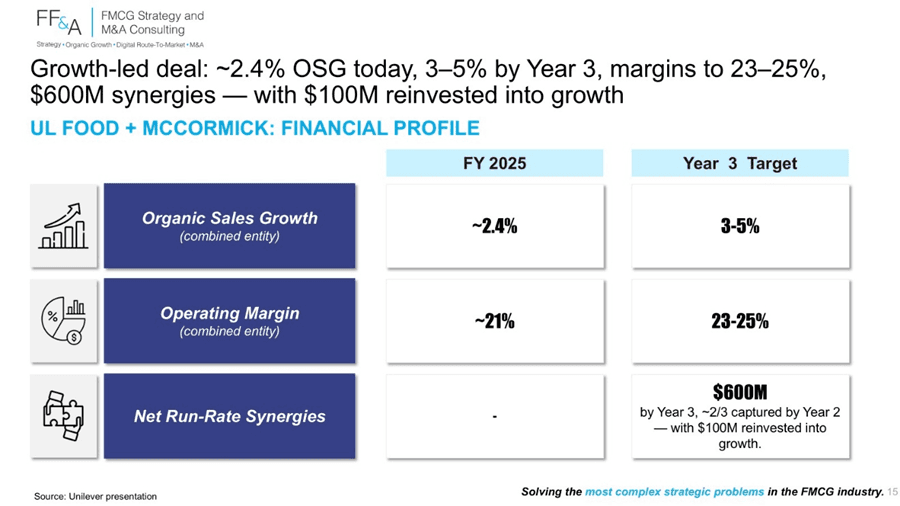
The UL × McCormick deal is structured to break this pattern: growth reinvestment is front and centre, synergy targets are realistic and phased, and the combined entity starts from a position of positive volume momentum. The combined entity's financial profile:
• Organic Sales Growth: ~2.4% in FY2025 → 3–5% target by Year 3
• Operating Margin: ~21% in FY2025 → 23–25% target by Year 3
• Net Run-Rate Synergies: $600M by Year 3, ~2/3rd captured by Year 2 — with $100M reinvested into growth
This is a volume-led, brand-led compounding story. Not a cost-cut-and-pray story.
6) A rapid, de-risked execution path
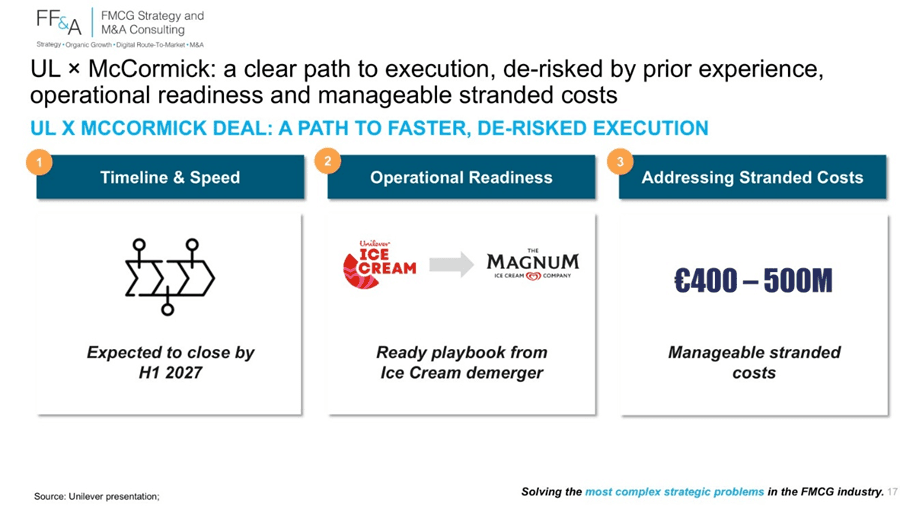
The UL × McCormick deal offers a clear path to execution — de-risked by experience, operational readiness and manageable stranded costs:
• Timeline & Speed: Expected to close by H1 2027
• Operational Readiness: Unilever has already run this playbook once with the Ice Cream demerger (Magnum Ice Cream Co. spin-off, completed December 2025). Systems, processes, Day 1 readiness — all battle-tested
• Stranded Costs: Already mapped at €400–500M — manageable considering UL track record in this area
• One-time integration costs: ~$300M — totally absorbable for the combined entity
Execution risk is the #1 killer of large transactions. Unilever has done the work upfront to take it off the table.
7) UL RemainCo: a €39bn pure-play HPC powerhouse future-fit in a strategic context for the FMCG industry where the premium for quality portfolio keeps increasing
Few really understand how the FMCG industry has structurally changed since post-COVID. While we will not repeat in details our detailed analysis and the corresponding consequences (cf. FMCG CEOs: 2025 Results In Review. 2025 Confirmed Broken Algo And Increasing Premium For Quality Portfolio. Expect Three Large Shifts In 2026), premium for quality portfolio and widening gap between Winners & Losers are emerging as obvious consequences
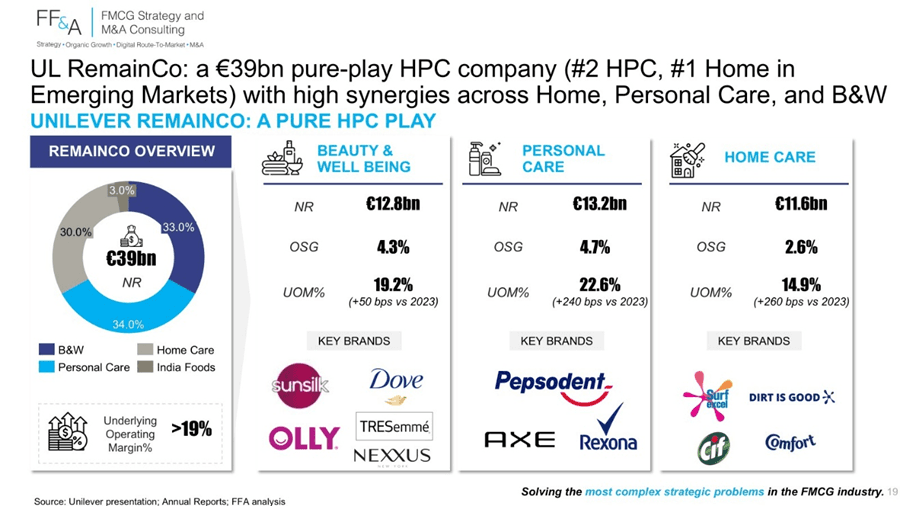
#2 global HPC. #1 Home Care in Emerging Markets. Three pillars, all with expanding margins:
• Beauty & Wellbeing: €12.8bn NR | 4.3% OSG | 19.2% UOM (+50bps vs 2023)
• Personal Care: €13.2bn NR | 4.7% OSG | 22.6% UOM (+240bps vs 2023)
• Home Care: €11.6bn NR | 2.6% OSG | 14.9% UOM (+260bps vs 2023)
Anchored in iconic power brands: Dove, Rexona, Lux, Sunsilk, TRESemmé, Vaseline, Pepsodent, Axe, Nexxus, OLLY, Cif, Comfort, Surf Excel etc. — plus the India Foods business (HUL) staying with RemainCo.
Synergies are significant between those three Business Groups: R&D, pace of innovations, premiumization & margin improvement potential, marketing spend intensity, GTM. With each BG playing a different yet complementary role in the RemainCo portfolio.
This portfolio is the natural endpoint of a multi-year strategic pivot.
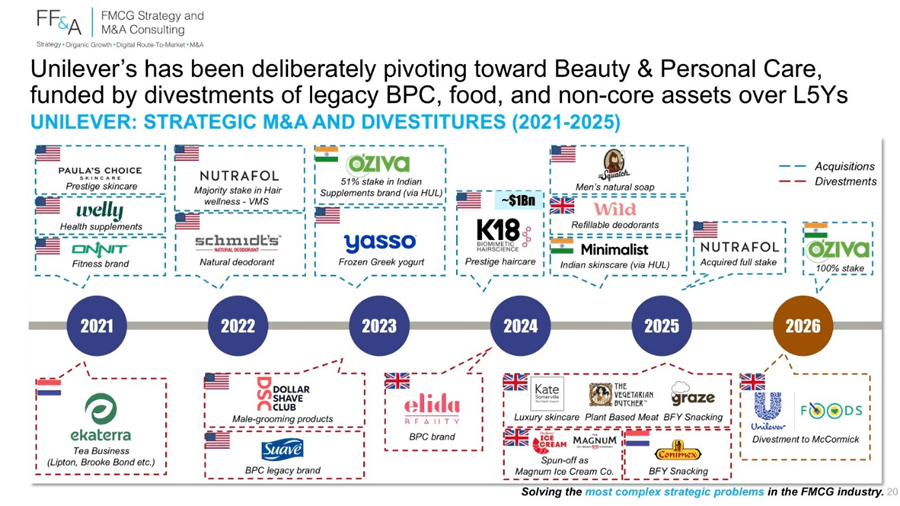
Over 2021-2025, Unilever has been deliberately reshaping toward Beauty & Personal Care —
· Acquiring Paula's Choice, Nutrafol, Wild, K18, Minimalist, Dr. Squatch, OZIVA, Welly, Schmidt's, ONNIT, Yasso — funded by,
· Divestments of legacy BPC brands, the tea business (Lipton, Brooke Bond), Dollar Shave Club, Elida Beauty, plant-based meat, BFY snacking, and the Magnum Ice Cream Co. spin-off.
The Foods divestment to McCormick is the culmination of that pivot.
8) UL RemainCo: a higher-quality growth company post-separation
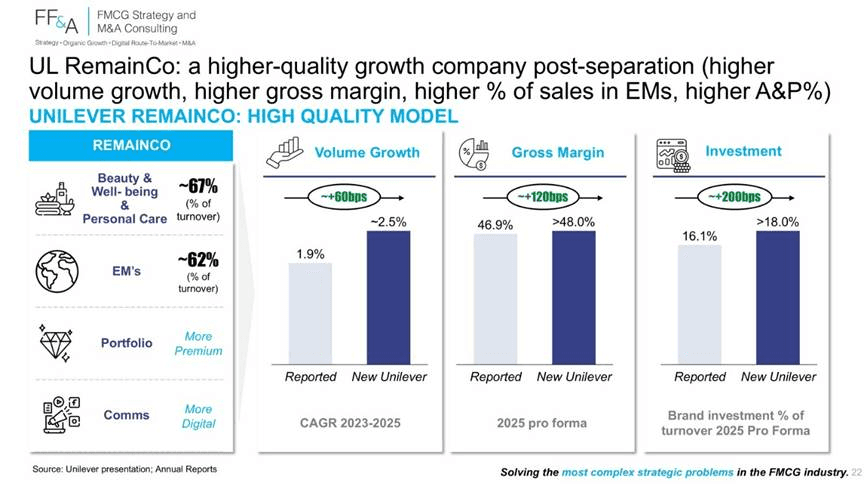
Every key metric improves. This is addition by subtraction — a sharper, faster, better-invested company:
· Volume Growth (CAGR 2023-25): 1.9% (Reported) → ~2.5% (New Unilever) — a ~+60bps uplift in the growth rate itself
· Gross Margin (2025 Pro Forma): 46.9% → >48.0% (+~120bps)
· Brand Investment % of turnover (2025 Pro Forma): 16.1% → >18.0% (+~200bps)
· Portfolio mix: Beauty & Wellbeing + Personal Care become ~67% of turnover
· Emerging Markets exposure: Rises to ~62% of turnover
· A more premium, digital portfolio increasing its exposure to the top profit profit pools in the FMCG industry & to the fastest growing channels
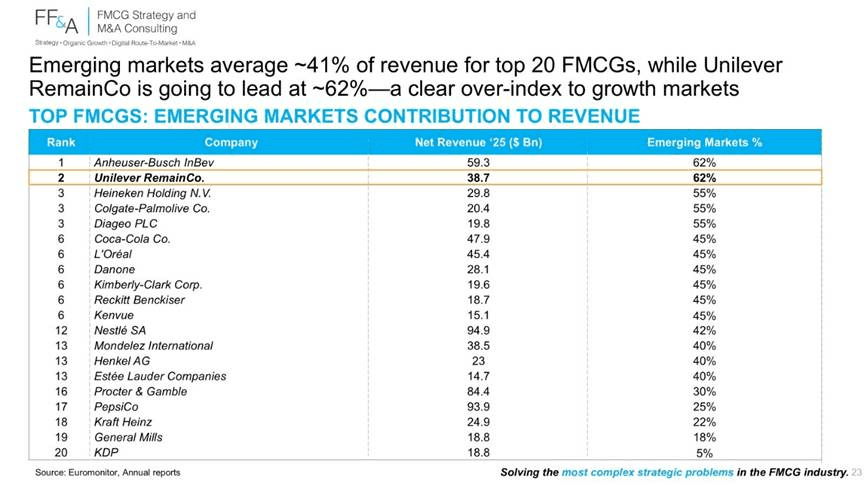
On EM exposure specifically, UL RemainCo will rank #1 ex-aequo globally among the top 20 FMCGs at ~62% — tied with AB InBev (62%) and ahead of Heineken (55%), Colgate (55%), Diageo (55%), Coca-Cola (45%), L'Oréal (45%), Kimberly-Clark (45%), Reckitt (45%), Nestlé (42%), Mondelez (40%), P&G (30%), PepsiCo (25%), Kraft Heinz (22%) and General Mills (18%).
The average across the top 20 is ~41%. UL RemainCo is the clearest emerging-markets-skewed pure-play HPC story in the industry.
9) UL RemainCo: A clear capital allocation framework
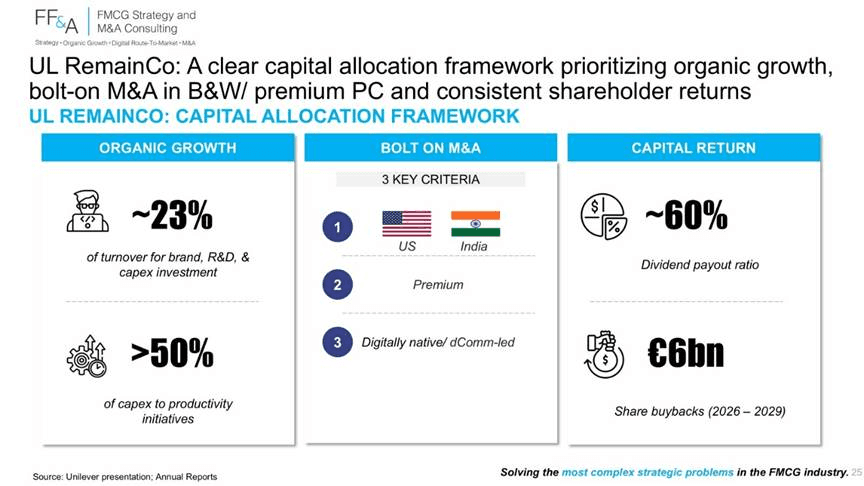
Disciplined and growth-oriented. No large transformational deals.
• Organic Growth: ~23% of turnover for brand, R&D and capex investment | >50% of capex directed to productivity initiatives
• Bolt-on M&A with three key criteria: (i) US & India as priority geographies, (ii) Premium positioning, (iii) Digitally native / dComm-led brands
As again demonstrated by last week acquisition
• Capital Return: ~60% dividend payout ratio | €6bn share buybacks across 2026-2029
The framework explicitly rules out the kind of mega-deal that has historically destroyed value across the industry. Discipline & consistency are the strategy.
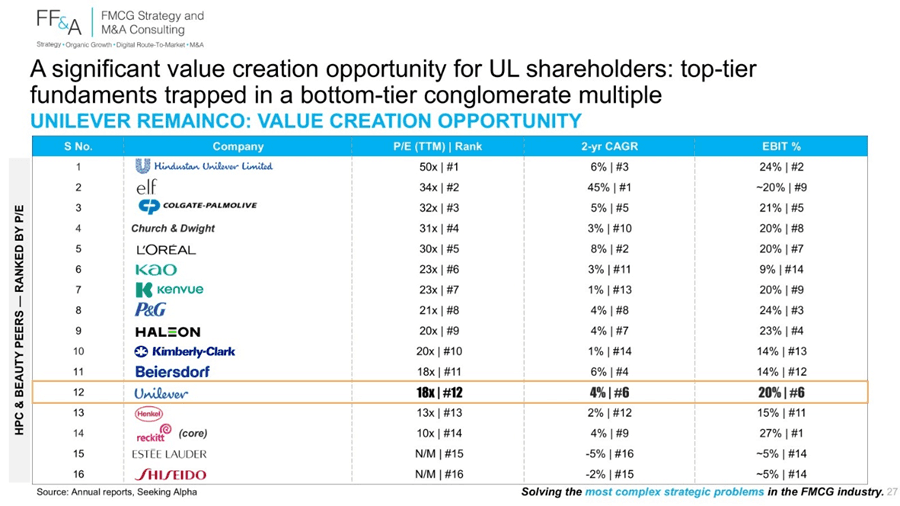
10) A significant value creation opportunity for UL shareholders
UL RemainCo delivers top-tier HPC fundamentals but trades at a bottom-tier multiple:
• Top-tier fundamentals: 4% 2-year revenue CAGR, 4% FY25 organic growth, ~20% EBIT margin
• Bottom-tier multiple: Unilever at 18x P/E (TTM) — well below the HPC & Beauty peer set
Versus key HPC peers:
• Colgate-Palmolive: 32x P/E
• Church & Dwight: 31x P/E
• L'Oréal: 30x P/E
• P&G: 21x P/E
• Unilever: 18x P/E (even lower excluding HUL)
Top-tier fundamentals trapped in a bottom-tier conglomerate multiple. The separation removes the conglomerate discount and creates a material re-rating opportunity post-close. Pretty unique in the FMCG industry today.
Bringing it all together
The Unilever Foods × McCormick deal is likely the most consequential FMCG transaction since AB InBev/SABMiller. And we think the market is still missing the point (although stock price of each company corrected positively last week erasing some of the first declines)
$44.8bn, a record multiple for a mature FMCG asset. A tax advantageous set-up. Zero category overlap with leading position on uniquely attractive segment within Food (Flavour). $600M in synergies. A proven carve-out playbook. A deal done from a position of strength on each side that will accelerate volume growth for both parties (McCormick & Unilever RemainCo)
This is neither Kraft-Heinz, nor ABI-SABMiller, nor Reckitt/Mead Johnson.
This is different.
For RemainCo, it gets even more interesting: a €39bn pure-play HPC powerhouse — top-tier growth, expanding margins, rising brand investment, #1 exposure globally to Emerging Markets in % of revenue — yet still trading at a bottom-tier P/E versus Colgate, P&G, Reckitt and L'Oréal. The re-rating opportunity is material.
The thesis is strong. The strategic & cultural fit are real.
So why are financial analysts not convinced?
Their concerns are legitimate: dis-synergy risk, a more leveraged balance sheet post-deal, execution fatigue from running two consecutive carve-outs, a (perceived) greater exposure to Food, and the overhang of a separation timeline. Add to that persistent short-term concerns on Emerging Markets exposure and, some, impatient capital — and the sell-off becomes understandable, even if we think it's ultimately wrong.
Yet, the market doesn’t always have a perfect track record when it comes to predicting over the short-term future success of large M&A transactions (ABI-SABMiller, Kraft-Heinz, Reckitt-MJ market responses were all positive when the deals broke and we know what happened to their stock price since then: respectively -42%, -70% & -36%)
However, over the long-term the market is always right
Time for Unilever & MCC to focus on what they can control: consistent & flawless execution along with patient education of the investment community
In the meantime, some financial analysts should maybe remember Marcel Proust lines in In Search Of Lost Time: 'The real voyage of discovery consists not in seeking new landscapes but in having new eyes.'
Exciting times for all
Frederic
Get in touch:
To follow Frederic, please click Here. To start a conversation, email at: frederic@fredericfernandezassociates.com
To get the full deck of this publication, please write us at contact@fredericfernandezassociates.com
To subscribe to our newsletter and receive all our CEOs Insights, sign-up at the following link: FMCG CEOs: FMCG CEOs: Managing For Growth
About FF&A:
FF&A solves the most complex strategic problems of the world's largest FMCG companies across:
- Corporate Strategy
- Organic Growth (cf. our proprietary Zero-Based-Growth - https://lnkd.in/eWQEmcK3)
- Small Brands Growth (cf. our proprietary How Small Brands Grow - https://lnkd.in/eyp3Baq5)
- Digital RTM / Ecommerce (cf. our proprietary Ecommerce 2.0 - https://lnkd.in/e4-Q69Fi)
- M&A (cf. our proprietary Best Acquirers approach in FMCG - https://lnkd.in/gK7yj8Gm)
14 out of the top 20 world's largest FMCG companies are repeat Clients.
FF&A team intervenes all across the globe and across all FMCG categories. To know more, please visit our websites: www.fredericfernandezassociates.com | www.exponentialfmcg.com
No FF&A employees own any financial instruments on any FMCG companies or companies mentioned in the above article. All the above information are public information.
Enjoyed this article?

FMCG CEOs: Managing For Growth
Strategic insights for FMCG/ CPG CEOs